
Daniel Poppick’s Novel of White-Collar Work
The first novel by the poet asks us what fantasies get us through the day?
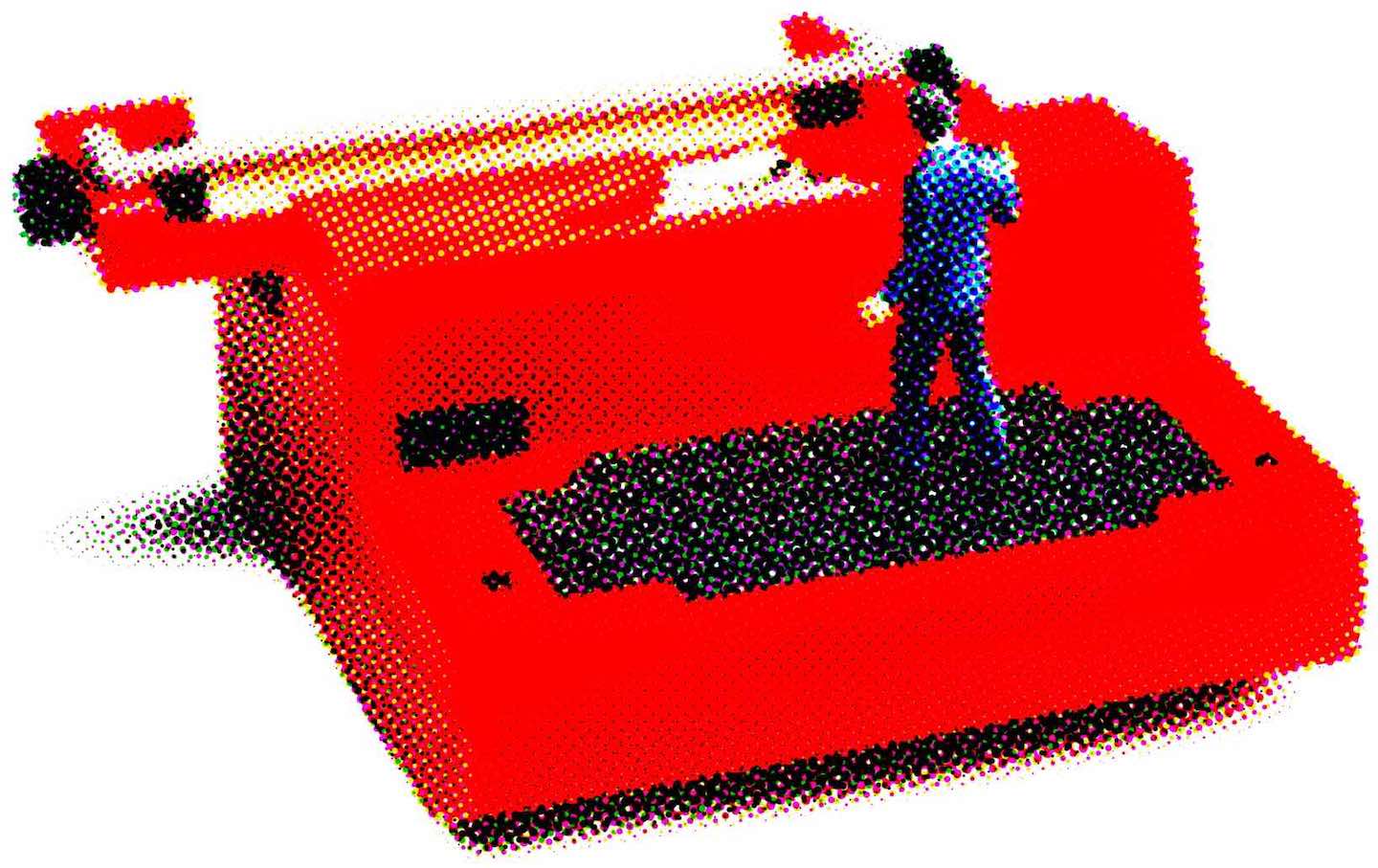
(CSA-Printstock / Getty Images)
“Money is a kind of poetry,” Wallace Stevens, the insurance executive better known as a poet, once wrote. As metaphors, money and poetry might be improbably alike; they can both transform one thing (time) into something else (a hairclip, a frozen lake). But for Stevens, maybe this equation had a special import. How could someone who wrote that he had “no life except in poetry” explain the incongruous fact that he spent most of his day parsing surety, risk, and fidelity bonds? Another way to ask this question: If most American poets are required to work at another job (such is the condition of an economy that assigns poetry almost no market value), what tools can be marshaled to make that situation tenable—what fantasies get us through the day?
The Copywriter, poet Daniel Poppick’s first novel, begins with a moment of corporate seduction. The narrator, D__, who markets “last season’s kitsch status pieces” for a living, is called in to meet with his company’s new 24-year-old CEO. “Everything we do needs to have heart,” the CEO tells him, from packaging “Yas Queen” throw pillows to writing copy about eggplant-emoji-shaped drones. “Transfixed, I agree,” Poppick’s narrator reports. “And oddly, not just because my job depends on it.”
Faced with work that one suspects is utterly meaningless, a person might adopt narrower and narrower parameters for meaning. Perhaps reading about the Bluetooth speaker suggestively placed in the tip of that eggplant-emoji-shaped drone really would brighten someone’s day? But then again… really? Almost certainly not.
D__’s acquiescence doesn’t last, and soon after, he’s back to mocking the company’s “garbage” products and juvenile CEO. But he keeps that to himself. At work, he’s punctual, polite, and somewhat obsequious; as he puts it, a “savvy professional operator.” This is such a familiar way of relating to one’s work that it’s become a cliché: to go through the motions without believing in them, to understand one’s compromises as a necessary concession to the stakes of life (such as rent and healthcare) and yet believe that one’s “real” self is located elsewhere. That self might emerge in private, among friends, or maybe in one’s art. In this split, money and poetry return to their familiar, oppositional poles: Poetry is the site of authenticity, money the cause of deception.
The Copywriter follows D___ from 2017 to 2019, a period during which he is fired from his eponymous job, gets dumped by his girlfriend, reads Proust, moves in with his parents, travels across the country, and eventually finds another copywriting job. The book is organized as a series of journals that blend prose, parables, aphorisms, and poetry. D___ describes his (or, really, any) office as a place so incomprehensible, it sounds surreal. The dial tone of the office phone is “the drone of desire, gilded with anticipation.” The calendar is arranged “like a vase of corrected flowers.” When the 24-year-old CEO disappears “like a puddle in extractive sun” just as D___ and his whole department expect to be fired, his absence is like the absolution of a minor god: “The word we are all awaiting never comes.”
Stevens never wrote about his work, giving the impression of its ephemerality and unrelatedness, as if it were completed in a vacuum-sealed container and excised from his inner life. And yet the office—its smells and politics, its grievances petty, existential, or edifying—must have made an impression. Perhaps Stevens chose to locate those conflicts elsewhere, in a snowy field. Poppick takes a different approach: The Copywriter is part office satire but also part poetics of absurdity, making use of the corporate world’s vacuous jargon and ugly furniture. The question becomes: What can poetry do to transform or remake the dull day job—to make it bearable, make it interesting, or simply make it mean something else?
When people learn that D__ is a poet, they tend to ask what his poetry is about. “Most of it doesn’t rhyme,” D__ tells them. If his response sounds disdainful and possibly arrogant, maybe it helps that D__ is tormented by similar questions. He and his poet friends often argue about what poetry should accomplish. “I’m no longer interested in fractured syntax, or even language’s materiality,” D__’s friend Ruth declares. Later, she mourns her creative peak in third grade, when she wrote about “real things” like “Ferrets. Immigration. Poachers in Wyoming. The industrial revolution, the Bread and Roses Strike of 1912, the state of Texas.” Like D__, most of the poets in the novel have day jobs. His girlfriend, Lucy, works at a magazine; his friend Will delivers office furniture. A former classmate who works at Apple is praised for having “his shit together.” Ruth is leaving New York to get a PhD, and as D__ drives her to the airport, he assures her that academia won’t “cut [her] off” from poetry. They offer one another consolation, but it’s not clear whether this encouragement can be believed. If these day jobs take up increasing space and significance in their lives, should that be celebrated, minimized, or simply restated as obvious and unavoidable?
D___ becomes so desperate to settle what it means to be a poet that at a combination basement reading/math-rock concert in St. Louis, he corners the only man listening and asks, “What do you think makes poetry different from the conversation that we’re having right now?” The man replies, “I think it’s a little carceral to draw a line, any line, between one thing and another, in any situation.”
Part of the tension of the novel is that D__ really does want to draw a line, in part to separate his “real” writing from the work he does to make money. The failure to separate these two identities, we learn, can become ridiculous, as is the case when D__ commissions his poet friend Will as a copywriter and receives this marketing blurb for a soy candle:
A scent like the ghostly hum of an electric vehicle waiting at a traffic light, a vehicle bearing children just released from a rehearsal of a school musical like Into the Woods, children whose hearts are swollen to the point of bursting with sophisticated song but are still well behaved, cirrus clouds stretching out over the dusk-blackened landscape beyond your windshield like affectionate, white-winged reptiles beckoning you home….
D__ prides himself on being able to mimic the “false” standards of the workplace while, crucially, understanding those standards to be ridiculous. He describes his creative process at his first job this way: “I think of a sequence of words so stupid I can barely bring myself to type them. But I know from experience that this feeling means I’ve landed on a keeper.” And yet the actual sentence he writes in this instance is sort of fabulous: “Feeling pail? Dig this: you need sun, and a castle to call your own.”
D__ might be unnerved by this praise, and even more by my suspicion that what makes this sentence interesting, and possibly even good—its mash-up of cliché and simple language games—is similar to what he aspires to, with more sophistication, in his poetry. Elsewhere in the novel, after a lengthy creative drought, D__ finally writes a poem: “A bell can do everything. / A bell can die entering / A bell called debt exeunt fate, / A bell cannibalizing dew’s extinction feature, gladly / A bell, cancels description’s error for good….” It’s primarily interested in words—which relationships we assume and which we don’t—and what happens to the meaning of something, like a bell or fate, when we make an unexpected next link.
It’s not that D__’s poetry is equivalent to his copywriting, but that they have something important in common. And if D__ understands his presence at work to be a form of playing pretend, his writing suggests that the division between art and work might not quite hold up. More unnerving than the requirement to perform a false self at work may be the knowledge that we carry something of ourselves between places, that the choices we make in one arena of our life will eventually affect our expression in another. The day job is never just a day job.
Popular
“swipe left below to view more authors”Swipe →Toward the end of The Copywriter, D__ is hired by a “storied Midtown Jewish arts and community center.” (Poppick himself currently works at Manhattan’s 92nd Street Y.) This might sound better than writing about eggplant-emoji-shaped drones with suggestively placed speakers, but for D___, it’s complicated. “Once I was in the business of selling products,” he thinks. “Now I’m in the business of selling time.” Unlike D__’s first job, with its exclusive interest in profit, this arts center has its own values—values its leaders profess in religious, and often grandiose, terms—and yet those values seem mysteriously inadequate, protrusive in all the wrong ways. After a gunman in Pittsburgh commits an act of mass murder in a synagogue, D__’s office hangs an American flag in the lobby, which feels to him “like putting a cross up in the waiting room of Planned Parenthood after an abortion clinic is bombed.” Later, the center decides to host a series of talks with “a prominent former US statesman of European Jewish extraction” known for “committing an impressive litany of war crimes leading to millions of civilian deaths.” (In other words, Henry Kissinger.) When D__ is tasked with writing the event description, he faces a moral conundrum.
It’s not just that he opposes the choice to host the speaker, but that the event makes him think about how he has spent the last three years of Trump’s presidency, with its escalating violence and bigotry. He has mostly written stuff that he thinks is worthless. But he’s also been writing poetry. And that must mean something, right? D___ anxiously asks Ruth: “What does poetry do?”
There is a certain type of novel that ultimately reveals its characters with grand intellectual ambitions, such as writers and academics, to be petty and venal, more interested in self-preservation than in the ideas they profess to venerate. It’s not hard to imagine that D__ might be unmasked this way. Or that, exhausted from asking too much of poetry, he will eventually ask too little and just give up.
And yet, in the end, D__ does take a moral position, not in his poetry but at work. “I would prefer not to,” he writes to his boss, borrowing a line from that most famous of office refuseniks, Bartleby himself.
Does D__’s moment of courage have anything to do with poetry? Maybe not. In fact, it seems critical that the arena in which D__ ultimately stages his minor rebellion isn’t in his writing, but at the office. The equation that usually flows one way—D__’s unhappy work life becoming the material for his art—reverses course. Something of the critical voice we hear in D__’s prose comes out in public.
And yet this moment also suggests the ways in which money and poetry are not alike. If corporate work asks us to conflate ourselves with our job, to merge our ambitions and standards with those of the office, poetry urges us to take this situation less literally, to ask: What else could this be? What could be substituted for it? And what does that look like, sound like? It’s the poet, not the good employee, who imagines a way to wriggle out of a tricky bind. Which is to say, when it comes to money and poetry’s likeness, a line of verse can do what a line of credit does not: It can make the normal relation between things less standard. It can create the distance necessary to look again, and to respond to the circumstances of our life in our own language. To make the next word not the obvious link but one that undoes the sentence, clearing the path for something else on its way.
Become a Sustaining Donor This September
Between the reemergence of right-wing red-baiting and Donald Trump’s use of the chilling National Security Presidential Memorandum–7 to criminalize left political organizing, we’re seeing McCarthyism reborn before our eyes.
This assault on democracy cannot be ignored or wished away. Resisting it requires bravery in the face of threats and repression, a steadfast commitment to the truth, and the unwavering belief that we can—and will—overcome this darkness.
We must have an independent media that sets the record straight, unearths corruption and abuses of power, and advances a politics of justice and dignity for all if we’re to win this fight.
That’s why I’m writing to you today. This September, The Nation needs to add 100 monthly donors to sustain our progressive journalism. Your contribution makes the next investigative report, the next truth-speaking column, and the next pathbreaking essay all possible.
I hope you’ll support our work with a recurring donation today. If you donate $10 or more a month, we’ll send you a brand new “Hands Off the Free Press!” sticker to recognise your commitment to our cause. Please, donate today.
Onward,
Katrina vanden Heuvel
Editor and Publisher, The Nation
More from The Nation
What Remains of Riis? What Remains of Riis?
A new members’ club has revived Riis Park’s long-vacant bathhouse, reopening old questions about whom the People’s Beach is really for.
We Need to Protect College Sports from Ted Cruz We Need to Protect College Sports from Ted Cruz
In this week’s Elie v. U.S., our justice correspondent looks at the Supreme Court’s rejection of Trump’s latest move to restrict mail-in voting. Plus, why Ted Cruz’s college-...
Why Aren’t We Talking About the Warmongering Lies of Mike Rogers? Why Aren’t We Talking About the Warmongering Lies of Mike Rogers?
The media’s relentless focus on Hasan Piker allows the dishonest GOP hawk (and actual Michigan Senate candidate) to evade scrutiny.
Netanyahu Is Accused of Ignoring Warnings About October 7 Netanyahu Is Accused of Ignoring Warnings About October 7
Will justice be served?
Trump Is a Runaway Train—and Nobody’s Pulling the Brakes Trump Is a Runaway Train—and Nobody’s Pulling the Brakes
Everywhere you look, the president is causing chaos and destruction.

