
From Universities to the Vatican, the AI Backlash Can’t Be Ignored
If AI devours entire industries, who believes that the precariat’s newest members will receive more support than autoworkers and textile makers before them?
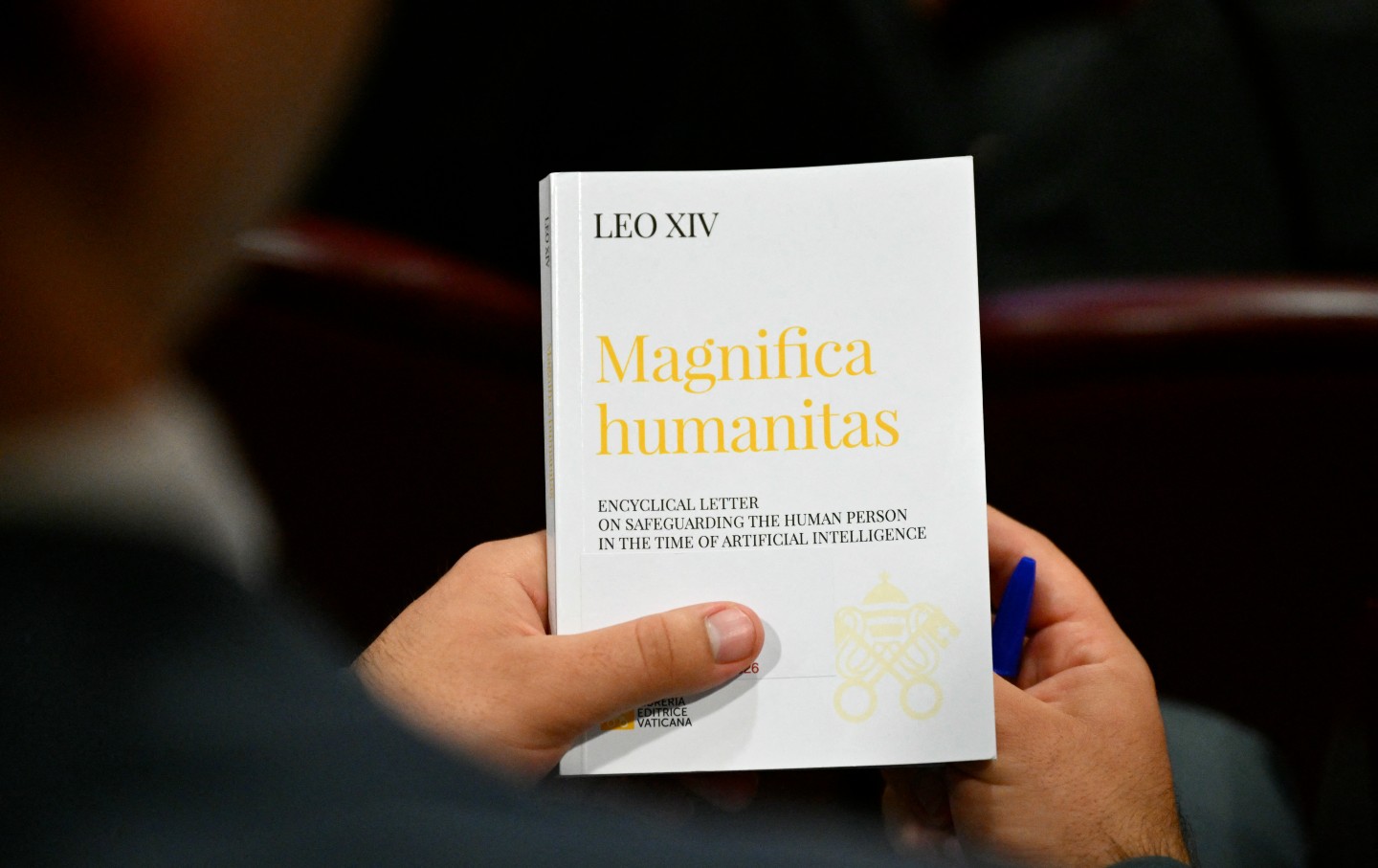
Fresh from his dustup with President Trump, Pope Leo released an encyclical targeting a perhaps even more formidable foe: unfettered artificial intelligence. In the missive, he called for regulation of the tech industry, whose products have sparked an era that finds human dignity “threatened by new forms of dehumanization.”
It’s an extraordinarily timely warning. Despite the carnival of corruption and disastrous policymaking unleashed by the sitting president, we may look back on this period not primarily as the Trump era but as the dawn of the AI age. Unbound by term limits, the technology is poised to remake our economy and society—at least, that’s what the guys who earn billions by hyping it say.
But, like the pope, the public—which didn’t vote for any of this—is making its displeasure known. Commencement speakers striking an optimistic note on AI have been booed by new grads entering a workforce menaced by robotic takeover. In offices, employees are quietly sabotaging their bosses’ attempts to embed AI into the workplace. And data centers are so politically toxic on Earth that tech leaders are chasing long-shot efforts to send them to space. As AI becomes ever-more omnipresent, so does resistance to it.
While AI skepticism is a global phenomenon, it’s particularly potent in the US: A poll of 30 countries found that Americans had the least faith in their government to regulate AI appropriately. That’s understandable considering that this nation has watched its business leaders offshore millions of jobs, while its elected officials prove willing to rescue Wall Street and leave Main Streets to painful economic decline. If AI devours entire industries, there’s little reason to believe that the newest members of the precariat will receive more support than autoworkers and textile makers before them.
And that’s to say nothing of the environmental impacts of the water- and electricity-guzzling data centers that power AI computing, raising local utility bills and straining drought-prone regions. If all that weren’t ecologically hazardous enough, the Trump administration announced that it would lend $1 billion to the infamous, currently defunct power facility on Three Mile Island, the site of the worst nuclear accident on US soil. It’s being resurrected to juice Microsoft data centers.
All these potentially catastrophic risks are still part of the best-case scenario, which assumes that, despite its drawbacks, AI will perform the increasingly high-stakes tasks it is delegated as competently as the humans it replaces. Even darker outcomes are possible. A study at King’s College London had three AI models—versions of GPT, Claude, and Gemini—face off in a series of simulated war games. With a full range of tools at their disposal, from diplomatic de-escalation to all-out nuclear war, the models decided to deploy tactical nuclear weapons in 95 percent of simulations.
And the use of AI in war-gaming is not merely theoretical. The US Air Force recently debuted an AI-powered system called WarMatrix with a press release claiming that it’s meant to “enhance” war-gaming, rather than replace existing approaches. Still, the military also touts the fact that these “advanced tools” can enable faster decision-making and provide “timely, credible insights to senior leaders.”
For the past 80 years, humanity has benefited from a collective aversion to the use of weapons of mass destruction. Artificial intelligence feels no such repulsion. As the pope wrote, AI “can only bring about conflict more quickly and render it more impersonal, lowering the threshold for resorting to violence, transforming defense into threat prediction and thus reducing victims to data.” If any global power chooses to rely on this technology for strategic counsel when making legitimately existential decisions, then the 53 percent of Americans who think AI is likely to destroy humanity could well be proven right.
Thankfully, the Four Horsemen haven’t left the barn just yet. With effective regulation, worst-case scenarios can be permanently prevented. To that end, Senator Elizabeth Warren published an op-ed last month advocating for taxing AI companies and data centers. And in March, Senator Bernie Sanders and Representative Alexandria Ocasio-Cortez introduced a bill that would impose a moratorium on data center construction.
Like other AI skeptics, Sanders and AOC have been smeared as Luddites attempting to throw a wrench in the gears of progress. But, as John Nichols suggested in a recent article for The Nation, perhaps the designation isn’t quite the withering put-down AI boosters intend. The Luddites weren’t wild-eyed technophobes vainly trying to make the Industrial Revolution grind to a halt. Instead, they were skilled artisans aiming to save their livelihoods and preserve their dignity.
We may be seeing something of a Luddite rebirth. Towns across the nation have thwarted dozens of data center projects, and in April, voters in Port Washington, Wisconsin, passed America’s first anti–data center referendum. Maine legislators marked another milestone that month when they approved the first statewide ban. Though it was vetoed by Governor Janet Mills, statehouses around the country are considering similar measures. Meanwhile, parents are pushing back on AI in schools, and a collection of journalists and researchers just launched the AI Resist List, which tracks global efforts to hold the industry accountable.
In community after community, people are organizing to protect human work and perhaps even humanity itself. After all, as Pope Leo put it, “humanity in all its grandeur and woundedness—must never be replaced or surpassed.”
More from The Nation

On Being Awarded the Women Waging Peace Award On Being Awarded the Women Waging Peace Award
It has never been more urgent to revive the idea of peace, not as a slogan, but as the only serious, respectable, responsible, reasonable, humane position.


PSA: Trump Continues to Commit Crimes PSA: Trump Continues to Commit Crimes
While the president is unlikely to face any consequences for his patently illegal, taxpayer-funded ads, it’s essential to remember he should.

Freedom Can’t Be Fenced In Freedom Can’t Be Fenced In
A call for freedom written across a pedestrian overpass, framed by wire.

Zohran Mamdani’s Campaign May Have Accomplished Something More Fundamental Than Moving Policy Debate to the Left Zohran Mamdani’s Campaign May Have Accomplished Something More Fundamental Than Moving Policy Debate to the Left
It’s the people, stupid.

