
On Redistricting, Will Virginia Democrats Surrender, or Get Creative?
Democrats must stop conceding that the only answer for various racist voting laws is that Democrats just have to vote more and harder and better.
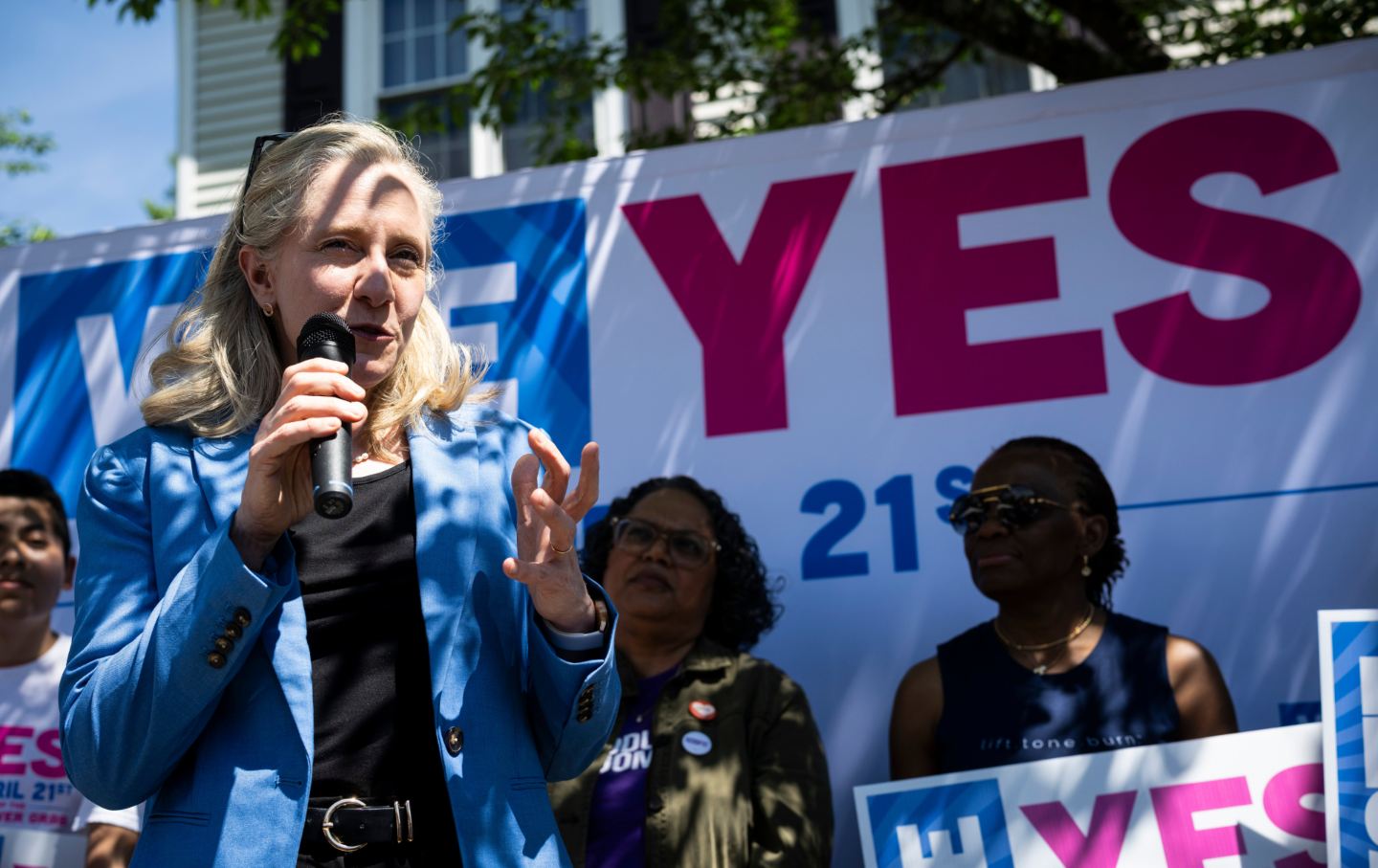
Virginia Governor Abigail Spanberger at an event in Woodbridge, promoting the redistricting measure that was on the ballot in April.
(Graeme Sloan / Bloomberg via Getty Images)
We try to keep despair out of these pages, tough as the times are. That’s why I didn’t write about Friday’s Virginia Supreme Court’s decision striking down new voter-approved congressional maps for extremely dubious reasons (read Virginia political expert Carolyn Fiddler’s awesome explanation of the ruling here).
Coming after the Supreme Court (of the United States) decision invalidating Louisiana’s congressional maps for taking race into account, the Bayou State’s immediately postponing upcoming elections as a result, and Tennessee’s swift move to use the SCOTUS ruling to wipe a majority-Black congressional district literally off the political map, last week was the worst for voting rights since the court’s 2013 Shelby v. Holder ruling struck down two vital sections of the Voting Rights Act. I admit to not seeing much light down this tunnel that afternoon.
Related Article
Adding to my dismay on Friday, Virginia Democratic leaders came out against the court’s ruling, but seemed resigned to let its Republican majority undo the will of state voters.
“I am disappointed by the Supreme Court of Virginia’s ruling,” Governor Abigail Spanberger, a centrist who initially opposed the redistricting push, then supported it, said in a statement. “But my focus as Governor will be on ensuring that all voters have the information necessary to make their voices heard this November in the midterm elections because in those elections we—the voters—will have the final say.” Democratic House speaker Don Scott echoed Spanberger: “We respect the court.”
Let me pause here and say: I don’t respect that court, or its outcome-driven reasoning. And I am sick and tired of Democrats conceding that the only answer for various racist laws—Jim Crow redistricting, onerous voter ID, now a GOP-dominated state Supreme Court overturning the will of Virginia’s voters—is that Democrats just have to vote more and harder and better. Because that basically means Black Democrats, as well as Democrats of other races who live in multicultural districts. But mainly Black Democrats. But also, all Democrats have to work harder to jump these Jim Crow hurdles, rather than working to simply get their voters to the polls, as Republicans do. (Republican voters don’t have to go to a government office and prove they are not Nazis, Klan members, insurrectionists, or simply dyed-in-the-wool racists, for instance, before casting a vote. Perhaps they should.)
But over the weekend, it began to look like some Virginia leaders will fight for the maps voters chose. Even House minority leader Hakeem Jeffries, who is normally a little too placid for the taste of most progressives, had taken a stronger line than some of his Virginia Democratic colleagues. “It’s an all-hands-on-deck moment, and it’s unprecedented in American history as far as we can tell that an actual election has been overturned by a handful of unelected judges,” Jeffries said. “We’re not going to step back. We will continue to fight back.” Now some Virginia Democrats are joining the fight.
Loudoun County Representative Suhas Subramanyam joined a call with Jeffries last weekend and said he was looking for ways to undo the ruling. “Everyone has got to have a strong stomach right now; this is a complete disaster waiting to happen if people are timid. We have Republican states ignoring their constitutions and interrupting early voting and ignoring their Supreme Courts all together. We know based on that, Republicans would explore every single option possible to move this forward.”
Among the Democrats’ options: The legislature could choose to ignore the decision, conceivably, but that would require state Board of Elections support. Another idea that is fairly easy, but not necessarily immediately popular, is that the General Assembly lower the age of Supreme Court mandatory retirement—to 54, which would force all the justices, including the youngest Republican, to the sidelines, and let the General Assembly Democratic majority appoint a whole new court. It’s simple: They have the power to do it. Less simple: They’d have to let the new court rehear the challenge to redistricting, and it’s unclear how long it might take. (The idea surfaced on Friday night on TheDownballot.com, a progressive site covering state legislatures.)
One can imagine many reasons to oppose this idea—most Supreme Court age limits are around 70. But we are in a war for democracy, and a lot of once unthinkable ideas are being thought. As long as they are not violent, I’m for thinking them.
“The national pressure on Virginia Democrats has never happened before,” says Carolyn Fiddler. “So Virginia Democrats are having an interesting moment.”
But Monday afternoon Democratic state Senate leader Scott Surovall said replacing the entire Supreme Court isn’t a viable notion. “As a practical matter,” the move “would not be capable of being implemented” given the “time frame,” he told The New Republic. So maybe it’s back to the drawing board for Democrats who want to fight back.
Spanberger’s position on any reform is important; she’d have to sign it into law. The governor hasn’t yet commented on any of the ideas floating around, but most observers think she’s dubious, at least for now.
Popular
“swipe left below to view more authors”Swipe →On the other hand, Spanberger is one-term-limited, according to Virginia law. She must be thinking of her next move. Senator Tim Kaine will be 74 at the time of his next election, in 2030, the year she has to leave office. Senator Mark Warner, now 72, is running for reelection this year. The governor would probably be the leading candidate to succeed either of them, should they not run next time. She might think that requires her trademark centrism, or she might suspect more is demanded of her during this crisis of democracy. Spanberger certainly made the right political decision in reversing her stand on the redistricting amendment.
Carolyn Fiddler won’t try to predict what the governor will decide. Among Democrats statewide, though, she says: “I think there will be an appetite to fight.” We’ll see soon what that means.
Become a Sustaining Donor This September
Between the reemergence of right-wing red-baiting and Donald Trump’s use of the chilling National Security Presidential Memorandum–7 to criminalize left political organizing, we’re seeing McCarthyism reborn before our eyes.
This assault on democracy cannot be ignored or wished away. Resisting it requires bravery in the face of threats and repression, a steadfast commitment to the truth, and the unwavering belief that we can—and will—overcome this darkness.
We must have an independent media that sets the record straight, unearths corruption and abuses of power, and advances a politics of justice and dignity for all if we’re to win this fight.
That’s why I’m writing to you today. This September, The Nation needs to add 100 monthly donors to sustain our progressive journalism. Your contribution makes the next investigative report, the next truth-speaking column, and the next pathbreaking essay all possible.
I hope you’ll support our work with a recurring donation today. If you donate $10 or more a month, we’ll send you a brand new “Hands Off the Free Press!” sticker to recognise your commitment to our cause. Please, donate today.
Onward,
Katrina vanden Heuvel
Editor and Publisher, The Nation
More from The Nation

Trump Is Using Your Taxpayer Money to Pay for Illegal Election Propaganda Trump Is Using Your Taxpayer Money to Pay for Illegal Election Propaganda
But as brazen and authoritarian as these ad spots are, they seem likely to backfire.

Clavicular’s Charges Are One Thing. Rape Culture Is Another. Clavicular’s Charges Are One Thing. Rape Culture Is Another.
Braden Peters consistently acts as though the autonomy of women is a maladaptive trait, and dogmatically dismisses any claim to female equality as an outlying aberration.
Kimberly Guilfoyle Is a Master of Mafia Diplomacy Kimberly Guilfoyle Is a Master of Mafia Diplomacy
The US Ambassador to Greece is making suspicious deals for her buddies.
Missing Guardrails for AI Missing Guardrails for AI
Trump ignores the threat of extinction.

