
I Partied With the Next Generation of the British Right
UK conservatism is changing dramatically, as I discovered when I hung out with some of the right’s youngest, drunkest up-and-comers.

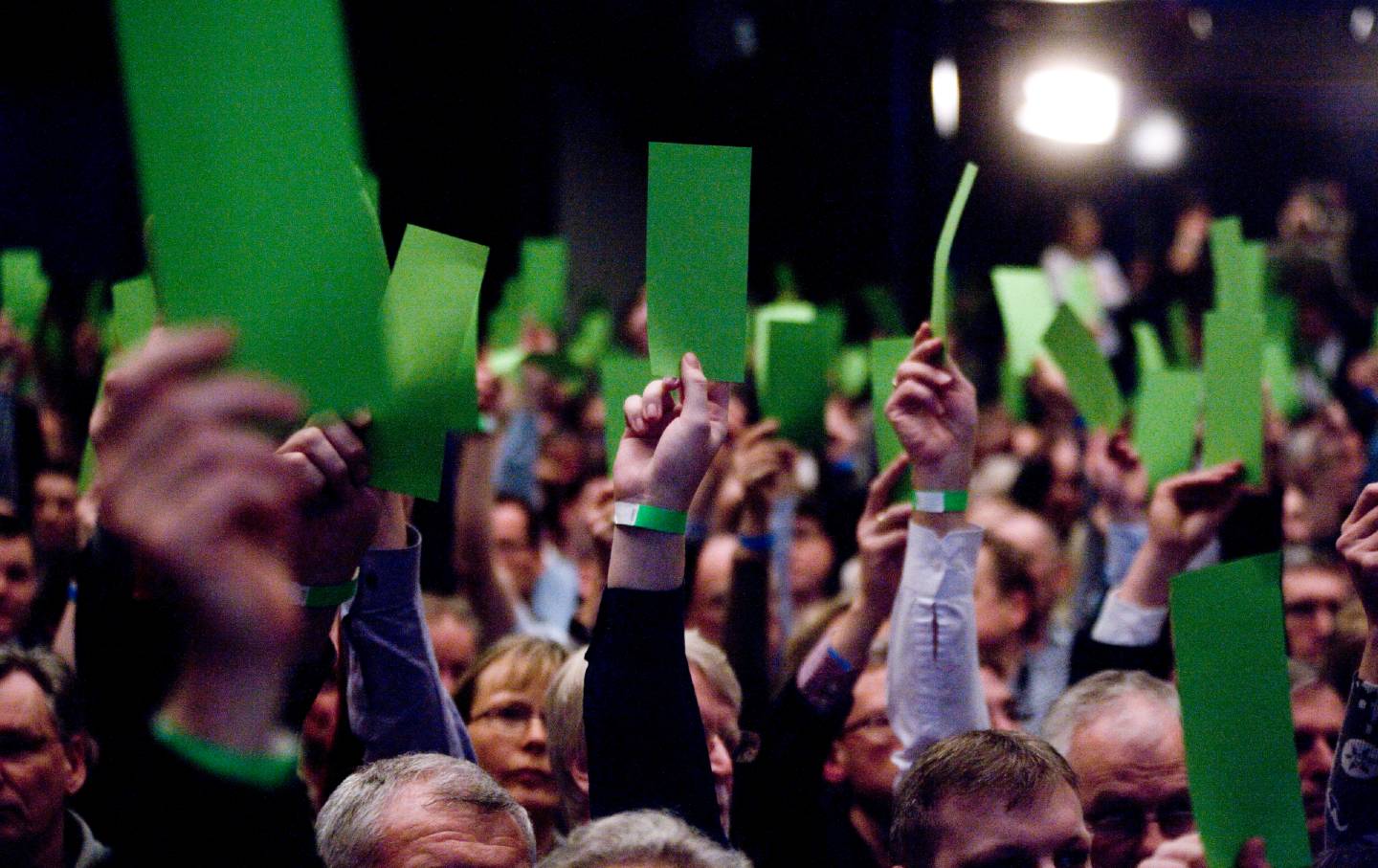
A delegate at the Conservative party conference in Manchester, England. on October 6, 2025.
( Ian Forsyth / Getty Images)It was a rainy evening in February at the House of Lords, and inside the peers’ private dining room, the vice chairman of Cambridge University’s Conservative Association, scarcely 20 years old, had already downed a few glasses of port by the time he took the podium. “My lords, ladies, and gentlemen,” Arlo Alexander intoned in a languid drawl that could have emanated from an Edwardian phonograph. “You will, I think, agree with me that we currently on the right in Britain are not too far removed from the warring, squabbling kingdoms of early 10th century England, whose infighting left themselves vulnerable to the heathen—and thus dangerously progressive—Danes.”
I was sitting at a table in the back corner, where I had ended up after innocently agreeing to swap seats with someone. The trade seemed unobjectionable: table 12’s only apparent difference, to me, was that it lay far from the action and contained most of the (very few) people of color in the room. Later, I was told by insiders that I had been duped. “You can’t be at 12!” my disbelieving new friends exclaimed. “Tables 11 and 12 are the absolute dregs!”
From the dregs, however, I had a clear view of the head of the room, where the speech was now in full swing. After the fist-banging and drunken cheering had subsided, Alexander conceded that, in fact, not everyone in the room might agree with him. Yes, there were many old-school, high Tories like himself, who used to dominate such spaces—men who, like him, “still resented Wellington for allowing Catholic emancipation.” But there were also, he pointed out, “members of new and emerging popular movements on the right”—especially at table 1, the most boisterous and boorish in the room.
The vice chairman would not name them, but most everyone there understood the “new and emerging popular movements” to which he was referring. It was the loud presence of Reform UK—Nigel Farage’s far-right insurgent party, formed from the ashes of his Brexit Party, and now, in the lead-up to today’s local elections, polling far ahead of both Labour and the Conservatives in every published survey. And it was not just the rowdy men at table 1. As the evening wore on, it became clear that Reform sympathies were sprinkled across almost every corner of the room.
In the past two years, the Conservatives’ grasp on the British right has steadily slipped as the country’s politics have polarized and a string of scandals under the Johnson, Truss, and Sunak governments bred a sense of betrayal among Tory voters. The conventional story about Reform is that its appeal is bounded—that the party draws from disaffected, downwardly mobile voters in places that the Tories long overlooked. When one thinks of Reform, the stereotypical picture that emerges is filled with lorry drivers and prison guards, of pale, portly men draped in the English flag shouting racist obscenities with beer on their breath. The British establishment, whatever its other troubles, has, the story goes, remained somewhat insulated from the movement.
By that logic, Oxbridge Conservative associations should be the last places on earth where a Farageist insurgency could take root. From Harold Macmillan’s time to Rishi Sunak’s, they have been the breeding ground of the party’s brain trust, training students in parliamentary debate, teaching them how to campaign, and equipping them with the networks to land jobs in government. Around three-quarters of all Conservative Prime Ministers were educated at Oxbridge. To this day, at the Cambridge University Conservative Association’s regular “Port and Policy” events, one can find tweedy Tories trading barbs. (The Labour Association equivalent is called “Pints and Politics.”)
But spend an evening liquored up with the tuxedoed scions of the Oxbridge Tory establishment, and it becomes clear that they are, privately, warming to Reform.
I had started to gather that impression earlier that evening, when members of the Association and their guests (including me) assembled in Parliament Square, just across the street from the Houses of Parliament themselves. As we clustered beneath the imposing bronze statue of Winston Churchill that sits in the square, I wondered what the old Tory would have made of the scene in front of me. At first, it seemed as though Churchill would be quite at home among these latter-day Conservatives. Sheltered by silk scarves and wood-handled umbrellas, men in coattails, tuxedos, and smoking jackets, and women in long dresses with carefully coiffed hair, mingled in the rain as their names were read from a list.
But very quickly, I couldn’t shake the feeling that this Conservative Party would scarcely have been recognizable to Churchill. The Tories have always been a coalition of factions, of course—Macmillan’s “wets” against Thatcher’s monetarists, the Monday Club’s bigots against its liberal modernizers, the Eurosceptics against the Europhiles. Even within Churchill’s own party, in the 1930s, there were fascist sympathizers on his own benches as he warned of Hitler. But those were quarrels within a recognizable family, fought over the meaning of a shared inheritance. What I encountered in Parliament Square felt different in kind. In the same crowd, I spoke with Thatcherites and Trumpian state-capitalists, crypto-fascist antisemites and staunch Zionists, xenophobic Anglicans and “high Tory” Muslims, prep school monarchists and provincial populists—and a fair number who, one suspected, had come to play dress up more than talk politics.
Perhaps, given what had been happening in Cambridge conservative circles in the months prior, I shouldn’t have been so surprised by the splintered British right that I observed. Though Cambridge, like Oxford, has no Reform society, the months before the dinner had been replete with signs of the rightward drift. One month earlier, the Association had caused a stir when it published a speaker schedule that included Tom Rowsell, a YouTuber accused of links to eugenicist circles who has a “winged Othala” tattoo of the kind used on Nazi uniforms. It also included Jack Anderton, a 25-year-old Reform UK social-media advisor who has written, among other things, that Britain “would be better off” if it had stayed neutral in the Second World War rather than fighting Nazi Germany, and that “in the coming Meritocracy” Britain “could and should regain” some of its former colonies. The Association’s chairman, Oscar Lingwood—the third-year undergraduate who had organized the dinner that night—was himself spotted at a Reform UK rally in East London only five days before our dinner.
Cambridge’s young right is, in fact, behind the curve. Reform’s momentum among young people is surging. The “crossover age”—the point at which a voter becomes more likely to vote Tory than for any other party—has climbed to 64, and Onward’s Ballot of the Sexes report, published this past October, found Reform leading among men aged 16 to 25, with 31 percent of the vote.
And though Oxbridge Conservatives have so far held out against the emergence of Reform associations, the shift is plainly evident elsewhere. Newcastle University’s Conservative society merged with its local Reform branch before the 2024–25 academic year and reported a tenfold jump in participation. The University of York’s counterpart lost roughly half its members to a newly founded York Reform Society—the third such group at a British university, after Exeter and Durham, which together with York rank among the Russell Group universities with the highest proportions of white students.
Among the future leaders of the British right I had spoken with that night, the attitude toward the party they were nominally gathered to honor was not one of celebration. The first keynote speaker, Patrick Christys—a presenter on the hard-right GB News channel whose show functions as something close to a Reform UK mouthpiece—was hardly more sympathetic. He delivered a wholesale roast tour through British politics that, for all its locker-room vulgarity, laid bare the fraught moment facing Britons. The Green Party, he announced, were “tree-hugging, hemp-wearing, tofu-loving eco-fanatics who worshipped Greta Thunberg like a kind of neurodivergent Swedish Messiah,” a party now made up of “people who don’t believe gender exists, and people who shout Allahu Akbar when they win a local council election.” Jeremy Corbyn’s new left-wing outfit, Your Party, he called “Jezbollah.” Labour fared no better.
Strikingly, however, the Conservative Party got the same treatment. Boris Johnson, he said, may have been the “fun kind of lad” with whom you could go for a “quiet pint” and “wake up a week later in Mogadishu.” But he had also “allowed half of Mogadishu to come to Britain.” The Tories had “let the civil service be dominated by rainbow-lanyard-wearing numpties.” Fourteen years in power, and they had conserved nothing; instead, they had facilitated an “invasion of this country.” Like most of the people I spoke to, Reform, by contrast, was almost entirely spared of criticism. Christys even praised it for having clean hands and bold leadership.
While Christys had played the comedian, the second speaker, Gavin Ashenden—a former Anglican bishop and chaplain to Queen Elizabeth II, who had left the Church of England in 2017 on the grounds that it had grown too progressive—played the prophet. His targets were the “civilizational” threats of Marxism and Islam. Between 1970 and the present, he claimed, there had been “over 200,000” Islamic terrorist attacks worldwide—“mandated,” he explained, “in the Quran and in the Hadith.” “There are about eight congregations in the north of England now where the majority of the population under 16 are Muslim,” he said. “They’re going to grow up. Demographically, in the time of my grandchildren, a large part of the country will vote for Islam, for Sharia.” Some of the people of color around me, I noticed, had stopped laughing; the rest of the room booed the prospect vigorously.
It was, as the chairman later privately admitted to me, even by the standards of the evening, an extraordinary thing to hear in the House of Lords—a genteel great-replacement narrative delivered by a former Royal chaplain to a room of Cambridge undergraduates. But Ashenden’s concluding note on the right’s future political strategy was something everyone in the room seemed to agree upon. “Conservatives see things working and want to make them work better. Reformers think they’re not working and want to change everything. There’s something to be said politically for both working hand in hand.”
Beyond the walls of the House of Lords, the possibility that Reform and the Tories will have to work together is looking ever more likely. In the month leading up to the dinner, the high-profile Conservative politicians Robert Jenrick (the former home secretary), Suella Braverman, and Nadhim Zahawi defected to Reform, among a string of others. Of Tory voters in 2019 who returned to the polls in 2024, more than a quarter switched to Reform—nearly three times as many as defected to Labour. And that figure, already nearly two years old, almost certainly understates where things stand now.
Popular
“swipe left below to view more authors”Swipe →At the end of the night, as the guests stumbled out into the cold where taxis idled to take them to after parties, I asked those around me how they found the dinner. One non-white Tory who sat across from me expressed discomfort at some of the rhetoric, which he called “just racist.” “It’s not what the Conservative Party is,” he lamented. “Reform is, in my view, a very un-Conservative Party.”
A fervently Anglican—and fervently drunk—architecture student from southeast England, slurring and swaying, struck a more equivocal note. “I’d say I’m sympathetic to a reasonable number of Reform policies, but I’ll always be a Tory because I value tradition. The Tory Party is very old. It’s fairly superficial and slightly shallow, I must admit, but I will always be a Tory.”
But many others were closer to conversion, even if they weren’t yet willing to admit it publicly. “You can just read the actual Reform manifesto from last time,” one economics student told me. “Among other things, it was, in fact, full of ideas, which is more than can be said for their opponents.”
On Thursday, those private sympathies will get their first public test. The local elections will register, in actual ballots, how many of the people who still call themselves Conservatives—from the shires of Essex and Norfolk down to the Cambridge undergraduates I’d met—are ready to leave the party of Churchill behind.
More from The Nation

Japan’s Far Right Is Courting Young Voters Japan’s Far Right Is Courting Young Voters
Sanseitō has attracted young voters through a robust social-media strategy, Charlie Kirk–like public speaking events, and anti-establishment messaging.

This AI Panic Is Nothing New This AI Panic Is Nothing New
In the 1940s, The Nation asked questions about the atomic bomb we’re asking of artificial intelligence today.

The Decades-Old Roots of Trump’s War on Iran The Decades-Old Roots of Trump’s War on Iran
An interview with historian Behrooz Ghamari-Tabrizi about the generations of US presidents who have tried to destroy the Iranian regime.

Emmanuel Macron’s Turbulent Exit Emmanuel Macron’s Turbulent Exit
Between a budget crisis and a cost-of-living squeeze, Macron is leaving a country feeling more insecure than ever—and ready to take to the streets.

Israel’s Election Can’t Fix What Netanyahu Broke Israel’s Election Can’t Fix What Netanyahu Broke
The fundamental problem is not the name of the prime minister, but rather the actions of the Israeli government and the urgent issues that need to be addressed.
The AfD’s Rise Isn’t Just About East Germany The AfD’s Rise Isn’t Just About East Germany
The Alternative für Deutschland has a stable national poll lead, including in the former West Germany. Its rise owes to much more than Eastern grievances.

