
How Can We Reimagine Higher Education in the Age of Climate Change?
An interview with the founders of Gull Island Institute.
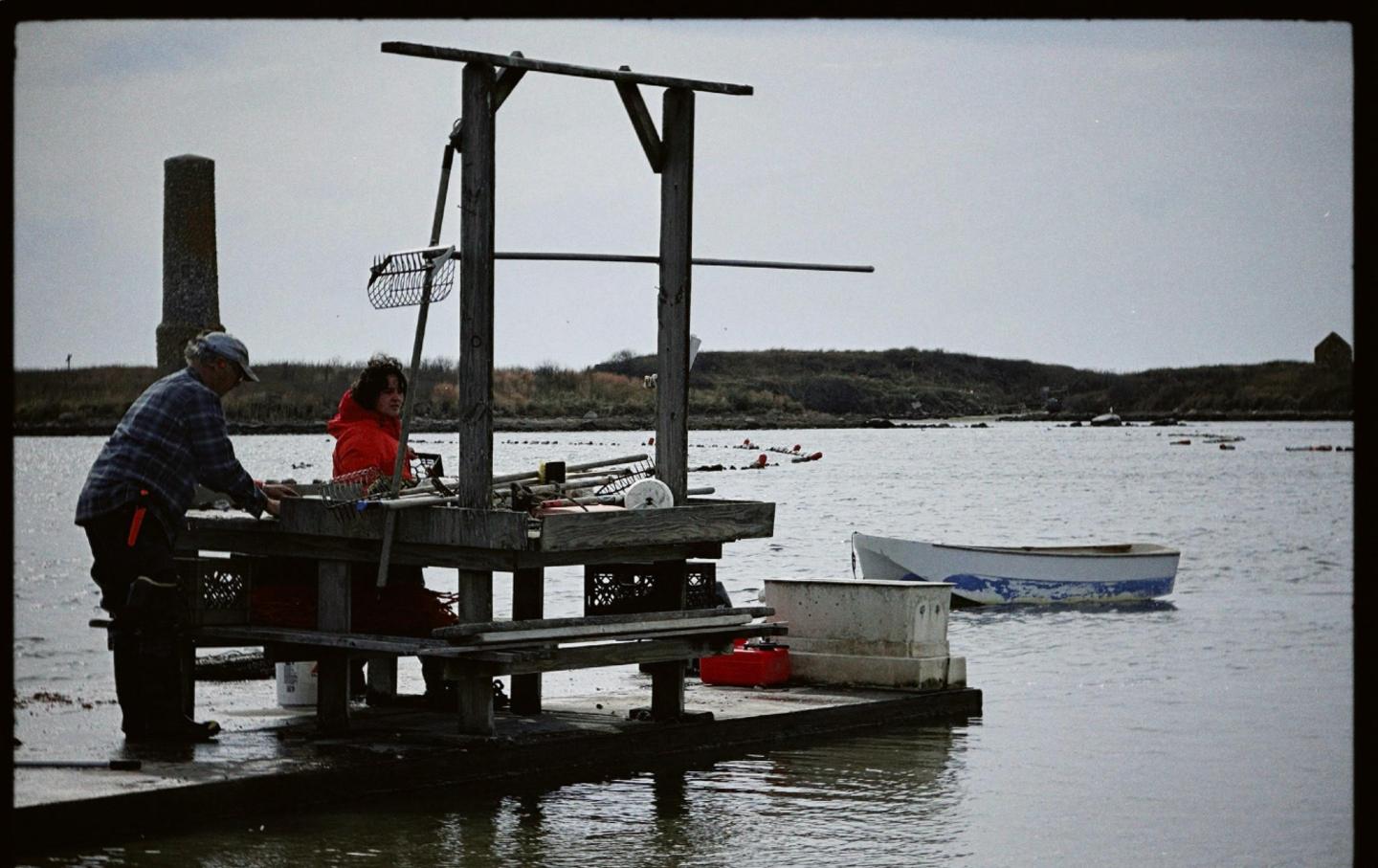
What might it mean to reimagine higher education in the face of climate change? How will colleges adapt, not just to environmental catastrophe but all the other challenges to civic life: from AI and increasing automation to deepening political divides and wealth inequality. The Massachusetts-based Gull Island Institute offers an education that attempts to answer some of these questions. Its mission is to prepare a new generation for democratic citizenship on a changing planet through place-based learning rooted in rigorous academics, physical labor, and student self-governance. To this end, students participate in seminars focused on Western and Indigenous traditions and the history and ecology of the region, alongside daily labor rotations including aquaculture, land conservation, cooking, and sustainable gardening. Tuition and room-and-board are free of charge to students.
The Nation spoke with Ana Keilson and Justin Reynolds, who founded the Gull Island Institute in 2022. We discussed the crisis of higher education today and how the Gull Island Institute seeks to provide solutions to it, as well as the long-term future of place-based education. This interview has been edited for length and clarity.
—Daniel Steinmetz-Jenkins
Daniel Steinmetz-Jenkins: What is the Gull Island Institute and what gave you the idea to start it?
Ann Keilson & Justin Reynolds: The Gull Island Institute is an educational nonprofit with a mission to reimagine the liberal arts for a changing planet. Our pedagogy is based in three “pillars” of rigorous academics, physical labor, and student self-governance; our faculty come from across the disciplines—the natural and social sciences, humanities and arts, as well as local business owners, tribal elders and representatives from the Mashpee and Aquinnah Wampanoag tribes, and community organizers. We run two types of programs: The first is a four-week tuition-free program on islands off Cape Cod for eight to nine undergraduates selected from a national cohort; the second is our “Classroom to Island,” partnership programs where we incorporate our approach into credit-bearing courses at colleges and universities and community colleges. To date, we’ve run partnership programs with Yale, Wesleyan, Columbia Climate School, and the Cape Cod Community College.
The idea to start the Gull Island Institute came from a desire to reform higher education. We both received our PhDs in history from Columbia in the late 2010s and taught there and at Harvard for a number of years. As postdocs and teaching faculty, we experienced higher ed’s legitimation crisis early and from the inside. For us and many of our colleagues, it was clear that the institutions we called our own had become reckless guardians of intellectual life and the undergraduate experience, in particular. We witnessed firsthand how higher education prioritized capital growth, the casualization and exploitation of academic labor while expanding administration. We watched in dismay as the leaders around us incentivized research and specialization at the expense of formative education and meaningful teaching. We were both very involved in union organizing for graduate students at Columbia and non-tenure-track faculty at Harvard in the 2010s and early 2020s. In some ways, founding Gull was continuous with this work to make universities more accountable and truer to professed values of intellectual and personal formation.
The second point of departure for Gull Island had to do with climate change. Over the past 15 years now, we’ve been continually struck by how institutions of liberal arts learning—including leadership and many faculty—have failed to meaningfully reckon with what liberal arts should be in an age of climate change. Then, in 2020 when Covid hit, like so many other people, we really questioned what we were doing in the university, and why. We were fortunate to have the opportunity in the summer of 2021 to teach at Deep Springs College, where we were first exposed to the three “pillared” model of academics, labor, and self-governance. Not only did we come to think of that model as a key that unlocked the question of what liberal arts learning could look like for an age of climate change, but it also inspired us to “step out” on our own, so to speak, and imagine alternative possibilities for a learning and intellectual community that was not the “traditional” university or college. In the spring of 2022, we ran a weeklong pilot program on an island an hour off the coast of Cape Cod with some of our former students from Harvard and Deep Springs, and, well, here we are today.
DSJ: What is wrong with higher education today?
AK/JR: It’s hard to generalize across the sector. But a major problem is the disconnection of higher education from place. In one sense, any university true to its name will be in some tension with the truths that surround it—after all these are places you go in search of understanding beyond received opinion. But there’s a perception today that these institutions have discounted their role in local communities to mutual detriment. This is not just a question of town-gown conflicts and struggles over real estate; rather, it’s about whether colleges recognize the kinds of knowledge that sustain local communities as deserving a place in higher education. That includes historical and ecological knowledge; knowhow carried by workers and citizens of the region, not to mention tribal and Indigenous leaders whose land these institutions occupy. The idea that local folks might have something to teach undergraduates strikes some people as unusual. But I think it’s increasingly consistent with the ways many liberal arts colleges understand the goal of educating young people.
For example, one upshot of climate science and politics in recent years is a more earth-bound and place-oriented understanding of citizenship, recognizing human responsibilities toward and relations with the natural environment as part of civic life. Liberal arts colleges like to talk about how they prepare young people to be citizens, but as places to foster inquiry into and capacities of stewardship, they’re terribly set up. The norm is for students to go through college without any grasp of the ecosystems of which their school and campus is a part. They live on manicured quads, eat at dining halls; provisioning, maintenance, and waste management are outsourced, and courses in local history and ecology are few and far between.
Design a school that confronts students with the material processes that allow its community to function, and you can powerfully raise some banner “climate” questions—from scalar thinking to food systems to the principles structuring local land use. But the model also has adjacent consequences that speak to an array of problems bedeviling higher education. Dignifying local community members as faculty challenges knowledge hierarchies; it also very often forces students to take seriously, and engage with, political positions different than their own. The need to negotiate relationships in close quarters requires building habits of sustained, face-to-face attention—without having to legislate a device or AI policy. Most of all, there is just a basic virtue, consonant with the best ambitions of the liberal arts tradition, of cultivating a capacity to “think what you are doing” in Hannah Arendt’s phrase: finding intellectual life in everyday life and being able to live ideas.
Climate change in this sense is a convenient truth. Back to your question, there are a whole number of things wrong with higher education today. The trick is finding interventions that are rich enough to address more than one at a time. Attending to the place where higher education takes place is, we think, among the more urgent and promising of these.
DSJ: Given this, what place does Gull have in the larger ecosystem of higher education today?
AK/JR: It’s a good question since the microcollege model is clearly not for everyone and the virtues of smallness mean these institutions are unlikely ever to matriculate enough people to make up a significant share of post-secondary students in this country. The bigger question, then, is what impact this model can have, especially in this moment for the field. We see the Gull Island Institute’s role as one of mediator between the microcollege ecosystem and the broader higher education sector. The task is full spectrum: from articulating a new vision of the meaning and value of liberal arts education to developing institutional forms and financial models that will allow it to become accessible to more people and more communities. On the one hand, that means working with existing institutions to incorporate aspects of the “three-pillared” approach into their curricula—as we do in our partnership programs and, more recently, advising in the creation of the Columbia University Unson Microcollege in Itoshima, Japan. On the other it means working with local partners, from tribal, town, business communities to high schools and community colleges, to develop liberal arts programs on shorter and more flexible time scales—a scaffolding of sorts that can provide a range of students with venues of transformative learning that do not necessarily require being enrolled in four-year liberal arts institutions.
DSJ: You call Gull Island a “liberal arts” institute. Why? What is the Institute’s approach to the liberal arts?
AK/JR: As historians we approach these questions by thinking about the development of the liberal arts over time, if only to clarify interventions worth trying today. The classical idea of the artes liberales—arts appropriate to a free person—is, for us, still the place to begin. In Roman antiquity, this entailed familiarity with subjects, from rhetoric and logic to music, geometry, and astronomy, thought to equip patricians with skills and knowledge needed to participate virtuously in public life. “Free” here was a legal status enjoyed by a male elite whose liberty consisted, significantly, in leisure: Propertied and generally slave-owning, they did not need to work to live and could take part in politics instead. By the late Middle Ages, the alternative to the liberal arts was codified, tellingly, as the mechanical or “servile” arts—trades practiced to meet material needs, such as agriculture, mining, cooking, and commerce. Today these fall in the category of vocational education.
In the 20th century, some key assumptions of the classical antithesis began to come apart, particularly after 1945, when higher education in the US and Europe first became accessible to reasonably large segments of the population. It’s then that we see educators and apologists start to conceive of a liberal arts degree as a pathway to jobs that will ensure economic security and mobility. Whatever you think of this move, it’s a curious inversion of the work/leisure, free/servile dichotomies. Most of today’s debates over whether the point of college is professional success or self-formation take place in its shadow.
It’s a remarkably narrow debate though, in part because people tend to take for granted the meanings of freedom and necessity in education and life. Our approach to liberal arts is to try to be a bit playful with these categories. The labor component of our programs makes providing for the community’s concrete needs a matter of necessity. At the same time, intellectual inquiry is tethered to reflection on the meaning and stakes of practical problems and communal relationships. Can the arts of farming and cooking be liberating, and if so under what conditions? In what sense might intellectual inquiry be “necessary”? It also brings to the fore crucial questions of care work and domestic labor typically rendered invisible.
If we live in an age when the liberal and servile arts can’t be disentangled, we at least should acknowledge that, in education and in life the meaning of what is free and what is necessary is not set. Part of the challenge is to open up a space to think these through.
One more point! Reimagining the liberal arts is different from revitalizing the humanities. There is much to admire in many recent efforts at the latter, from expanding general education at community colleges to reviving Great Brooks programs. But the humanities’ concern with “the human” leaves too much out. Today, knowledge of the natural world is mediated primarily by the natural sciences, while Indigenous thought has been most consequential in rigorously raising questions of the “more-than-human.” Any meaningful effort to reinvigorate the liberal arts must reckon with other, non-humanistic, domains of knowledge—both for the sake of the humanities and the disciplines defined in opposition to them. Our seminar is one small attempt to do this. It is explicitly concerned with bringing the natural sciences and Wampanoag traditions into conversation with Western philosophical and literary texts, all around the core questions of what makes places habitable and how we can inhabit them well. The advantage of assuming a focus on the category of “place”—as opposed to, say, the category of “the human”—is the purchase it affords on objects of inquiry that fall beyond homo sapiens: the land, other creatures, systems of climate, geomorphology, divinities and spirits, etc.
DSJ: How has your own work changed since the founding of Gull in 2022?
AK/JR: Obviously, things are different under Trump in 2026 than they were under Biden in 2022. There is a crisis of civic life. There are a number of financial headwinds, a heightening of chaos and fear in the university ecosystem. Everyone in the nonprofit world knows fundraising is tough going these days. It was especially tough last year, when higher ed and confidence in it took hits from all sides. This prompted us to think hard about our business plan and how Gull can exist sustainably in such volatile political, social, and economic times. Along those lines, we think it’s important for your readers to know that we do not have an angel investor or a major benefactor. Instead, our work is sustained through midsize individual donations (our average donation is around $150 dollars), in addition to grants—none of them federal—and revenue from our partnership programs.
Popular
“swipe left below to view more authors”Swipe →What’s also different is that since 2022 we’ve really leaned into our work with community colleges. In addition to her role at Gull Island, Ana teaches on faculty at the Cape Cod Community College (4Cs), and her work there—combined with the partnership program we run with the college—has made a big impact on us, not just in terms of how we approach issues of access and equity, but more generally in terms of how we conceive of our work itself and the basic value of a liberal arts education. Some of the most brilliant students we’ve ever met, anywhere, have come from 4Cs. Their ideas in the classroom have transformed our thinking about habitability, about place, about the meaning and value of work, and about the aims of education. In turn, those ideas have shaped how we run our programs and our institute overall.
Finally, the current administration’s approach to the climate—its extractivist worldview, passion for fossil fuels, and its contempt for climate diplomacy—has made our mission more urgent than ever. Not only has the integrity of the social fabric has weakened considerably, and not only have so many people forgotten how to deliberate in civic fora, but in many cases caring about the climate emergency is a thing of the past.
DSJ: It’s a depressing time to be in higher education. What gives you hope?
AK/JR: It is indeed! It is especially depressing when we talk to those in the university who feel like there’s no way out of the mess. Something that gives us hope right now is what we’ve noticed as a recent and subtle shift in the zeitgeist—from a sense of nihilism and hopelessness to one of openness and experimentation. If it’s the case that we’ve hit rock bottom, or something close to it, what do we have to lose? We’d like to think that this is part of the recovery from the kick in the face that was 2025: Even in the first few weeks of 2026, we’ve seen real interest among people in positions of power to do things differently. Faculty, university and college administrators, and individuals who control the purse-strings of budgets seem to be less terrified than they were last year of taking a chance on something new. (Of course we don’t want to jinx anything!)
For Gull specifically, this might have to do with the fact that we’ve survived something of a start-up phase and have proven that students, faculty—even administrators—learn a tremendous amount from our programs, and that our work makes an impact in local communities.
Which is all to say, for those reformers out there: Hang on, and don’t give up! Change is coming, and it will be for the good.
Become a Sustaining Donor This September
Between the reemergence of right-wing red-baiting and Donald Trump’s use of the chilling National Security Presidential Memorandum–7 to criminalize left political organizing, we’re seeing McCarthyism reborn before our eyes.
This assault on democracy cannot be ignored or wished away. Resisting it requires bravery in the face of threats and repression, a steadfast commitment to the truth, and the unwavering belief that we can—and will—overcome this darkness.
We must have an independent media that sets the record straight, unearths corruption and abuses of power, and advances a politics of justice and dignity for all if we’re to win this fight.
That’s why I’m writing to you today. This September, The Nation needs to add 100 monthly donors to sustain our progressive journalism. Your contribution makes the next investigative report, the next truth-speaking column, and the next pathbreaking essay all possible.
I hope you’ll support our work with a recurring donation today. If you donate $10 or more a month, we’ll send you a brand new “Hands Off the Free Press!” sticker to recognise your commitment to our cause. Please, donate today.
Onward,
Katrina vanden Heuvel
Editor and Publisher, The Nation
More from The Nation
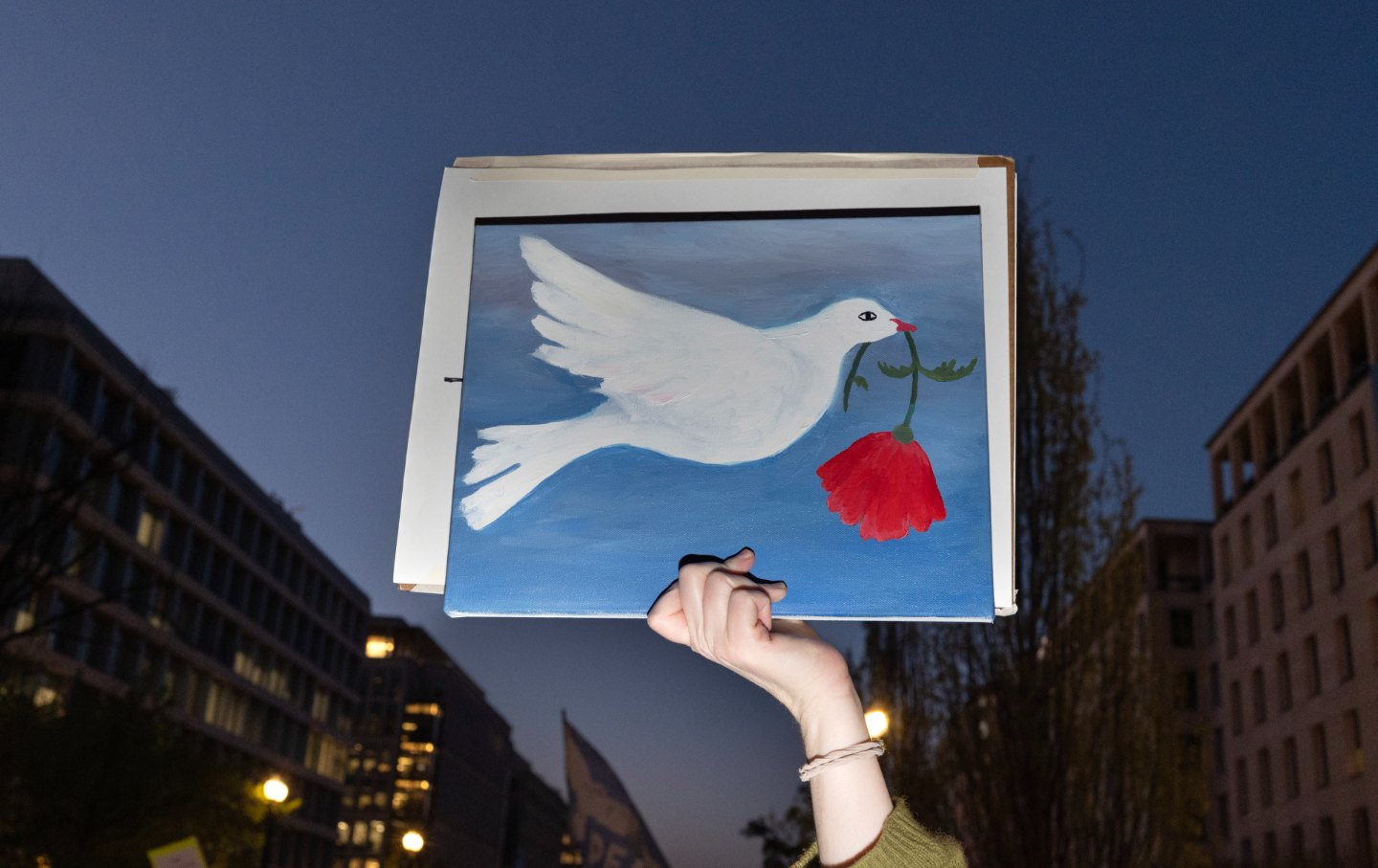
As Morale Sags, More Military Service Members Are Having a Crisis of Conscience As Morale Sags, More Military Service Members Are Having a Crisis of Conscience
According to multiple GI rights organizations, service members are inquiring in unprecedented numbers about seeking conscientious objector status.
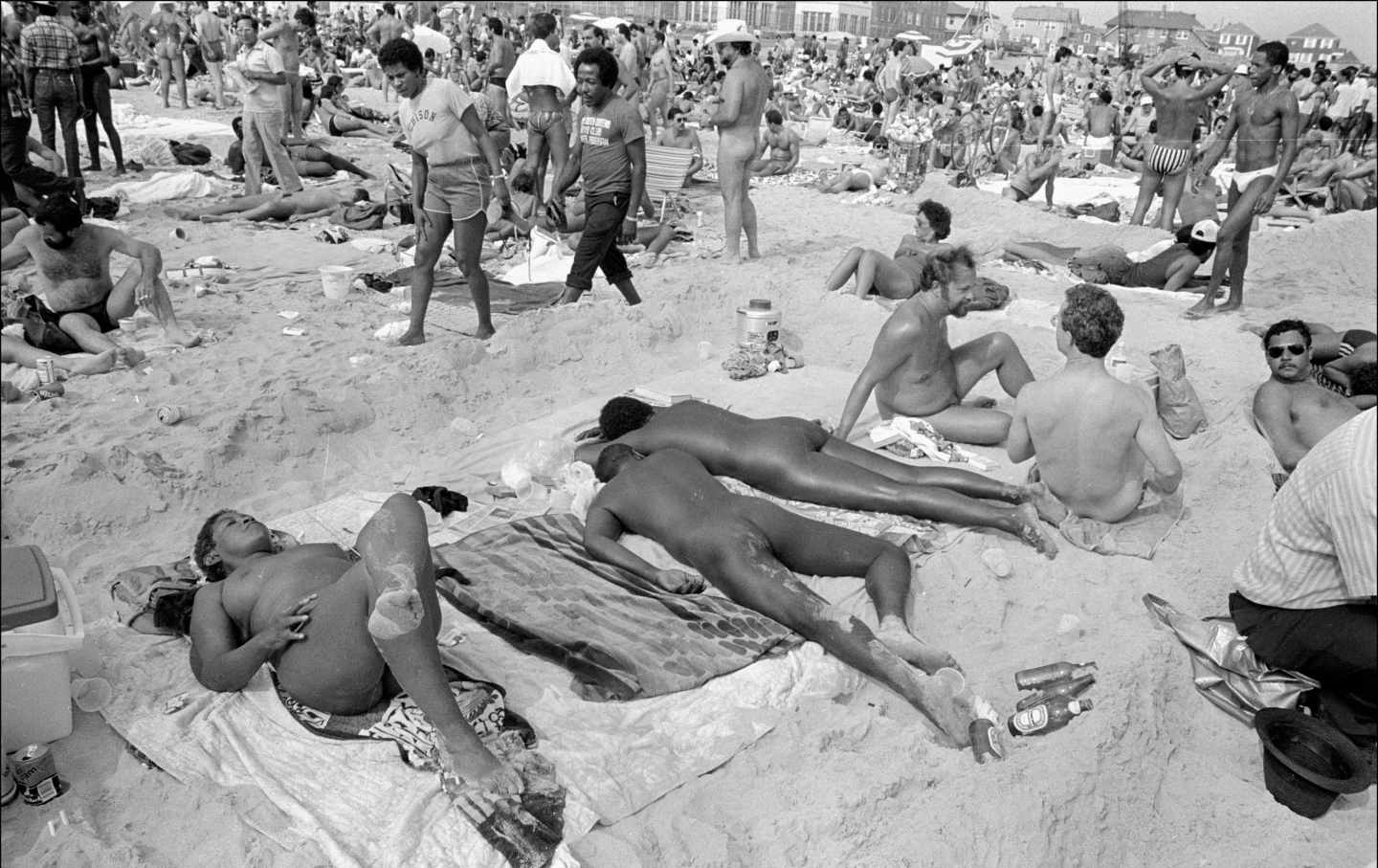
What Remains of Riis? What Remains of Riis?
A new members’ club has revived Riis Park’s long-vacant bathhouse, reopening old questions about whom the People’s Beach is really for.

When Texas Sex Ed Falls Short, Gen Z Women Turn to Social Media When Texas Sex Ed Falls Short, Gen Z Women Turn to Social Media
A 2025 study found that 70 percent of adolescents sought reproductive health information through social media platforms.
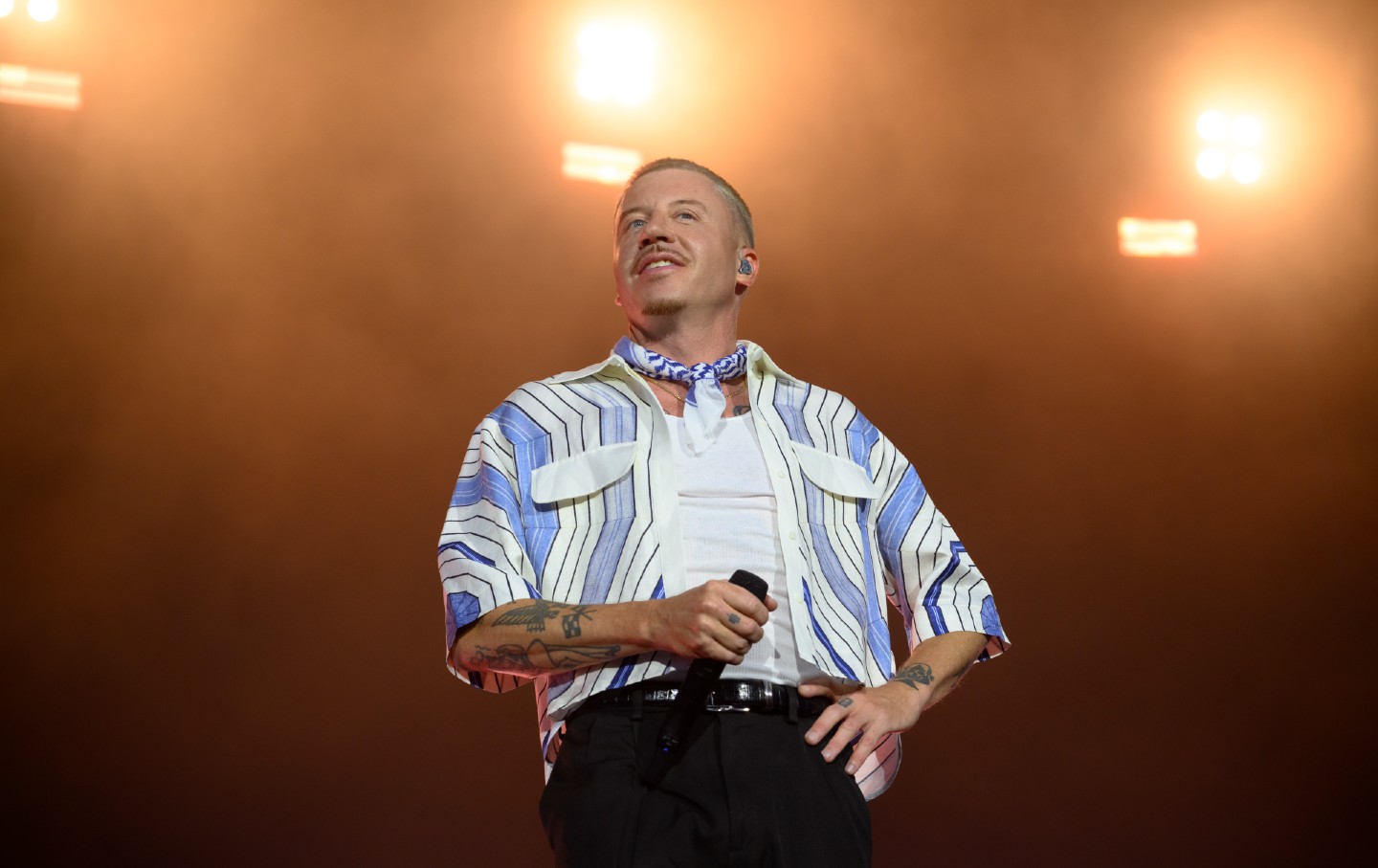
Justice for Macklemore Justice for Macklemore
The rapper has been dumped from Ed Sheeran’s tour for saying “free Palestine.” That’s a disgrace.

We Are Living Under Roy Cohnian Logic We Are Living Under Roy Cohnian Logic
The political fixer created a career for himself as a self-promoting, ubiquitous hustler. Like Trump, he got away with it by having the right friends.
Time Has Run Out for AI Risk Deniers Time Has Run Out for AI Risk Deniers
The recent spate of reports about the technology’s destructive power underline two prime directives: Be afraid, and regulate aggressively.

