
Searching for Solidarity at the Train Station
Mattia Filice’s Driver, a poetic novel about train conductors in France, offers an empathetic vision of working for the public.
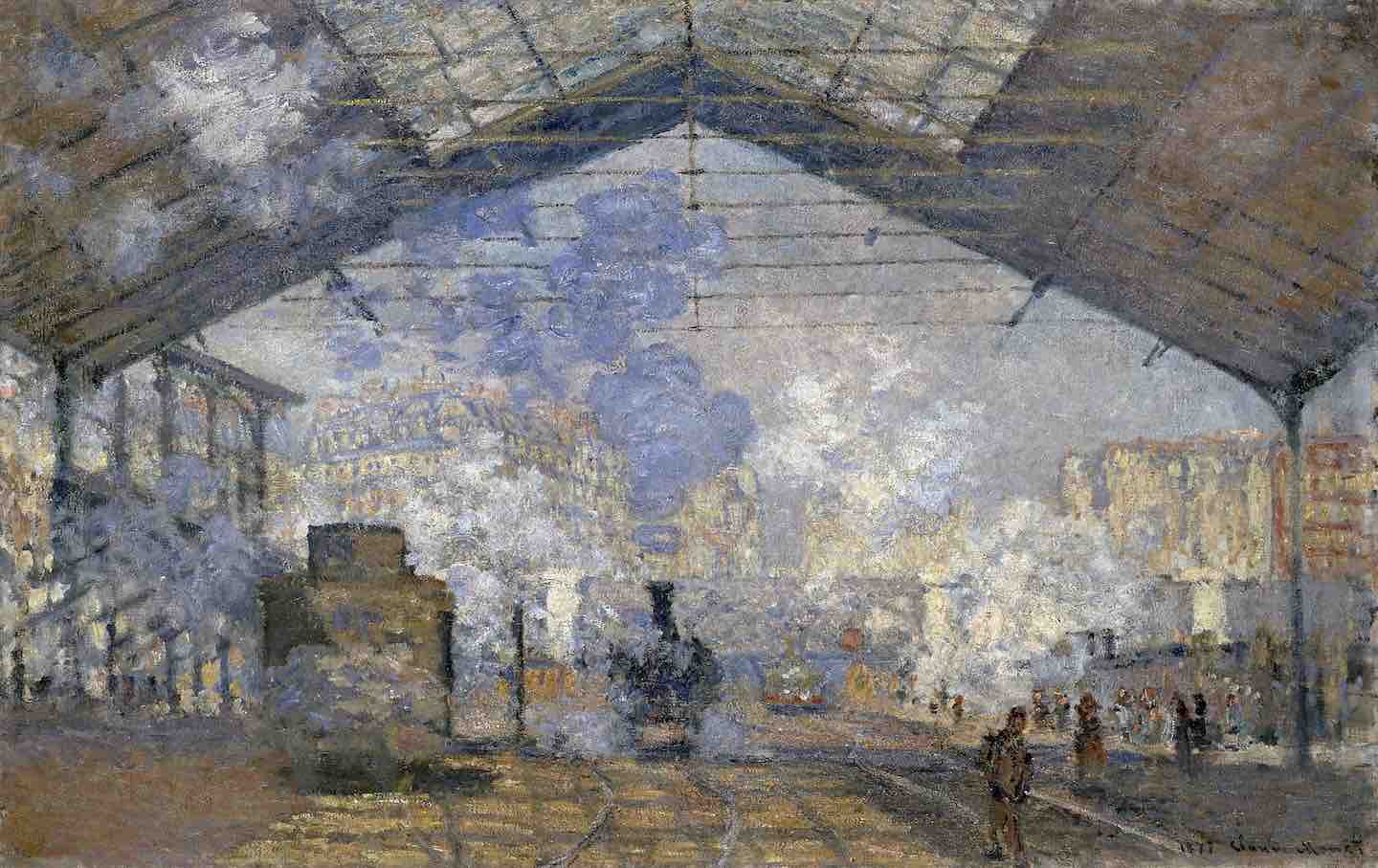
Claude Monet, The Saint-Lazare Station, 1877.
(VCG Wilson / Corbis via Getty Images)At the end of Émile Zola’s 1890 novel La Bête humaine, a runaway train careens through the night, an “escaped monster” of astonishing force that advances toward “the future in spite of all, heedless of the blood that might be spilt.” Zola’s was one of the first novels to seriously consider the social and cultural ramifications of the train, which had yanked Europe into the industrial age and facilitated a great migration of workers from the country to the city. With this had come profound anxiety about the perils of modernity, incarnate in the hulking machines now roaring across the continent. What Zola saw in the train remains relevant: If anything, we have only become more apprehensive about our reliance on unfeeling technology—and the possibility that we might lose something of ourselves in the headlong race toward an optimized future.
Books in review
Driver
Buy this bookIn Europe, the railway still reigns as a mode of transport: More than twice as many people in France alone travel by train each year as in America. But this is more than just evidence of a well-maintained intranational infrastructure. The railways that crisscross the continent are seen as a birthright and a site of contestation for the fragile social democracy that knits together much of Europe. An outsider might confuse the SNCF, the state-owned company that operates regional train service in France, for an entire branch of the French government, so omnipresent it is in the daily lives of millions, and so dispositive of national disorder. Persistent battles over wages and pensions lead to regular railway strikes—as much a part of the annual calendar as Paris Saint-Germain matches—that snarl the country’s matrices of commerce. Railway workers (or chéminots) are leading figures in the perennial struggle for workers’ rights, but also objects of misplaced ire: deemed tyrannical by the disgruntled commuters and scheming bosses for whom their demands for dignity are merely inconvenient, yet relied upon to to keep a nation smoothly functioning.
It is this presumption of authority—and the suggestion of danger—that attracts the anonymous narrator of Mattia Filice’s verse novel, Driver (translated by Jacques Houis), to his calling. Waiting for a commuter train delayed by a storm, he is suddenly struck by the driver’s control of quotidian rhythms and the appealingly transient, adrenalized nature of his work: “no office or sedentary living.” A film projectionist by training, the narrator admits he has only “a rough idea” of who a driver might be—a cowboy of sorts, “a deep voice a cocky attitude / a guy who stands up for himself.” But this vague impression is motivation enough for him to undertake a series of grueling interviews and psychological tests, and to agree to a militant course of training with the SNCF, cloaked here in a secretive epithet: “the Company.”
The narrator and his fellow trainees “are evaluated 24-7 / observed scrutinized peeled / like the orange” a colleague eats every morning. They attempt to memorize the 12,000 technical terms contained in their manuals, and to prove to the watchful Company that they won’t succumb to such intolerable afflictions as fatigue or nerves. So much for our John Wayne of the rails: Bruised from his hazing, he sees that what he has been initiated into is “an apprenticeship in kowtowing.” The driver, he quickly realizes, is a “hybrid creature,” one “invested with both power and submission.” His colleague puts it more simply: “You don’t thank an orange / You squeeze it.” The trains they operate are heirlooms from a bygone age of European prowess, to be defended and maintained with prideful care. But the drivers themselves are rendered nearly invisible to the public they serve. Sequestered in their train cabs—and asked to apply a kind of monastic focus to their work—they are the thankless guardians of a crucial institution, and Driver sets out to uncover the unique pressures of their role. But it also charts the enervating and even corrosive nature of work itself—and the means of resistance, however partial, that might be available to all of us.
Like his narrator, Filice began driving SNCF trains in the early 2000s, and he started to write about his life as a driver around the same time. Writing, he has said, was “an outlet, a way to express myself when my company didn’t necessarily allow me to.” Indeed, Driver unfurls with a kind of breathless, confessional intensity, freed from the constraints that the Company places on language. Drivers must master a dense lexicon, its colorless phrases designed to be dutifully intoned: “I obey the signal passively and immediately / I perform a one-bar decrease and watch the manometers.” For Filice’s narrator, these locutions “form a chain and enchain the imagination,” forcing him to seek “a sensitive refuge” in the poetry he reads between training sessions. He also finds relief in the easy patter of his colleagues, ”a hodgepodge of society” from both the French metropole and its former colonies. Snatches of Bambara and Moroccan Arabic whiz by, followed by fragments of Rimbaud and Apollinaire. Hundreds of other dashed-off references suggest a cultural consciousness oversaturated by globalism—most of Filice’s touchstones are from the Anglophone world, from Star Wars to Kendrick Lamar—and geopolitical unrest: One Company manager is distracted, mid-drubbing of a trainee, by news of the Madrid train bombings.
Crude technical jargon is also repurposed, somewhat defiantly, into figurative language. A particularly demanding trainer has “eyes shaped like smoothing coils”; an unusually brawny driver, “a world class Bro,” is “thick as a catenary support.” One student driver who wakes up late for the day’s session—a mortal sin in this world of rigid timetables—puts a “bridge rectifier in his voice / to seem serene” when he asks a Company functionary where his classmates have gone. Drivers are prone to merge with their environs, so thoroughly have they absorbed their training: Regarding one veteran driver, the narrator notices that the “the furrows of the tracks have formed” on his face.
And if all of this might not be enough to juggle, Filice often indulges in the mythic register, which provides a narrative blueprint, laying out the Manichean terms of engagement. The novice drivers are vying to become “knights” and questing for a “Grail” (a sheet of paper authorizing them to control a specific route), while also revolting against an intractable “lord” (management) who fights “battles in the conference room.” (In a novel full of stylistic flourishes, this one works much less successfully.)
Clearly, Filice means to overwhelm—to simulate, by way of a propulsive, cacophonous style, the head-spinning experience of commanding a 1,800-ton “metallic serpent.” One lurches, dizzied, from one stanza to the next, searching for the stability of a familiar reference, an unfractured sentence. Amid the deluge, certain unsettling details flash into focus, as when the narrator learns that the “absolute record” for fatal incidents experienced by one (still-active) driver is 16. “He took my share,” the narrator assures himself, a little hysterically. “No doubt about it. It’s settled. I settled it.” Or when one of those very incidents appears in frame, summarized with a swift, grim precision: A young woman uses a temporary walkway to exit a station in Normandy and “looks at the exact moment, both quick and cruel, when the alignment between the train leaving and the train arriving at 147 kilometers an hour produces a blind spot.” (The SNCF was later convicted of involuntary manslaughter in her death, having failed to adequately warn pedestrians of the danger posed by crossing—or to protect the driver who tried in vain to alert her.)
This episode is one of many in the book that illustrate a certain disconnect between the political rhetoric that has long surrounded Europe’s nationalized rail networks and the reality of their management today. The trains, it’s often suggested, belong to and benefit the people; they complement the robust social protections—universal healthcare, retirement schemes—that underpin European life. But decades of neoliberal policy have chipped away at these welfare states, undermined unions, and prodded public companies into behaving more like private ones—which is why Filice’s narrator finds himself working for a Company stacked with “mass-produced” managers who possess the “capacity to be compassionate” to workers’ grievances but blithely rule out the possibility of actual reform. The result is a system that does not always privilege the human, contrary to its claims. Faced with one irksome situation after another—a fatality here, a malfunction there—the Company might produce a terse statement or gin up an investigation to locate a scapegoat. As the narrator observes, “it’s not in the Company’s interest / for us to die on the job / it’s a stain.” And though he is not immediately given to striking—fretting that “victory is out of reach”—he begins to grasp the purpose of collective confrontation: for these workers to make themselves starkly visible to a Company that would rather not deal with them at all.
As Filice’s narrator earns his stripes and settles into his work for the Company, he encounters yet another alien vocabulary: the invective and doublespeak his bosses use to goad their subordinates into accepting ever more precarious conditions, and to root out dissidence before it flowers. These are “slippery words—smooth as a Photoshopped image meant to make scrollers salivate”; they are “instant words, syrupy, limp, and gelatinous words.” The drivers are told that they are “the last link in the chain”—the vital, galvanizing component—but also that they should stop “acting like spoiled brats falling out of love” with their “toys”: “we should even be happy about our situation.” That means a life lived in perpetual arrears, as the age of retirement rises. (“When I joined the company / I had thirty-two years left / Now I have thirty-four,” a chéminot laments.) To the Company’s representatives, to strike is to self-flatter, to dare to consider oneself above parsimony. “If it’s such a chore for them they should say so,” one mandarin sniffs at the picket line. “There are those who do public service and those who undo it.”
The narrator and his colleagues are only free from Company talk (and Company surveillance) in the moments they steal in lounges between train departures, or in the dormitories where they crash for a few fitful hours before returning to the rails. In those liminal settings, “we cut our thoughts short and slice up our words / like our meals that we’ve learned to eat / at an accelerated speed.” Add to this the debilitating effects of enforced insomnia, and the narrator is left with “torn, short, amputated thoughts,” which seep out in jittery spurts of prose, as if the lyric form can no longer contain them. These are the most compelling moments in Driver—when the sheer profusion of language seems liable to give way altogether, revealing a psyche under siege:
I am a zombie, I am present, walking on the sidewalk, but above my body, beside my body, I am watching my body as it moves, I can see my body as it moves, I see nothing but my body and on every side shadows, reflections, bits of information, a street sign, a red light turning green, crumbs of thought.
Here, Filice reaches beyond the specifics of this highly specialized profession to gesture at something more universal: the way the punishing cadences of work tend to break down the language we might otherwise use to shore ourselves up, and leave us depleted and alienated. Work “sets the pace of my days, compresses my emotions, and violates my desire,” the narrator notes bitterly. But recording his experiences allows him to “regulate the tensions that course through my body.” And by carefully threading together his colleagues’ stories—the respected mentor who passes away in his sleep, three years before retirement; the gadfly who invites passengers into his cab to ward off loneliness—he restores to them the subjecthood they have been denied as workers, throttled by a system that sees them as yet another pliant part of the machinery.
Of course, to register the violence of work—by way of writing, or public declamations of protest—is not to ensure its diminishment. As Filice warns us, a thrown switch is unlikely to halt a runaway train. So long as a national economy exists to be serviced, the Company will stay the course, gathering more velocity as it narrows its outlays and barrels toward profit. Driver ends with the narrator and his comrades celebrating a successful strike, but also warily plotting out their next steps: taking stock of still-unmet demands, anticipating the next action. Half-hopeful, half-restive, the narrator reflects that “solidarity is a fire that needs to be stoked or it goes out.” There are still more chéminots to be drawn into their efforts; there are disagreements to be parsed, tactics to be sharpened. These lively moments of communion and friction are the necessary preconditions of movement-building. But they are also reminders of what it means, and feels like, to be a worker, pressed into relation with your fellow laborers. Such experiences flicker in and out of our working lives, puncturing monotony, leavening dread—and delivering us back to ourselves, if only for an instant.
Become a Sustaining Donor This September
Between the reemergence of right-wing red-baiting and Donald Trump’s use of the chilling National Security Presidential Memorandum–7 to criminalize left political organizing, we’re seeing McCarthyism reborn before our eyes.
This assault on democracy cannot be ignored or wished away. Resisting it requires bravery in the face of threats and repression, a steadfast commitment to the truth, and the unwavering belief that we can—and will—overcome this darkness.
We must have an independent media that sets the record straight, unearths corruption and abuses of power, and advances a politics of justice and dignity for all if we’re to win this fight.
That’s why I’m writing to you today. This September, The Nation needs to add 100 monthly donors to sustain our progressive journalism. Your contribution makes the next investigative report, the next truth-speaking column, and the next pathbreaking essay all possible.
I hope you’ll support our work with a recurring donation today. If you donate $10 or more a month, we’ll send you a brand new “Hands Off the Free Press!” sticker to recognise your commitment to our cause. Please, donate today.
Onward,
Katrina vanden Heuvel
Editor and Publisher, The Nation
More from The Nation

America Without the NFL America Without the NFL
Chuck Klosterman’s Football is a eulogy for the sport on the eve of its decline.
Edward Said: Between Worlds Edward Said: Between Worlds
A new film biography depicts the Palestinian writer as still out of place—and ahead of his time.
Imani Thompson’s Grad-School Thriller Imani Thompson’s Grad-School Thriller
In Honey, the novelist offers a different take on the campus satire.
Love and Literature in Leslie Fiedler’s America Love and Literature in Leslie Fiedler’s America
When will the American novel grow up?

