
The Last Cheap Ride
The collapse of intercity bus service isn’t an accident of the market. It’s the result of treating transportation as a privilege.
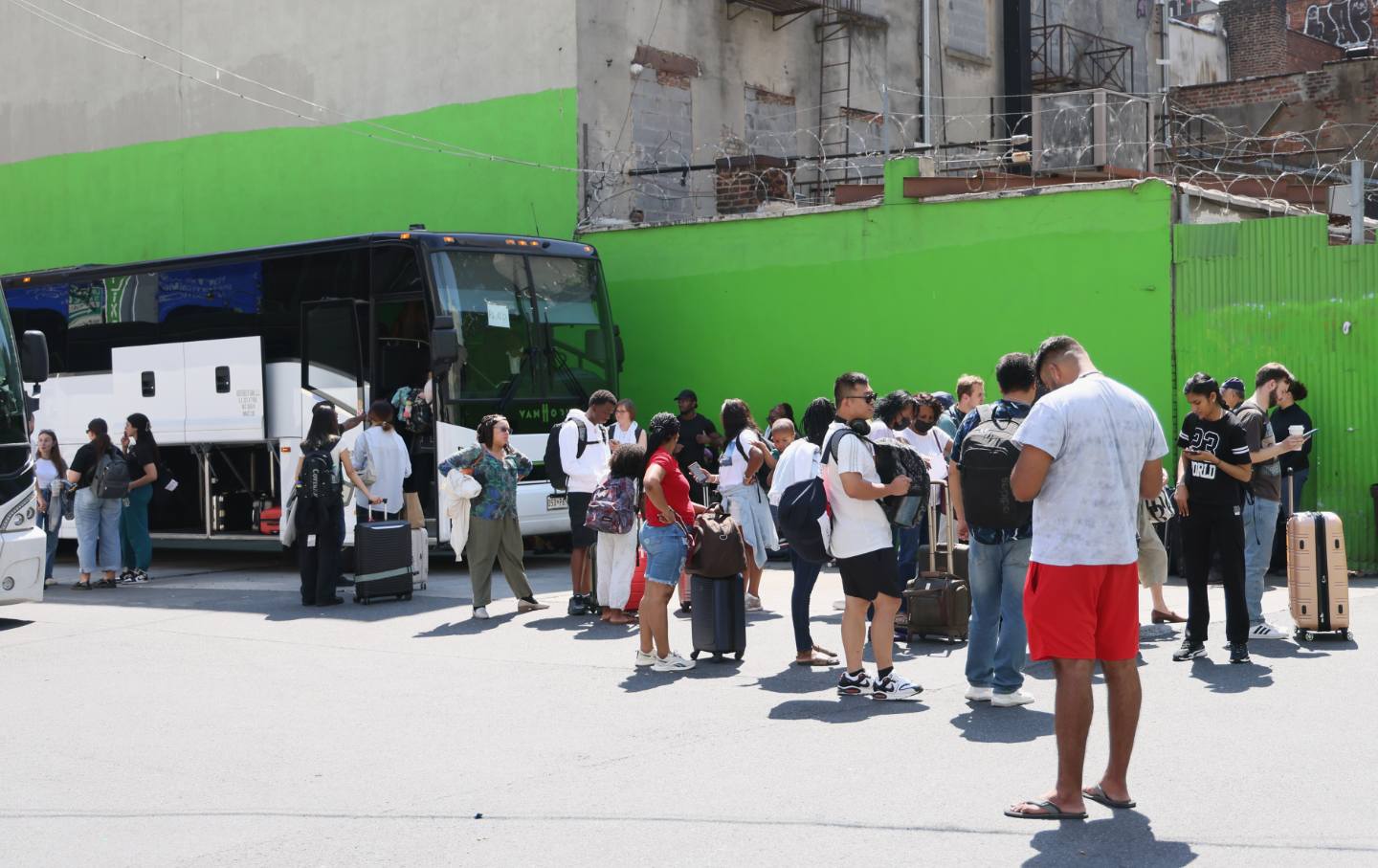
On the outskirts of an American town, a bus is scheduled to arrive. Only there’s no station—no ticket counter or waiting area, no screen offering updates on a delay that’s already stretching on. Just a small cluster of people standing with their bags at the edge of the pavement, looking up and down the street and refreshing their phones. When the bus finally arrives, the driver climbs down to check tickets. Someone asks a question, but he brushes them off. No time. No explanation. No one else around.
This scene isn’t an aberration. It’s what intercity bus travel looks like after decades of deregulation and abandonment. The unraveling of Greyhound—the nation’s largest intercity bus company, which for much of the 20th century was synonymous with long-distance travel—is often framed as a story of corporate mismanagement and declining service, but the deeper story is structural: a mode of transportation that millions of Americans rely on, stripped of the infrastructure that once supported it. What remains is a private network that can still move people between cities but has retreated from many of the communities that need it most.
The people left behind aren’t casual travelers looking to save a few dollars. They depend on the bus for trips that can’t be postponed—medical appointments, court dates, family emergencies, work obligations. For riders with no car and few alternatives, a delay isn’t just an inconvenience; it often means the trip doesn’t happen at all. And the thinner the transit options, the higher the stakes when service is cut.
Greyhound’s decline didn’t begin with one bad year or one bad CEO. Since its mid-20th-century heyday, when downtown terminals linked thousands of destinations and buses were a routine part of American travel for everyone from students and service members to families and vacationers, the company has faced steady pressure from external forces. Chief among them were the rise of car ownership, cheaper air tickets, and, most crucially, the deregulation of intercity buses. Previously, bus companies were required to keep service broadly available, subsidizing unprofitable routes with revenue from ones in higher demand. The Bus Regulatory Reform Act of 1982 lifted those requirements, shifting service away from smaller markets. Routes that didn’t pay for themselves—including across much of the rural Midwest and other lightly populated regions—were the first to disappear.
In 2021, FlixBus, a German travel-technology company, acquired Greyhound. Today, the two brands operate as a single intercity network spanning more than 1,800 destinations. Flix says it remains committed to serving rural areas, noting that hundreds of small towns are included in its network. Even so, the system reaches fewer places—especially in rural areas—than the one Greyhound once ran: a network that, at the height of its expansion in the early 1940s, operated roughly 4,750 bus stations nationwide.
The contraction has not only reduced routes; it has reshaped the infrastructure that once supported them. Greyhound’s terminal properties were not included in the Flix acquisition and remained with Greyhound’s former parent company, FirstGroup, which later sold them to other owners.
While Flix still operates out of major urban transit hubs such as New York’s Port Authority Bus Terminal, Los Angeles’s Union Station, and Boston’s South Station, the company relies on a model built around app-based ticketing and curbside pickup rather than privately owned stations in markets with lighter demand. Flix’s CEO, Kai Boysan, says the curbside model keeps prices down and improves on-time performance, with rates that exceeded 85 percent during this past winter’s holiday season and that are close to 100 percent in certain regions.
Even as it defends the curbside model as a way to avoid the costs of privately owned terminals, Flix argues that intercity buses should have access to publicly supported transit centers that connect local buses and commuter rail lines. The company is pushing for “reasonable access” rights to those facilities and says that federal programs like the Section 5311 Intercity Bus Program, which sets aside a portion of federal rural transit funding to support intercity bus service in rural areas with smaller populations, are critical to sustaining service in underserved regions. Without those protections, Boysan says, buses will continue to be pushed to peripheral locations—and passengers will continue to face delays, transfers, and ticketing without the infrastructure that once anchored the system.
The fight over stations isn’t just about urban real estate; it’s about whether intercity buses are considered a core component of a city’s transportation system at all. Local governments “need to view bus stations as one of their obligations or one of their infrastructure priorities,” says Joseph P. Schwieterman, a transportation scholar at DePaul University who studies intercity bus and rail systems. “Some have good transit centers, but the transit agencies won’t let bus lines use them. Others are kind of hostile to the bus because they view it as a source of crime.” So the bus still runs but the station doesn’t—and with it go the waiting room, bathrooms, charging stations, and staffed counter that riders depend on.
The collapse of intercity bus service isn’t an accident of the market. It’s the result of treating transportation as a private service rather than a public responsibility. One solution, according to Genevieve Giuliano, a professor of public policy at the University of Southern California, is to provide the kind of public backing that’s extended to air travel—an investment that, while not a remedy for every issue facing intercity buses, could help stabilize the network itself. “There are subsidies that are paid by the federal government to carriers to include unprofitable links in their networks as part of basic air mobility,” Giuliano says. She wonders why we haven’t applied the same logic to bus travel.
Efforts to fix the system run into a simple reality: The people who rely on intercity buses carry little political weight. Their needs rarely shape transportation policy, and pushing buses away from central transit facilities reinforces their marginal status, making it easier for the infrastructure around them to disappear. Meanwhile, Greyhound’s reputation as a last-resort service deters riders who have alternatives. Giuliano has suggested a voucher system that could widen access and draw in riders who currently have other options—expanding not just the customer base for bus travel but the political constituency behind it. For now, she says, “we haven’t seen enough public support to say, ‘Well, you should also be subsidizing the intercity bus lines.’” Abandoning an essential service is easier when the people left behind are easy to ignore.
The consequences are not abstract. “The right to travel as a civil-rights issue gets at employment, housing, and leisure,” says Morgan Hecht Dominguez, an attorney at Disability Law Colorado. Without formal stations, there’s no way to enforce basic accommodations, such as ADA-compliant boarding and staffed ticketing. In the curbside model, those gaps show up quickly: A rider who needs accessible boarding or help rebooking a missed connection may have nowhere to turn. Nico Meyering, a Greyhound rider in Philadelphia who lives with a rare genetic breathing disorder, says the stakes are clear: “If we are not able to move about the nation as our needs dictate, then our freedom is limited. We don’t have true freedom.”
Popular
“swipe left below to view more authors”Swipe →In rural communities, the consequences are just as stark. “There are people living in very rural areas who have no means of getting not only around their communities but between them,” says Stevie Pasamonte, a transit organizer at the Alliance for a Just Society. For these riders, mobility is a lifeline, and a loss of service doesn’t mean a longer walk—it means a severed connection to work, family, or medical care. When that lifeline is cut, it isn’t fate; it’s policy.
Back at that curbside stop, the scene no longer reads as a temporary glitch. It’s the predictable result of policy decisions, economic pressures, local resistance, and a transportation network allowed to fail because the people affected are all too easy to ignore. The bus still comes and goes. The system falls further behind.
Become a Sustaining Donor This September
Between the reemergence of right-wing red-baiting and Donald Trump’s use of the chilling National Security Presidential Memorandum–7 to criminalize left political organizing, we’re seeing McCarthyism reborn before our eyes.
This assault on democracy cannot be ignored or wished away. Resisting it requires bravery in the face of threats and repression, a steadfast commitment to the truth, and the unwavering belief that we can—and will—overcome this darkness.
We must have an independent media that sets the record straight, unearths corruption and abuses of power, and advances a politics of justice and dignity for all if we’re to win this fight.
That’s why I’m writing to you today. This September, The Nation needs to add 100 monthly donors to sustain our progressive journalism. Your contribution makes the next investigative report, the next truth-speaking column, and the next pathbreaking essay all possible.
I hope you’ll support our work with a recurring donation today. If you donate $10 or more a month, we’ll send you a brand new “Hands Off the Free Press!” sticker to recognise your commitment to our cause. Please, donate today.
Onward,
Katrina vanden Heuvel
Editor and Publisher, The Nation
More from The Nation

Irish Goalkeeper Gavin Bazunu’s Refusal to Play Against Israel Puts Him on the Right Side of History Irish Goalkeeper Gavin Bazunu’s Refusal to Play Against Israel Puts Him on the Right Side of History
Bazunu’s decision raises the perennial question: Why is a country that is currently committing a genocide allowed to compete in the first place?
The Promises and Compromises of the University of California The Promises and Compromises of the University of California
I grew up in a neighborhood manufactured by the University of California, Irvine. It felt like a utopia for academics—until the university forsook its mission of serving the publi...

Is Platonic Co-Parenting the Future of the Family? Is Platonic Co-Parenting the Future of the Family?
Disillusioned with the nuclear family and apprehensive of tethering their reproductive futures to the bleak hellscape of modern love, young people are seeking a different way.

Treat Spotify Like a Public Utility Treat Spotify Like a Public Utility
Music streaming platforms have way too much control over musicians and music lovers. It’s time to rein them in.
How Trump’s Crackdown on Speech Has Damaged the Student Press How Trump’s Crackdown on Speech Has Damaged the Student Press
I serve as editor in chief and president of The Stanford Daily. Our newsroom has keenly felt the effects of Trump’s campus crackdown, which is why we sued the federal government.

