Esther Kinsky’s Celluloid Dreams
In Seeing Further, a novel obsessed with the tactile feeling of arthouse cinema, the sad state of our moviegoing comes into focus.
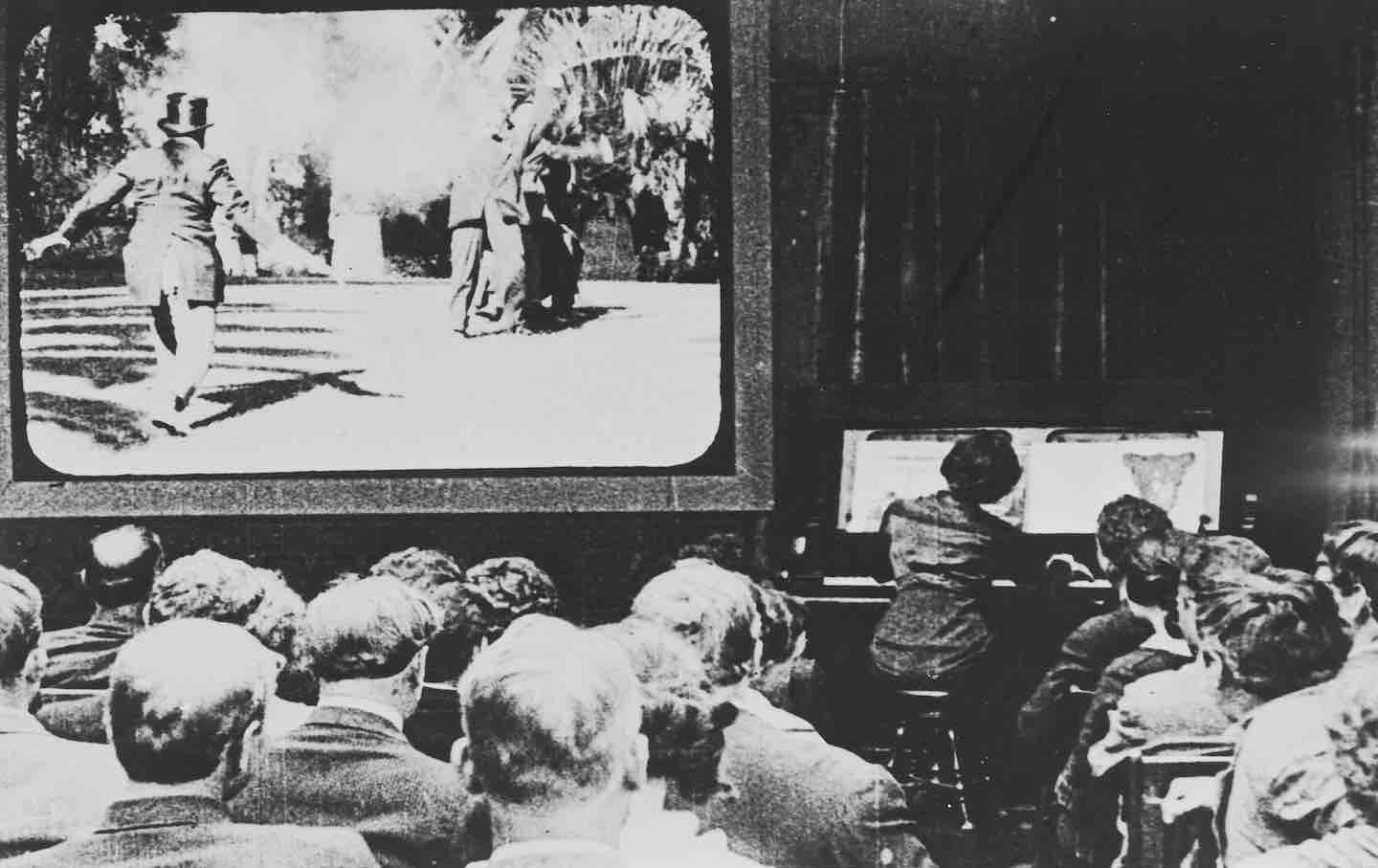
Early movie house interior with audience and piano player, 1913.
(Bettmann / Getty Images)In Ray Carney’s Cassavetes on Cassavetes, the filmmaker John Cassavetes is asked by a friend, Burt Lane, what makes him tick. The two are sitting in a restaurant, their table set with silverware, salt and pepper shakers, and condiments. Cassavetes grabs each object one by one, brings it close, and then drops it to the floor. Lane interprets the performance as an answer: “He was telling me that he felt a void inside himself that he couldn’t fill no matter how fiercely he grabbed for things.” Iconoclastic, collaborative, combative, Cassavetes made art to wage a war with that void. He knew it was futile. “The idea of making a film,” Cassavetes once said, “is to package a lifetime of emotion and ideas into a two-hour capsule form, two hours where some images flash across the screen and in that two hours the hope is that the audience will forget everything and that celluloid will change lives. Now that’s insane, that’s a preposterously presumptuous assumption, and yet that’s the hope.”
The narrator of Esther Kinsky’s latest novel, Seeing Further, believes that once upon a time, celluloid could change lives. Susceptible to Cassavetes’s insane hope, she won’t resign herself to fatalism. The novel’s narrator closely resembles Kinsky herself, a German author and translator fixated on peripatetic, ethnographic projects that delve into the lives of the people she encounters. Despite their differences in self-presentation, Kinsky and Cassavetes share a set of values regarding cinema. It was Cassavetes who proclaimed that “television sucks,” and Kinsky agrees but puts it more mildly: Television and the “permanent accessibility of private screens” diminished cinema’s cultural footprint and drew people to these lesser forms of viewing. The two also share a gripe: There’s a right way and a wrong way to make and consume art—what Kinsky calls “the how of seeing.” As both project and object, cinema is social. Cassavetes made his movies with the input and authorship of his actors; Kinsky’s notion of an ideal cinema is a communal viewing coauthored by the gazes of an audience. To lodge its complaints, Kinsky’s novel invokes the director, a champion of grievance, right from the epigraph: “There is something important in people, something that’s dying—the senses, a universal thing.” Kinsky reframes seeing as a deliberate and conscientious choice rather than the passive absorption of visual input. Favoring the how of seeing over the what also serves a story purpose: With a few exceptions, it’s difficult for books to dramatize what’s being watched on a screen. Seeing Further’s focus on the conditions of viewership drives home its point about a shifting cinema landscape, but it also allows the book to roam beyond the confines of the theater.
Books in review
Seeing Further
Buy this bookIn Seeing Further—translated by Caroline Schmidt—the nameless narrator travels to a small Hungarian town, where she buys, refurbishes, and reopens a defunct cinema; a few weeks later, the theater shuts down. Depicting one woman’s attempt to rekindle cinema in rural Hungary, the novel is about what can and can’t be revived, but the narrator’s personal project is to experience the death of cinema firsthand. The book smudges the boundaries between fiction and nonfiction with its essayistic aloofness and ethnographic bent. Black-and-white photographs of the landscape, the town, and the cinema’s interior grant the book the posture of a travelogue. The novel begins when the narrator visits the Alföld, a vast flatlands in the southeast of Hungary, with a vague notion of photographing the landscape. This is “a land of dearth, a region of voids”—a blankness she finds appealing: “What was this essential quality that refused to submit to a frame?” Here in Hungary, she thinks she has found a place that is unfixed from time, which makes it even harder to capture: “Aside from a desire to see this flat country,” she confesses, “I was drawn by a vague idea of boundlessness, the uniform light, and the suspension of temporality.” It’s a landscape that, while hostile to image-making, is the perfect setting for the narrator to stage her own confrontation with the void.
Exploring a town near the Alföld, the narrator discovers a shuttered local cinema (mozi) that had once been “a piece of life, a space of refuge and a horizon of hope” but now was “a place of obsolete passions.” A man stops to ask if she wants to buy it. “Yes, perhaps I want to buy the cinema,” she replies. She goes into the theater and sits in the auditorium, not sure what she hopes to find. Beneath the gesture of public revival is a more private and muddled motive. In town, she meets Joszi, a bicycle repairman whose talents extend to many other machines. Joszi happens to be the former projectionist, and he becomes the narrator’s closest ally as she embarks on the quest to reopen the cinema. She assembles a crew of helpers: Joszi works to get the projectors up and running, a woman named Rozalia cleans the theater, and the bricklayer Antal and a man named Pista spackle and paint the main wall until it’s smooth enough to be used as the screen. When the theater opens, the narrator is overwhelmed by seeing light and image moving through the darkness, and she feels, for a moment at least, that the project is a success. But the dark auditorium conceals the utter lack of a crowd. “Why doesn’t anyone come to the cinema?” the narrator asks Joszi after their unsuccessful summer, the theater’s first and only season. Joszi doesn’t know, but he hazards a guess: “Maybe people want to be alone with everything they miss.” Even the narrator, who wishes to reinstate “the compulsory communality of the cinematic experience,” seems to cherish her time alone in the large and empty theater. Despite, or perhaps because of, her aloof singularity, her relative blankness, Kinsky’s narrator is drawn to the stories of other people, and the book’s richest and most vivid section unfolds not on the big screen or in the theater but in her account of the life of a projectionist: Joszi’s mentor, Deutsch László.
László—or Laci—was the first proprietor and projectionist of the village mozi, and a significant portion of the novel explores his life story, which coincided with the rise of 20th-century film technologies and the violent twists and turns of European history. In 1927, Laci worked for a timber merchant, who took him along on a trip to Budapest. Laci was 17 years old at the time and spent his scant free hours at the cinema, where, after watching and rewatching the show, he went back to the booth and asked the projectionist for a tutorial. Equally in love with the visual product and its machinery, Laci lets the medium claim him as its priest. Kinsky presents his life as a hagiography: Laci becomes the book’s patron saint. As one of many lost projectionists, his story gestures at the scores of those untold. And the narrator is not the only pilgrim to the past: At Laci’s grave in the town cemetery, she finds a strip of celluloid wedged in a crack in the stone. Probably Joczi put it there to give the dexterous spirit of his mentor something to fiddle with—or to help his dead friend transfer to the film stock and live forever as a movie. “The celluloid never lets you go,” Joczi says, speaking the curse of devotion.
Seeing Further is an apt enough title, though it belies the book’s tactile obsessions. To collapse the distinction between touch and sight, Kinsky turns to John Berger: “It is seeing which establishes our place in the surrounding world.” Another Berger line feels equally pertinent: “To touch something is to situate oneself in relation to it.” The constant reference to hands and fingers becomes a sort of leitmotif in the novel: “the old-fashioned tear-off tickets made of a thin textured cardboard and the smooth ones printed from a computer”; “Laci carefully slid a piece of film through his fingertips, feeling the smoothness of the material, but also the sharp edges of the punched holes that the teeth of the projector would grab on to.” Kinsky’s attention to touch emphasizes that the visual medium requires manual skill. Józsi proudly notes the memories stored in his digits: “Every groove black from lubricating oil, his fingertips covered in calluses, but Józsi insisted that his first encounter with that smooth, soft and yet obstinately fragile celluloid material still dwelt inside his fingers, it had never let him go.” In one sense, the narrator is in awe of the mechanical talents that can produce something as untouchably magical as the moving image. But there’s another layer of admiration for the technical aspects of film: that the busy work of hands can produce something that stills and arrests the body—the paralyzing agent of cinema. Viewing’s privilege of stillness owes a debt to the work of many moving hands: actors, writers, musicians, camerapersons, engineers, editors, projectionists. Cinema as craft and creation convenes a crowd.
Despite the narrator’s efforts, however, a revived community of cinema is never realized. Sixteen years pass between the theater’s closing and the novel’s epilogue, in which she returns to the Alföld. The narrator has seen cinemas die all across Europe, and now she wishes to revisit her twice-dead theater. “I wanted to see the multi-seated temple of moving images in its abandoned state again,” she confesses, “to ask questions from the remove of years, either to myself or to the cinema auditorium, deserted as it was, and sound out the town’s slumped promises once again, to listen out for signs of life, for the silence.” The eulogy for the institution that once attracted and honed the attention of the people gives way to something more complicated. On the one hand, the narrator, like the Romantics, valorizes the ruins, seeing in the institution’s death another kind of art. But on the other, this leads to a sense of self-satisfaction: that she was one of the select few who could value this past. Her complaints about “the illusory convenience of continually available data” and “the feeble opinion that it’s enough to watch digitalized images flicker across any old screen” have a self-righteous, sullen tone.
Her return trip reraises the question: Why did she do it? Reopening the theater only underscored the larger economic, social, and technological forces preventing a true revitalization of the cinema and, more importantly, this overlooked Hungarian town. With little hope for success, and glancing acknowledgment of the conditions under which cinema faded from a position of cultural priority, the narrator’s experiment now looks like a self-serving stunt with more than a hint of class tourism. The project’s futility reveals an inherent masochism: to not only suffer the theater’s failure but also feel more painfully the distance of the past. After the summer’s lone success—a dozen people attend a screening of Somewhere in Europe, a 1948 Hungarian film about a gang of orphans in the aftermath of World War II—the narrator is besieged by doubts as she bikes home. “I didn’t see a single shooting star to wish upon,” she thinks. “And what would I have wished for? For the mozi dream to hold out a while? That an audience would suddenly materialize, that the cinema as a place would be rediscovered, that fate would step in and catapult me back to a city with many cinemas?” Shame creeps into the self-questioning as the implausible dream resolves into a sad reality. She winds up wishing for nothing.
But if futility wasn’t exactly a motive, it also wasn’t a deterrent. Opening the cinema didn’t restore a public good, but it did serve a private agenda. Kinsky’s narrator is eager to lay claim to the legacy of the lost projectionists, those heroes of cinema who once devoted their lives to the how of seeing. “Do you even have one of your own laid here to rest?” a woman asks the narrator when she visits the cemetery. The answer is no, but the narrator would like to claim Laci as her forebear—to keep a tradition of value alive, to prove that her moviegoing heart is in the right place, and to feel as marginal as the cinema she loves. “After the cinema summer in the Hungarian lowlands, for sixteen years I watched cinemas die,” the narrator states in the epilogue. Now she can say she did her part to stem the tide. The cynic in me is tempted to read it as a performance of aesthetic principle, a private confirmation of values. But the project touches others, if only a handful, who feel the jolt of wonder in the theater. Joszi, for one, is delighted and enlivened by the work, though remembering the life that once was is bittersweet. The theater is an “emblem for the great truth of cinema,” and while it represents an age of film unlikely to return, Kinsky’s ultimate point is that even when hope isn’t practical, it’s the right thing to do.
Become a Sustaining Donor This September
Between the reemergence of right-wing red-baiting and Donald Trump’s use of the chilling National Security Presidential Memorandum–7 to criminalize left political organizing, we’re seeing McCarthyism reborn before our eyes.
This assault on democracy cannot be ignored or wished away. Resisting it requires bravery in the face of threats and repression, a steadfast commitment to the truth, and the unwavering belief that we can—and will—overcome this darkness.
We must have an independent media that sets the record straight, unearths corruption and abuses of power, and advances a politics of justice and dignity for all if we’re to win this fight.
That’s why I’m writing to you today. This September, The Nation needs to add 100 monthly donors to sustain our progressive journalism. Your contribution makes the next investigative report, the next truth-speaking column, and the next pathbreaking essay all possible.
I hope you’ll support our work with a recurring donation today. If you donate $10 or more a month, we’ll send you a brand new “Hands Off the Free Press!” sticker to recognise your commitment to our cause. Please, donate today.
Onward,
Katrina vanden Heuvel
Editor and Publisher, The Nation