Trump’s TV-Warped Brain Is Putting the World in Danger
The president is experiencing the Iran War almost entirely through misleading video clips—and that’s very bad news for all of us.
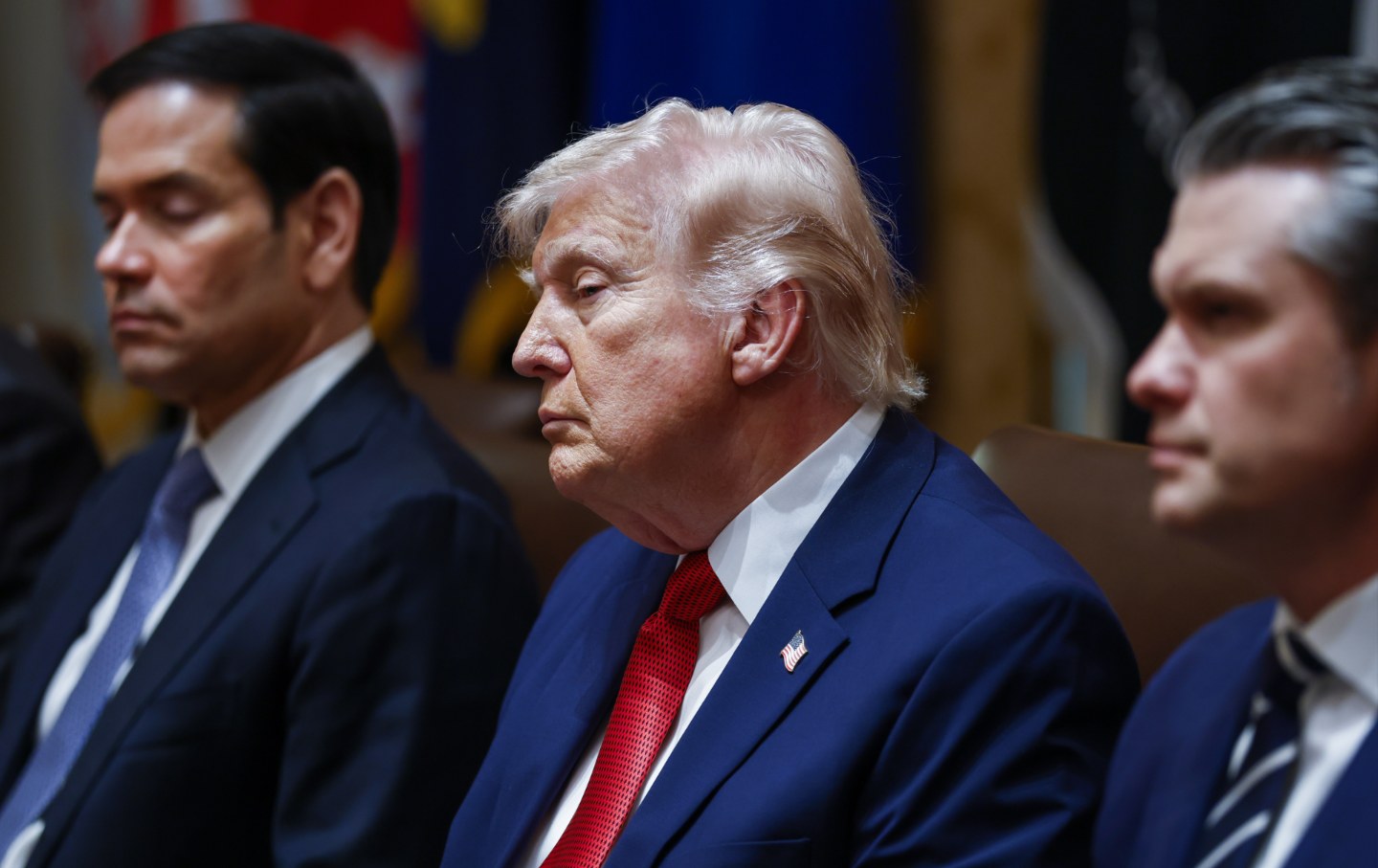
Donald Trump during a cabinet meeting at the White House on Thursday, March 26, 2026.
(Will Oliver / EPA / Bloomberg via Getty Images)Everything about America’s reckless and baseless attack on Iran flies in the face of objective reality, from the failed round-robin competition within the Trump White House to identify a coherent casus belli to President Donald Trump’s fabricated anecdote about a conveniently unnamed former president’s professing envy over the war to his invention of nonexistent ceasefire negotiations to climb down from the next war-crime escalation of the conflict he was poised to unleash.
Our president is, of course, a bottomless fount of this sort of auto-generated delusion, going back to the days when he posed as his own PR flack to manipulate New York tabloid coverage of his flailing real estate empire. But harnessing Trump’s defective grasp of the real to the towering Moloch of the American war machine represents an unprecedented new level of imperial nihilism—and the chief motive force behind it is the same thing that transformed this inert Caligulan stooge into our commander in chief in the first place: television.
Amid the senseless mounting carnage of the Iran war, NBC News’s report on how Trump’s daily briefings on the conflict consist not of substantive information but of bite-sized video montages came off as a deflating afterthought. Nor was it shocking to learn that these clip reels appear to be little more than glorified cheerleading exercises, documenting the scale of destruction wrought by the American air war while pointedly omitting the deflating news of Iranian counterattacks and diplomatic resistance to the shambolic succession of jury-rigged American “off-ramps.” One administration official characterized the daily clip roundup as a nonstop loop of footage devoted to “blowing stuff up.” Condensing each day’s new digest of carnage from on high into a tight two-minute compass calls to mind the “two-minute hates” immortalized in George Orwell’s 1984—only where those rancorous hallucinations of current events were crafted for mass consumption, these videos are curated for the Maximum Leader’s delectation.
This poses a very fraught problem in terms of what cultural studies mavens used to call “audience reception theory”—the notion that consumers of media aren’t passive automatons but active interpreters endowing texts with new layers of meaning. In Trump’s case, the reception field is very much a closed loop—so much so that the president is reportedly upset and disoriented by actual news reports on the conflict that contradict the warm bath of bombing montages that start his day. White House sources told NBC that
the videos are…driving Trump’s increasing frustration with news coverage of the war. Trump has pointed to the success depicted in the daily videos to privately question why his administration can’t better influence the public narrative, asking aides why the news media doesn’t emphasize what he’s seeing, one of the current U.S. officials and [a] former U.S. official said.
In one truly scary episode, Trump was reportedly bewildered to see news reports of a successful Iranian strike on five Air Force planes as they were refueling at Prince Sultan Air Base in Saudi Arabia; his daily video montage had contained nothing about the attack. Yet while Trump “reacted angrily behind the scenes” to this gap in his spoon-fed account of the war’s progress, he nonetheless continued hewing to his election-tested message of blaming the press for allegedly fabricating the news he dislikes; “publicly he posted on Truth Social calling coverage of the strike misleading and accusing media organizations of wanting the U.S. ‘to lose the War,’” NBC reports.
In other words, even when confronted with evidence that his personal war briefings are bowdlerized agitprop, Trump’s solution is not to change his briefings but to change the reporting—to the point of seconding his lickspittle FCC commissioner Brandan Carr’s threat to withdraw broadcasting licenses from networks that don’t produce news that meets the White House’s jingoistic standards. In this strongman version of audience reception theory, Trump, as the most powerful TV viewer alive, naturally should dictate the content and coverage priorities for the entire mediasphere.
There are, of course, endless problems arising from this model of news as agitprop for an audience of one. For starters, it’s vital for any commander in chief to encounter and absorb bad news about a military conflict, since under the deranged and unconstitutional conditions of the imperial presidency, the occupant of the White House is endowed with maximal war-making power. If he continues to operate in a blissful information bubble assuring him all is well and that his military prowess is unparalleled, conflicts quickly become quagmires, and quagmires turn into world-historical imperial follies. That’s the long-memory-holed reason that the modern conservative movement’s ideological assault on the media was hatched from the grievances of the Nixon White House, as it presided over the successive disastrous interventions in Vietnam, Laos, and Cambodia; that administration, too, demanded a newly prostrate and compliant media to cheerlead on its blind imperial madness.
At a deeper level, though, Trump’s Baudrillardian experience of war as TV does something arguably worse than transform him into a cathode-addled Caesar figure; it numbs the planet’s most lethal perpetrator of mass violence from comprehending the effects of his actions. We saw this syndrome in horrifying real time during Trump’s deeply unsettling press conference after the US illegally kidnapped Venezuelan President Nicolas Maduro and his wife. Trump, who at times appeared on the verge of falling asleep, offered yet another jury-rigged rationale for the violent violation of another nation’s sovereignty, citing the country’s nationalization of its oil industry in the 1970s as evidence that “they stole our oil. We can’t let them get away with that”—even though the oil in question was never really ours, and despite the US oil industry’s repeated insistence that it would prefer to have nothing to do with the capital-intensive effort to upgrade Venezuela’s decaying oil infrastructure. Trump blearily went on to threaten military takeovers of Cuba and Mexico—at that point Iran was out of the administration’s kaleidoscopic axis of evil, since Trump was no doubt still relishing the sugar high of his bombing attack on the Islamic Republic last summer. For no intelligible reason, he riffed on the National Guard siege of Washington DC and ICE’s reign of terror in Los Angeles; these lawless exercises of federal force were evidently all of a piece in the president’s war-besotted lizard brain. It was like watching Chauncy Gardner, the TV-addicted simpleton president from Being There, morph into Coriolanus before our eyes.
That was evidently how Trump experienced it as well. In an interview with Fox & Friends ahead of the press conference, he enthused about his own audience reception of the Venezuela raid: “I watched it literally like I was watching a TV show.”
Become a Sustaining Donor This September
Between the reemergence of right-wing red-baiting and Donald Trump’s use of the chilling National Security Presidential Memorandum–7 to criminalize left political organizing, we’re seeing McCarthyism reborn before our eyes.
This assault on democracy cannot be ignored or wished away. Resisting it requires bravery in the face of threats and repression, a steadfast commitment to the truth, and the unwavering belief that we can—and will—overcome this darkness.
We must have an independent media that sets the record straight, unearths corruption and abuses of power, and advances a politics of justice and dignity for all if we’re to win this fight.
That’s why I’m writing to you today. This September, The Nation needs to add 100 monthly donors to sustain our progressive journalism. Your contribution makes the next investigative report, the next truth-speaking column, and the next pathbreaking essay all possible.
I hope you’ll support our work with a recurring donation today. If you donate $10 or more a month, we’ll send you a brand new “Hands Off the Free Press!” sticker to recognise your commitment to our cause. Please, donate today.
Onward,
Katrina vanden Heuvel
Editor and Publisher, The Nation