
The Enigma of Gertrude Stein
Why do we misunderstand one of modernism’s great writers?
No one understands Gertrude Stein. For this, we should all give thanks. It is almost a cliché to emphasize her work’s difficulty, but her writing remains imposing, both due to its sheer volume—her unpublished writings were originally collected in eight volumes, to say nothing of the numerous books published during her life—and its style.
Books in review
Gertrude Stein: An Afterlife
Buy this bookThe style, of course, is what made her both famed and ridiculed, striking out from conventional narrative and often even the conventional meanings of words. If you ever find yourself absorbed in Stein, there is almost a natural desire to imitate her rhythms. Nobody ever entirely nails her peculiarities, though: the flat, dry vocabulary, the off-kilter blend of abstraction and table talk, and perhaps most of all the repetition—sentences that extend themselves and double back and fill up space with their insistence. As Francesca Wade quotes Stein in her new biography, Gertrude Stein: An Afterlife, “Repeating is the whole of living, and by repeating comes understanding, and understanding is to some the most important part of living.” Maybe the reverse maxim here is that we can never repeat enough, so we can never really understand.
Stein’s work staked out the boundaries of what was possible for writers to do with language in the 20th century; our idea of the literary avant-garde is unthinkable without her. Understandably, Stein also wanted credit for this innovation: to be seen as a central figure, as she frequently claimed she was, and not simply someone expanding the margins. Readers, however, have been more ambivalent, and to this day Stein is often considered a catalyst or foil for other, more celebrated male moderns (Picasso, Hemingway), an interesting experiment that perhaps need not be repeated.
T.S. Eliot warned that if later writers did copy her, a “new barbarian age” of literature would follow. A handful of Stein’s books are still widely read today (The Autobiography of Alice B. Toklas, Tender Buttons, Three Lives), but the majority are not. Much of Stein remains undiscovered, at least for the common reader, even as she figures as a known quantity in the imagination: “A rose is a rose is a rose,” “There is no there there,” and so on. Despite her reputation for inscrutability, few modern writers had such a knack for catchphrases that could be plucked from their work.
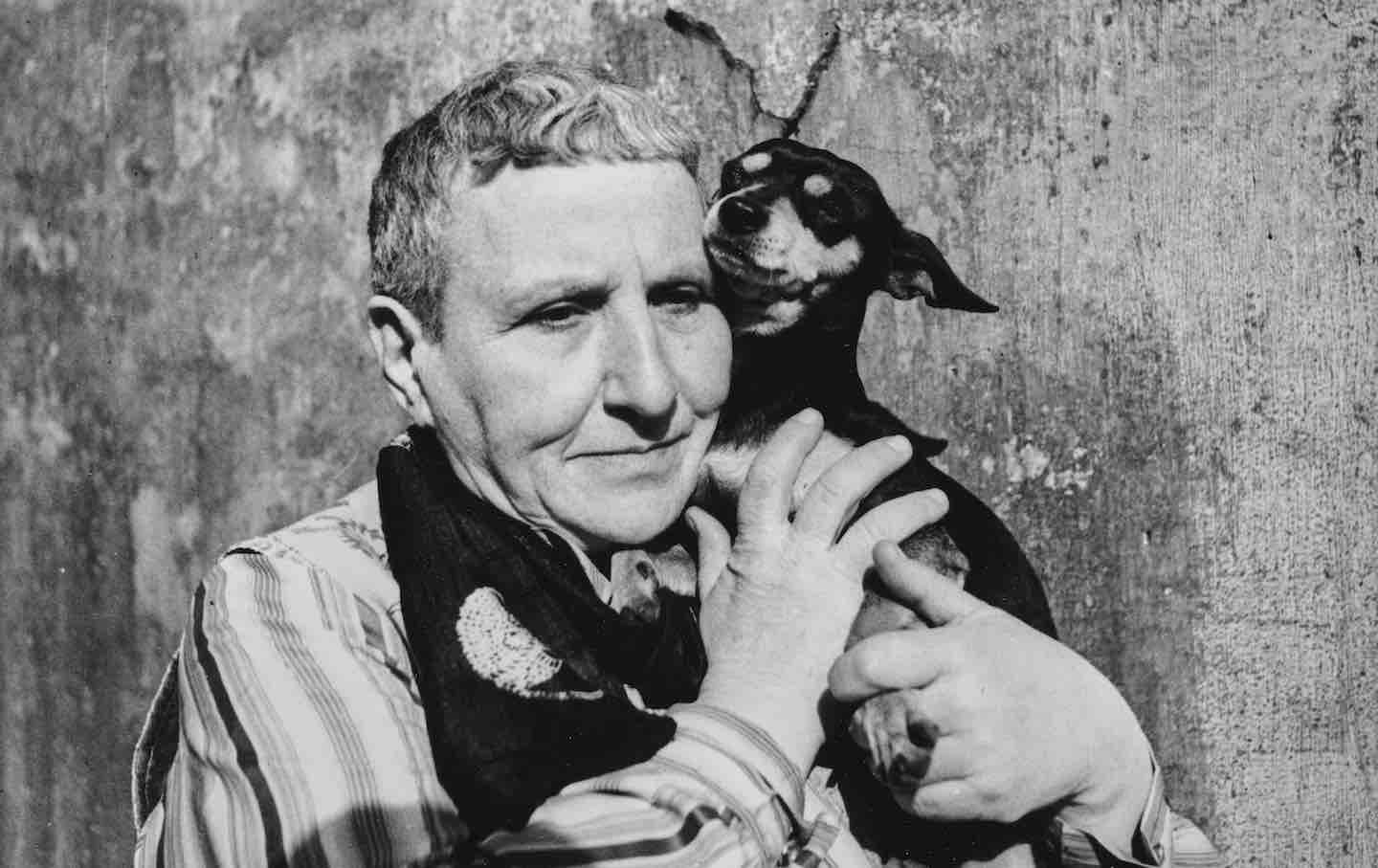
Curiosity and mockery garnered Stein attention and eventually celebrity, which she harnessed, transforming herself into a public personality. She presented the image of the brash American abroad, the witty ringleader of the mythological Parisian salon with her partner, Alice B. Toklas, always hiding just behind her in the shadows. She drove fast, wore monkish robes, and walked her poodle Basket along the Seine. Biographies are made for lives like hers, perhaps because Stein satisfies two desires inherent in the form: gossip and controversy. She agitates the old, inevitable question of how the life interlocks with the writing, and perhaps the dangerous biographical question of the life overtaking the work. (After all, shouldn’t we love the work first to want to know the life?) Her experiences had everything to do with it: “Facts of life make literature,” she wrote, while also denying that the texts meant anything beyond the words on the page. A real understanding of the two poles remains blocked, elusive, and so all the more intriguing. But why try to hold together both knowledge—one service a good biography can offer us—and the mystery of incomprehension? As Stein wrote, “Nobody knows what you mean no matter what you mean, nor how clearly you mean what you mean.” Perhaps it is a testament to her greatness that, within her fame, she can be as little known as she is.
Wade’s biography approaches this gap between fact and reputation with a formal decision, dividing her account of Stein’s life into two halves—“Life” and “Afterlife.” Wade’s own sense of the two parts is instructive:
The first is the narrative she crafted carefully in her autobiographies, lectures and interviews, where her long struggle to find readers leads triumphantly to success.… The second, filling in some of the first version’s deliberate gaps, is a story that could only be told posthumously, taking account of the archive’s secrets: the unpublished texts, the private jottings, the people—mostly women—Stein purported to have forgotten. The two stories mirror and complement one another: one cannot be told without the other.
From the outset, this view casts some doubt on the first account; if it needs to be adjusted later, then we know from the start that we shouldn’t trust it completely. Still, it’s a charming picture. The book’s opening half is a tight, controlled narrative of Stein’s life. It covers all the major moments, beginning with her California childhood and the creation of the wealth that would largely sustain her literary career (Stein’s brother helped create San Francisco’s cable-car system), then on to Radcliffe and the important work she would do in William James’s psychology lab, where Wade convincingly draws connections between the experiments Stein ran and her later interest in spontaneous writing. After a failed bout with medical school, where her supervisors discouraged women students, Stein exited for Paris and the bohemian milieu, surging upward and scarcely looking back.
These early years are of particular interest, as it becomes clear that Stein’s narrative of her own life became more controlled as she developed as a writer—the autobiographical is always near to hand in Stein, even at her most abstract. An account of the all-important meeting and merger with Toklas remains sketchy (almost certainly by Stein’s choice), but the reader is introduced to the intermediary figure of Annette Rosenshine, a cousin of Toklas’s “whom Stein saw daily for psychological interrogation” in Paris. Stein seems to have mildly tortured Rosenshine, perhaps as the friend of a potential love interest, then dropped her completely as the relationship with Toklas blossomed. Neither biographer nor reader ever gets to quite touch the quick of this famous partnership, but it lends a sense of how important omission is to the construction of the persona.
Once Stein is settled at 27 Rue de Fleurus, her famous residence, and determined to produce great works of literature, the narrative flows from one book to the next, all shepherded by Toklas’s devoted typing and editing. The hunt for fame was dogged, and then suddenly it came. These are the iconic scenes of Stein: the witty talk and status-jockeying of the salon; the volunteer ambulance driving in the First World War; the opera Four Saints in Three Acts; and her triumphant American tour. The amusing quips in interviews and on the lecture circuit, the idyllic life in the South of France, the Second World War and the German occupation (complete with a flight from Paris with a Cézanne and a Picasso stashed in her car), and the illness that claimed her soon after the armistice—it’s a life so full that it’s almost surprising there were things to hide.
With what level of skepticism, then, should we take this story as re-presented by Wade? It’s hard to say that it is exactly Stein’s version of things—after all, she had already written several accounts, most famously The Autobiography of Alice B. Toklas (1932), the commercial breakthrough that gave her the taste of success she craved but also triggered further doubts about her ability. Written almost as a joke at the reader’s expense, it quickly came to overshadow all her previous labors, to Stein’s chagrin. She freely admitted that she hungered for adulation, and Wade’s biography suggests that the PR routine, while thoroughly enjoyed by Stein, was also secondary to the pursuit of serious writing and the effort to get it into the hands of readers. Stein took considerable trouble in her life to get her work published, whether it was cultivating important friends to advocate for her, or else working with Toklas to self-publish the less accessible work in her Plain Editions imprint. The first half of Wade’s book spends time on these doubts and frustrations, along with the other messy tangles of life that Stein preferred to conceal.
Two controversies in particular have, over time, been integrated into Stein’s legend. The first is her early relationship with the bluestocking May Bookstaver, a woman Stein met and befriended while she was a medical student at Johns Hopkins. Entering a coterie of modern lesbian women for the first time, Stein fell hard for Bookstaver, and wrote a manuscript that explored her yearning in a love triangle in which she was ultimately the loser. The manuscript remained in the drawer, as with many of Stein’s projects; when the work was dug up and given to Toklas, it triggered jealousy and conflict in their seemingly airtight relationship—after all, it disturbed the public image of the pair as perfectly bound together, inseparable. Wade’s biography, in both halves, traces the complicated path to publication of a text ahead of its time.
Popular
“swipe left below to view more authors”Swipe →The second controversy, perhaps more unsettling to the contemporary reader, is Stein’s friendship with the French Americanist scholar Bernard Fäy, who went on to become a rather sinister operative of the Vichy regime—his particular interest seems to have been executing Freemasons—and who protected Stein in southern France during the war and insulated her from the horrors of the Holocaust. Accusations of collaboration have become a tarnished spot on Stein’s legacy, and it is still unclear how much she knew and how naïve she let herself be.
The second half of Wade’s book takes an epistemological turn, working to show how the myth of Stein was born in all of its complications. As Parul Seghal put it recently in an essay on contemporary biographers, “The biography of today recoils from stuffing its subject into a straitjacket of interpretation, with all contradictions smoothly reconciled into a unified self. Instead we find an emphasis on the fragility and provisionality of identity, on performance, on motive being mysterious and many-tentacled.” While this is hardly a new idea—digging in the archives among the scheming biographers helped make the career of Janet Malcolm, for one (with Gertrude Stein as one of her subjects, no less)—it speaks to a gradual change in the writing of biography, both formally and in sensibility. Biographies have become more self-consciously literary (with some of them self-indulgently leaning toward memoir, presuming the author is on an equal footing with their subject) and more wary of promising a complete picture of a life. Wade’s book is somewhere between public-facing and academic, seeking to bolster an authoritative account of a life with deeper questions of process. How, exactly, did we learn about Bookstaver or Fäy? Someone had to do the legwork of finding out. Wade likens it to a kind of detective work—Stein’s favorite kind of fiction to read.
Much of the “Afterlife” section concerns the battle to secure the writer’s reputation after her death in 1946 from stomach cancer. Stein’s friends and disciples edge toward center stage, notably the writer and impresario Carl Van Vechten. A somewhat controversial figure himself (he falls somewhere between booster and tokenizer of the Harlem Renaissance, another of his causes), Van Vechten struggled with the burden of acting as literary executor, an unglamorous task for someone who would rather have lingered in the spotlight. Next came the scholars, who quickly began entering Stein’s archives at Yale to chase the enigma. The most notable of these is Leon Katz, who was memorably depicted by Malcolm in an essay for The New Yorker that was collected into Two Lives, her own attempt at dissecting the Stein myth. Katz is the spitting image of the diligent yet diffident scholar, brilliant, eccentric, and ultimately avoidant of the spotlight; given unprecedented access, he delayed for decades in publishing his work, infuriating his colleagues and becoming a minor enigma himself.
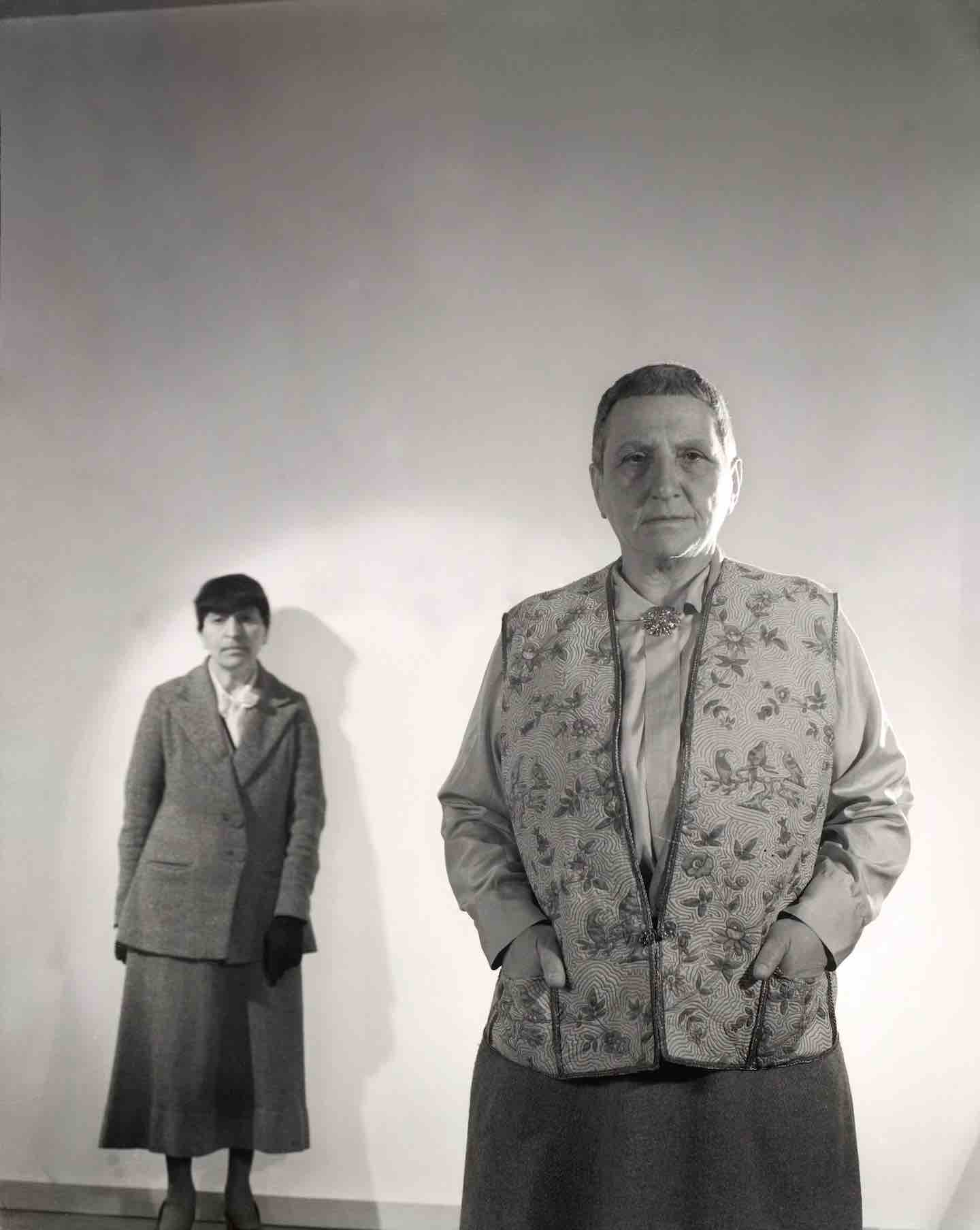
It was Katz who discovered the apparently forgotten notebooks that Stein kept while she was writing her biggest and most forbidding novel, The Making of Americans (1925, though probably finished in 1911). Widely considered to be a landmark in Stein’s work—she considered it her masterpiece—not just because of its length (my edition is 925 pages) and supposed impenetrability, The Making of Americans was a milestone in Stein’s journey of ambition. It is both a rearranged account of Stein’s family history and a defiant challenge to the tradition of the 19th-century novel. Beginning with two families and spinning itself out into an attempted history of everyone who ever lived, The Making is like no novel that has existed before or since. In the notebooks, Katz found complex diagrams describing and linking together the many people Stein knew and attempting to classify them into different types of fundamental character—perhaps the residue of her medical training. Influenced by Otto Weininger’s Sex and Character, a popular psychological text of the time that allowed Stein to view herself as a “masculine” genius, the notebooks are a window into the creation of a work that certainly was not written “automatically” (a process of spontaneity often associated with her), but with much effort and deliberation. They also provided ample biographical grist for a scholar to dig into, as Stein was essentially giving up the clues as to which character was based on whom.
These insights were monumental for the cloistered field of Stein studies, but for laymen, Katz’s research also shows the limits of biographical understanding. What does it tell us that a character in The Making was based on a cousin of Stein’s? We don’t know that cousin, and we’re not really interested in her. It’s enough to know that Stein was trying to draw precise insights from her acquaintances, an effort closer to what we might call realism than we might otherwise acknowledge. Wade’s investigation helps us tease out the specifics here, and to try to think about when and why background makes the text richer. Does it help to know that the references in Stein’s erotic writing to “having a cow” have to do with the regularity of Toklas’s bowel movements? Honestly, I think it does. But it is to be expected—and perhaps it is even a source of pleasure—that source and signification can never line back up completely.
The “Afterlife” does have its hero: the indomitable Alice B. Toklas. She is a somewhat recessive figure in the first part of Wade’s biography, partly by designation in the myth, but she emerges after Stein’s death as a living testament to her, fiercely guarding her turf. Toklas’s story is a bit disheartening, as it is one of gradual diminishment: As her house grows colder (she is unable to heat the rooms of the apartment on the meager allowance provided in Stein’s will), Toklas grows forgetful, and the Cubist paintings that provided the background to this parallel life are taken away for safekeeping under a court order by Stein’s relatives. Katz managed to ingratiate himself with Toklas and recorded their conversations. (His notebooks of these conversations seem to have been a spur for Wade’s book.) Toklas’s account of their life together may be no more reliable than any other, but it also humanizes Stein in a way that no other perspective can. In a letter after Stein’s death, she writes, “I can’t tell the casual stranger that I loved Baby and that is all I seem to know now—that I love her and that she is gone.” Toklas’s love for her partner is the simplest vision of Stein we can be given. But it is no less difficult to understand this—another mystery that can never be unlocked.
Wade writes in the introduction that Stein’s “work is always about the conditions of its own creation: the process, to her, was more important than the finished text.” A distinct ambiguity hovers in this observation. There is, of course, something contemporary about a focus on process—or at least we associate it with the avant-garde of the later 20th century, as Wade projects Stein forward into John Cage and Fluxus. But to go back to the first part of that sentence: What, really, are the conditions of that creation? The answer seems to split immediately into two possibilities. On the one hand, maybe the conditions are simply the conditions of an open imagination. We see Stein at her desk all night, hour after hour, letting the words flow out of her. This seems to be an idea that Stein endorsed at times—though there is a case to be made that her explanations of her process came retroactively—and she has often been associated with automatic writing, though there is considerable evidence that she revised at least some of her work extensively. (“Everything I write means exactly what it says,” Stein told us helpfully.) But the mystery of creation adds something seductive to the writer’s power. As much as scholars would like to explicate the process, it is very often in the writer’s interest not to reveal it.
But anyone who has read enough of the more “difficult” Stein notices her life bleeding in all the time: a sudden appearance of Basket, or what clearly comes across as salon talk snapped up for its idiosyncratic cadences. Wade later notes the research of the scholar Ulla Dydo into Stein’s daybooks; all of her peculiar language sprang from direct, even quite literal experience, even as she worked later to efface the connection. This in itself exposes the shallowness of certain ideas about where “value” comes from in literature. Recording daily life is a kind of meditation, both automatic and deliberate: It passes through the mind and comes out as something willed, but not quite expected. As William Gass puts it in his brief foreword to The Making of Americans, which attempts to close-read just one sentence from the book, “style is consciousness.”
There has always been a fundamental hostility in some corners to Stein’s writing. Why work to understand what it means? What will we do with ourselves if we find, in the end, that it means nothing at all? For many, the idea that difficult works of literature are a kind of code—full of references, secret messages, and schemas that we struggle to understand—is the pleasure and the purpose. But Stein underlines literature’s fundamental instability, its dance with the great zero of nonsense, the threat of the charlatan. Access to her biography might help decode some of the hidden meaning, but that lens, we know, has its limits. Every reader comes to a work with their own knowledge and assumptions, and they enjoy it or they do not. That framework can change with knowledge, but it never quite gets to the bottom of a writer’s idiosyncrasies. If an interesting life were all it took, the literary canon would look quite different than it does.
One thing Wade’s biography emphasized for me was Stein’s vocation as a fundamentally erotic writer. Some of her overtly sexual work, like the long poem “Lifting Belly,” are described and given their due. The biography also outlines the complex history of the early novella Q.E.D.—the work about Bookstaver that so angered Toklas—parts of which were later revised into Three Lives, particularly for “Melanctha.” It also includes the story of the revision of Stanzas in Meditation, Stein’s book-length poem that is one of her most esoteric and brilliant works. Bookstaver still lingered over the imaginations of Stein and Toklas long after she had left the scene, to the extent that (supposedly) Toklas forced Stein to cross out every instance of the word may in the text and replace it with can. This is a crucial speculation as to what extent Toklas was in some sense a co-creator with Stein. But it also goes beyond lived experience—in Stein’s work, there is a fundamental promiscuity of language, a shifting and slippery quality to her sentences and paragraphs, and a charge in seeing how the new parts might fit together. Sex may have aspects that are involuntary, but if it is good, it is never automatic. Stein’s gift is the power of deep affinity, a writer’s ability to believe that words can be newly arranged, new sentences can be conjured, and that there is a wonder in discovering what meaning might be disclosed.
Historically speaking, fiction did not follow the path Stein indicated. The same commercial imperatives that she struggled with are just as present today, if not intensified. Look to poetry, instead, for Stein’s influence—her discombobulation of the sentence has permanently entered its DNA (maybe this is part of why so much contemporary poetry finds itself little read, even as it longs for an audience). At the same time, isn’t the Stein model more relevant than ever, when personality needs to be the publicity vanguard that creates acceptance for work that ever fewer people are willing to read?
Today, the way readers tend to know about Gertrude Stein is a mirror for the way they increasingly know literature. Our knowledge of what exists increases: We go down Wikipedia rabbit holes, save books in our wish lists, listen to podcasts about books we don’t plan to read anytime soon. But encounters with literature at the point of contact can feel scarce. I have not heard anyone wonder about what a particular passage in a new book really means in quite some time. Either we know already, or we quickly concede we’ll never really know, and we try to appreciate it and turn the page. Stein enlivens us to the mystery: that everything is strange and nothing is strange too, and that if we sit down and let the words overtake us, we might wonder for a long time.
Your support makes stories like this possible
From illegal war on Iran to an inhumane fuel blockade of Cuba, from AI weapons to crypto corruption, this is a time of staggering chaos, cruelty, and violence.
Unlike other publications that parrot the views of authoritarians, billionaires, and corporations, The Nation publishes stories that hold the powerful to account and center the communities too often denied a voice in the national media—stories like the one you’ve just read.
Each day, our journalism cuts through lies and distortions, contextualizes the developments reshaping politics around the globe, and advances progressive ideas that oxygenate our movements and instigate change in the halls of power.
This independent journalism is only possible with the support of our readers. If you want to see more urgent coverage like this, please donate to The Nation today.
More from The Nation
The Rise of the Sensitivity Reader The Rise of the Sensitivity Reader
Adam Szetela’s That Book Is Dangerous! examines the emergence of a new job in publishing—secondary readers who comb through books for possible offenses.
Pierre Guyotat’s Moral Order Pierre Guyotat’s Moral Order
The French writer’s fiction engages in a radical egalitarian project aimed at negating the right’s nihilism.
Searching for Solidarity at the Train Station Searching for Solidarity at the Train Station
Mattia Filice’s Driver, a poetic novel about train conductors in France, offers an empathetic vision of working for the public.

Are Economists Going the Way of the Dinosaur? Are Economists Going the Way of the Dinosaur?
In Eswar S. Prasad’s The Doom Loop, he attempts to defend a profession that failed to foresee the crisis of the post-liberal world.
Siegfried Kracauer’s Quixotic Anti-War Novel Siegfried Kracauer’s Quixotic Anti-War Novel
In 1928’ s Ginster, the German writer broke the mold of the World War I novel by refusing politics for aesthetics.

Is Victor Wembanyama the Most Interesting Person in Sports? Is Victor Wembanyama the Most Interesting Person in Sports?
He’s a contender for the spot not so much for who he is now but because of the person he is clearly becoming.

