
How the SAVE Act Seeks to Undermine the Right to Vote
After you strip away the lies about rampant voter fraud, the GOP bill is a frontal assault on hard-won protections of the franchise.
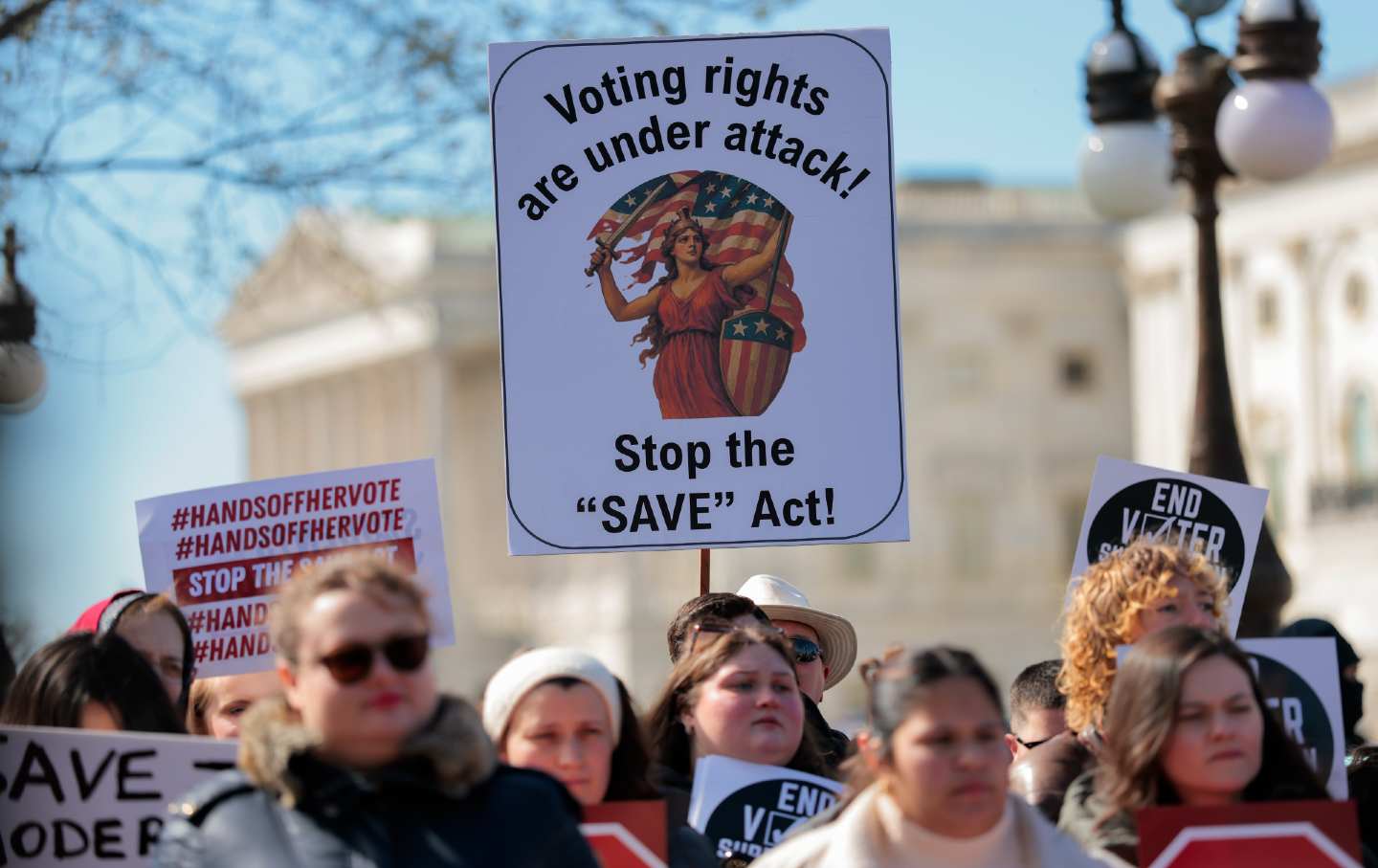
Demonstrators at a rally against the SAVE America Act outside the US Capitol.
(Heather Diehl / Getty Images)Republican supporters of the SAVE America Act, which forbids election officials from accepting and processing a federal voter application unless the applicant presents “documentary proof” of United States citizenship, describe the law as a “commonsense” measure to prevent voter fraud. Yet in blatant defiance of common sense, Republican lawmakers are seeking to commit a fraud: a brazen seizure of ballot access based on the lie that American elections are under siege by hordes of noncitizens voting. The GOP is colluding with President Donald Trump—who has threatened to veto all other pending federal legislation until the SAVE Act’s passage is secured—to take over federal elections via xenophobic campfire tales of rampant illegal voting. The resulting crackdown would be a disastrous assault on the core principle of American democracy: the constitutional right to vote.
Republicans argue that none of the bill’s many restrictions on ballot access are a big deal. Florida GOP Representative Kathryn Cammack summed up the perverse logic behind this new war on the franchise by claiming in a speech on the House floor that Americans routinely provide government-issued identification to access certain amenities of American life legally; therefore, mandating that Americans prove their citizenship before voting does not breach an already established norm. “You have to show an ID to board a plane, to buy alcohol, or to cash a check,” Cammack said during an April 2025 debate on the bill. “Why should people not have to verify their citizenship to register to vote?”
The obvious answer here is that voting is not a business transaction. We may bicker as consumers over TSA security measures or balk at Sunday blue laws in dry municipalities, but boarding an airplane or purchasing alcohol is not a constitutionally guaranteed right. The right to vote is—one that’s fortified by a series of federal laws and four constitutional amendments.
Still, the Constitution prohibits only specific forms of disenfranchisement rather than universally affirming the right to vote, leaving room for Republicans to impose procedural restrictions on voting that do not explicitly violate those prohibitions; this was the hallmark of Jim Crow bans on voting enacted via literacy tests and poll taxes. The SAVE Act operates within this constitutional gap by conditioning access to voting on documentary proof of citizenship before someone registers to vote. Each additional requirement—purchasing documents, following stringent verification steps, and surmounting exhaustive administrative hurdles—further widens the procedural distance between eligible voters and their ballots.
It’s also clear that the Republican Party doesn’t treat all regulated consumer pursuits equally—consider, for example, how fiercely it resists any infringement on the constitutionally protected right to bear arms. Several Republicans oppose HR 8, the Bipartisan Background Checks Act, federal legislation that prohibits firearm transfers between private parties unless the weapon is initially acquired by a licensed gun dealer, manufacturer, or importer who then conducts a background check. Cammack called the bill an attempt to “create a national firearm registry, allowing the government to target gun owners.” Just a month prior to her rhetorical bid to normalize the SAVE Act’s demands that voters meet onerous proof of citizenship requirements, she cosponsored HR 2184, a bill aimed at protecting gun owners who are mistakenly denied a firearm. The bill stipulates that federal officials, not would-be purchasers, prove grounds for disqualifying the citizen from owning a firearm. As she argued in a context strikingly adjacent to the Constitution’s protections of the franchise, the federal government “should have the burden of showing a valid reason for the denial of the constitutional right to bear arms,” which, as she ardently insisted, “shall not be infringed.”
In other words, Republicans’ particular demand that Americans treat a constitutional right as a conditional right that requires credentials before exercise, rather than as a presumptive right demanding that the federal government produce a cogent argument for its surrender, seems to apply only to suffrage. This blatant contradiction tells you all you need to know: The Republican Party is not interested in the sanctity of elections or protecting American citizens. It is devoted to electoral obstruction, as conservatives seek to fulfill President Trump’s directive to “nationalize” elections. Here’s the consumer analogy we should be stressing: If the SAVE Act becomes law, it will be easier to buy a firearm than to register to vote.
If the SAVE Act wins passage in the Senate and President Trump signs it into law, it will amend the 1993 National Voter Registration Act (NVRA), a federal law that requires states to establish procedures permitting individuals to register to vote at the same time they apply for government-related services such as the granting of a drivers’ license, or to register by mail. Also known as the “Motor Voter” bill, the NVRA does not require documentary proof of citizenship; instead, it stipulates that a state’s driver’s license application can serve as a voter registration application for federal elections. The act also created a National Voter Registration form that requires applicants to attest, under penalty of perjury, that they are US citizens. It explicitly warns that providing false information can result in fines or imprisonment, and that noncitizens seeking to register may be deported or denied entry into the United States.
The oath in the NVRA harks back to the Reconstruction Act of 1867, which set the terms for Confederate states’ readmission to the Union. Each state was required to grant suffrage to Black citizens—in particular, Black male citizens over 21 years of age—and to draft a new Constitution that adopted the 14th Amendment. A majority of each state’s voters would have to ratify the new Constitution by a ballot initiative before its readmission could go forward. To prevent Southern states from enacting voter suppression laws targeting eligible Black voters, the Reconstruction Acts set forth voter registration requirements to close procedural barriers between Black men and their ability to cast a ballot. Under these provisions, individuals seeking to register pledged an oath stating the state and county in which they reside, that they were older than 21, have not committed a felony, and are not disenfranchised for participating in rebellion against the United States. The act also forbade states from challenging the applicant’s qualifications or launching investigations into them. Falsifying the oath could result in a charge of perjury.
The Reconstruction Act explicitly operated on the principle that if the goal is to expand democracy, Congress should lower barriers to it and punish fraud on the back end. That principle also shapes the provisions of the NVRA, which rejects the notion that a citizen must prove their lawful status before exercising their citizenship rights.
Republicans have spent the last 33 years attacking these principles as they sought to repeal or weaken the NVRA. One key breakthrough in this battle was the 2005 passage of the REAL ID Act, authored by Wisconsin GOP Representative James Sensenbrenner. Arising out of the post-9/11 stampede to jump-start the American surveillance state, the law nationalized standards for states to issue identification for federal purposes, such as boarding a plane or entering certain federal buildings. The new federal ID required applicants to submit evidence of citizenship or lawful status by providing a photo identity document or a non-photo document that includes the person’s full legal name and date of birth, a document showing the person’s date of birth, proof of a Social Security account number, and documentation showing the person’s name and address of principal residence. As the act stands, there are no limits the federal government can impose on national standards for citizens to obtain a federal ID; it authorizes the secretary of Homeland Security—or by extension, the president—to continue adding requirements.
During a February 2005 debate on the bill, former Texas Democratic Representative Silvestre Reyes warned that the REAL ID Act was “nothing less than a bureaucratic back door to a national ID system,” and libertarian GOP Representative Ron Paul said the bill could jeopardize the “exercise of our constitutionally guaranteed rights.” Now that dystopian future has come to pass. Since President Trump cannot outright revoke and revise birthright citizenship—though he has tried that, too, via executive order—he is using the REAL ID Act to empower his administration with near-totalitarian authority to shape citizenship identification standards, as Democrats warned in 2005.
The GOP, a party that claims to oppose government intrusion, has already unleashed a federal apparatus in which agents can stop, detain, and kidnap American citizens while obscuring their own identities. Meanwhile, these same putative small-government defenders of individual constitutionally secured liberties also insist that ordinary Americans produce narrow forms of identification in order to exercise their constitutional right to vote.
The grim lessons of the War on Terror and its blank-check backing of the modern surveillance state reinforce a moral that we should have long ago absorbed: The laws Republicans implement to target noncitizens specifically will be repurposed to target eligible voters in general.
It’s painfully clear that the SAVE Act will harm law-abiding voters, even though GOP lawmakers claim that the bill is not intended to disenfranchise citizens but rather will only deter noncitizens from voting. Republican legislators have cited a handful of instances of voter fraud in Georgia, Michigan, and other states to make such conduct seem endemic. In reality, voter fraud is not anything like a serious problem, and has never been shown to influence the outcome of an election.
Georgia officials have publicized a 2022 audit of Georgia’s voter rolls that identified over 1,600 attempted registrations by noncitizens spanning from 1997 to February 2022—but the state’s own description of the audit shows that officials placed those applicants in “pending citizenship” status and never actually added them to the rolls of registered voters. Reports indicated that none of these failed registrants has cast a ballot in Georgia elections. As of January 2022, there were about 7 million active voters in Georgia, making the 1,634 cases of noncitizens registering to vote about .02 percent of the total voting population. Michigan’s Department of State post-election audit also underscores the statistical insignificance of alleged voter fraud. In the 2024 general election, Michigan identified 15 credible cases of noncitizens casting ballots—0.00028 percent of more than 5.7 million votes—and referred 13 for potential prosecution.
Popular
“swipe left below to view more authors”Swipe →Despite the paranoid fantasies of MAGA lawmakers, the number of noncitizens who register and attempt to vote is minuscule. Yet even if there were a problem to address here, proof-of-citizenship laws wouldn’t be a solution. They do not primarily target noncitizens at the ballot box—they impose documentary obstacles that citizens must hurdle before entering the electorate.
Take what happened in Wisconsin in 2011, when the GOP-led legislature passed Wisconsin Act 23. The law required Wisconsin residents to present a photo ID to vote. In April 2014, US District Judge Lynn Adelman ruled that Act 23 disenfranchised 300,000 registered voters—9 percent of the state’s total—because they did not have identification that met the law’s requirements. In the face of those findings, the Wisconsin Supreme Court upheld Act 23 in 2014. Despite attempts to challenge the ruling, the state’s strict voter-ID requirements are still intact. In April 2025, Wisconsin voters passed a referendum to add a voter-ID requirement to the state’s Constitution.
In Kansas, a proof-of-citizenship registration law placed tens of thousands of eligible citizens in suspended status. These voters believed they had registered, but later found out they were not on the rolls. Reuters reported that more than 36,000 Kansans were left in limbo after the law took effect in 2013. Meanwhile, Kansas officials could identify just three noncitizens who had voted in the prior decade before the law’s enactment. A federal judge concluded the state’s interests could not outweigh the risk of disenfranchising thousands of qualified voters.
These outcomes are nowhere nearly as widely reported as the Republican lies about voter fraud that prompted these statewide crackdowns on voting rights. As a result, the shallow pitches that today’s SAVE Act advocates make for ballot restrictions strike many Americans as reasonable. The ubiquitousness of driver’s licenses has inured Americans to the belief that the constitutional rights of citizenship are only legible if citizens can present the right paper and plastic. Polls indicate that 84 percent of Americans support requiring voters to present photo identification at their polling place, and 83 percent support requiring individuals to provide proof of citizenship when registering to vote for the first time.
Yet the very form of identification more than 80 percent of Americans rely on—a driver’s license—will not signify citizenship under the SAVE Act. The bill does not recognize a REAL ID card as acceptable proof of citizenship. The practical effect of the SAVE Act is not to target ineligible voters but to create new burdens on eligible ones; as the kindred voter-suppression laws in Kansas and Wisconsin show, the law would impose debilitating restrictions on the franchise for Americans who lack ready access to passports, birth certificates, or perfectly matching records.
But for the sake of argument, let’s imagine that the federal government widely distributed the documents the SAVE Act requires Americans to possess. The mandate to provide such documents before registering to vote would still be a first-order barrier to the right to vote. Democrat opponents of the bill are right to point out that married women whose names on their birth certificates do not match their present legal names have already encountered difficulty obtaining a REAL ID. But that’s largely immaterial: The SAVE Act deserves our swift repudiation, in principle, because it imposes procedural distance between the voter and the exercise of the ballot—hallowed ground that, in any viable democracy, shall not be infringed.
More from The Nation

The Shadow Knows The Shadow Knows
High-tech weapons, low-tech intelligence.
Tom Hayden’s Legacy and the New American Left Tom Hayden’s Legacy and the New American Left
It’s been 10 years since he passed away.
The Decades-Long Battle Within the Democratic Party Establishment Between the Heirs of Dean Acheson and Franklin Roosevelt The Decades-Long Battle Within the Democratic Party Establishment Between the Heirs of Dean Acheson and Franklin Roosevelt
The calamitous history of America’s wars of choice.
Vivek Ramaswamy’s New Attack Ad Should Be a National Scandal Vivek Ramaswamy’s New Attack Ad Should Be a National Scandal
The Ohio GOP gubernatorial candidate has accused his Democratic opponent, Amy Acton, of lying about being raped when she was 12 years old.
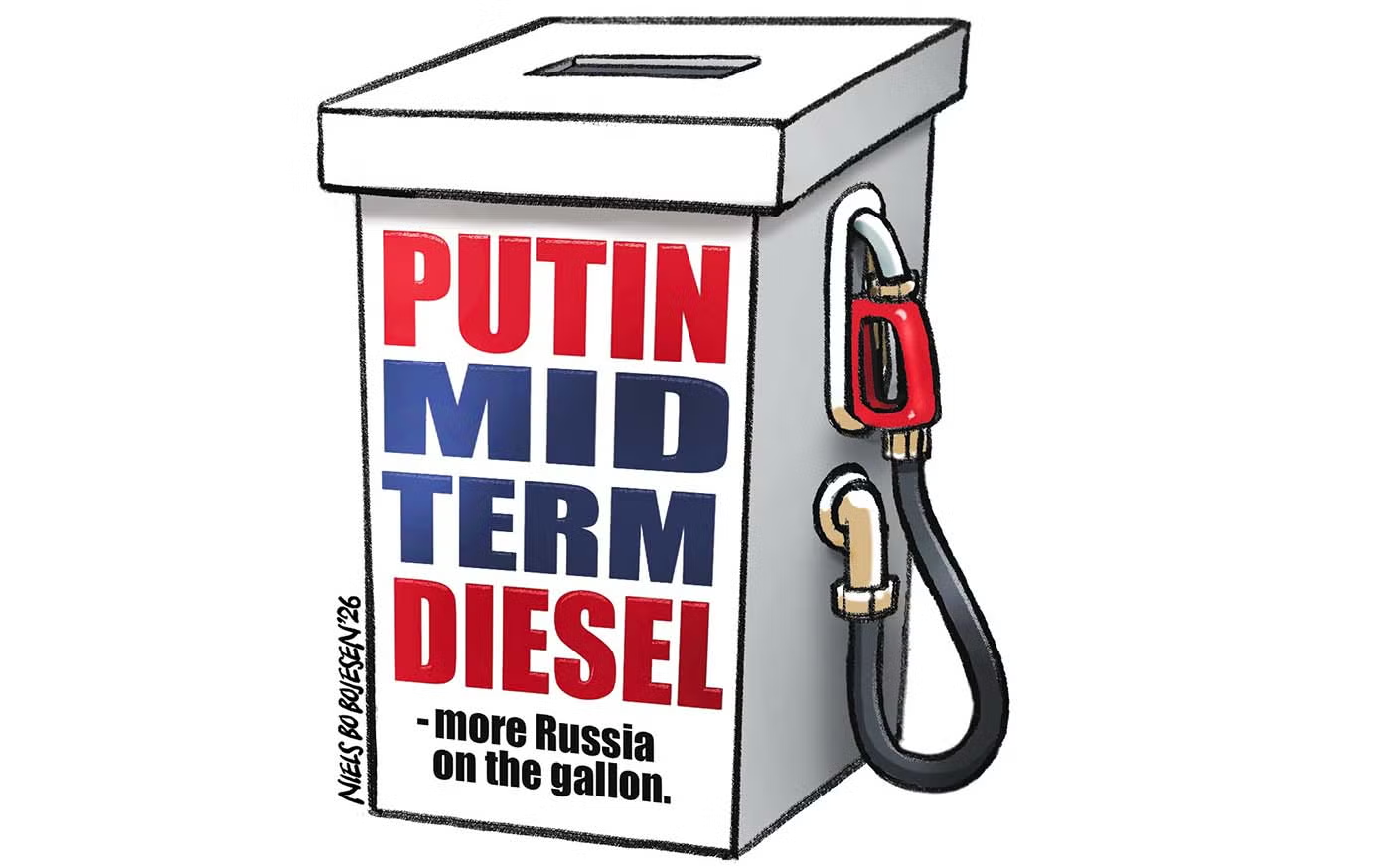
Dirty Business Dirty Business
Trump turns to Russian oil to lower fuel prices in the United States ahead of the midterm elections, throwing Ukraine under the bus.

Could Mississippi Really Send a Democrat to the Senate? Could Mississippi Really Send a Democrat to the Senate?
The answer, amazingly, is yes.

