
When Did the Natural World Stop Feeling Sublime?
In Is a River Alive?, Robert Macfarlane challenges himself, and others, to find a new way to write about nature.
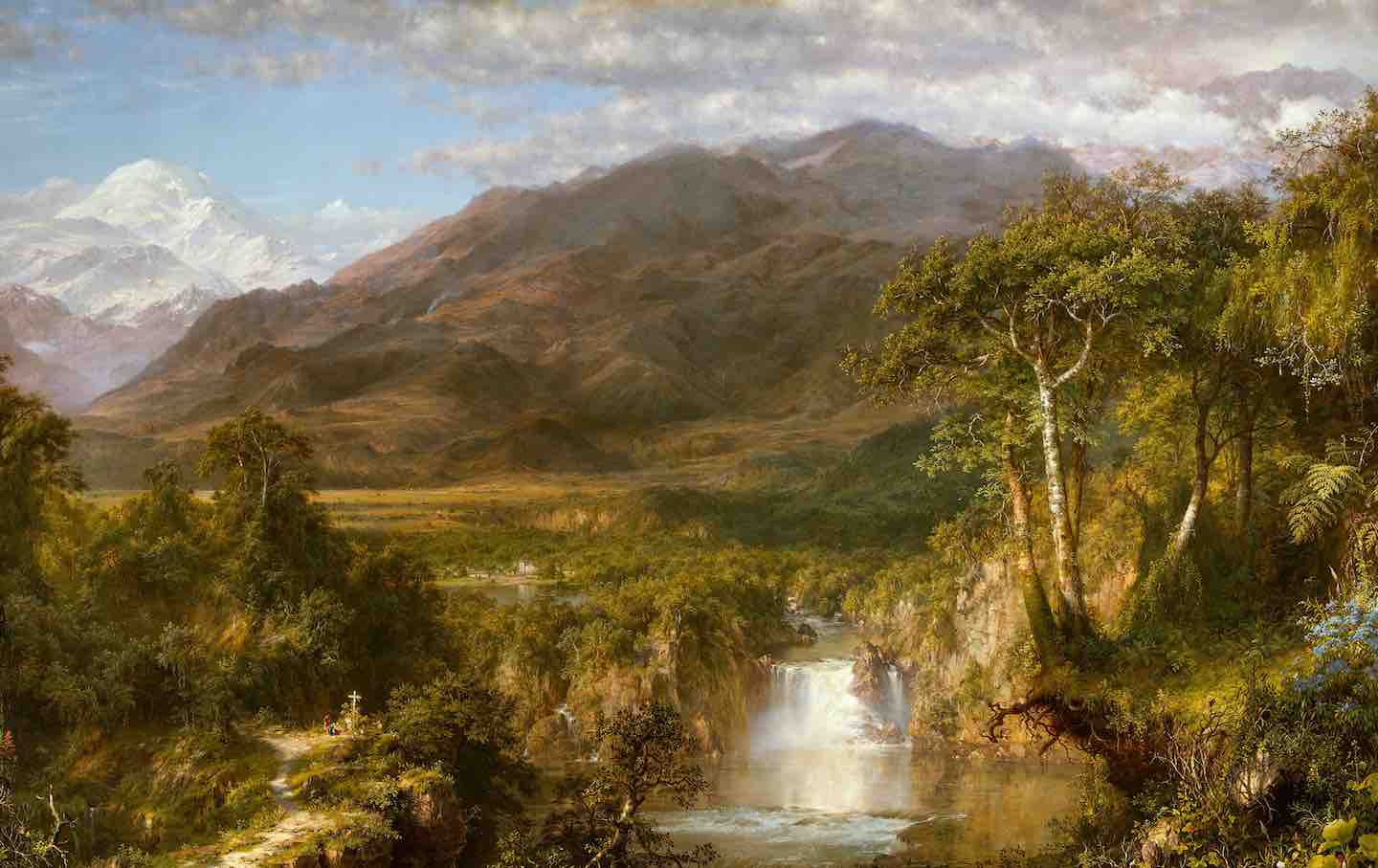
Frederic Edwin Church, Heart of the Andes, 1859.
(Heritage Art / Heritage Images via Getty Images)Written in 1798, Samuel Taylor Coleridge’s “Rime of the Ancient Mariner” kicked off the Romantic era with the senseless killing of an albatross. Pay attention to the unseen, Coleridge’s poem instructs, because there is something invisible and unknowable in nature. Somehow, the bird’s death augurs catastrophe. It’s a symbol—a highly aestheticized thing that cannot satisfyingly explain the “motiveless malignity” of the Mariner’s crime. This is nature writing at its best and most challenging.
Books in review
Is a River Alive?
Buy this bookThe turn of the 19th century coincided with the height of the Industrial Revolution in England, and artists of the Romantic movement, seeking awe and wonder in the natural world, found destruction all around. In 1808, William Blake studied the “dark Satanic Mills” as antithetical to Heaven. “Bring me my bow of burning gold!” he wrote, warring against the “clouded hills” of the factories. Similarly, after the albatross dies, Coleridge’s crew becomes “choked with soot.” Peter Sacks, a poet, critic, and painter whose work often deals with the environment, has called the Lake Poets—Coleridge, Wordsworth—among the first to detect the coming Anthropocene.
The changing climate was a subject not just for poets but for painters, too. In 2023, a study in the Proceedings of the National Academy of Sciences argued that the Impressionists were responding as much to smog as to light, for their “stylistic changes…toward hazier contours and a whiter color palette are consistent with the optical changes expected from higher atmospheric aerosol concentrations.” Michael Lobel’s book Van Gogh and the End of Nature (2024) contended that to ignore this influence was “doing real damage,” relegating figures like Van Gogh to a fantasy world far removed from ours. Jackie Wullschläger’s 2024 Monet biography went on to frame a large body of the painter’s work as studying the “industrial era into which he was born,” and the J.M.W. Turner Museum recently held an exhibition of works that “record[ed] the early stages of the climate and ecological breakdown.”
We might think of climate change, and the anxieties it produced, as a new phenomenon, but it is clear now that so many of the artists of the 19th century were depicting nature not merely as pastoral idylls but as something transformed by human hubris. Yet it has taken more than a century—and our own looming climate catastrophe—to realize that the imperiled natural world was always a feature of modern art.
In The Great Derangement, Amitav Ghosh argues that the 19th-century novel was exclusively interested in “the moderate and orderly.” This aesthetic rejected catastrophe, preferring a gradualist’s understanding of deep time and incremental, predictable change. Ghosh insists that the effects of such rationality on literature have been deadly: The “earth of the Anthropocene is precisely a world of insistent, inescapable continuities animated by forces that are nothing if not inconceivably vast,” and yet the world of these novels operates by “excluding those inconceivably large forces, and by telescoping the changes into the duration of a limited-time horizon.” An immediate natural disaster might help propel a plot, but the slow creep of temperature not so much. One reason that such subjects are difficult to render in literature is that they are neither human nor nonhuman but something in between. Ghosh calls this “the environmental uncanny”: the “mysterious work of our own hands returning to haunt us in unthinkable shapes and forms,” like those “invisible Natures” of drought and destruction that visit the Mariner after he kills the albatross.
In failing to be uncanny, nature writing loses its emotional truth. Joyce Carol Oates blames this deficiency on a “painfully limited set of responses” in so-called nature writers, who repeatedly deploy words like “REVERENCE” and “MYSTICAL ONENESS,” making the reader doubt their sincerity. According to the environmental journalist Michelle Nijhuis, nature writing is now the Most Hated Genre, at once histrionic and dull, and she calls on the writer Robert Macfarlane to back her up. “‘Nature writing’ has become a cant phrase,” he asserts in a 2015 essay, “branded and bandied out of any useful existence, and I would be glad to see its deletion from the current discourse.”
This is hefty criticism, especially since Macfarlane has been dubbed “the great nature writer, and nature poet, of this generation.” His 10th book, Is a River Alive?, is ostensibly a journalistic account of the Rights of Nature movement, a framework that grants legal standing to forests and rivers. But the book’s greater project is to offer a new mode of environmental writing—an attempt at capturing “the environmental uncanny”—and the experiment offers insight into the genre writ large, and how climate change has reoriented our writing about the natural world.
To Macfarlane, the challenges of overcoming passivity and treacly art are one and the same. “Existing ways of relating to flowing water have failed to stop the slow violence to which our rivers have been subjected,” he writes, preparing to bring us down endangered rivers in the Andes, Chennai, and Quebec, “to see what transformations occur when rivers are recognized as both alive and killable.”
This quest is environmental, but only secondarily. Primarily, Macfarlane is concerned with the power of the writer to change how we feel about the world we live in. “A good grammar of animacy can still re-enchant existence,” he promises, granting “new possibilities of encounter” if only we abandon the “status of stuff.” The way to do this, he says, is by deploying dramatically different language. By way of example, he looks to a group of Native American women who wrote that they “relate to these lands who are alive” in a recent New York Times op-ed. From that point on, Macfarlane uses who instead of that to describe rivers. He wants to feel the stirrings of the sublime again; he wants to uncover this direct relationship with the natural world.
Macfarlane tries to refasten our relationship to nature in a couple of ways, the main one being (to borrow Oates’s label) REVERENCE. Nature writing has been criticized for being overly dry, but Macfarlane’s is anything but: He pours down unusual verbs, exhaustingly flaunting his superior attention and word choice. He notices how “dusk furs the forest,” which is elsewhere “seamed by streams and seething with sound.” “Shadow and flame tiger the leaves that fringe the clearing,” and the “river smelts moonlight to silver.” Everywhere he looks, he finds “lozenges”—of light, of whale fins—and torrents of frothing: “The forest froths with sound…a vast semiotic broth” in the “green on green on green, a roiling green and the floor a frothing brown of sumptuous rot and rich decay.” Watching some storks do a mating dance, he muses: “I guess if you have a two-foot-long beak for a mouth, the art of kissing is hard to master. Clickety-clack, snicker-snack!”
All of this, presumably, is meant to summon that awesome sense of nature’s vastness, mystery, and play. In the cloud-forests of Ecuador, Macfarlane shows us how “life thrives upon life upon life in a seemingly endless mise en abyme that bewilders the imagination and opens a scale-slide of wonder into which the mind might plummet.” The Mutehekau Shipu (Magpie River) of Canada “curls umbilically,” a life-force, and on the coastline of Chennai, “we walk beneath the great arc of planets.”
Popular
“swipe left below to view more authors”Swipe →Reading these words, I often failed to attain the same sense of exaltation. Instead, I felt distanced from the world, always a thick ream of text (and somebody else’s consciousness) between me and the things being described. I cringed at the storks, or rather, at his reverence for them. At one point, Macfarlane gushes: “There is a happiness in me that I cannot control and do not wish to.” But the act of translation is part of the challenge, and not one that he completely overcomes.
Unless he is not trying to. As I kept reading, I wondered about the ways that Macfarlane actually leaned into the artifice, which had the effect of emphasizing the writer’s place in order to ask the reader what’s working. “Is a river alive?” is a real question for him. Sometimes he thinks that it is; often he thinks that, no, it is too “quicksilver” and diffuse to label in such human terms. “I wonder how on earth to write about the anima of this place,” he says, as though we are in a workshop together, “what language might meet its aboundingly relational being, could convey this emerald pluriverse where life forms and forms of life become metamorphically indistinguishable from one another.”
So when “snicker-snack” gave me pause, this wasn’t necessarily a bad thing—it was part of the experiment of modeling a new way of writing, one that self-consciously imposes craft on nature. Saturated with all the seething and frothing and REVERENCE, I began to appreciate the way that Macfarlane’s playfulness, on the one hand so cloying, was cultivating a paradoxical sense of closeness by insisting on the role of the artist.
In Ecuador, it’s “hypotaxia”; in India, it’s “metaphor…the trope which transforms, joins like with unlike”; and on Quebec’s Lake Magpie, it’s vastness. “I must surrender agency to this incomprehensible presence,” he says, returning to the traditional Romantic language of beholding enormity and wondering how humans can recognize our smallness without succumbing to fatalism. One way to evoke this feeling is by creating art—and another, Macfarlane demonstrates, is by criticizing it. Uniquely from any other form, writing is able to collapse time and space, demonstrating interconnectivity and that elusive “environmental uncanny.” Macfarlane jumps from riverbanks to lawyers’ offices and back, enacting “scale-shifts” that drier accounts (legalistic, journalistic, activist) cannot. This is such an obvious magic of writing that we rarely think of it.
“Nature is no great mother who has borne us,” Oscar Wilde wrote in his 1891 essay “The Decay of Lying.” “She is our creation…. Things are because we see them, and what we see, and how we see it, depends on the Arts that have influenced us.”
But nobody wants to be told what to think, let alone be manipulated. Partly for this reason, such efforts tend to fail. Take a look at Union Square’s Climate Clock (no one does), or at Extrapolations, a 2021 TV series starring Meryl Streep and David Schwimmer that was panned for transforming them into “didactic sandwich boards.”
When asked how to engage with climate change without becoming didactic, Margaret Atwood replied simply, “The climate is not a person.” That is, things need to be depicted “in the context of a changed climate” but not with the climate front and center. Ghosh likewise encourages complexity, noting that the climate events of our era “are distillations of all of human history: they express the entirety of our being over time.”
At first, Macfarlane might read like another awestruck nature writer. But the lesson he offers is just as subtle: He deliberately demonstrates that nature can’t be “captured,” no matter how thoughtful the language. Something is bound to be lacking, or off. And this gap creates a new sort of uncanny. It is here, somewhere between the vast rivers and human expression, that we are at our smallest and our greatest, and once again feel the sublime.
Become a Sustaining Donor This September
Between the reemergence of right-wing red-baiting and Donald Trump’s use of the chilling National Security Presidential Memorandum–7 to criminalize left political organizing, we’re seeing McCarthyism reborn before our eyes.
This assault on democracy cannot be ignored or wished away. Resisting it requires bravery in the face of threats and repression, a steadfast commitment to the truth, and the unwavering belief that we can—and will—overcome this darkness.
We must have an independent media that sets the record straight, unearths corruption and abuses of power, and advances a politics of justice and dignity for all if we’re to win this fight.
That’s why I’m writing to you today. This September, The Nation needs to add 100 monthly donors to sustain our progressive journalism. Your contribution makes the next investigative report, the next truth-speaking column, and the next pathbreaking essay all possible.
I hope you’ll support our work with a recurring donation today. If you donate $10 or more a month, we’ll send you a brand new “Hands Off the Free Press!” sticker to recognise your commitment to our cause. Please, donate today.
Onward,
Katrina vanden Heuvel
Editor and Publisher, The Nation
More from The Nation

America Without the NFL America Without the NFL
Chuck Klosterman’s Football is a eulogy for the sport on the eve of its decline.
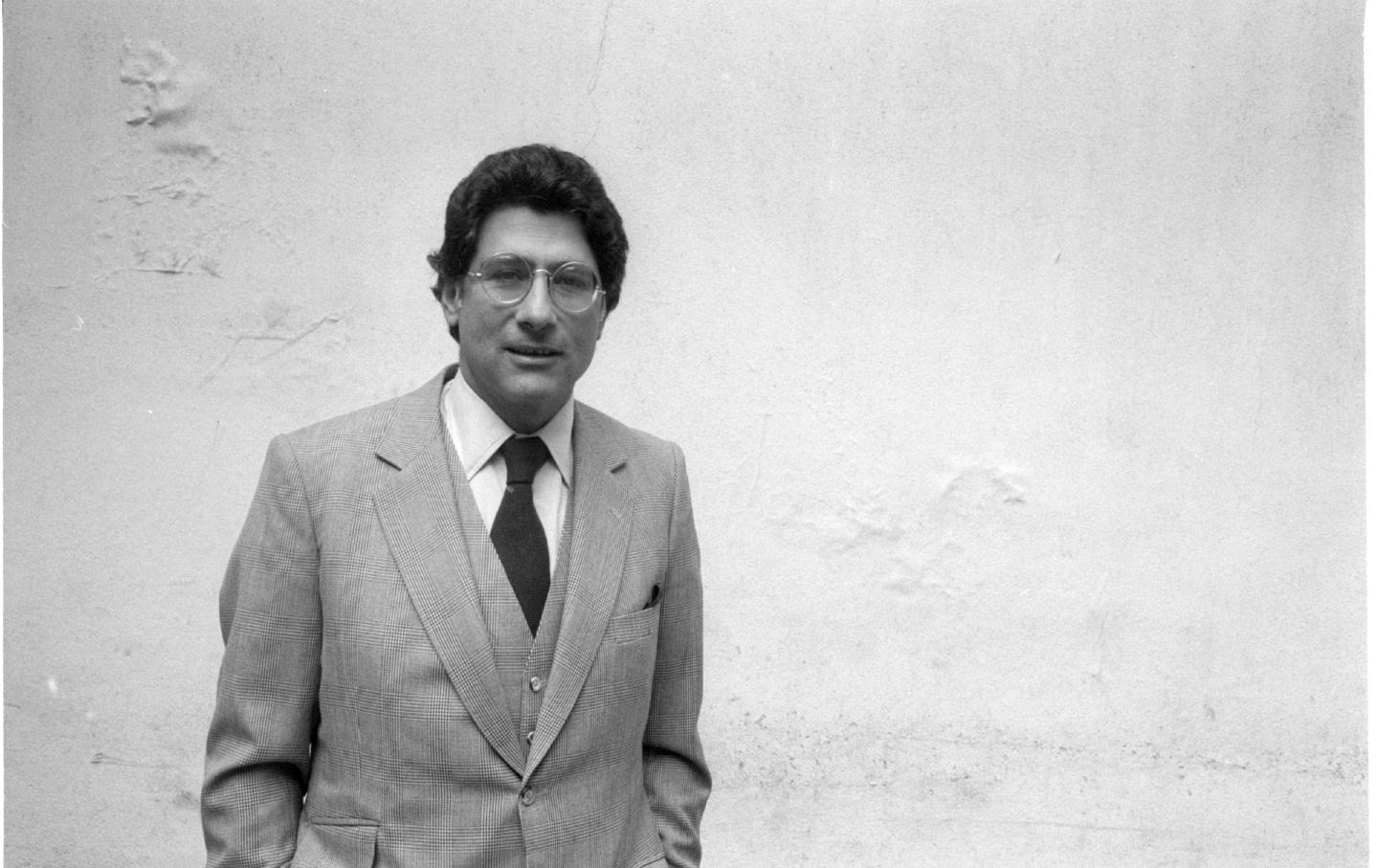
Edward Said: Between Worlds Edward Said: Between Worlds
A new film biography depicts the Palestinian writer as still out of place—and ahead of his time.
Imani Thompson’s Grad-School Thriller Imani Thompson’s Grad-School Thriller
In Honey, the novelist offers a different take on the campus satire.
Love and Literature in Leslie Fiedler’s America Love and Literature in Leslie Fiedler’s America
When will the American novel grow up?

