
Stop Making Sense
The extreme performance art of Tehching Hsieh
Tehching Hsieh—an “Artist Without Art”
In his performances, he questioned whether or not an artwork needed to supply a specific meaning in order to generate a feeling.
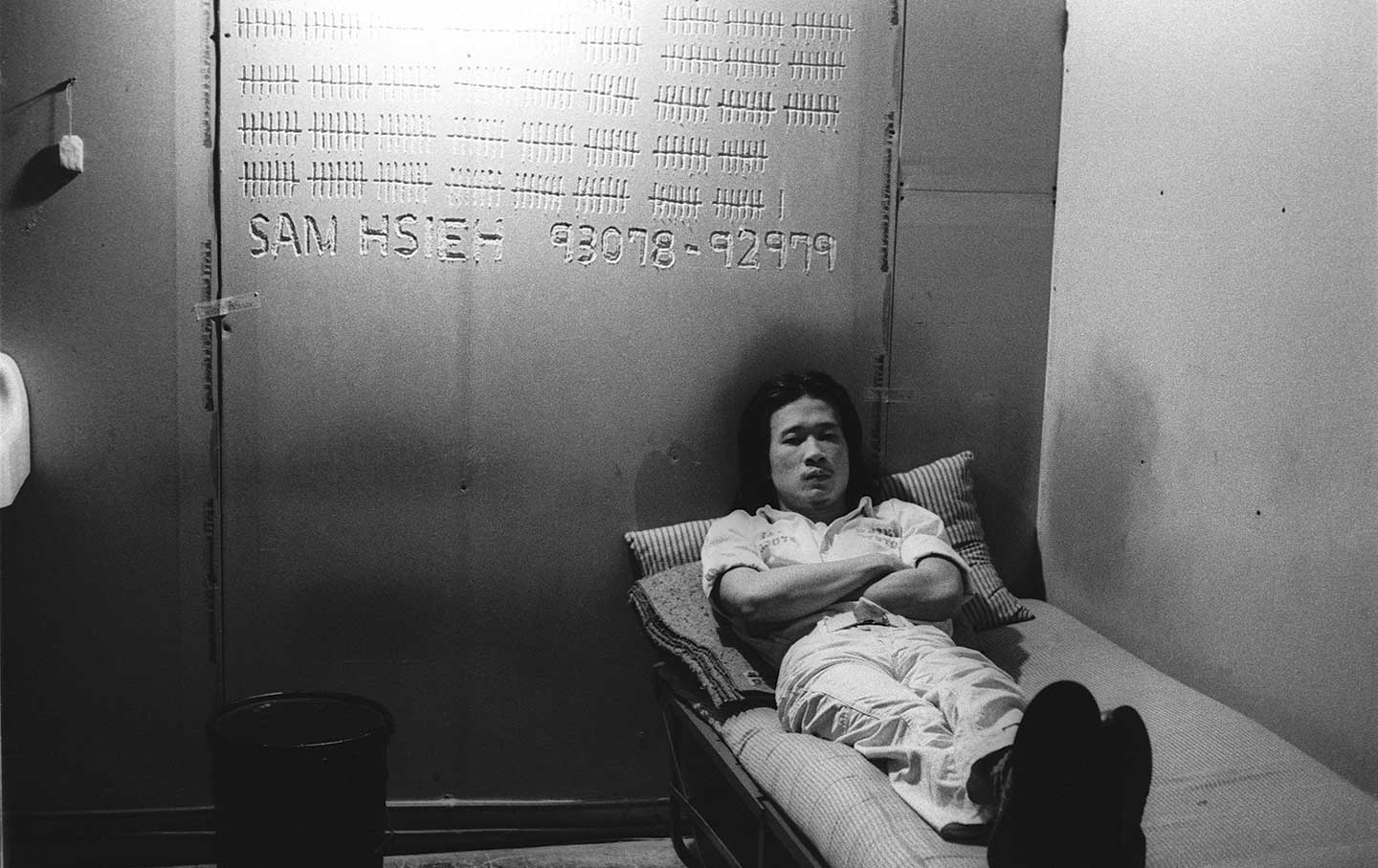
On September 30, 1978, the performance artist TehChing Hsieh had himself locked inside a jail cell he’d built in his studio in lower Manhattan. The space was surrounded by wooden bars and measured just over 100 square feet; it contained a cot, a sink, a mirror, a pail, and a single bare light bulb on one wall. A friend brought Hsieh food and emptied the pail that he used as a toilet. For an entire year, Hsieh did not talk, read, write, listen to music, or watch TV. He thought and paced, slept and ate; he washed his hands and brushed his teeth. Each day, he marked the passage of time by having his photograph taken and carving a single mark into the wall with his nail clippers. On September 29, 1979, he was released.
One Year Performance 1978–1979—or Cage Piece, as it’s more commonly known —was neither Hsieh’s first artwork nor his first performance. But it signaled the start of a period in which he subjected himself to several yearlong feats of endurance in the name of art: After the cage, he would go on to punch a time clock literally once every hour, live outside on the streets of New York City, and tie himself, 24/7, to another artist, Linda Montano. All of these pieces were shaped by strict rules and meticulously documented. Together, they started to bring Hsieh, who was then an undocumented immigrant from Taiwan, into the avant-garde art world of New York—albeit at a remove, since he wasn’t very social and was never quite fluent in English.
By the mid-1980s, many curators, writers, and fellow artists knew what Hsieh was doing—even if, as is so often the case with his work, they didn’t understand his reasons for doing it or what it meant. Some were dismissive, but others responded to the extraordinary nature of his art with engagement and respect. In 1980, the poet and performance artist Jackson Mac Low wrote a postcard to Hsieh, asking (sympathetically, he stressed), “Why do you do such performances?… There must be much more to them than is apparent.” Two years later, in the midst of One Year Performance 1981–1982 (Outdoor Piece), Hsieh was arrested after an altercation with a man on the street; the judge in the case didn’t make Hsieh enter the courtroom, because he’d read an article on the artist’s work in The Wall Street Journal. “These days anything is art,” he commented.
And then, for his fifth and final one-year performance, Hsieh did something truly radical: He dropped out. Beginning on July 1, 1985, he would “not do ART, not talk ART, not see ART, not read ART, not go to ART gallery and ART museum for one year,” he declared in one of the trademark typewritten announcements that he posted around Soho and mailed to members of the art community. “Just as he was acquiring a significant artistic profile, Hsieh cut himself out of the picture,” the curator Adrian Heathfield writes in Out of Now, a monograph coauthored with Hsieh. “He became an artist without art.”
Shortly after the year was up, Hsieh announced his next project: For 13 years, he would make art but not show it publicly. Now he would be an artist engaged with art again, but also one without an audience—and without an audience, who is there to care about the art?
Hsieh’s followers remained loyal even after he’d abandoned them. His performances weren’t much exhibited or written about, but they became legendary nonetheless, first through word of mouth and later thanks to a DVD he made about his work. In a way, the contours of Hsieh’s story made him a perfect cult figure: He was an outsider who, without any institutional training or backing, had conceived and accomplished feats that seemed to shift the parameters of performance art. And then, without getting any substantial credit for it, he all but disappeared.
As it turned out, Hsieh was hiding in plain sight: After briefly going west as part of the Thirteen Year Plan, he returned to New York, opened an artist residence in Williamsburg, and moved into a loft in Clinton Hill to tend to his archive. At one point, Hsieh opened a café with his wife (it has since closed, and the two have divorced). He sometimes worked in construction. Then, in the late 2000s, he began to receive long-overdue recognition.
The latest iteration of that attention—which includes his representing Taiwan at the 2017 Venice Biennale—is Tehching Hsieh: Lifeworks 1978–1999, a retrospective of the artist’s performances that opened last fall at Dia Beacon. Adapting a layout designed by Hsieh, the exhibition cleverly uses space and documentation to capture the immensity of his work. Within the first four galleries, which are devoted individually to the one-year performances, materials accumulate: hundreds of photographs, time cards, maps, and cassette tapes. Then you arrive at No Art Piece, and the gallery is almost entirely empty. The absence is striking—and it’s followed by an even larger void for the Thirteen Year Plan. The size of each gallery corresponds to the featured piece’s length of time, so the yearlong projects all get the same square footage, while to reach the end of the Thirteen Year Plan gallery, you must traverse a huge, evocative space filled only with structural columns. (Even the gaps between the galleries themselves correspond to the amount of time that passed between the works.)
The show, in essence, generates an embodied experience. A year sounds measurable but still abstract, until you’re standing in a room surrounded by 365 photographs of Hsieh that could be identical if not for the growth of his hair. What’s more, in order to really see that progression, you must move your own body. Ingeniously, and somewhat ironically, all of this physicality serves to dramatize the highly conceptual nature of Hsieh’s art.
Yet what exactly are those concepts? In other words, what is Hsieh’s work really about? The difficulty in answering that question, and the many attempts people have made to do so, is part of Hsieh’s ongoing mystique. (To wit, 770 people showed up for the artist’s talk at Dia Beacon on opening day.) Cage Piece could be read as a commentary on the severity of imprisonment; No Art Piece might be about a creative block. But the retrospective demonstrates that Hsieh’s art doesn’t have straightforward subject matter so much as a clear, overpowering form. And that form shapes the work’s defining paradoxes: It is rigorous yet excessive, philosophical yet irrational. It is simultaneously private and public, life as much as art. Most important, it often seems senseless—and that senselessness is what gives it meaning.
Hsieh grew up in a small town in southern Taiwan as one of 15 children born to a father who had five successive wives. The family’s members all lived together and the household was strict, but Hsieh’s mother indulged him. Taiwan itself was fairly conservative too, but Hsieh was able to grow out his hair and listen to rock music; he studied painting and, in 1967, dropped out of high school. After he completed three years of mandatory military service, his paintings were exhibited at the gallery of the American News Bureau in Taiwan. But Hsieh was already becoming more interested in the possibilities of art outside the confines of static images. In 1973, he recorded himself jumping out of a second-story window onto a concrete floor; he broke both his ankles and called it Jump Piece. He later performed a piece in which he ate fried rice, and then fruit salad, until he threw up.
Hsieh’s works were in conversation with performances happening oceans away: In 1971 in Santa Ana, California, Chris Burden conscripted a friend to shoot him in the arm, while in 1974, Marina Abramović offered herself up to an audience in Naples with 72 objects at their disposal, including a scalpel. Artists were using their bodies as a canvas, and their physical limits became aesthetic expressions.
Seeking a more cutting-edge art scene, Hsieh decided to leave Taiwan. He trained as a merchant mariner and, in 1974, took a gig on an oil tanker heading for the United States. When the ship docked in Philadelphia, Hsieh fled and paid a cab driver $150 to take him to New York City. There, he worked low-wage jobs, shared an apartment, and thought about making art. It would take four years for him to conceive and prepare his first one-year performance; it would take another decade for him to receive amnesty and the stability that comes with citizenship. By then, though, Hsieh had already embarked on his Thirteen Year Plan, which means he’d already started to disappear.
Most performance art revolves around a single action or event, and even if that event lasts an entire day, it remains comprehensible. There have been long durational works before and after Hsieh—from Joseph Beuys living in a gallery with a coyote for three days in 1974, to Marina Abramović and Ulay walking the Great Wall of China in 1988 to mark the end of their relationship—but Hsieh’s art took place on a scale that’s difficult for a viewer to conceive. In each case, he arranged for copious documentation: In Time Clock Piece, for instance, for every hour that he punched a time card, he also took a self-portrait as a single frame of 16-millimeter film, eventually assembling an entire movie. But even with these things laid out before you, as at Dia Beacon, it’s overwhelming—there’s no way to take it all in.
What’s more, the use of years as a time frame starts to bring Hsieh’s work into the realm of the absurd. “It doesn’t really matter how I spend time: time is still passing,” he tells Heathfield in an interview in Out of Now. “Wasting time is my basic attitude to life; it is a gesture of dealing with the absurdity between life and time.” Hsieh—who often speaks in statements that read like riddles—highlights that absurdity by taking the conditions of life to the extreme: His performances aren’t centered on idiosyncratic gestures or symbolic acts but rather on the repetition and accumulation of quotidian experiences. Nothing really happens; there’s no narrative or catharsis. Art becomes the container for an exaggerated version of life, a performance of the passage of time.
This is part of what makes Hsieh’s work so tricky to grasp. He wasn’t trying to create meaning, as both artists and their critics are wont to do; he was trying to capture it. Take, for instance, Outdoor Piece, in which Hsieh ruled that he would not enter any shelter, including subways and tents, for an entire year. It would make sense to assign the work some implicit commentary (on homelessness or urban poverty), and indeed, you can hypothesize that by reading into the resultant black-and-white photos of Hsieh living outside in all seasons, as well as the maps he marked up with his daily routes. But the more you search for meaning there, the less you’ll find it. Hsieh’s adoption of and adherence to such a strict set of limits redirects our attention to the process of the performance, its harsh repetitions and absurdities, rather than its content. I think this is why he includes so much documentation: to drown out our search for subject matter and emphasize the primacy of form.
Still, there are moments when the inklings of intent shine through. When I look at Rope Piece—for which Hsieh and Montano were attached by eight feet of rope but forbidden to touch each other—I see a reflection, however inadvertent, on the fragility of intimacy. Especially because you can track the increasing tension in their relationship by the fact that, on the second day of the project, they recorded 345 minutes of conversation between them (the daily cassette tapes are displayed under the photographs), whereas on a day near the end of the year, they spoke for only 32 minutes.
In this way, if Hsieh’s art is about anything, it’s about how we, as people, survive: shut up alone, out on the streets, attached to others, visible or not. It is a survey of the basic conditions of existence. As others have pointed out, this makes sense when you consider that Hsieh was undocumented while making these works. It’s telling that each of his six primary performances features a deprivation in some way. (With No Art Piece, Hsieh refused himself access to his own creative practice, and with the Thirteen Year Plan, he lost his audience.) He was still testing the limits of his mind and his body, as he’d done when he jumped out the window—except now he continued testing past the point of pain or even logic.
There is a harshness to Hsieh’s performances, and one of its clearest manifestations is the artist’s own face. In the daily photographs for Cage Piece, Hsieh stares straight into the camera, unsmiling; given the jumpsuit that he’s wearing, which displays his name and two sets of numbers (the start and end dates of the performance), he looks like he’s posing for a mug shot. In the Time Clock images, Hsieh appears equally deadpan but with an added layer of visible exhaustion, since he could never sleep for more than an hour at a time. The stare softens somewhat in Outdoor Piece, since the photos are more situational, but aside from some moments of calm, he mostly looks like a man trying to make it to the next day.
Popular
“swipe left below to view more authors”Swipe →Rope Piece, however, is the exception to this rule. Although she’s clearly versed in the art of the stare, Montano introduces a new element into what by then had become a self-sustaining Hsieh equation. In keeping with his previous performances, the pair took a photograph of themselves every day, but the pictures are more like snapshots than portraits. There’s an intimate quality to the imagery, as in one photo where Montano and Hsieh lie in their separate beds, leaning on their arms and gazing at each other like chatty roommates in a college dorm. The ends of the taut rope are buried under their sheets, making it seem more like a symbolic tether than a literal one.
On my visit to Dia Beacon, this was the moment when I began to see the playfulness in Hsieh’s work, not just its severity. He used the framework of durational art as a means to boil life down to its essence, and that process produced confinement, deprivation, endurance, yes—but also ridiculousness and a different, self-sustained kind of freedom.
Hsieh’s time as a practicing artist formally ended on New Year’s Eve in 1999. He held a press conference of sorts in Manhattan’s Judson Memorial Church to announce that he’d finished the Thirteen Year Plan and would now abandon art. At the event, the performance artist Martha Wilson presented a poster that Hsieh had made. Using colorful letters cut out from different publications, it read: “I kept myself alive. I passed the Dec 31, 1999.” The poster lists the location of the work as “Earth” and includes an image of the planet.
Whenever I read that statement, my brain trips on the second sentence. I want to insert the word time, to make it read the way that I imagine Hsieh might say it in conversation. He has often said that his work is about passing, unfolding, or wasting time. For Hsieh, time was material, subject, and form, and art was the tool he used to make it visible.
But in Hsieh’s case, time outlasts art. Art fades away, becomes an empty gallery that’s filled with potential but remains empty nonetheless. Then all that’s left is keeping oneself alive, or as Hsieh put it, “life as a life sentence.” This could be a gloomy sentiment, but in the Thirteen Year Plan poster, it’s conveyed whimsically—part scrapbook, part ransom note—in another of Hsieh’s contradictions. It speaks, I think, to what his art tries to tell us: that while it is serious and often hard work to keep ourselves alive, it is also a cause for celebration.
Support independent journalism that does not fall in line
Even before February 28, the reasons for Donald Trump’s imploding approval rating were abundantly clear: untrammeled corruption and personal enrichment to the tune of billions of dollars during an affordability crisis, a foreign policy guided only by his own derelict sense of morality, and the deployment of a murderous campaign of occupation, detention, and deportation on American streets.
Now an undeclared, unauthorized, unpopular, and unconstitutional war of aggression against Iran has spread like wildfire through the region and into Europe. A new “forever war”—with an ever-increasing likelihood of American troops on the ground—may very well be upon us.
As we’ve seen over and over, this administration uses lies, misdirection, and attempts to flood the zone to justify its abuses of power at home and abroad. Just as Trump, Marco Rubio, and Pete Hegseth offer erratic and contradictory rationales for the attacks on Iran, the administration is also spreading the lie that the upcoming midterm elections are under threat from noncitizens on voter rolls. When these lies go unchecked, they become the basis for further authoritarian encroachment and war.
In these dark times, independent journalism is uniquely able to uncover the falsehoods that threaten our republic—and civilians around the world—and shine a bright light on the truth.
The Nation’s experienced team of writers, editors, and fact-checkers understands the scale of what we’re up against and the urgency with which we have to act. That’s why we’re publishing critical reporting and analysis of the war on Iran, ICE violence at home, new forms of voter suppression emerging in the courts, and much more.
But this journalism is possible only with your support.
This March, The Nation needs to raise $50,000 to ensure that we have the resources for reporting and analysis that sets the record straight and empowers people of conscience to organize. Will you donate today?
More from The Nation
The Fictitious Capital of HBO’s Industry The Fictitious Capital of HBO’s "Industry"
In the show's fourth season, everyone has a story to sell and very few are true.
George Packer’s Liberal Imagination George Packer’s Liberal Imagination
What happens when liberalism’s crisis is made into a fable?
The Greatest Love Is Grieving The Greatest Love Is Grieving
I spent years as a labor organizer. Marguerite Duras’s war novel taught me that the strongest fighters are always the women hurting the most.

