
Werner Herzog Between Fact and Fiction
The German auteur’s recent book presents a strange, idiosyncratic vision of the concept of “truth,” one that defines how he sees the world and his art.
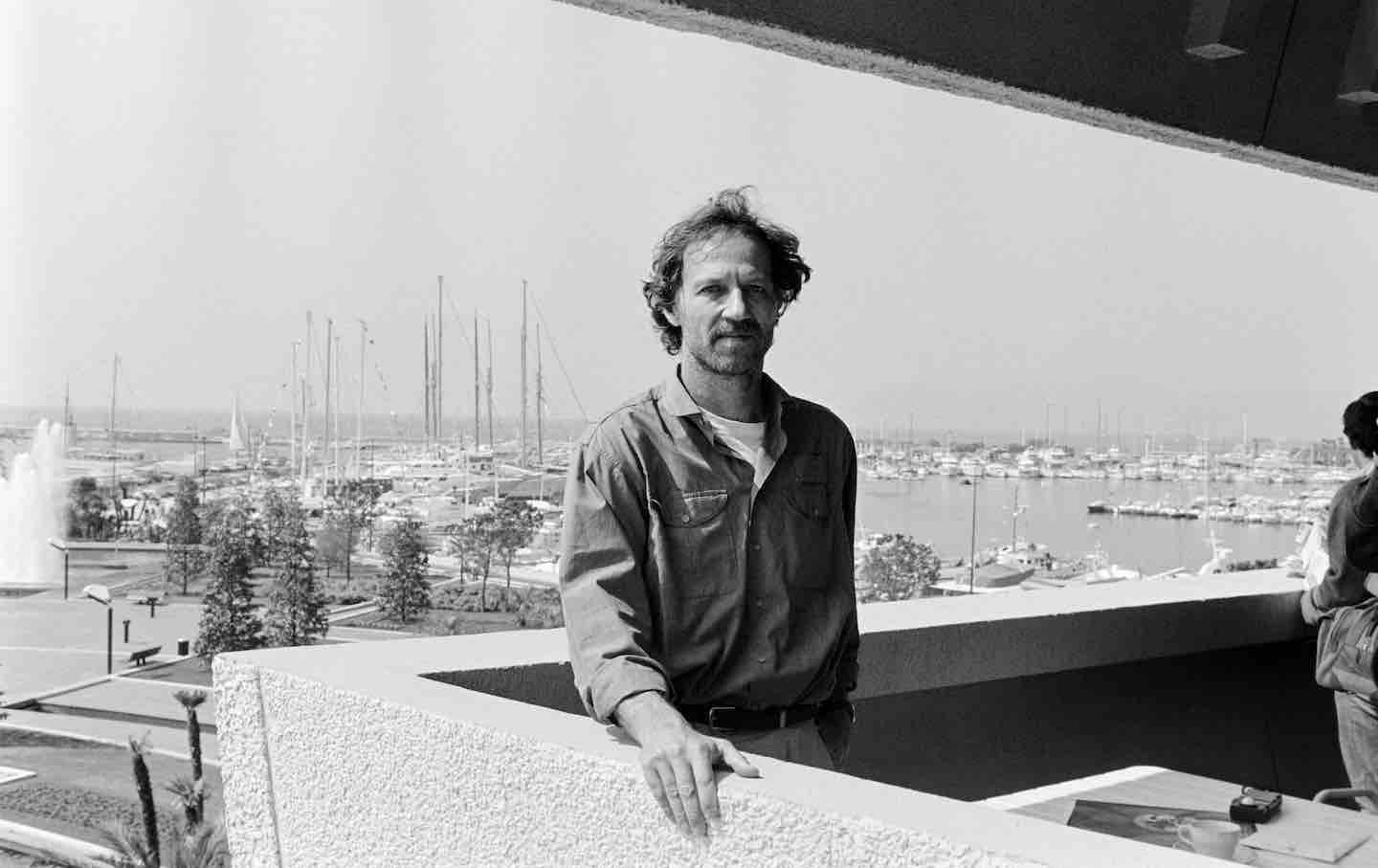
Werner Herzog, 1984.
(Frederic Garcia / Gamma-Rapho via Getty Images)In 1970 or ’71, Werner Herzog accompanied a pair of deaf-blind women on their first flight in an airplane. The outing was Herzog’s idea, a joyride in a little four-seat Cessna to celebrate one of the women’s birthdays but also to capture their reactions for a film he was making called The Land of Silence and Darkness. The footage from that afternoon displays many of what would become the hallmarks of Herzog’s style over the coming half-century: the daring gambit on the border of exploitation, the obsession with vision and existential loneliness, and the search for poetry at the extremes of human experience. It is an astonishing piece of filmmaking. No matter how many times I have seen it, it never fails to evoke an overwhelming complex of thought and feeling that is hard to put into words. As with the flight itself, one has to experience it to know what it is about, and even then it is hard not to come away with the sense of having encountered something powerfully human that nevertheless lies beyond our capacity to articulate it in speech. As if to confirm this impression, Herzog, whose unmistakable voice and philosophical commentary have become the most recognizable part of both the man and his work, is silent. He doesn’t even ask afterward what it was like.
Books in review
The Future of Truth
Buy this bookThis, too, would become a characteristic of Herzog’s oeuvre: the search for an elusive transcendence over the edge of the ordinary that he calls “ecstatic truth.” Herzog is obsessed with the idea of truth and has insisted for decades that it is the central concern of all his films. This might seem rich from one of the great self-mythologizers of our time, who has never hidden the fact that he punches up his documentaries with fabrication, scripted scenes, and misattributed quotes, and who once described Fitzcarraldo as his greatest documentary. Yet the truth that Herzog has in mind is more like the truth of poetry than the mere facts and shared understanding that he mocks as “the truth of accountants.” As he put it in a 1999 manifesto, “There are deeper strata of truth in cinema, and there is such a thing as poetic, ecstatic truth. It is mysterious and elusive, and can be reached only through fabrication and imagination and stylization.”
The idea that an artist, even a documentarian, would mix fact with fiction is not quite so radical today as it might have been at the peak of cinema verité. Yet questions of truth and its relation to reality are more pressing and vexed than ever. Getting at deep truths by means of artful lies may seem less appealing or daring in the era of the deepfake. Herzog’s oft-repeated provocation that only the “conman, the liar who knew what he was talking about, would speak the truth” loses some of its countercultural appeal when the conmen move from the margins of society to the centers of power and bullshit becomes de rigueur.
What separates the auteur who resolutely clings to a personal, unempirical vision of the truth, and who has few scruples about lying if it convinces his audience of that vision’s reality, from the conspiracy theorists and propagandists who seek to deceive the public by similar means? How to distinguish what Herzog describes as his films’ exploitation of the “collective willingness to be transported into the realm of poetry, of madness, and of the pure joy of storytelling” from darker, more dangerous attempts to channel that willingness into political projects and collective madness?
The answer seems obvious. Herzog makes idiosyncratic films about the sorts of truth that can be found in cave paintings and the flight of ski-jumpers and men devoured by bears, while today’s AI-powered propagandists seek to manipulate viewers into a political stance via the banal aesthetics of cable news and social media. But that’s a little too easy; we’d like to be able to say more about how to distinguish between visionaries and what makes one deep truth truer than another. Herzog seems to appreciate the predicament. He has written a book, The Future of Truth (translated by the great Michael Hoffmann), to explain himself, or at least to put some distance between his life’s work and what is widely agreed to be one of the most pressing social and democratic dangers of our time. It is a book that he has been promising to write for years to expand upon his guiding ideal of ecstatic truth, which he has previously only been able to gesture at and move past by saying he’d need a whole book to explain. And now we have that book.
The Future of Truth is divided into 11 chapters with titles like “What is Truth?,” “Philosophical Efforts,” “Fake News: A Brief History,” “Ecstatic Truth,” “The Post-Truth Era,” and “The Future of Truth” that promise insight into Herzog’s vision of ecstatic truth and, by pressing it up against contemporary concerns, perhaps also to shed some off-kilter illumination onto our shared predicament. Alas, what we get in these chapters is a profound deflation of the excitement portended by their titles, not because ecstatic truth is the sort of thing that fundamentally cannot be put into words—as may be—but because the author hardly bothers trying.
It would be unreasonable to demand an exhaustive treatise on the nature of truth from an artist who has spent his life making intuitive magic with images and who has been known to explain himself with Hölderlin’s line that “man is a god when he dreams, a beggar when he reflects.” But since he has decided to write a book of reflections on the subject, we would at least like to see him give it a try. A little mischief at a minimum. What we mostly get, instead, are passages repurposed from earlier books and interviews stitched together and repackaged in such a slight and slapdash form—with neither the coherence of argument nor the constellation of collage and aphorism—that one gets the sense that the book was completed either to satisfy a contractual obligation or to finance an upcoming film.
This is disappointing, not least because two years ago, Herzog published a book as original and superb as his best films, the memoir Every Man for Himself and God Against All (also translated by Hofmann). Herzog’s memoir is an extraordinary piece of work that proves he is perfectly capable of evoking all the wonder and eccentric illumination of his films in prose. It contains dozens of moments far more illuminating on the question of truth (among much else) than its slim sequel, delivered not through explanation but story and image—an indication of just how indispensable images and narrative are to Herzog’s poetic evocation of a world that exceeds his grasp. Here, for instance, is Herzog at 16, out at sea with some local fishermen off the rugged coast of Hora Sfakion, Crete:
Above me was the orb of the cosmos, stars that I felt I could reach up and grab; everything was rocking me in an infinite cradle. And below me, lit up brightly by the carbide lamp, was the depth of the ocean, as though the dome of the firmament formed a sphere with it. Instead of stars, there were lots of flashing silvery fish. Bedded in a cosmos without compare, above, below, all around, a speechless silence, I found myself in a stunned surprise. I was certain that there and then I knew all there was to know. My fate had been revealed to me…. I was completely convinced I would never see my eighteenth birthday because, lit up by such grace as I now was, there could never be anything like ordinary time for me again.
Those curious about Herzog’s views on ecstatic truth would be better served by reading his memoir or the book-length interview with Paul Cronin published as Werner Herzog: A Guide for the Perplexed, notwithstanding the fact that a good deal of those previous books reappears in this one.
Whole chapters consist of anecdotes from the memoir that are retold or expanded upon with no new revelations or insight, least of all about fake news or the future of truth, as promised. (Although to be fair, his story about Mike Tyson’s prodigious knowledge of the Merovingians is so good that it bears repeating.) The book’s observations about the nature of truth are also rehashed nearly verbatim from previous works to somewhat deadening effect, as the provocations of a visionary begin to sound a bit more like inert slogans than careful (or even wild) thinking on the subject. A highlight of the book—and perhaps its hidden moral—is a two-paragraph chapter about a pig in Sicily that fell into the sewer, was trapped there, and eventually changed the shape of its body to fit its confinement, followed by a rumination on the colossal amount of inbreeding it would take to reach to Alpha Centauri. However, it turns out that this story, too, has already appeared in print at least twice, once in a 1979 diary entry published by The Paris Review in 2009 under the fitting title “Language Itself Resists,” and again in a broader selection from his diaries published that same year as Conquest of the Useless.
Herzog comes closest to considering the place of ecstatic truth in a “post-truth era” in a chapter on the novel powers of artificial intelligence to produce “fictive ‘truths.’” It is one of the few chapters that appears to have been written specifically for this book, which seems to indicate that Herzog is sensitive to the challenge that today’s shifting epistemic tides pose to his guiding ideal. But instead of grappling with the question, or at least giving his view of it, Herzog offers a brief catalog of things that LLMs are OK at, includes a few execrable poems written by AI, and then ends abruptly by informing the reader that an AI-generated photo recently won an international photography contest. Nothing is said about the possibility of an LLM producing anything truly original; or the fact that it doesn’t actually live in, perceive, or understand the world whose signs it probabilistically manipulates; or the enormous environmental costs of using these tools to supplant elementary human thinking, which one would think ought to bother a man who rightly describes the drive to extraplanetary colonization as a morally grotesque abandonment of the only habitable planet we will ever have. And it’s too bad, since we’d like to know what Werner Herzog thinks about all that.
Viewed in the most generous light, the book’s failure to achieve what it sets out to do suggests that perhaps we shouldn’t want an explanation of Herzog’s view of truth,and certainly that Herzog may not want to understand what he means by “ecstatic truth” in fear of extinguishing the need to quest after it.
Popular
“swipe left below to view more authors”Swipe →It is obvious that what Herzog really cares about is the quest—so much so that its object, truth, seems of negligible importance by comparison. It might just as well have been authenticity or beauty or transcendence or something altogether invented, so long as it offered an unreachable destination. In the chapter on “Philosophical Efforts,” Herzog writes, “The quest itself, bringing us nearer to the unrevealed truth, allows us to participate in something inherently unattainable, which is truth.” Anyone else and we’d want to know what grounds he has for thinking that this claim about the nature of truth is itself true, but for Herzog such questions miss the point. The reality of an unattainable, ecstatic truth is an article of faith that justifies and structures his life’s work. Like that other great visionary Don Quixote, Herzog has spent a lifetime plunging himself into ordeals and suffering whose absurdity only serves to intensify his commitment to the quest by testifying to the reality of its elusive, unrevealed object. Who would endure such hardships, we cannot help but ask, if there weren’t some reality to the vision, if there weren’t something true about ecstatic truth? But if this is a sort of truth, then it is a truth in which one must believe but cannot know. It may be the sort of thing we can glimpse in the films and memoirs, but it will be very hard (if not impossible) to capture, rather than allude to, in speech and writing.
Herzog’s attempt to finally grasp the truth he has defined as ungraspable calls to mind the doomed adventures of the incorrigible visionaries he has spent his career mythologizing, men who cling so implacably to their idea of how things ought to be that it seems to elevate them above the meaninglessness of existence even as it sinks them down into it with the inevitable failure of hubris. Yet when I return to the book’s concluding chapter on “The Future of Truth” and find a mere two sentences of the hollowest platitude, I don’t think of Fitzcaraldo or Aguirre but that bit from Hölderlin that Herzog is fond of reciting. The full quote paints a different picture: “O man is a god when he dreams, a beggar when he thinks, and when enthusiasm is gone, he stands there like a wayward son whom the father has driven out of the house and regards the meager pennies that pity gave him for the journey.”
Many times has Herzog faced the world at the start of such a journey, wayward, unfunded, and uncertain where it might lead. And many times has he returned with marvels in his hands. Let us hope that this book marks the beginning of a journey and not its end.
More from The Nation
The Genius of Charli XCX The Genius of Charli XCX
On her new album, Music, Fashion, Film, the musician embraces rock.

The Architectural Follies of Trump’s Washington, DC The Architectural Follies of Trump’s Washington, DC
The president plans to remake the capital in his own image, but is all he is doing destroying what’s already there?
The Carnival of Venice Biennale The Carnival of Venice Biennale
That so much of the art of “In Minor Keys” is muted in effect is ironic, because so much of it is overproduced, aspirationally eye-catching, and so big.

