
The Scientists Groveling to Trump Are Kidding Themselves
The government has pulled back from massive cuts to the NIH, but it’s still destroying scientific research. So why are some groups appeasing the president?
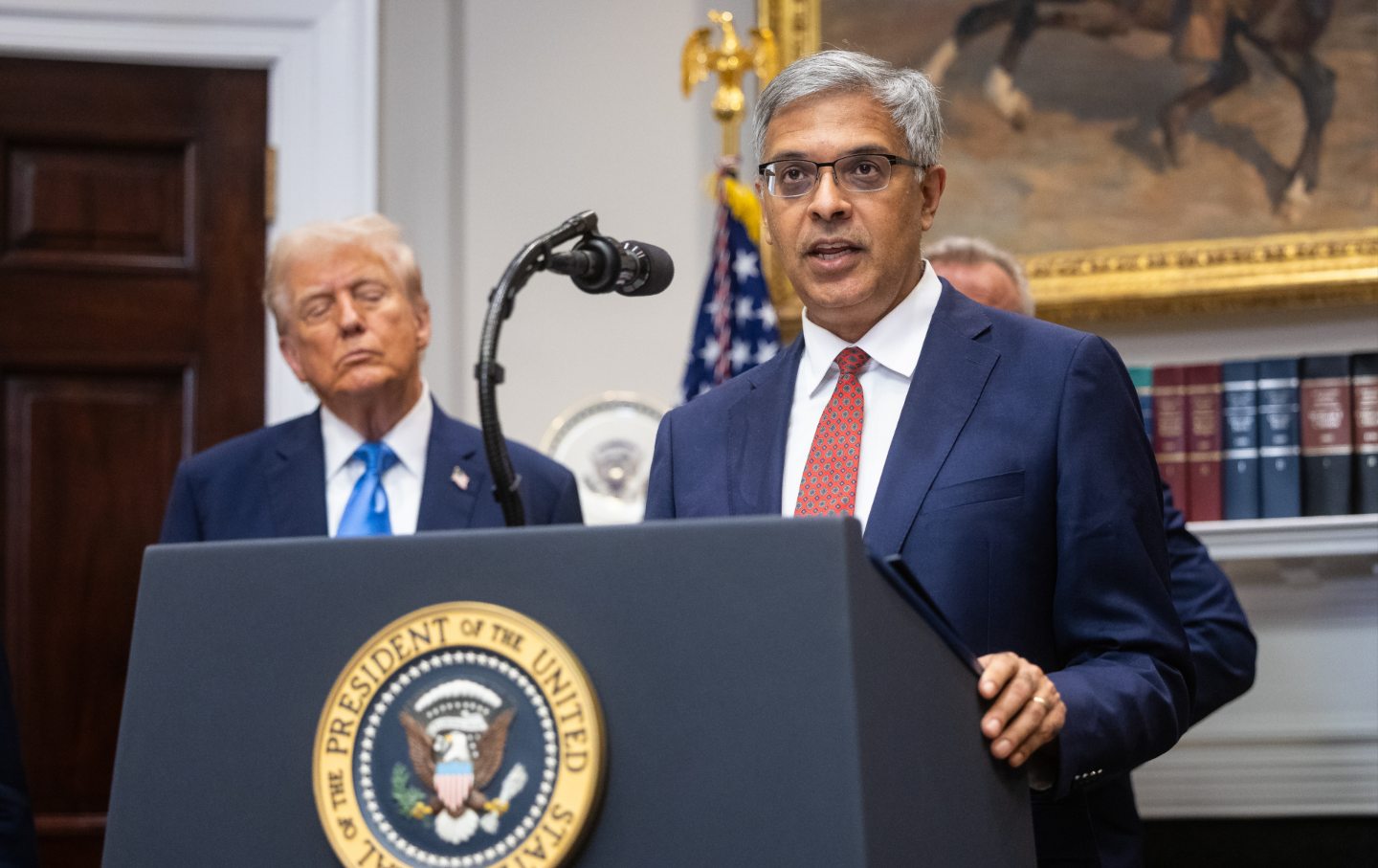
President Donald Trump, left, and Jayanta Bhattacharya, director of the US National Institutes of Health (NIH), in the Roosevelt Room of the White House, on Monday, September 22, 2025.
(Francis Chung / Politico / Bloomberg via Getty Images)The US National Institutes of Health (NIH) has been an engine for medical discovery for decades—generating new treatments, methods of prevention, and diagnosis of diseases for Americans and the world, as well as pumping tens of billions of dollars into our economy and creating hundreds of thousands of jobs.
Thankfully, the budget bill passed by Congress and signed by President Trump earlier this month rejected massive cuts to biomedical research that the White House had been pushing. Trump wanted a 40 percent reduction in the NIH budget; instead, Congress gave the agency a small increase.
This news should have me celebrating. Yet I am not. That’s because, even though Congress appears unwilling to totally destroy the NIH, the Trump administration is still doing widespread, if less highly publicized, damage to biomedical research in this country. This is happening under the guidance of Office of Management and Budget head Russell Vought, NIH Director Jay Bhattacharya (who has just been named the acting head of the CDC), and Bhattacharya’s deputy and mini-me, Matthew Memoli.
While it may seem hard for some outsiders to believe that our leaders want to actively undermine medical science in this way, what is happening at NIH headquarters in Bethesda should have everyone worrying about the health of our nation, now and into the foreseeable future. That’s why it’s so distressing to see some of our leading scientists kowtowing to Trump these days.
The NIH is being subjected to a series of what one might categorize as “dirty tricks,” administrative maneuvers to ensure that less research gets funded this year and in subsequent ones.
The first of these tricks is a budget sleight of hand. NIH grants are generally made for a five-year period, with payment to universities made on an annual basis out of each year’s appropriation from Congress. But the White House has insisted that the NIH be allowed to front-load funding for grants into the current fiscal year—that is, to put the entire five-year cost of any grant into its 2026 budget.
This means the NIH cannot fund as many scientific proposals as it did previously because, instead of needing to commit to one year of funding in 2026, it must now commit to five years. Last year, this meant the total number of grants funded in that fiscal year was nearly a quarter below the average number of grants supported over the previous 10 years. Sounds complicated, but the bottom line is that we lost thousands of potential new proposals that might have gotten funded except for these shenanigans. What new ideas have now been shelved due to this kind of behavior?
The NIH has also undermined its usual process for grant approvals. The agency is composed of 27 distinct institutes and centers. Once a grant makes it through the process of peer review, it is sent to each institute’s advisory council for final approval before funding. But Bhattacharya and Memoli have let the memberships of most of the institutes’ advisory councils expire, leaving the majority of the councils without the ability to carry out this essential function. This has slowed the work in getting grants out the door and to researchers around the country. It’s not incompetence—the career staff at the NIH know how to run the place. It is malevolence from the highest levels at the agency, and deputy director Memoli, in particular, knows how to throw sand in the gears.
Bhattacharya and Memoli (with the support of Robert F. Kennedy Jr.) are reshaping the NIH in more profound ways still. The directorships of nearly half of the agency’s institutes are empty, and the vacancies are being filled without the usual rigorous search process. As Science reported late last year, the director of the NIH’s environmental health sciences institute was replaced with “a neuroepidemiologist who had little relevant experience but is a close friend of Vice President JD Vance. There was no obvious search process or even an announcement that the current director would be taking a different job at NIH.”
You don’t pick people without relevant expertise to run an organization in any sector of society if you have a real commitment to its functioning. You put people in place like this to be yes-men to those higher up.
Bhattacharya is not subtle about his goals. He recently said at a talk at Duke: “I want the NIH to be a central driver of the MAHA agenda.… Essentially, it’s kind of the research arm of MAHA.” And this transformation is being carried out by edict and fiat.
Normally, individual institute priorities are generally developed through a rigorous, consultative process. Not anymore. Last month, Bhattacharya and two other staffers rolled out the agenda for the National Institute of Allergy and Infectious Diseases in a short commentary in Nature Medicine. The central mission of the article was to reframe infectious disease research as “America first,” stating that diseases that affect Americans will now be the priority for the agency. That means key global killers, like malaria and tuberculosis, or emerging threats, from Ebola, to mpox, to dengue, are out-of-the-picture in Bethesda.
Just last week, Bhattacharya decided that NIAID would shelve all its work on pandemic preparedness and biodefense. If this all sounds bizarre and unhinged, it is because it is. But remember what Secretary Kennedy has told us: “If you are healthy, it’s almost impossible for you to be killed by an infectious disease in modern times because we have nutrition, because we have access to medicines. It’s very, very difficult for any infectious disease to kill a healthy human being.” In this light, taking key NIAID priorities offline is par for the course. Make America Healthy Again, indeed.
So I am not in the mood for celebration, though some of my colleagues are. Some of them are going further—all but popping champagne with the government. Seeing the Science and Technology Action Committee—made up of some of our nation’s top scientists and advocates—groveling in thanks to President Trump for signing the budget is an embarrassment at a time when American biomedical research is fighting for its life.
I’ve only scratched the surface of what Russell Vought, RFK Jr., Jay Bhattacharya, and Matthew Memoli have in store for us. If scientists think that kissing up to the president has any strategic value, they are quite mistaken; the destruction of American science isn’t slowing down, and all this smells like appeasement. It’s reflexive, naïve, and outdated Beltway thinking too: A hand extended to the White House is intended to signal some sense of a shared, bipartisan commitment to research in America, when all the president’s men dream of is seeing the NIH in ruins. It’s the insiders’ game, what the very serious people do: We sit down; we discuss; we claim victory; we share the credit. Yet in 2026 we are breaking bread with Hannibal Lecter and, sorry to say, we’re not dining companions; we’re just all on the menu.
More from The Nation

What’s It Like Inside a Data Center? What’s It Like Inside a Data Center?
Northern Virginia is laden with structures that house data for Fortune 500 companies. I went inside just one of those monstrosities that bothers its neighbors.
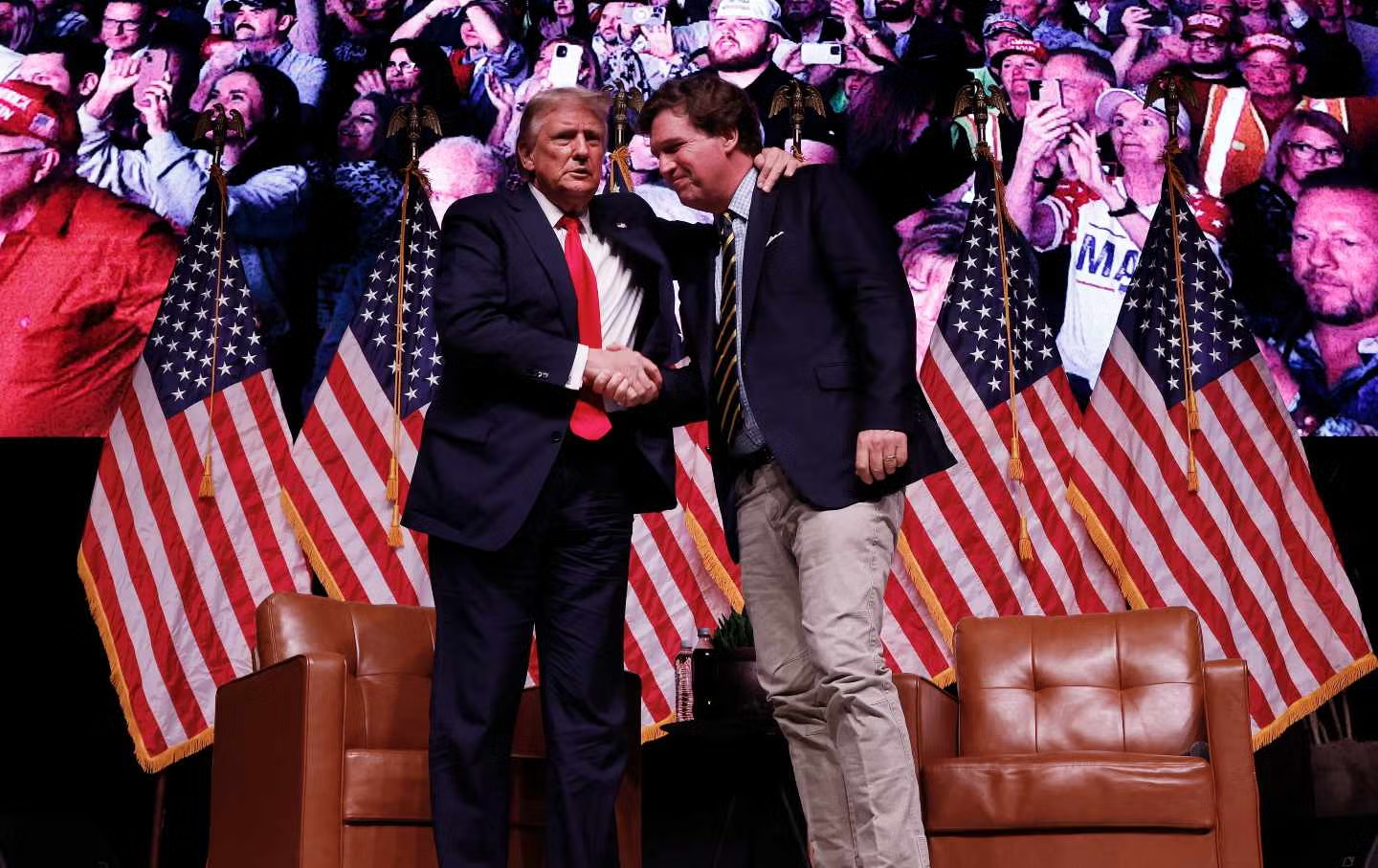
What Trump and Tucker Carlson Have in Common What Trump and Tucker Carlson Have in Common
Carlson has broken with Trump largely over the war in Iran. But on Ukraine and immigration, the two speak very much the same language.

The Jewish Case Against AI The Jewish Case Against AI
Haredi rabbis and the secular left agree: This technology is a threat to the entire social fabric.
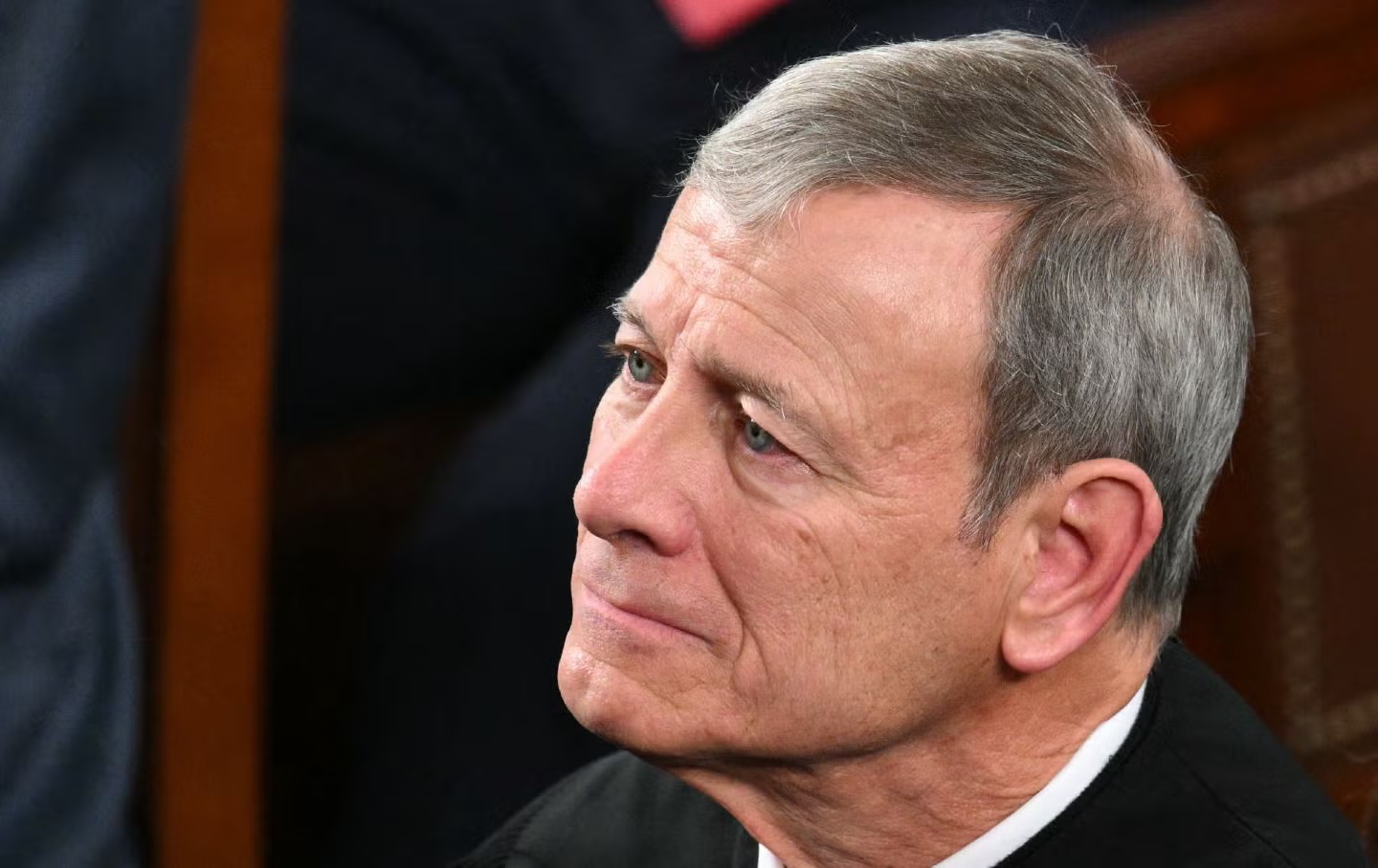
The Fight for Educational Equality Is Also a Fight for a Just Supreme Court The Fight for Educational Equality Is Also a Fight for a Just Supreme Court
The court has severely weakened our ability to make an education system that fulfills the promise of Brown.
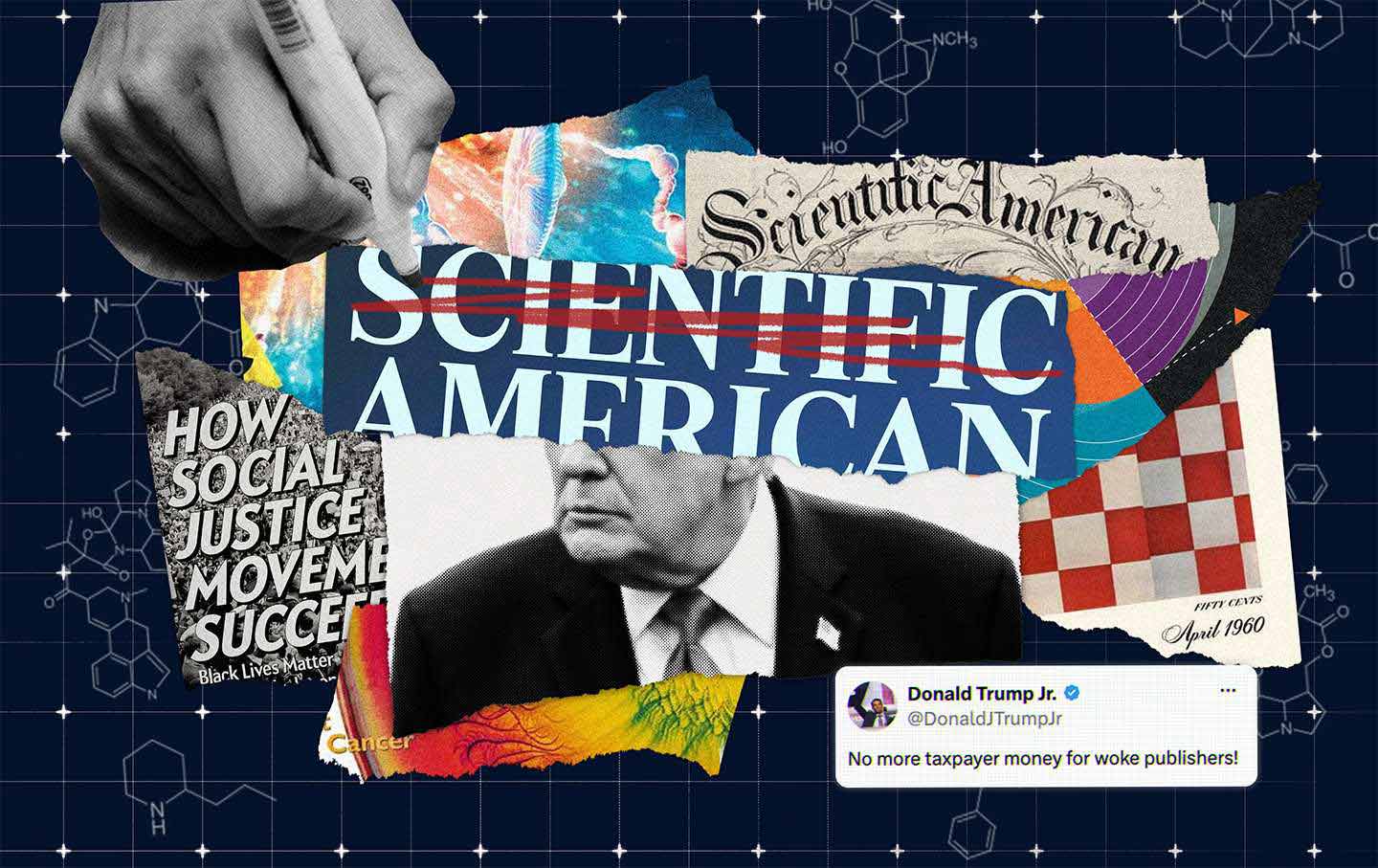
The Fall of “Scientific American” The Fall of “Scientific American”
When the beloved science publication got too political, its corporate owners stepped in. Now its future is uncertain.

The Bookstore Revolution in Taiwan’s Conservative Heartlands The Bookstore Revolution in Taiwan’s Conservative Heartlands
After Taiwan legalized same-sex marriage, gender-themed bookstores are working to build the social acceptance that the law alone couldn’t deliver.

