The Job of Being Jesse Jackson
Jackson’s lessons for today’s Democrats.
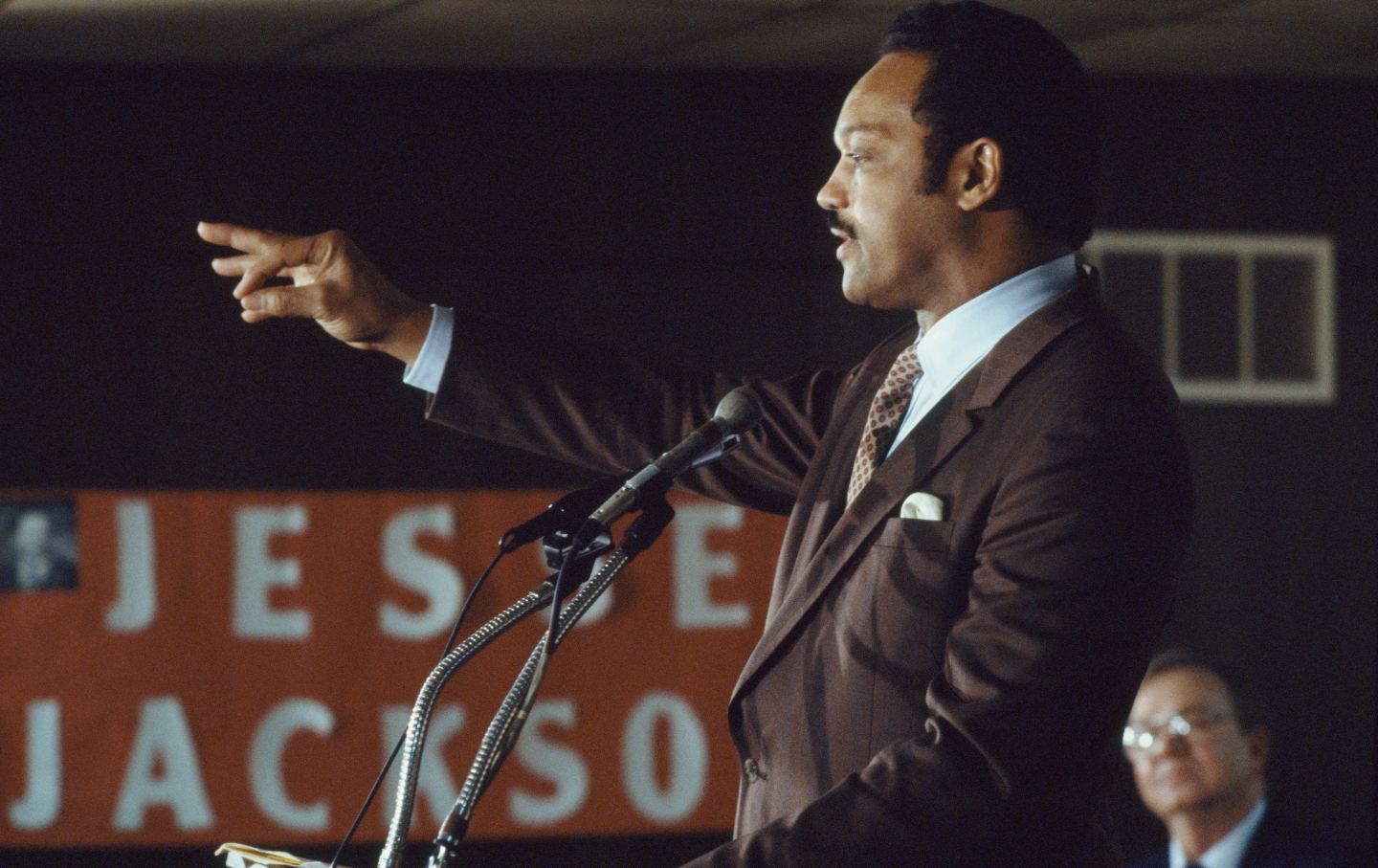
In 2000, I got to spend some intense hours with Jesse Jackson, when he and his son Jesse Jackson Jr., then in Congress, collaborated with me on a book about capital punishment. Commitments across the country kept the elder Jackson constantly on the road, so I would grab writing time with him in hotel rooms, airport lounges, breakfast joints.
It was the Bush-Gore presidential election year, and virtually every time I arrived Jesse was working the phone. I got to overhear a strikingly different style of persuasion from that of the stentorian public orator I’d intermittently covered. Jesse’s off-camera political voice was generally forbearing: quietly connecting, humorously cajoling, deal-making with the artful rhythm and grace of a choreographer. Jesse held in his head a map of the nationwide grassroots Democratic Party: Which clergy could turn out the church buses in East St. Louis? Which banker could arrange a campaign donation in Des Moines? Which union local could swing Maryland? Jesse knew all the players, knew the tone and the particular words that would stir each one to action. He was the great Democratic national chairman we never had.
Following Kamala Harris’s loss to Donald Trump, I thought often of Jesse’s relentlessly human-scale, ward-level organizing—especially when I looked at the 2024 election results in my own city of New Haven and realized just how dramatically Democratic turnout had fallen since 2020: another election lost, in the words of Jesse’s 1984 Democratic Convention speech, “by the margin of our despair.” Our present catastrophe is the sum total of tactics embraced by two generations of liberal campaign technocrats, their eyes on deep-pocket contributors and computer modeling, who willfully ignored the lessons of Jackson’s transformational and inclusive cross-class, cross-racial tree-shaking.
Jesse’s major-media obituaries make dutiful note of the complications and contradictions of his career. (The best assessment of much of the press coverage of his death can be found in Jesse’s own 1984 SNL opening monologue. Look it up.) But I’ve been thinking of the issues on which Jackson simply kept on keeping on, unshaken by shifts of political winds. One of them was capital punishment. By 2000, the Clinton administration had expanded the federal death penalty. Racially coded mandatory minimum sentences were adopted nationwide; criminal justice reform was dismissed, and soon September 11 would drive forward a new national race to the bottom in human rights. No politician had anything to gain then (or ever) from writing a book arguing for death-penalty abolition—let alone anything remotely like Jackson’s career-long investment of thousands of hours intervening for individual death-row prisoners in the US and overseas.
Jesse could read a room with extraordinary acuity. Like Babe Ruth pointing to the bleachers before hitting a home run, he would pick out which politician at a breakfast or rally was about to approach him for an autograph or a favor, and in my experience always called it right. But over those few months of our collaboration, I saw another side too: how on some days, just how hard it could be to be Jesse Jackson. He’d sometimes wake depleted, facing yet another 20-hour day, nerves abraded, circles under his eyes. His aides would coax him back into his suit and tie. But then he would step into the hotel hallway and instantly resume the job of being Jesse Jackson. He’d perfected this skill at instant transformation for the benefit of the chambermaid or porter who—every day, no matter where he was staying—would almost immediately approach him to share a moment of grace: a word or a touch or blessing from the man who had urged them to say aloud, “I am somebody.”