Bad Bunny’s Technicolor Halftime Stole the Super Bowl
The Puerto Rican artist’s performance was a gleeful rebuke of Trump’s death cult and a celebration of life.
Bad Bunny performs during the halftime show for Super Bowl LX at Levi’s Stadium on February 8, 2026.
(Stan Grossfeld / The Boston Globe via Getty Images)The past year in Stephen Miller’s America has been unbearably bleak. When masked thugs with “blanket immunity” kidnap 5-year-olds and murder nurses, it tends to darken the national mood. But international mega-star Benito Antonio Martínez Ocasio (aka Bad Bunny) took the stage during the Super Bowl halftime show and gave the best possible response to Miller’s dystopic dreams: a burst of unbridled joy and a dizzying celebration of love, labor, and the power of living our everyday lives despite hardships, all performed in a lyrical language that Miller, in every possible way, lacks the capacity to understand.
People should view Bad Bunny’s singular performance as the second part of a political two-step aimed at the white-nativist heart of this racist regime. Part one was a week ago, when, after winning the Grammy for album of the year, Bad Bunny began his acceptance speech by saying, “Before I say thanks to God, I’m going to say: ICE out!”—to rapturous cheers. It was an ingenious first step, teeing up the halftime show as a future instrument for broadcasting the anti-ICE fervor hitting red and blue states alike.
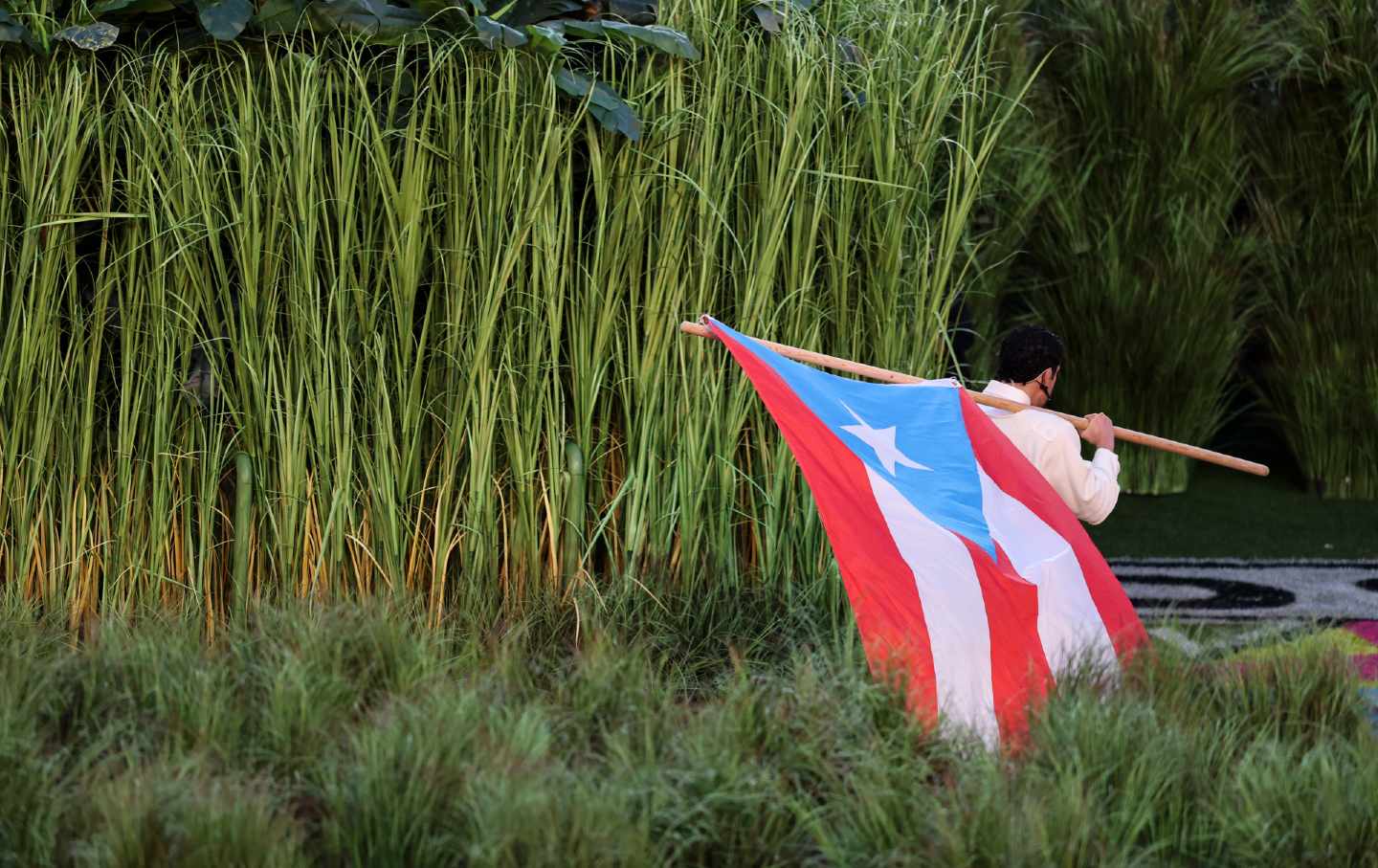
Then came step two: bringing the technicolor beauty of Puerto Rican culture to the Super Bowl stage. In a time of monsters, Bad Bunny was posing an alternative world: a place where laborers are seen and celebrated, where hurricanes and their victims aren’t forgotten, and where community—not atomization—fuels society. In the swirl of his irrepressible music, sung only in Spanish, and an elaborate set design that conjured the Caribbean in rich and playful detail, Bad Bunny refused to step into our dismal world. Instead, he brought us into his.
I saw the game in a bar, where the people watching around me initially seemed more interested in the halftime show because of the controversy around Bad Bunny’s selection as a performer—the prospect of his Spanish-only music had predictably enraged right-wingers and prompted them to launch a counter halftime show, which spectacularly failed. In 30 seconds, though, many were standing and dancing, everyone locked into every move on the stage. When Ricky Martin came out as a surprise guest, you could feel the room swoon. At the end, everyone rose in an actual ovation.
The performance was so dense with meaning that, during the fourth quarter, people around me turned to discussing what part of the show they connected with the most—and not only because that was more fun than debating whether the Patriots were going to punt again.
For me, the most powerful moment was when Bad Bunny name-checked, one after the other, every country in the Americas: a bold, delightfully unsubtle statement against white ethnocentrism and USA puffery. When Bad Bunny said during his Grammy speech, “We’re not savage, we’re not animals, we’re not aliens. We are humans, and we are Americans,” the “we are Americans” part had rankled some in immigrant rights circles because it seemed to differentiate the foreign-born. Bad Bunny’s rapid-fire listing—which pointedly did not ignore Cuba or Venezuela—could be seen as a response to that, telling Trump’s cruel regime that “America” is more than just the United States; it’s a region that goes from the top of Canada to the southern tip of Chile. The United States is a part of a community of nations—though it hasn’t been acting like it, instead targeting fishing boats off the coasts of other members of this community and blasting them from the sky like some fascist Death Star.
Bad Bunny’s performance will launch a thousand term papers intent on decoding every last moment, including when he gave a Grammy to a young child who had been watching from a staged living room seemingly set in Puerto Rico. Such a scene was particularly resonant knowing that, earlier in January, a 5-year-old boy from Minnesota named Liam Ramos had been abducted from his school by ICE and sent to a Texas detention center. Immediately after the show, people began debating online whether the child on stage was Ramos himself. He wasn’t, but it speaks to how deftly Bad Bunny pulled off his two-step that masses of people thought so.
In response, of course, Trump had a racist temper tantrum. Perhaps he was offended by a billboard in the background—in English, for his benefit—that read, “The only thing more powerful than hate is love.” For this cowardly regime, it’s now a political act just to acknowledge the cultural power of Puerto Rico, to speak a beautiful language, to sing, and to dance, and to live in peace.
During this show of shows, it was difficult to not think about a more serious moment at a recent Bad Bunny concert in Chile. There, the artist led the crowd in a song by legendary Chilean folksinger Victor Jara, who was something like the Bob Dylan of Chile, and whose songs of protest were known around the world. Shortly after the 1973 coup, Augusto Pinochet’s thugs mutilated his guitar-playing hands before the dictator executed him. Perhaps Jara’s most famous song was “El Derecho de Vivir en la Paz.” Bad Bunny had the entire crowd singing this 60-year-old song. For those who don’t know what it means, the title translates to “The Right to Live in Peace.”
One of Pinochet’s early orders was to paint over the vibrant, revolutionary murals of Chile, covering them in gray. Bad Bunny’s performance was an act of protest against such repression. It was the revenge of the muralistas. And not a moment too soon.
Correction: A previous version of this article misstated how Victor Jara died.