How to Survive in a House Without Walls
After their home was obliterated, Rasha Abou Jalal and her family remain determined to build a new one, even if it must be built out of nothing.
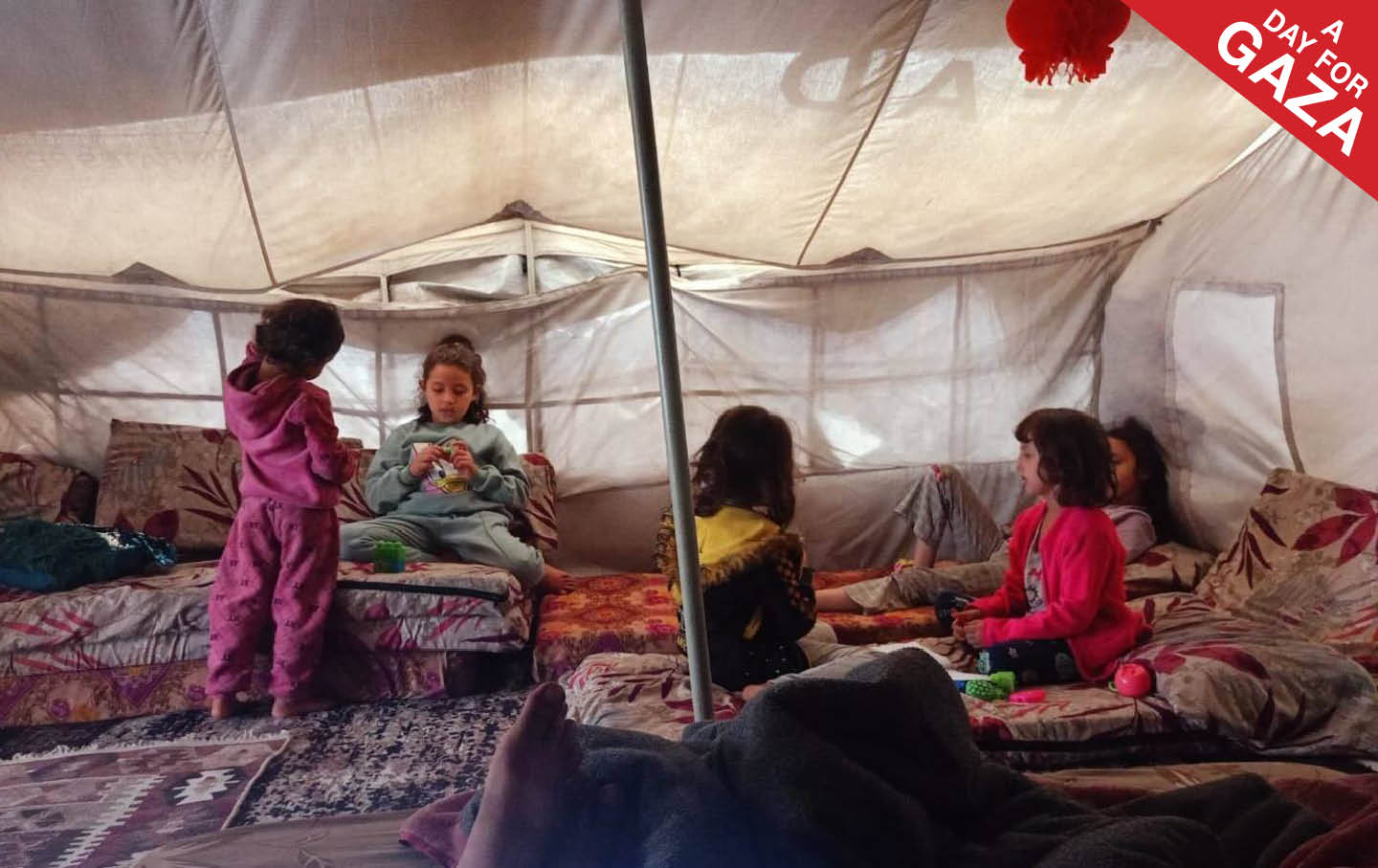
This tent was what passed as a home for Rasha Abou Jalal and her family when the ceasefire began in October 2025.
(Rasha Abou Jalal)This piece is part of A Day for Gaza, an initiative in which The Nation has turned over its website exclusively to voices from the Gaza Strip. You can find all of the work in the series here.
We—my husband and our five children—did not return home this past October, after a ceasefire paused the bloody Israeli war that stretched for two years. There was, to be more precise, no home to return to; it was obliterated in the first weeks of the war. No traces remain. We have only the memories now.
As of this writing, we have settled in a rented house in the south of Gaza City—though “house” is a generous description. It is the remnants of a home. There are no walls here; it is a shelter that itself seems ambivalent toward our habitation. Our children run wild through a living room that opens directly onto rubble, so the threat of their falling through the ruins is always imminent.
I still remember my husband’s gaze as we prepared to move into the house. Looking around, he said, “We can’t possibly live here, but we’ll build a home, even if it must be built out of nothing.”
A Day for Gaza
-
A Ceasefire in Name Only
-
The Gaza Street That Refuses to Die
-
A Catalog of Gaza’s Loss
-
My Sister’s Death Still Echoes Inside Me
-
What Gaza’s Photographers Have Seen
-
How to Survive in a House Without Walls
-
What Edward Said Teaches Us About Gaza
-
What Happens to the Educators When the Schools Have Been Destroyed?
-
At the Doorstep of Tomorrow
-
“We Have Covered Events No Human Can Bear”
He began gathering old scraps of wood and nylon. Enlisting the help of a few friends who were craftsmen, he fastened wooden planks to the wall and stretched nylon over the hollow gaps, creating a makeshift cover to protect our children.
The walls are flimsy, trembling violently in the breeze. But this is all we have. Despite the ceasefire, Israel has prohibited building materials from entering the Strip. There is no cement, no steel, no real tools to build with.
Still, my husband didn’t wait. He kneaded red clay with water and, with the help of those same friends, pasted the mixture over the holes that had formed in the corners of our home.
I watched him carefully smooth the cement, patchworking gravel in the little crevices. “Will it hold?” I asked.
Without looking up, he replied, “What’s important is not whether this will hold, but whether we will.”
Every detail of this home is imprinted with memories of displacement. The nylon that drapes the walls recalls tent shelters, the wooden planks the long nights out in the cold, and the red clay the ground where we pitched the tents that flooded with every rainfall. Twelve times we were forced to move, each time fleeing toward the same, singular mirage: safety. We have spent so long living among stopgaps, it has become difficult to imagine our lives as anything more than provisional.
Because of the Israeli blockade, we are left to rebuild our lives with the crudest of devices, as though what follows a genocidal attack on our land is a test. To survive now, we must prove that we are deserving of life at its most primitive. With every repair, it is as if we are asking permission for a permanence that may one day allow us to build a home that preserves our dignity.
In late December, heavy rain fell across Gaza City. As we watched the sky from our home, a tentative knock came at the door. My brother-in-law and his family stood there, soaked and weary, holding in their arms their children and the few clothes they owned.
Their tent, at a shelter site west of Gaza City, had been swept away by the rain. The dirt beneath it had sunk amid the downpour, and the nylon could not hold against the wind. Our home, already too small to hold the seven of us, had suddenly turned into a refuge.
My sister-in-law, sitting on the ground, pressed one of her children against her chest, trying desperately to warm them. Her body trembled. I asked her, calmly, “What happened, exactly?” She sighed. “The rain came all at once; water seeped in from underneath the tent. We tried to lift the covers, to pull the ropes tight, but the ground had already turned to mud.”
She fell silent for a second, then whispered, “When the tent collapsed, I didn’t have a thought—I grabbed the children and ran.” I asked her if she had saved anything. “No, the blankets were flooded, the mattresses were soaked, even the food spoiled.”
In this home, there is no space to spare, no real rooms, and the cold seeps in through every crevice. Despite that, we spread out across the ground together and shared what little we had of blankets, bread, and warmth.
My sister-in-law looked around and said, “Your home is small, but it saved us.”
I didn’t know what to say. The house we live in is falling apart, a shelter that requires daily repair. But in Gaza, we have stopped asking whether one has enough. The question now is only whether you can share what little you have.
We didn’t sleep well that night. The children were restless, and the sound of rainfall lasted until morning. Lying there, I thought of the thousands of families who had no door to knock on.
The tent, a temporary refuge, had become a threat. It took only rain to lay bare how fragile all of this was. Aid remains insufficient; our shelters are unsafe. We live a life deferred. Rain was once a merciful thing. Now it exposes the extent of our deprivation.
In Gaza, we exist in an interim. The impermanence of our lives has forced us into a state of constant apprehension. Even food demands an intolerable patience. Cooking gas is not available in the Strip, so we’ve been forced to build a clay oven in the corner of our home. For hours, I stand by a fire, cooking whatever food has been made available to us. Over and over, I feed wood into the opening, stir the pot, watch clouds of smoke rise and disappear. Most residents depend on such a clay oven, and so the smell of burning wood has become ubiquitous.
When the flames flare up, a thick smoke shrouds the room. This cloud must, of course, enter my lungs before it can exit through the window. Without fail, I choke, step back for a moment to catch my breath, and return again. Gasping for air, I wonder every time whether even food now demands a breath longer than I can manage.
This daily ritual is not a choice; it’s the direct consequence of a deliberate policy. Israel denies the entry of cooking gas so that our lives remain suspended over fire, wood, and smoke.
The small quantities allowed into the Strip force an untenable financial decision. Before the war, a kilo of cooking gas was 20 shekels; today it is more than 100. It’s a price most families in Gaza cannot afford, particularly after their savings were drained by the war—an economy of destitution that has made cooking itself a health hazard.
Not that there is much food for us to cook. Despite the ceasefire, Israel continues to limit the entry of food aid and other basic necessities into Gaza. As a result, hunger has become more regular than bombardment. Harsher, perhaps, in its silence and its protraction.
Over the months, the realities of this siege have crept across the Strip and into our home, even into my sister’s womb.
In the middle of December, my sister gave birth to a child a few days earlier than she was expecting. Immediately, his cry was not as it should have been; his screams did not fill the room the way a newborn’s usually do. They were debilitated and fitful, as if he were apologizing for entering a world that had nothing for him.
The room fell silent after the midwife placed him on the scale. His weight was far from healthy. Startlingly thin, he weighed just over three and a half pounds. It appeared as though his skin had been pulled tight over tiny, underdeveloped bones.
The doctor looked at my nephew, and then back at my sister’s washed-out face. “This child suffered from malnutrition inside the womb. His condition is fragile. Any simple infection could threaten his life.”
My sister looked at me with eyes drowned in fear. “I could feel he was exhausted inside me,” she said. “I couldn’t eat. We lived through months of harsh hunger. Weeks went by when I couldn’t get enough food.”
Her pregnancy had coincided with the worst months of the famine, between March and October 2025. My sister lived on two inadequate meals a day: lentils, dry bread, sometimes only tea to quiet her hunger. Like any pregnant woman, she needed milk, vitamins, and prenatal supplements, all of which had vanished or were impossible to obtain. Even clean drinking water was not consistently available.
After his birth, my nephew was placed in an incubator inside a crowded hospital ward. There were barely enough machines for the newborns, and electricity was sporadic. My sister reached into the incubator and placed her finger in her baby’s palm. He held on with such unexpected strength, as if stubbornly clinging to life.
His story is not an exception. In October alone, according to UNICEF, 9,300 children in Gaza were admitted for treatment for acute malnutrition. These numbers become faces in our homes: small bodies shivering in incubators, and mothers burdened with guilt because the siege has outpaced their ability to protect their children.
Today, my sister’s baby sleeps wrapped in a piece of cloth much larger than his little frame. Winter is here and every breath is measured, every day another test of survival. We are not asking for a miracle. We ask only for enough food, for milk, for something besides hunger to greet our children in this wicked world.