Mamdani Goes From a Winter Storm to a Fiscal One
The mayor publicizes a $12 billion hole in New York’s budget over the next two years—and draws some political battle lines.
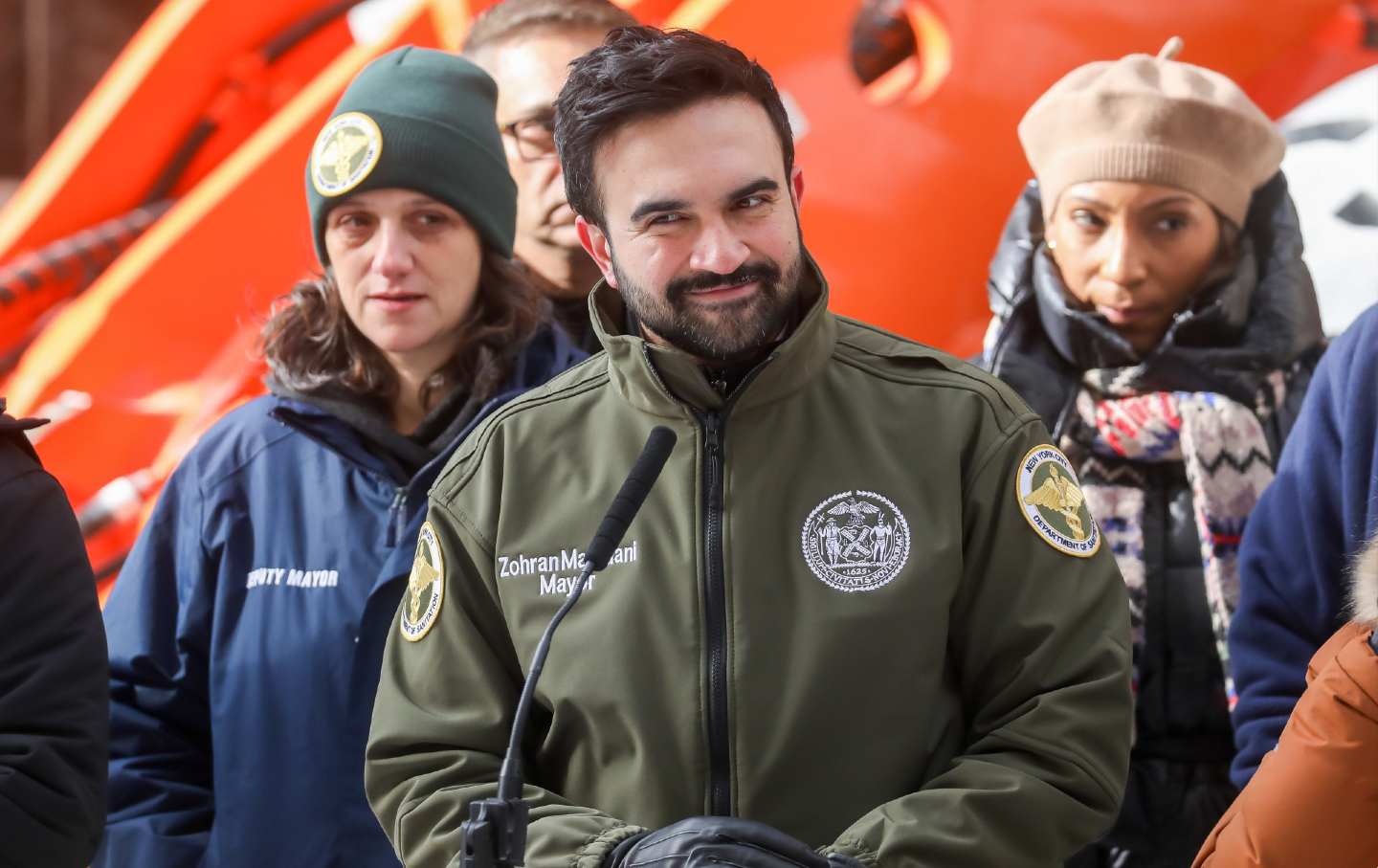
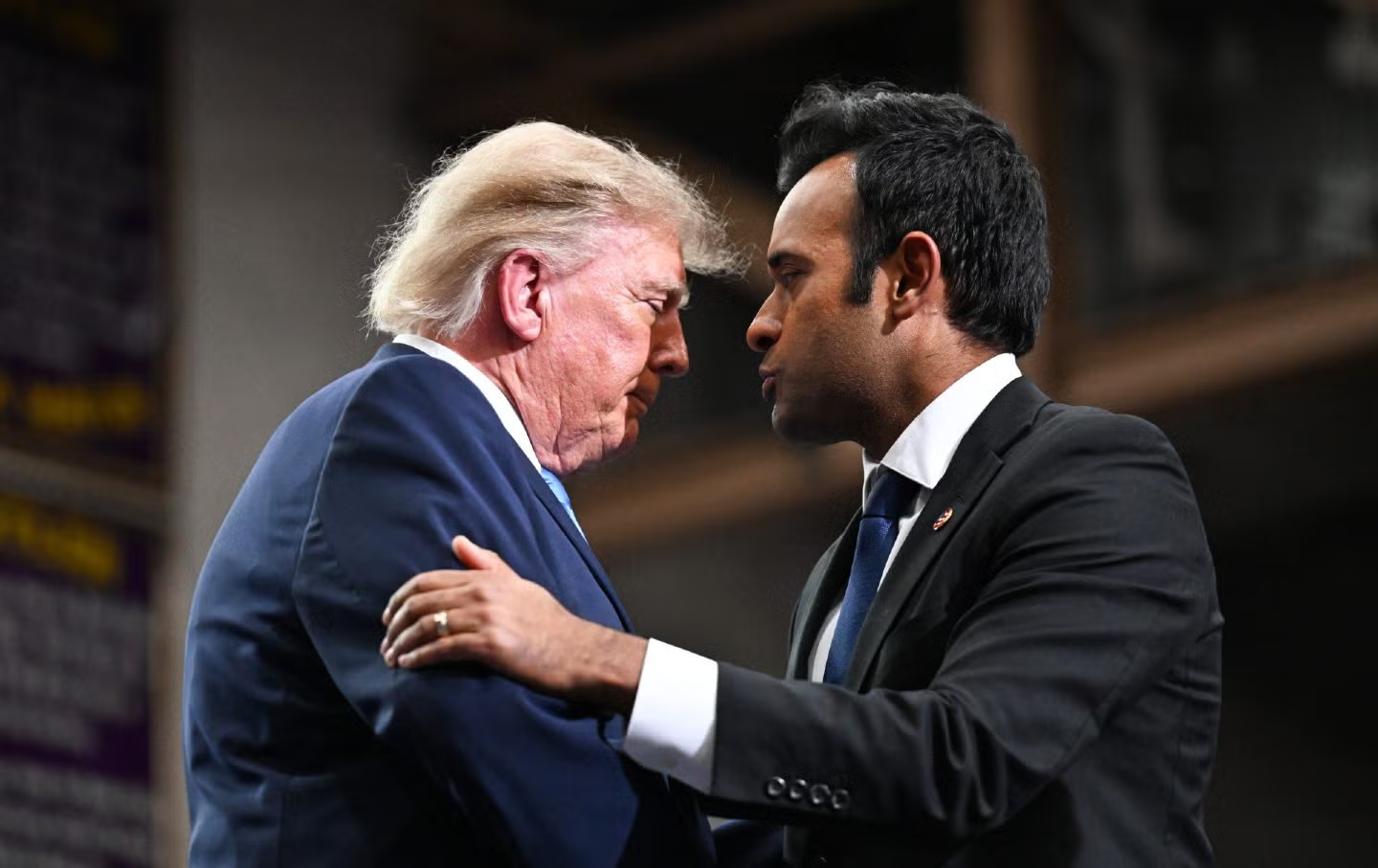
Zohran Mamdani gives a press conference on New York’s preparations for last week’s snowstorm.
(Michael Nagle / Bloomberg via Getty Images)The honeymoon is officially over.
That was the deeper meaning of Mayor Zohran Mamdani’s somber Wednesday morning City Hall press conference disclosing the not-exactly-shocking news that New York faces a $12 billion hole in the city’s finances over the next two fiscal years. The budget gap itself was old news, disclosed first by Comptroller Mark Levine nearly two weeks ago—in an announcement whose details owed much to his predecessor, former comptroller Brad Lander’s final report, which had projected “a $2.18 billion gap for FY 2026…a gap of $10.41 billion [in FY 2027], $13.24 billion in FY 2028, and $12.36 billion in FY 2029.”
Lander’s mid-December warning drew little coverage—apart from a New York Post editorial board’s crowing that the looming deficits “will surely dent Mayor-elect Zohran Mamdani’s freebie-filled socialist agenda.” But the mayor’s dramatic tale of his predecessor’s fiscal fiddling was designed with a clear political agenda in mind: both to underline the magnitude of the problem and to identify the villains responsible for this perfidy. “In the words of the Jackson 5, ‘it’s as easy as ABC,’” said the mayor, reprising a tune from his interview earlier in the week with ABC’s Jonathan Karl. “This is an Adams Budget Crisis.”
I’ll leave it to younger Nation readers to decide whether our code-switching mayor’s allusion was designed, as Gothamist suggested, to appeal to the aging boomers “most likely to care deeply about the details behind a major financial issue” or a callout to the TV network getting an early look at his next moves. In any event, as Mamdani stood in the Blue Room on Wednesday—his third formal press conference in as many days—flanked by First Deputy Mayor Dean Fuleihan and Budget Director Sherif Soliman, the scale of the problem was crystal clear. Accusing Eric Adams of having “underestimated known expenses” so he could claim that the city’s budget would balance—as it is required to by law—the mayor explained that “these are not differences of opinion between accountants. They are measured to the tune of more than $7 billion beyond what he published.”
“This is not just bad governance,” Mamdani continued. “It is negligence,” adding that “once we looked under the hood [of the city’s finances], the full picture was staggering.”
Nor was Adams the only culprit. Using charts and graphs to detail what he called a 10-year period during which the state “extracted our city’s resources,” Mamdani broke his self-imposed ban on uttering Andrew Cuomo’s name. “In fiscal year 2022 alone, the city sent $68.8 billion to Albany and got back $47.6 billion,” Mamdani said. Blaming his former rival for this “$21 billion chasm” constricting what New York City can spend on services for its citizens, the mayor described Albany’s approach as “punishment.”
“New York City is facing a massive fiscal crisis,” declared the mayor. Addressing it would require “recalibrating the broken fiscal relationship between the state and the city.”
But when reporters pressed him for details on what that recalibration might look like—or, given Governor Kathy Hochul’s declared opposition to raising taxes (especially while she’s running for reelection), whether he had a Plan B—the mayor declined to go beyond citing what he described as “encouraging” conversations with the governor and legislative leaders in Albany.
Nor would the mayor provide specifics on which city programs he’s prepared to sacrifice—however reluctantly—though some of these prospective cuts will doubtless be leaked between now and February 17, when the city will release its preliminary budget.
Still, for a mayor and an administration that has spent the first half of this week celebrating their largely successful navigation of the city’s worst snowstorm and cold spell in years, it was a sharp change in tone. Keeping the streets plowed isn’t exactly rocket science. But it is a challenge that some of Mamdani’s predecessors have notably—and publicly—failed to meet. And as the political scientist Christina Greer recently noted, “if you can’t clear the bar that is the baseline, then I think we know where we are.”
By the time Eric Adams got indicted, New Yorkers had learned not to expect much from his administration. And though Andrew Cuomo did a better job of maintaining the illusion of competence, he also offered little hope of addressing the city’s long-festering crises of affordability, inequality, and the decades of decline in the quality of city services.
Mamdani promised an urban renaissance. And though the magnitude of the city’s fiscal difficulties may have come as a surprise to him, it shouldn’t have. Because Andrew Cuomo wasn’t the only governor bleeding the city to fund Albany’s priorities. It was Kathy Hochul who decided to retain the Enhanced Federal Medical Assistance Percentage funds that the city uses to offset its share of Medicaid costs. She also raised the city’s contribution to mass transit costs by more than half a billion dollars a year, and held back—you might even say “extracted”—a hefty percentage of the city’s share of education funding, while also leaving New Yorkers on the hook to pay for more charter schools. Yet Hochul’s name never figured in Mamdani’s indictment.
But they say you catch more flies with honey than vinegar, and if Mamdani is going to have any hope of sweet-talking the governor into letting him raise the billions required to plug the budget gap by actually fulfilling his campaign pledge of increasing taxes on the wealthiest New Yorkers, he’ll need to deploy all of his considerable stores of charm. Asked several times on Wednesday what would happen if he can’t get that permission, the mayor repeatedly failed to answer.
Popular
“swipe left below to view more authors”Swipe →Which was also smart politics. Taking a small victory lap on Monday, Mamdani declared that “our city is up and running, thanks to the plans we put in place and the countless city workers who delivered on them.” Like this week’s big snow, the big hole in the city’s budget came with plenty of warning. In the weeks to come, we’ll find out whether here, too, City Hall has a plan in place to ride out the storm.