
After Every Clue
Laura Poitras and Mark Obenhaus’s Cover-Up and the scoops of Seymour Hersh
The Endless Scoops of Seymour Hersh
Laura Poitras and Mark Obenhaus’s Cover-Up explores the life and times of one of America’s greatest investigative reporters.
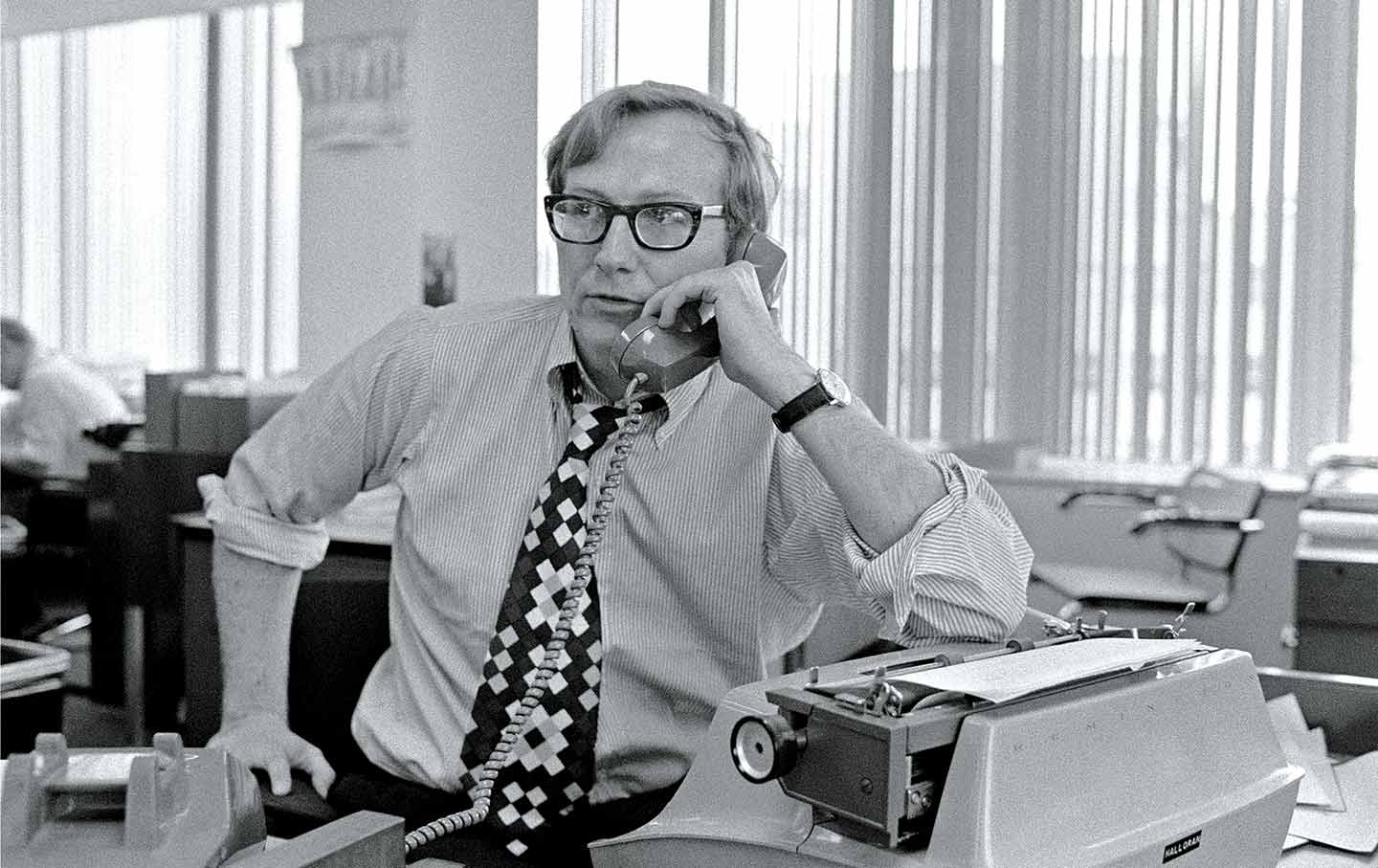
Seymour Hersh during his New York Times days.
(Wally McNamee / Getty)
Near the beginning of Cover-Up, the absorbing new documentary by Laura Poitras and Mark Obenhaus, there’s a shot of a Pentagon press briefing during the Vietnam War era. Still cameras click, movie cameras roll, and the auditorium’s seats are filled with reporters. Everyone is focused on the man at the podium, Defense Secretary Robert McNamara. The scene is a reminder that most journalists practice herd behavior. You write or broadcast what was said at the briefing, because if you don’t, your editor will berate you: “Hey, the rival newspaper [or rival network] just reported that McNamara said we’re winning the war. Why haven’t we heard that from you?” Whether covering City Hall or a state capital or the White House, every reporter worries about getting such a call. Yet in the end, the briefing is seldom the story that matters.
If there has ever been a reporter who refused to practice herd behavior, it is the subject of Cover-Up, Seymour Hersh. “When I was at the Pentagon for the AP,” he tells Poitras and Obenhaus, recalling his early reporting days during the Vietnam War, “instead of going to lunch with my colleagues, I’d go find young officers. You know, talk a little football, get to know them…. Eventually, Army guys would start saying, ‘Well, it’s Murder, Incorporated’” over there in Vietnam. Before long, Hersh had parted ways with the Associated Press (he would later do the same with The New York Times and would cease publishing in The New Yorker), but he was also about to break the story of the My Lai massacre, the deliberate slaughter of several hundred Vietnamese civilians—men, women, and children—in 1968 by US troops. The exposé would provide a huge boost to the anti-war movement. It would also launch Hersh’s career as one of the greatest investigative reporters this country has ever seen.
Cover-Up provides a vivid picture of Hersh at work. We learn how he tracks down every clue, whether by showing up at someone’s home unannounced, befriending an Army officer or a CIA agent with a guilty conscience, or taking notes on a document he’s viewing upside down, on a lawyer’s desk, while the lawyer thinks Hersh is jotting down what he’s saying. Skillfully leaping back and forth across decades, Cover-Up weaves together archival footage, interviews with an often reluctant Hersh, and shots of him in action, usually on the telephone. We also hear him discussed by others, including President Richard Nixon. (“The son of a bitch is a son of a bitch,” Nixon says of him to Henry Kissinger. “But he’s usually right, isn’t he?”) Hersh resisted Poitras’s requests to make a film about him for nearly 20 years before he finally gave in—and in the film, we even see him on camera trying to back out later. He comes across as extremely private, prickly, hyper-alert to lies, and relentless.
Cover-Up touches lightly—perhaps too lightly—on the more recent work that Hersh has been criticized for. This includes being soft on former Syrian dictator Bashar al-Assad (“I never thought he was Mother Teresa,” Hersh admits to the filmmakers, “but I thought he was OK”) and several major stories that relied on one or two anonymous sources that couldn’t be corroborated, such as Hersh’s assertion that the United States blew up the Nord Stream pipelines that delivered Russian gas to Germany. There have been some other questionable moments as well, but in a stellar career that has spanned more than 60 years, they can be forgiven.
Cover-Up has visual and auditory treats for those of us old enough to remember the days when we reporters wrote on manual typewriters and sent our stories to a newspaper’s typesetters in pneumatic tubes. But the film by no means romanticizes the news business; its eye is always on Hersh’s resistance to the herd behavior showcased in that early scene. “The biggest trouble I had was managing Sy at a newspaper that hated to be beaten but didn’t really want to be first,” explains Bill Kovach, the former New York Times Washington bureau chief. “The Times was scared to death of being first on a controversial story that challenged the credibility of the government.”
As it turned out, the newspaper had other fears as well. “That was the beginning of the end with me at The New York Times,” Hersh recalls, “when I started writing about corporations.” To give the Times a little credit, it did publish some of those stories. But it is impossible to imagine the stubbornly independent Hersh remaining long at any established news organization that tried to rein him in.
Following Hersh’s career from the tiny Dispatch News Service (which published the My Lai story) to The New York Times, The New Yorker, and the 11 books he’s written, Cover-Up reveals just how he got crucial evidence for a particularly important story from the 2000s: the one that documented how US troops had horrifically abused and tortured inmates at the Abu Ghraib prison in Iraq. Anyone who watched the media then will remember the shocking photographs of Iraqi prisoners—one with a leash around his neck; another, naked and cowering, being threatened by an attack dog; another, hooded, standing on a box with electrical wires attached to his hands; another, bent over and chained to a cell door. “If there hadn’t been photographs… no story,” Hersh remarks in the film.
How did he get them? On a radio show, Hersh invited people with information to contact him and then provided his telephone number. One woman called. Her name was Camille Lo Sapio, and she goes public for the first time in Cover-Up. Lo Sapio explains that she had lent her laptop to a former daughter-in-law who was deployed to Iraq. When the computer was returned, she found those photos on it.
One of the film’s final scenes is particularly haunting. Hersh is at home, looking at a table covered with photos of large, rough diagrams, hand-drawn with a thick marker pen, of houses and apartments in Gaza. Some of the diagrams appear to have been drawn on paper, some on walls, and several on sheet metal with bullet holes in it. Hersh is on the phone with the woman who has sent him these images. We hear her voice, lightly accented, as she explains that this is “a record of massacres that we can basically trace back to the units that committed the war crimes.” The woman isn’t named—is she Palestinian? Israeli? She asks to be identified in anything he will write as merely “a researcher recently returned from Gaza.”
At one point, Hersh asks her about the diagrams: “This is all background? I’m not allowed to write any of this?” The woman replies, “For now. But you’ll be the person I come to when we’re ready.”
As admirable as Hersh and this expertly crafted film about him are, in one way Cover-Up feels slightly dated, like those manual typewriters and pneumatic tubes we see on-screen. At the time of Hersh’s greatest achievements—the My Lai and Abu Ghraib exposés and a dozen other stories in between, such as Henry Kissinger’s support for the murderous 1973 coup in Chile—revealing the blatant violation of laws and ethical standards still had the power to shock us, and to spur outrage, demonstrations in the streets, even congressional investigations.
Is that still so today? In the week that I’m writing this, President Trump welcomed Saudi Crown Prince Mohammed bin Salman to the White House with trumpeters and an F-35 flyover—the man who, US intelligence determined, had ordered the 2018 murder and dismemberment (with a bone saw) of the critical journalist Jamal Khashoggi inside the Saudi consulate in Istanbul. When a White House reporter from ABC asked bin Salman about the brutal assassination, Trump attacked her for trying “to embarrass our guest.”
Popular
“swipe left below to view more authors”Swipe →That same week, it was reported that the US Coast Guard would consider the display of the Nazi swastika or the hangman’s noose as merely “potentially divisive” rather than as hate symbols. Under criticism, officials later backtracked. Also before backtracking, President Trump called for six Democratic members of Congress to be arrested and executed.
Every week brings similar examples. What once would have shocked us profoundly has been normalized; Trump and the climate he has fostered has hardened us. It is as if the value of shock, of the revelation of evil, has been diminished by runaway inflation.
There is another source of inflation as well. With the proliferation of smartphones and the pictures they take, do images still have the power to shock us and move us to action, as did those of My Lai and Abu Ghraib? We’ve seen untold thousands of photos and video clips of the destruction of Gaza and the suffering of its people, in painfully graphic detail. Yet we have let this mass murder go on with American weapons, under two presidents, for two years. And finally, today, we all increasingly do not know whether the image or video we’re looking at is real or generated.
This does not mean that we shouldn’t take inspiration from the life of someone like Seymour Hersh. But it does make the kind of work he’s done more difficult than ever. It means not only revealing the injustice that those in power don’t want revealed but also telling that story in a way that can break through the newly hardened shell around our hearts.
More from The Nation

The Culture of Experts and the Rise of MAHA The Culture of Experts and the Rise of MAHA
The left won’t win over rural Americans by condescending to them.
What’s It Like Inside a Data Center? What’s It Like Inside a Data Center?
Northern Virginia is laden with structures that house data for Fortune 500 companies. I went inside just one of those monstrosities that bothers its neighbors.
What Trump and Tucker Carlson Have in Common What Trump and Tucker Carlson Have in Common
Carlson has broken with Trump largely over the war in Iran. But on Ukraine and immigration, the two speak very much the same language.
The Jewish Case Against AI The Jewish Case Against AI
Haredi rabbis and the secular left agree: This technology is a threat to the entire social fabric.
The Fight for Educational Equality Is Also a Fight for a Just Supreme Court The Fight for Educational Equality Is Also a Fight for a Just Supreme Court
The court has severely weakened our ability to make an education system that fulfills the promise of Brown.
The Fall of “Scientific American” The Fall of “Scientific American”
When the Trump administration objected to the magazine's political coverage, its corporate owners stepped in. Now its future is uncertain.

