In America, Mass Shooting Survivors Can Never Know Peace
A growing number of US residents have lived through more than one massacre.
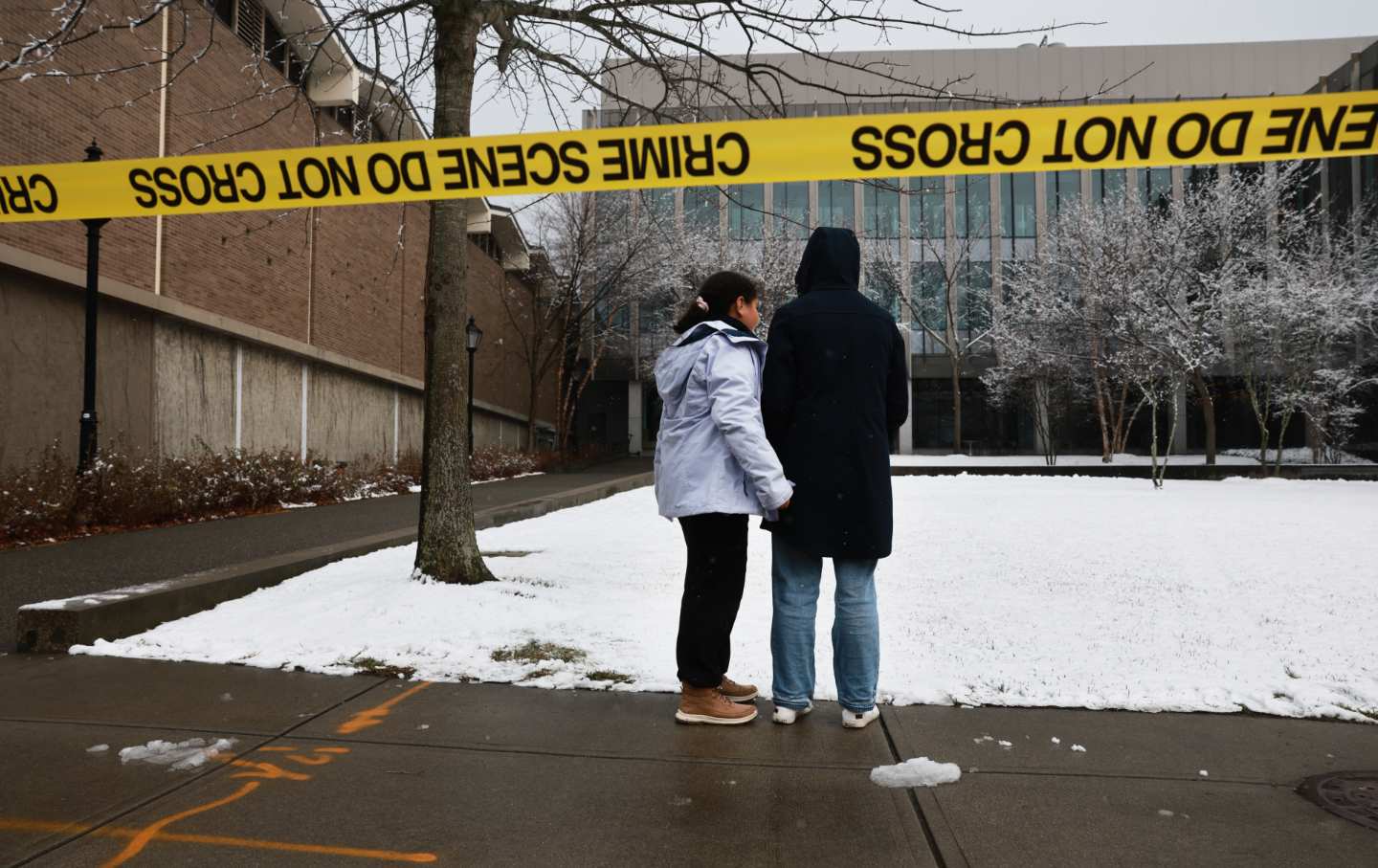
People pause outside of the engineering and physics building at Brown University, the site of a mass shooting that left at least two people dead and nine others injured the day before, December 14, 2025, in Providence, Rhode Island.
(Spencer Platt / Getty Images)On Saturday, Mia Tretta, a junior at Brown University, survived her second school shooting. Her first brush with death was a close one. In 2018, when she was 15, Tretta was shot in the abdomen during a shooting at Saugus High School in Santa Clarita, California, that killed two students murdered and injured two others. Then, over the weekend, she was one of hundreds of Brown students, faculty, and staff who were traumatized by a gunman whose spree left two dead and nine injured.
As Tretta told Spectrum News, “No one should ever have to go through one shooting, let alone two. She added, “I chose Brown, a place that I love, because it felt like somewhere I could finally be safe and finally, you know, be normal in this new normal that I live of a school shooting survivor. And it’s happened again.”
It would be a mistake to simply think of Tretta as particularly unlucky. In fact, she belongs to a growing community of US residents who have survived more than one mass shooting. She’s not even the only Brown student in this disturbing category.
In 2018, when she was 12 years old, Zoe Weissman was a student at Westglade Middle School, which is adjacent to Marjory Stoneman Douglas High School in Parkland, Florida. A shooting at the high school resulted in 17 dead and 18 injured. Another Parkland survivor would be further traumatized by a mass shooting at Florida State University.
On X, Weissman posted,
When I was 11, I told myself I’d never go through a school shooting. When I was 12, I told myself it would never happen again. Now I’m freshly 20, and I’ve once more been proven wrong. First Parkland, now Brown University. My safe haven away from my trauma.
Right-wing media influencer Nick Sortor, who has participated in a White House propaganda event on the putative dangers of left-wing extremism, challenged Weissman by asking how she could have been in high school at age 12. Sortor didn’t do the elementary research needed to discover that Weissman’s middle school was affected by the Parkland massacre.
Sortor is obviously a bad-faith actor, but he’s trying to exploit a wider ignorance of how pervasive mass shootings are—and how many times the same people survive multiple sprees.
In 2023, CNN reported,
Some Michigan State University students who survived Monday’s mass shooting—and their parents—had already been through a similar, horrific experience.
“(Fourteen) months ago I had to evacuate from Oxford High School when a fifteen year old opened fire and killed four of my classmates and injured seven more. Tonight, I am sitting under my desk at Michigan State University, once again texting everyone ‘I love you,’” Emma Riddle, a freshman studying history at the university tweeted overnight Monday. “When will this end?”
The BBC has also reported on other cases of people surviving more than one mass shooting. As the BBC notes, “For those who have witnessed more than one instance of gun violence in their lifetime, there comes an even greater risk for serious mental health issues like depression and post-traumatic stress disorder.”
Mass shootings can happen anywhere, as the horrific antisemitic attack at Australia’s Bondi Beach that left 16 dead and 42 injured this weekend shows. But it is a simple fact that they happen with particular frequency in the United States thanks to the ready availability of guns. As the American Journal of Public Health documented in 2017, “Mass shootings occur worldwide but are a particular problem in the United States. Despite being home to only 5% of the world’s population, roughly 31% of the world’s mass shootings have occurred in the United States. As of 2015, a mass shooting resulting in the death of four or more people occurred approximately every 12.5 days.”
The testimonies of Mia Tretta and Zoe Weissman help illuminate how pervasive and damaging American gun culture is. They are survivors turned activists who have used their experience to advocate for gun control, but their fundamental optimism has been betrayed by a gridlocked political system that refuses to tackle this problem. With their youthful faith in a better world, these students hoped to find a haven in Brown University. What they’ve learned instead is that contemporary America provides no real respite for the traumatized. The fact that they’ve had to experience the horrors of mass shootings twice while still very young is as stark a condemnation of the status quo as one could make.