
The Supreme Court’s Shadowy Plan to Subvert Democracy
In making frequent, ill use of the “shadow docket,” the high court is not just handing Trump policy victories. It’s upending the rule of law.
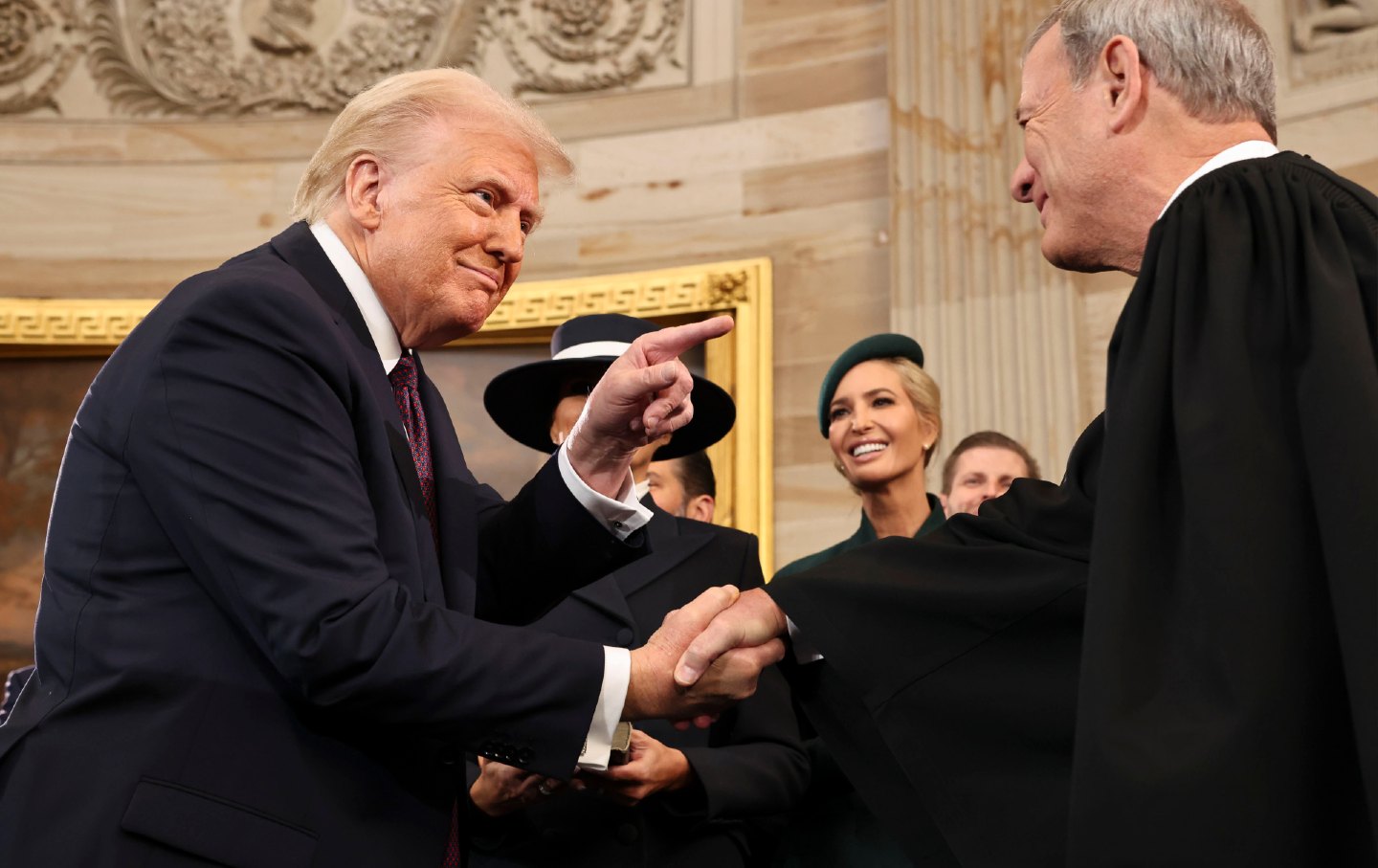
Courts play an important role in authoritarian regimes. They legitimize the actions of despots by declaring them “legal” or “constitutional.” They ensure institutional compliance with the regime’s rules. And they make politically unpopular decisions that align with the authoritarian’s goals while giving the authoritarian political distance from those goals. Quite simply, you can’t instigate a strongman takeover of a constitutional democracy without having a robust judicial power that’s willing to play along.
In the United States, Donald Trump’s regime has found its willing wingman in Chief Justice John Roberts and the other Republicans on the Supreme Court. The Roberts court is game to do everything Trump wants it to do and, as an added bonus, to do most of it in secret, under cover of what’s known as the shadow docket.
The “shadow docket” is the colloquial term for the court’s emergency docket—those cases for which the court, at the request of a litigant, issues expedited rulings and does so without a full briefing from the lawyers involved or a full hearing on the issue at hand. The emergency docket is supposed to be used for, well, emergencies: cases that require an immediate response to avert irrevocable harm. The classic emergency-docket case is a death-penalty appeal. A person set to be executed in the morning cannot wait for the court to consider their appeal in a year and a half.
Technically, shadow-docket rulings are supposed to be temporary, pending a full hearing by the court on the merits of the case. In reality, many are final, because the harm the Trump administration does in the interim cannot be easily undone. If the court temporarily approves Trump’s right to fire you or cut off your food or bomb your boat, it’s hard to undo those actions a year later, when the court considers the merits of your unemployed, starving, charred case.
Many court watchers have sounded the alarm over the Supreme Court’s use of the shadow docket in recent years—notably, since 2017, when Trump arrived at the White House. Until then, it was exceedingly rare for a president to make an emergency appeal to the Supreme Court. During their respective terms (for a total of 16 years), George W. Bush and Barack Obama each made only eight emergency appeals. Trump, by contrast, made 41 in his first term. Joe Biden made 19 over his four years in office, a number that the second Trump administration matched in just its first 20 weeks. Trump uses and abuses this process so much that some people now call it the “Trump docket.” Anytime he gets a lower-court ruling he doesn’t like, he runs to the Supreme Court asking for emergency relief. And he usually gets it: As of this writing, Trump has received decisions in 23 cases on the shadow docket. He’s won 20 of them. Every time Trump makes a shadow docket appeal he might as well shout “By the power of Greyskull,” because he’s about to transform from a feeble man who can’t grip a glass with one hand into HE-Man.
In its rulings for Trump, the Supreme Court is doing something more sinister than handing him policy victories; it’s upending the rule of law itself. Don’t just take my word for it—listen to one of the shadow docket’s loudest critics, Justice Elena Kagan. “Our emergency docket should never be used, as it has been this year, to permit what our own precedent bars,” she wrote in a dissent from one shadow-docket ruling. “Still more, it should not be used, as it also has been, to transfer government authority from Congress to the President, and thus to reshape the Nation’s separation of powers.”
It’s worth noting that, in ruling for Trump, the court has completely ignored the definition of emergency. It’s not an emergency when a lower court forces the Trump administration to follow well-established precedents or laws that are decades old. It’s not an emergency when a court forces the government to apply due process. It’s not an emergency when Trump doesn’t get his way. By granting Trump emergency relief, the court is telling him that every law is a mere suggestion that he is free to ignore until the Supreme Court finally weighs in.
The Supreme Court is not supposed to be the only judicial authority in the country, but its use of the shadow docket effectively voids the authority of every lower court in the US. The shadow docket is not just a power grab for Trump; it’s a power grab for the court as well. With it, the Supreme Court—and only the Supreme Court—can tell us which laws matter and which can be ignored.
And all of this supreme decision-making is happening in secret. That is another key feature of the authoritarian playbook. Recall that public courts were a democratizing innovation. Our system is supposed to be transparent: People have a right to go to almost any court they want (including the Supreme Court) and watch the hearings. The evidence presented to the judges can be seen by everybody. Judges are supposed to explain their rulings, and if those explanations are unpersuasive, future judges are more or less free to overrule them and tell us why.
None of that happens with the shadow docket. Once Trump makes an appeal, those who oppose him do not have time to produce evidence for why his appeal is bunk. Lawyers can only guess at what untested, whackadoodle legal theory his lawyers are pushing—or what information, if any, the justices are looking at before they issue their emergency ruling. And once those justices issue that ruling, they are not required to tell us why they did what they did.
Why did the Supreme Court overrule a 90-year-old precedent that should have prevented Trump from firing commissioners appointed by his predecessor? I don’t know. Why did the court believe that Trump could withhold food from hungry people during the government shutdown? I can’t say. Why can Trump kidnap people and send them to Uganda without a hearing? Beats me.
This lack of explanation is not just a problem for pedantic eggheads who want to write law-review articles. It causes practical chaos in the administration of law, because the Supreme Court expects everybody else to treat these unsigned, unexplained decisions as precedents. Yet if the court doesn’t explain itself, then lower courts have nothing to go by when the next, slightly different version of the same issue crops up. This puts lower courts in the unenviable position of either blindly acquiescing to whatever the Trump administration wants or having to stop Trump again, triggering yet another appeal and yet another unexplained shadow-docket ruling.
All of this helps the long-term project of authoritarianism. It legitimizes Trump’s facially illegal actions, it forces all of the other institutions to play along with whatever crazy thing Trump is doing, and it gives Trump distance from his most unpopular stuff because his administration doesn’t have to stand up in court and argue for whatever cruel and unusual thing he’s trying to do.
But don’t worry, the shadow docket will not be here to save every president. As we saw during the Biden administration, the Republican justices have no problem denying the shadow docket appeals from a Democratic president.
The Supreme Court’s use of the shadow docket is tyrannical. We are now being governed by the whims of six people who don’t have to explain themselves and can never be voted out of their positions of power.
People say that the wheels of justice move slowly. Maybe that’s still true. But the shadow docket makes sure that the wheels of injustice move at warp speed.
More from The Nation

What’s It Like Inside a Data Center? What’s It Like Inside a Data Center?
Northern Virginia is laden with structures that house data for Fortune 500 companies. I went inside just one of those monstrosities that bothers its neighbors.
What Trump and Tucker Carlson Have in Common What Trump and Tucker Carlson Have in Common
Carlson has broken with Trump largely over the war in Iran. But on Ukraine and immigration, the two speak very much the same language.

The Jewish Case Against AI The Jewish Case Against AI
Haredi rabbis and the secular left agree: This technology is a threat to the entire social fabric.
The Fight for Educational Equality Is Also a Fight for a Just Supreme Court The Fight for Educational Equality Is Also a Fight for a Just Supreme Court
The court has severely weakened our ability to make an education system that fulfills the promise of Brown.

The Fall of “Scientific American” The Fall of “Scientific American”
When the beloved science publication got too political, its corporate owners stepped in. Now its future is uncertain.
The Bookstore Revolution in Taiwan’s Conservative Heartlands The Bookstore Revolution in Taiwan’s Conservative Heartlands
After Taiwan legalized same-sex marriage, gender-themed bookstores are working to build the social acceptance that the law alone couldn’t deliver.

