
Mayor of LA to America: “Beware!”
Trump has made Los Angeles a testing ground for military intervention on our streets. Mayor Karen Bass says her city has become an example for how to fight back.
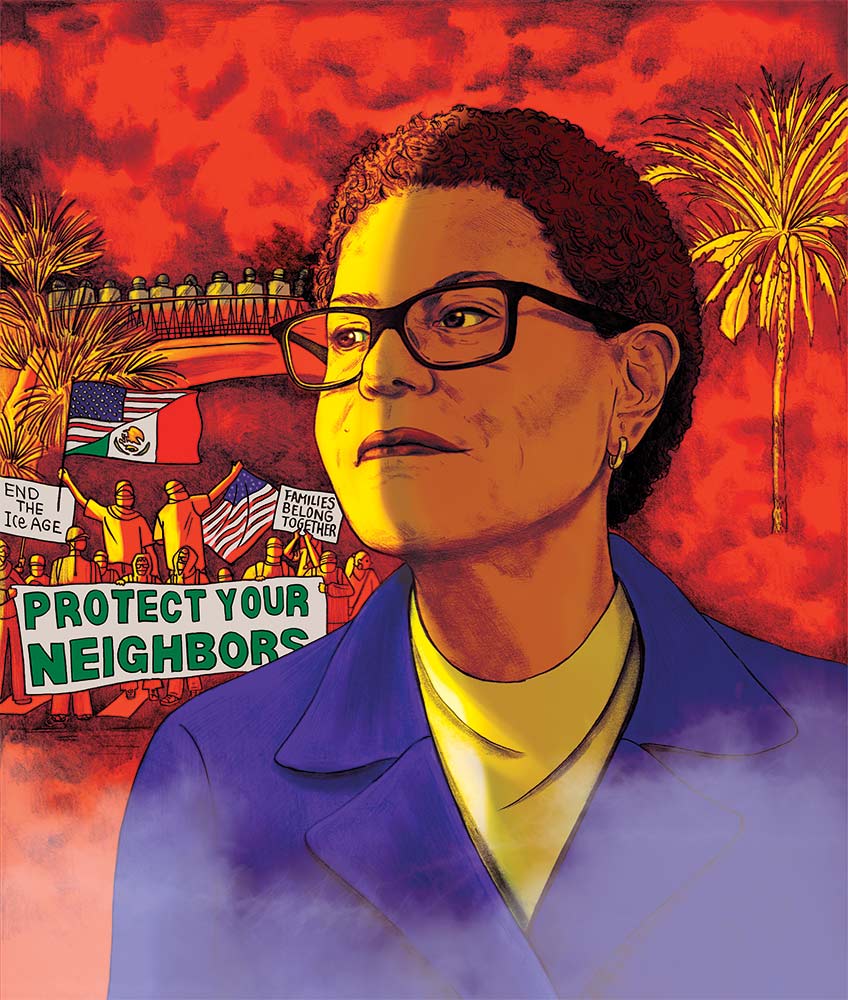
This article is part of a special Nation package devoted to LA’s bold stand against the Trump administration’s assaults on the city.
Calamity has dogged the political career of Karen Bass since her years in the California State Assembly. In 2008, she became the first Black woman to head the Assembly—or, indeed, the legislature of any state. But no sooner had she taken up the gavel than she was thrown into a budget standoff with then-Governor Arnold Schwarzenegger, as the nation’s worst recession in decades threatened California, the world’s fourth-largest economy. Bass went on to represent her congressional district in Los Angeles, often winning with more than 85 percent of the vote, but her election to the House in 2010 coincided with the peak of the Tea Party backlash. And after she was elected as chair of the Congressional Black Caucus during the early days of Trump’s first term, Covid struck.
Making her way back to Los Angeles in 2022, Bass defeated billionaire Rick Caruso to become mayor of the country’s second-argest city. Then wildfires struck in January 2025, leading to an effort to recall her as mayor and nearly upending her drive to tackle homelessness, the focus of a citywide state-of-emergency declaration she signed on her first day in office. The recall effort eventually failed, but then it was January of 2025 and Trump was headed back to the White House.
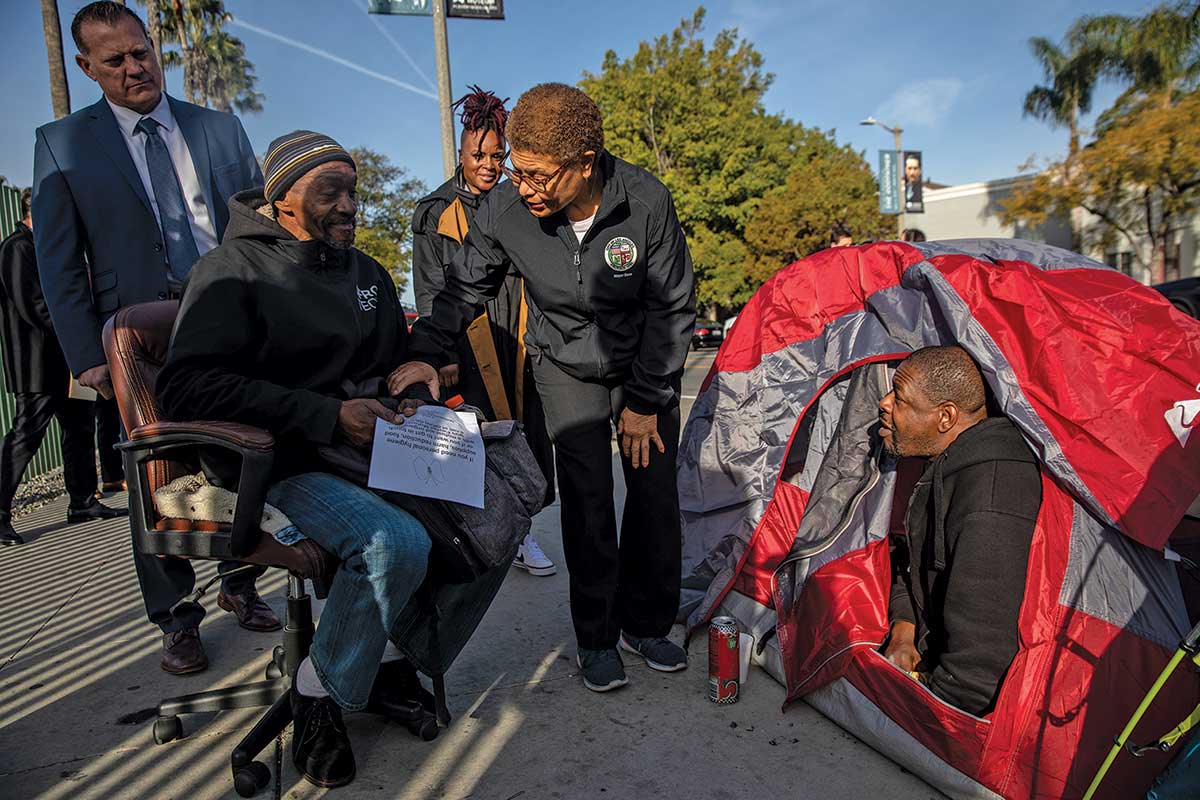
I spoke with Bass recently in Los Angeles. As we drove through the Skid Row encampments of unhoused Angelenos, drank brew at the Coffee Company, and stopped by a community organization’s anniversary bash, the mayor talked about the state of the city she serves and the country we live in. This interview has been edited for length and clarity.
Gail Reed
The Nation: Los Angeles has been thrust onto the national stage and into the headlines more than once this year.
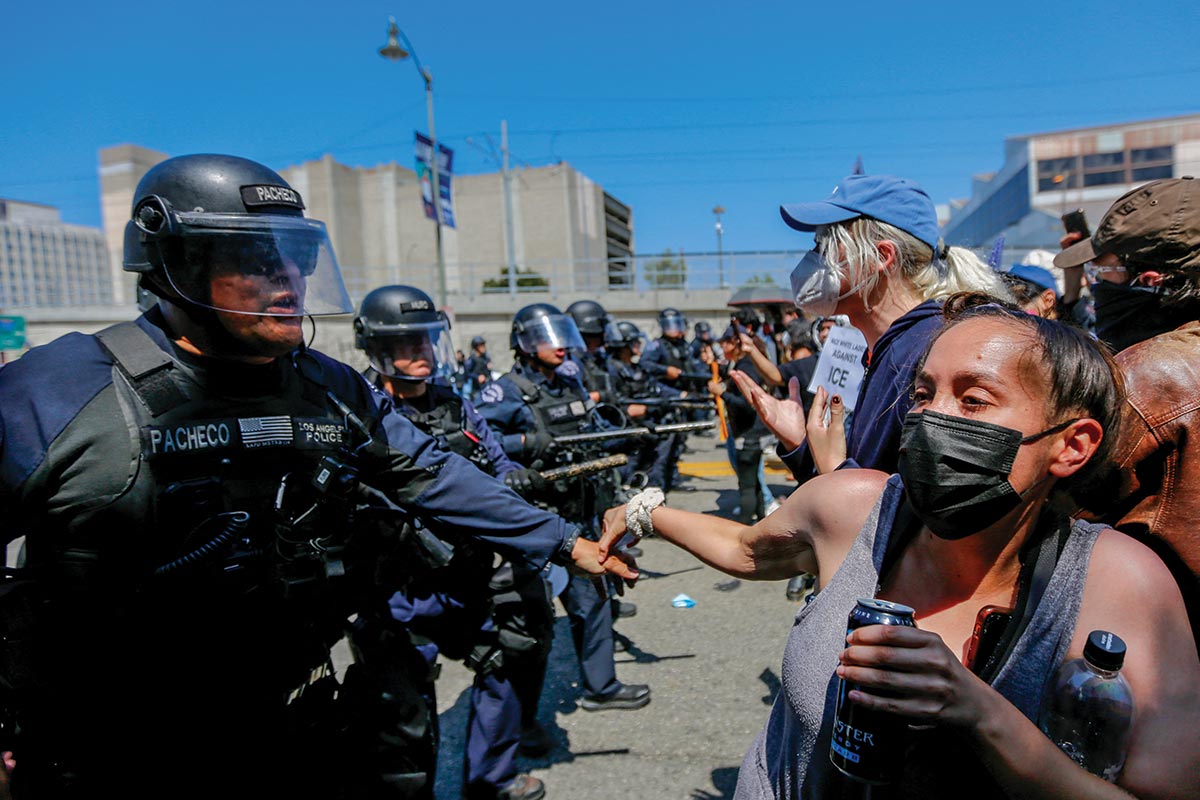
Karen Bass: The first part of the year, we had the worst natural disaster in California’s history. And we were in our recovery period when, on June 6, out of nowhere, the ICE raids started. ICE descended on multiple locations at the same time and just took people away day after day. They drove regular cars but with darkened windows, sometimes no license plates. They would jump out of the cars, fully masked, armed with rifles. They would literally snatch Latinos off the street, which is why, in our city, we refer to it as “the hunting of Latinos.” And this sowed absolute terror. An immediate protest started because, in our city, we are fortunate to have a well-established immigrant-rights infrastructure with organizations that are over 40 years old.
Supposedly to respond to the protests, the very next day, on Saturday, June 7, President Trump ordered 2,000 National Guard troops to Los Angeles, later increasing that to 4,000. He seized power from [Governor Gavin Newsom], who is commander in chief of the California National Guard. None of us asked for that. The National Guard arrived on Sunday morning. But hours before, Trump said to the world that he stopped Los Angeles from burning down because he had [already] deployed the National Guard.
Los Angeles is 500 square miles. The protests where there was some vandalism happened over four blocks. That was it. A riot never happened here. So you deploy 4,000 National Guards, 700 Marines, for what in our view amounted to unrest like you see after the Lakers win a championship—when 100 people hang around afterwards and set police cars on fire and graffiti up places.
The vandalism that did take place, in my mind, was egregious. Iconic locations that celebrate immigration were vandalized: Olvera Street, the first street in Los Angeles, which is essentially a tribute to Mexican culture, because this [land] was Mexico at one time. Then the Japanese American Museum, which sits on hallowed ground because it’s the very location where the Japanese were interned. A mural of Cesar Chavez had “F ICE” scrawled on it.
I’m not trying to sugarcoat the vandalism. The vandalism was bad, but it was not a riot, and the city was not burning down. The Los Angeles Police Department, with support from the county sheriffs, managed the vandalism. The National Guard were never needed here. They were used as props, and LA—a city that celebrates immigrants—was being used as an experiment.
The Nation: How large is Los Angeles’s Latino population?
KB: LA has 3.8 million people, and close to 50 percent of the population are Latinos. Most Latinos here are from Mexico, plus a significant number from Central America, then South America. Sectors of our economy are completely dependent on immigrant labor, including key industries like fashion, construction, hospitality, tourist venues. After the fires, we need to rebuild the Pacific Palisades. It’s estimated that at least 40 percent of the construction industry [in the city] is Latino, so the raids can absolutely affect rebuilding.
The Nation: Now the raids have moved on to other cities. What’s the takeaway?
KB: In LA, they never stopped, just slowed down. [Border Patrol commander Gregory Bovino, who led the Los Angeles raids,] moved on to Chicago. My point to the country is: Beware! This is being tested in liberal Los Angeles because, if they can get away with this here, then you can imagine what they could do in places where the mayor might be a Democrat but the state is Republican.
If you look at the cities in the president’s crosshairs, they are overwhelmingly governed by African American mayors. In my opinion, it was an attempt to drive a wedge between African Americans and Latinos, even though there are plenty of Black immigrants. In fact, the raids in Miami primarily targeted Haitians. We have a lot of Black immigrants here from Central America, South America, the Caribbean, and African countries.
The administration argues that they don’t need probable cause to pull someone over. Their probable cause is that you might be an immigrant; you might look Latino. They were testing what happens. Will the American public tolerate military intervention on our streets? There are not supposed to be military on our streets, and in fact, there is the Posse Comitatus Act, which specifically forbids military intervention for domestic problems.
The Nation: Now President Trump is threatening to invoke the Insurrection Act.
KB: Yes, and he would use that authority to seize complete control of a city, militarize it, and take over local law enforcement. Given that nowhere are we facing an insurrection, that would be a gross misuse of the power of the presidency.
The last time the act was invoked was in 1992 in Los Angeles, to quell the unrest that erupted after the police were acquitted in the beating of Rodney King. That was characterized as the most damaging civil unrest in recent US history and certainly doesn’t describe what is happening now.
The Nation: It’s clear that you draw from experiences that go beyond your city or one period in history. How would you characterize the crisis we’re facing in the US today?
KB: We need to look at how profound this moment is. I have said to young people that 40 years from now, you will remember this moment. In my opinion, we are facing the greatest threat to our democracy since the Civil War.
We’ve certainly had horrible things happen, like the internment of the Japanese, COINTELPRO, the murders of Black activists from the Panther Party and other militant organizations. But this is society-wide. When the president took office, the first thing he did was declare a war on racial justice, on DEI—diversity, equity, and inclusion. And who were the culprits? Essentially African Americans. He went out and fired African Americans who were in leadership, leaving a pall over the country that if you are an African American and in leadership, you’re suspect. You’re suspected of being incapable, unqualified, and that you only got there because of your race. Some 300,000 African American women were affected by DOGE cuts and other federal layoffs. And then [the administration] moved on to immigration.
The Nation: How do you see the administration’s policies playing out across the country?
KB: Trump is dosing the American public. In LA, we got a dose on immigration. Will Angelenos tolerate it? We did not—Angelenos stood strong. Our city was more united than I have ever seen it. We stood strong, we stood together, we were morally outraged as a city.
Then [Trump’s forces] moved on to other cities. They gave Washington, DC, a dose on crime and homelessness. The National Guard [was deployed] to “clean up homelessness and to address crime.” I can only imagine that the young people swept up were overwhelmingly African American, and they absolutely targeted juveniles. Right after, [the administration] wants to lower to 14 the age at which young people can be tried as adults.
Next, you go and you dose Chicago on immigration and crime. One of the most egregious interventions was a raid on an apartment building at 1 AM, where they literally deployed from a Blackhawk helicopter, kicked in doors, pulled people out on the street—whether they were clothed or not—zip-tied them. They did this to the Black and Latino residents in that building, under the guise of looking for Venezuelan gang members. The Black people might have been of multiple nationalities, but most were US citizens.
You had people in Los Angeles, and I’m sure other cities, who were in the country legally. You had US citizens who were pulled over and detained. When they were swept up off the street, their families had no idea where they were, because they weren’t allowed to have any contact with family members or legal counsel. This was a dramatic departure. Immigration enforcement has always happened, but people had ready access to their families and to legal counsel.
The Nation: We’re also seeing sweeping changes in how the federal government approaches higher education, the media, nonprofits—moves that enhance the power of the government and particularly the White House. When, during his first term, Trump referred to African nations as “shithole countries,” you spoke before African diplomats, assuring them our institutions constituted a bulwark strong enough to stand up to any one man’s outrageous opinions. What would you say today?
KB: I was deeply offended. But I did assure them that [Trump’s first] administration was an anomaly and that they should rest assured our institutions were strong.
But I was wrong: He has shown that our institutions are not strong. We never imagined an administration that would just slash and burn them.
It used to be in practice, but now [only] in theory, we have three coequal branches of government. We have the judiciary, which is no longer independent. We have both houses of Congress—yet, in my opinion, this speaker and the head of the Senate took their gavels over to Pennsylvania Avenue and surrendered them to the White House. And then we have the administration. Right now, we have one branch of government with all the power, and that is the executive branch.
The Nation: If the American public gets fed up and wants to elect a more progressive brand of Democrat in our cities, then, A, is it possible? And B, what kind of support do you need for that to happen?
KB: Well, and C, what are the consequences of it? I think the verdict on that is still out. We don’t fully know. You can have somebody elected to office with a strong progressive agenda who is going to be very vocal against the president. And they risk a cutoff of federal resources. They also risk punitive actions against them as leaders, but also against their city.
On the other hand, they risk that if they do nothing, or even if they try to get along. You risk getting punched in the face for existing. So I imagine that some people running, like in the New York [mayoral] race, are probably willing to take that risk. And everybody is terrified, wondering how on earth they will respond when it’s their turn.
The Nation: What can we expect next?
KB: They’ve been clear—criticize the administration all you want, but they did give us a play-by-play script. They put it in writing and told us everything they were going to do. We need to read that book by Project 2025.
Today, I think the fundamental thing happening is psychological: It’s getting us to accept and normalize. “Well, yeah, OK, the National Guard is here.” No! We should go, “Oh, my God, the National Guard is here!” “Oh, my God, you had the Marines in Los Angeles, and there was nothing going on!”
Interestingly, after the assassination of Charlie Kirk, you had a young Black man found in the South at a university, hanging from a tree. And, of course, it was said, “Oh, that’s suicide.” Really? Was it? And that was the next week.
The Nation: You didn’t see much about that.
KB: Of course you didn’t. You had Stephen Miller in Memphis talking to a whole room of police officers, saying you are hereby unleashed, unleashed with your guns. And what do you think are the demographics of that city’s population?
Progressives can speak out and connect the dots. I think it is especially incumbent on those of us who have achieved elder status to promote history, so that people understand that there was this guy named Joe McCarthy, whose name has become synonymous with a whole era of witch hunts, blacklists, and loyalty oaths. Federal and even many state workers, including California’s, had to take a loyalty pledge, swearing they were not now nor had ever been members of the Communist Party or organizations said to be affiliated.
Today, to receive a grant or a contract from this administration, you have to pledge [that you aren’t carrying out DEI or sanctuary-city policies]. You essentially pledge that you won’t promote people of color and you will cooperate with the hunting of immigrants in your cities. I tie that to [saying] “I am not now nor have I ever been….”
But I think young people would benefit from knowing that many of the things that we see happening all at once, if you pick them apart, they’ve happened before. This is one reason why I call it the greatest threat to our democracy since the Civil War: This is all happening at once, throughout our country, to everyone. This is the dismantling of our life as we have known it for the last century.
The Nation: You have talked about LA being a Petri dish for the rest of US cities. Is it also an example of what it means to elect a mayor on a progressive platform? Has your ideology, your vision of what needs to be done in city government, changed over this first period?
KB: Ideology is my anchor, enshrines my values, and guides my decisions. However, you cannot govern a city by ideology alone. People expect you to fix things. You need practical answers. For example, I ran my campaign calling for city buses and trains to be free. I still believe it’s something we should work toward. But then I faced the reality that it’s not affordable post-Covid. I could stay stuck in my ideology, or I could make as much of the [transit] system as free as possible. Right now, that means young people and students. And that was doable.
The Nation: You took office promising that your priority would be housing LA’s unhoused and finding long-term solutions to homelessness. How has that fared?
KB: I ran for mayor because homelessness had exploded. I was having flashbacks to the ’90s, when the crack-cocaine epidemic and gang violence exploded. At the time, Angelenos had become angry and bitter, and they just wanted to get rid of these people. They didn’t care what happened to them. That led to mass incarcerations and sentencing, which failed to address the root causes of the problems. I could feel that coming again, but this time criminalizing the unhoused population. So on my first day [as mayor], I put the city in a state of emergency, because we had tens of thousands of unhoused people in our city, some dying every day—a humanitarian crisis.
We have been getting thousands of people off the street. We do not have a problem with that. But I found a ton of other administrative problems in a system that was created never to end homelessness, only to manage it—I think with the delusional idea that it was just going to work its way out.
[Since Bass took office in December 2022, street homelessness has dropped by 17.5 percent, declining two years in a row, according to July 2025 University of Southern California data verified by the Department of Housing and Urban Development. And the use of makeshift shelters, tents, cars, vans, and RVs is down this year by 13.5 percent. Bass has been credited for resolving some 100 encampments and adopting a citywide homelessness prevention program while facilitating the construction of more than 30,000 affordable-housing units.]
The Nation: What happens to your program for tackling homelessness in the context of the White House’s policies?
KB: What did Trump do? He issued an executive order on homelessness, basically saying that people should be arrested, locked up. It was their fault, and cities were too namby-pamby in how they were dealing with it.
On our Skid Row, where we have more than 5,000 people living on the street, I can imagine the National Guard coming through and just “cleaning out” that area. I could see a facility like an Alligator Alcatraz being set up on federal property and people just being swept away.
This used to be an issue in a lot of Democratic cities, but now homelessness is everywhere. Yet the only cities Trump talks about are cities where the people who are unhoused are people of color. There are hundreds of thousands of white homeless people as well, but that’s not what his focus is.
So when I refer to “dosing,” it’s also [meant] to get the American population to not be horrified by troops walking up and down their street. It’s to get the American people to forget that the military is supposed to operate in foreign lands and not domestically. It’s to get the American population to believe that things are so out of control that you need the military to come in and take over because anybody who looks like me or is a Democrat is incompetent at governing. When I saw the pictures of tourists taking photographs with the National Guard, it was horrifying, because that’s how normalization begins.
We have three more years of this, but they started off this year with the strategy of “flood the zone,” traumatizing people. And that ushers in an agenda to fundamentally restructure the country. We need to pay attention to the restructuring that is going on while we fight these battles one by one. If we just get immersed in the battles or so depressed we can’t even think about it, then we have surrendered our country, and we have surrendered our people.
More from The Nation

What’s It Like Inside a Data Center? What’s It Like Inside a Data Center?
Northern Virginia is laden with structures that house data for Fortune 500 companies. I went inside just one of those monstrosities that bothers its neighbors.
What Trump and Tucker Carlson Have in Common What Trump and Tucker Carlson Have in Common
Carlson has broken with Trump largely over the war in Iran. But on Ukraine and immigration, the two speak very much the same language.

The Jewish Case Against AI The Jewish Case Against AI
Haredi rabbis and the secular left agree: This technology is a threat to the entire social fabric.
The Fight for Educational Equality Is Also a Fight for a Just Supreme Court The Fight for Educational Equality Is Also a Fight for a Just Supreme Court
The court has severely weakened our ability to make an education system that fulfills the promise of Brown.

The Fall of “Scientific American” The Fall of “Scientific American”
When the beloved science publication got too political, its corporate owners stepped in. Now its future is uncertain.

The Bookstore Revolution in Taiwan’s Conservative Heartlands The Bookstore Revolution in Taiwan’s Conservative Heartlands
After Taiwan legalized same-sex marriage, gender-themed bookstores are working to build the social acceptance that the law alone couldn’t deliver.

