Who’s Afraid of the Epstein Files?
The release of Jeffrey Epstein’s documents is likely to implicate a whole network of members of the American ruling class.
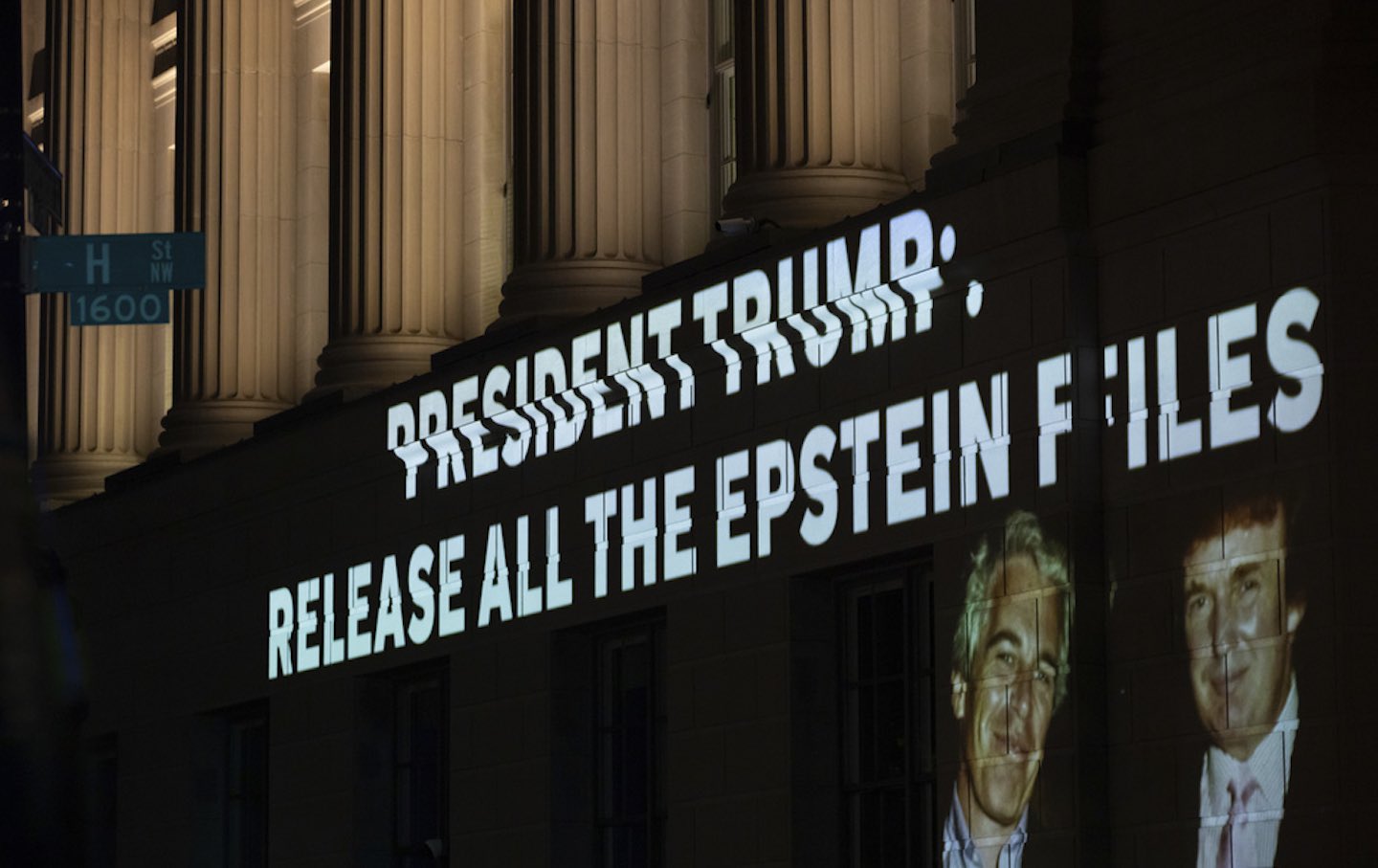
A projection onto a building near the White House demands that Donald Trump release the Epstein files in July 2025.
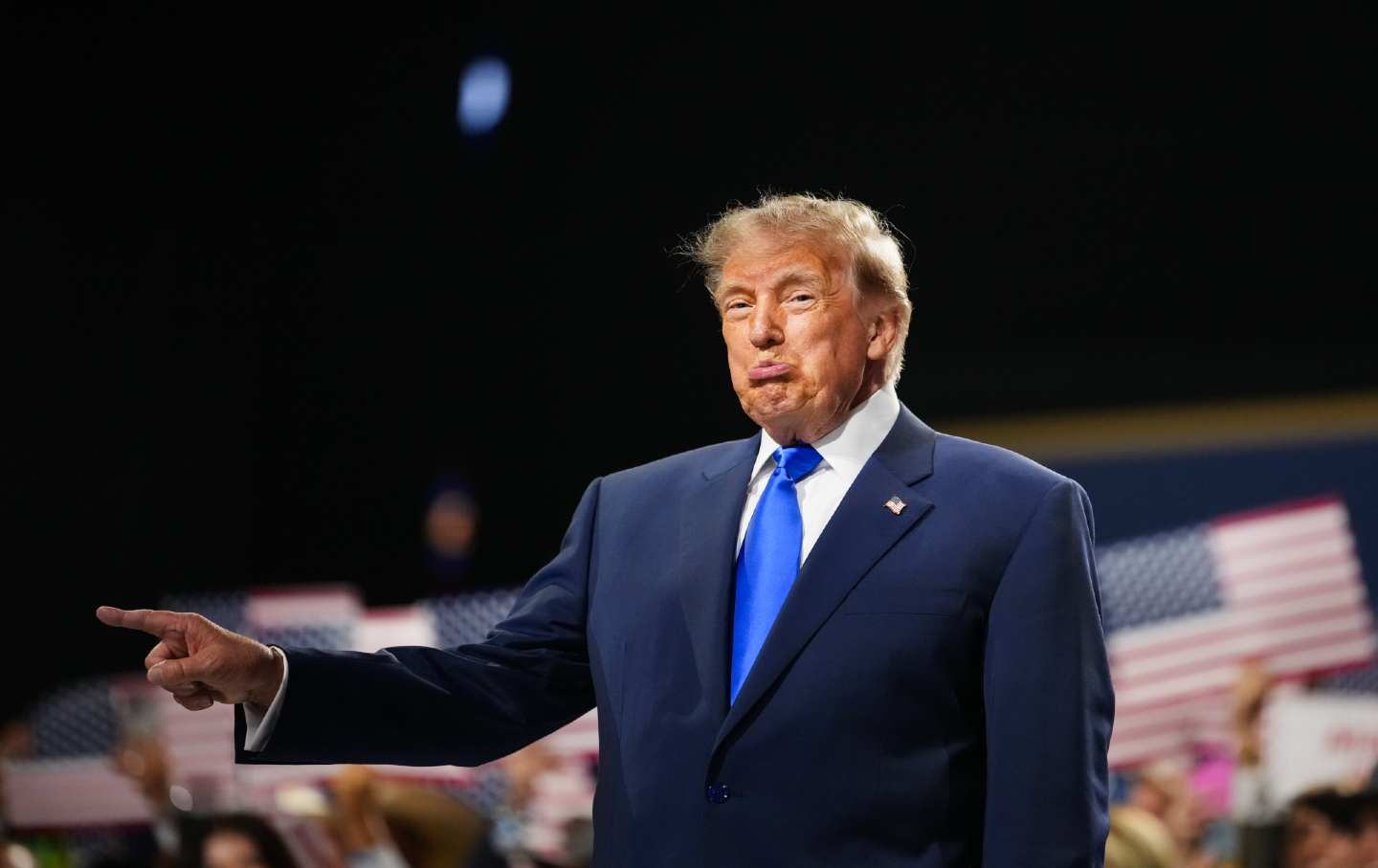
(Allison Bailey / NurPhoto via AP)Over the weekend, it seemed that months of Trump administration stonewalling of the release of the trove of federal documents behind the prosecution of notorious pedophile and sex trafficker Jeffrey Epstein came to a close. Late Sunday night, Trump bowed to the likely passage of the Epstein Files Transparency Act sometime this week with a Truth Social post announcing, “House Republicans should vote to release the Epstein files, because we have nothing to hide, and it’s time to move on from this Democrat Hoax.” The public may get a crash course in the broken system of elite impunity that vaulted Epstein, and Donald Trump, to prominence in the first place.
It’s not clear whether the Senate will also endorse the measure—or whether Trump would refrain from vetoing it after Congress approved it. (He created a potential legal out for himself by designating a new investigation into Epstein’s syndicate—focusing, of course, on Democratic malefactors—and could easily get his legal flunkies to say they’re unable to release files pertaining to an ongoing investigation.)
But if they are released to the public, the cache of documents relating to Epstein’s prosecution promises to upend the steadied, jealously guarded silence of the many bad actors in Epstein’s orbit in a way just hinted at in the 20,000 e-mails the House Oversight Committee released last week. Those documents were the property of Epstein’s estate, after the disgraced financier allegedly killed himself in custody, and didn’t figure into the legal case against him. The materials in what are now known as the Epstein Files, by contrast, directly targeted Epstein’s wide trafficking network, and the many powerful, wealthy, and influential men involved in it; the Justice Department reports that it makes up some 300 gigabytes of physical and digital evidence, including graphic documentation of the sexual victimization of underage girls at the hands of Epstein and his colleagues and cronies. If his journalistic collaborator Michael Wolff is to be believed, Epstein possessed around a dozen photos of Trump in the company of topless girls at Epstein’s Palm Beach compound, including a shot in which a group of them are pointing at a stain on Trump’s pants and laughing.
Trump’s Justice Department and FBI have issued predictably disingenuous statements saying that the files don’t contain materials suggesting that Epstein had blackmailed his clients; nor did they include “evidence that could predicate an investigation against uncharged third parties.” This would be something of a shock to the former prince Andrew, who was stripped of his monarchical title and perquisites after a series of damning disclosures about his alliance with Epstein. It would be news as well to former treasury secretary and Council of Economic Advisers head Larry Summers, who, per a new report from The Harvard Crimson, relied on Epstein as his “wingman” in an unsuccessful effort to bed one of his graduate students, who was apparently the daughter of one of Summers’s close associates atop the Asian Infrastructure Investment Bank. Summers has announced that, in the wake of these latest Epstein disclosures, he’s curtailing his “public commitments.”
Regardless, Trump’s federal law enforcement team has concluded that “no further disclosure would be appropriate or warranted,” claiming to adhere to the initial court-imposed seal on the documents, which was put in place to “protect victims.” One problem with this reasoning, of course, is that many Epstein survivors continue holding press conferences demanding that the files be made public—including one today, ahead of the House’s scheduled vote on the bill to secure their release.
The problem with trying to maintain a cordon sanitaire around the Epstein Files, keeping them solely focused on the abuses of Epstein and his convicted paramour and coconspirator Ghislaine Maxwell, is that Epstein was the polar opposite of a lone-wolf predator. His whole career was a case study in benefits accrued from the cultivation of wealthy and powerful associates, going back to his improbable elevation from a math-teaching gig at an exclusive Manhattan prep school to a lucrative spot on the trading desk at Bear Stearns. He then became the chief wealth-management adviser for Les Wexner, head of the Victoria’s Secret empire.
After he obtained power of attorney over Wexner’s holdings, it was easy for Epstein to put together the whole infrastructure behind his trafficking ring—his private jet, dubbed the Lolita Express, the island where he arranged no end of assignations involving trafficked girls and young women, and a host of financial instruments to fund it all—without leaving any paper trail beyond mundane stock trades. Fueling it all was a convoluted network of shell companies and dummy bank accounts—yet the funding behind Epstein’s depraved predatory empire appears to have been perfectly legal, and in line with offshore wealth management operations commonly deployed to create tax shelters and nameplate companies for the 0.1 percent. As Carl Beijer observes, “while Epstein likely used blackmail and other illegal schemes to avoid prosecution for his crimes, his primary strategy—offshore wealth management—was not just legal but a central feature of modern financial capitalism.”
That’s also why, in last week’s tranche of Epstein e-mails, his well-heeled correspondents were so comfortably candid in discussing both their desperate seduction campaigns and their financial affairs. There was no concern over their possible discovery, even though at the time of the exchanges, Epstein was already a convicted sex offender (albeit on a grotesquely plea-bargained reduced charge). There were no Eyes Wide Shut passwords, no evident adjournment to secure servers or chat channels (though Summers and Epstein did refer to the grad student whom Summers was targeting as “peril”—an evident racist call-out to her Asian heritage). It was simply understood that people given over to careers in financial predation were also practitioners of sexual predation; it wasn’t an accident that the lead financiers of the 1980s boom that made Epstein’s fortune called themselves “big swinging dicks.”
Nor is life under the predator’s code by any means confined to the American scene. In 2011, the head of the International Monetary Fund, French economist Dominique Strauss-Khan, faced rape charges from Nafissatou Diallo, a maid at Manhattan’s Sofitel hotel. She alleged that while she was cleaning his room, Strauss-Khan charged at her naked from out of the shower, molested her, and forced her to perform oral sex on him. The case was eventually settled out of court, with a rumored $6 million payout. Strauss-Khan was also arrested in France on gang-rape charges relating to a prostitution ring hosting sex parties there; French authorities later dropped the charges. Nevertheless, the principal overseer of the global financial system—and widely touted candidate for the French presidency—was, like Epstein, repeatedly arrested on sexual assault charges; unlike Epstein, he was permitted to fully buy his way out of them.
Be prepared to see many variations of Strauss-Khan’s high-finance version of droit du seigneur if and when the full release of the Epstein files comes to pass. But just bear in mind that, contrary to the quisling testimonials of Attorney General Pam Bondi and FBI Director Kash Patel, the next wave of documents won’t prove the absence of a legal case; rather, they will likely remind us of the many untouchable predators out there who remain above the law.
Become a Sustaining Donor This September
Between the reemergence of right-wing red-baiting and Donald Trump’s use of the chilling National Security Presidential Memorandum–7 to criminalize left political organizing, we’re seeing McCarthyism reborn before our eyes.
This assault on democracy cannot be ignored or wished away. Resisting it requires bravery in the face of threats and repression, a steadfast commitment to the truth, and the unwavering belief that we can—and will—overcome this darkness.
We must have an independent media that sets the record straight, unearths corruption and abuses of power, and advances a politics of justice and dignity for all if we’re to win this fight.
That’s why I’m writing to you today. This September, The Nation needs to add 100 monthly donors to sustain our progressive journalism. Your contribution makes the next investigative report, the next truth-speaking column, and the next pathbreaking essay all possible.
I hope you’ll support our work with a recurring donation today. If you donate $10 or more a month, we’ll send you a brand new “Hands Off the Free Press!” sticker to recognise your commitment to our cause. Please, donate today.
Onward,
Katrina vanden Heuvel
Editor and Publisher, The Nation