Minneapolis Braces Itself for the National Guard
Kristi Noem visited the Twin Cities and decried out-of-control crime. Is a federal occupation next?
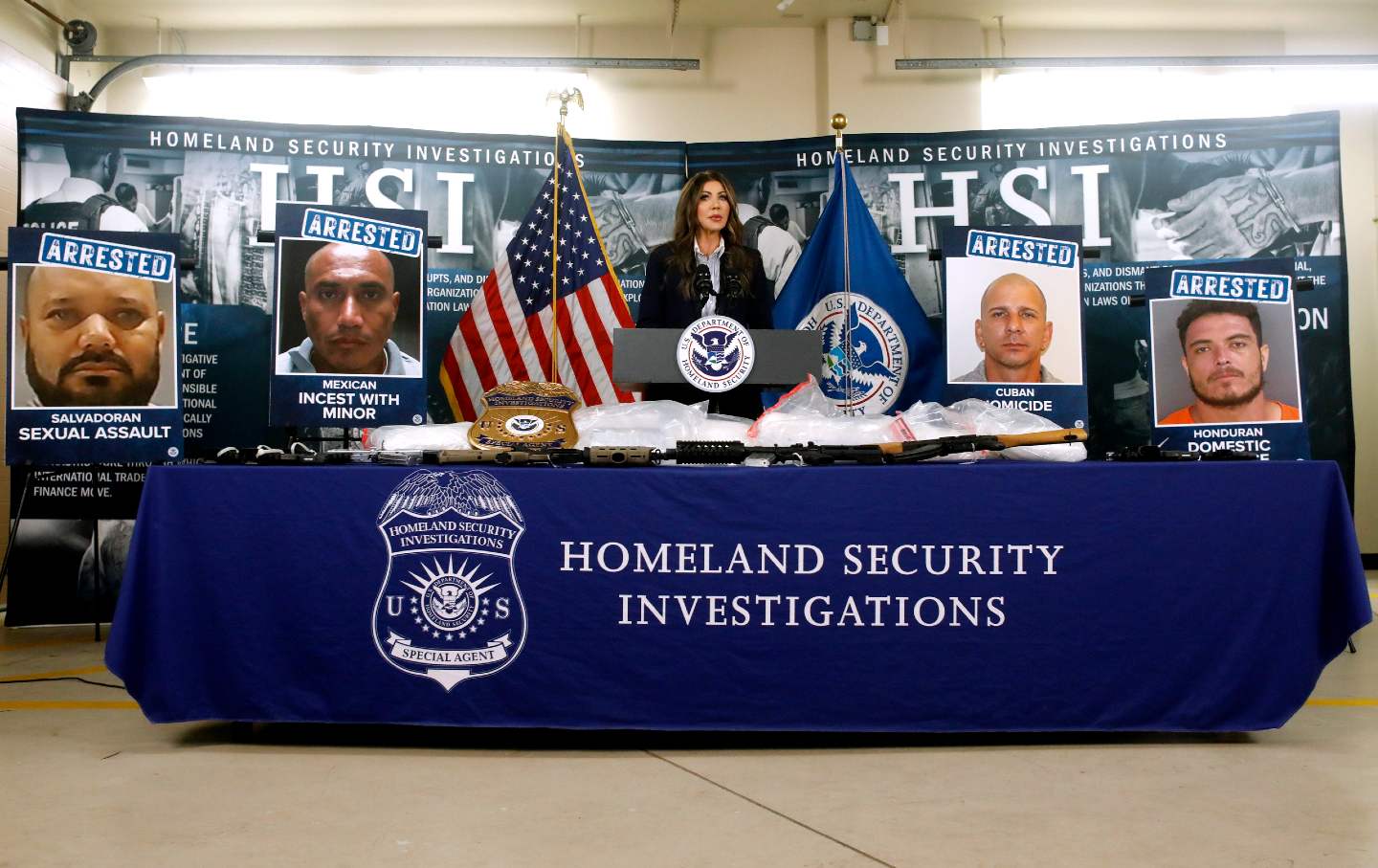
Department of Homeland Security Secretary Kristi Noem speaks during a press conference at a federal office building on October 20, 2025, in Bradenton, Florida.
(Octavio Jones / Getty Images)Fort Snelling, Minnesota—On Friday, beneath blue skies and orange leaves, a group of protesters gathered outside the Bishop Henry Whipple Building and held a moment of silence for those who have been killed, detained, or disappeared by Immigration and Customs Enforcement. Chants of “Say his name!” followed, as the protesters waited for a press conference from Kristi Noem, the secretary of the Department of Homeland Security.
The Bishop Henry Building, where deportation hearings take place, is located just minutes from the Minneapolis airport on Fort Snelling, which houses a military landmark of the same name. Dred Scott and his wife were enslaved at Fort Snelling before unsuccessfully suing for their freedom. Fort Snelling also served as a concentration camp for Dakota people following the US-Dakota War. At Friday’s midday gathering outside Bishop Henry, Brooke Bartholomew, cochair of Twin Cities Democratic Socialists of America, connected those camps to ICE detention today.
“There’s a clear through line between that genocidal settler-colonial government and today’s racist, fascist regime,” she told a crowd of dozens through a megaphone. “What’s been happening across this country and other parts of the world is what modern fascism looks like,” she added, from increased militarization to the creation of a racialized Other as a scapegoat for social problems.
Just after 4:30 pm, Noem took to a podium inside Bishop Henry to reiterate DHS’s commitment to “making America safe again” by ridding the country of “the worst of the worst,” a phrase consistently applied to immigrants of color. In front of her, assault weapons were splayed out on a table, alongside piles of confiscated drugs. On either side was an oversize photograph of people her office had arrested. Their names weren’t listed, but their nationalities were: Mexican, Salvadoran.
To a room full of reporters and those watching on livestream, Noem boasted about Operation Twin Shield; warned of expanding ICE operations, made possible by the recent, rapid hiring of new officers; and expressed her agency’s desire for additional detention partnerships and law-enforcement agreements in the state. She also asked Minnesotans to support law enforcement, citing an increase in violence against officers. Given the city’s recent history with police, it’s an ask that will likely go unanswered.
By the time Noem made her address, the protest outside the facility had grown to several hundred people. Many Twin Cities residents were bracing themselves for Noem to announce the deployment of the National Guard. When asked about such plans, she deferred the decision to President Donald Trump and instead spent her time staging the proper pretense. She scolded incumbent Mayor Jacob Frey, who is up for reelection on November 4, and Governor Tim Walz for their lack of cooperation, which she said has caused a rise in violent crime. According to Minnesota Public Radio, crime in Minneapolis peaked in 2020 and 2021.
“I don’t know how he sleeps at night,” Noem said of Walz at the press conference, in reference to his dubbing ICE a “modern-day Gestapo” earlier this year. Noem seemed to be laying the grounds for sending in troops sometime in the future. Claims of unchecked crime have been used to justify Trump’s deployment of the National Guard to Chicago, Memphis, and Washington, DC. In Chicago, federal agents carried out Operation Midway Blitz, used pepper spray and tear gas against journalists and protesters, and killed a man during an immigration raid.
In September, the Department of Justice sued Minnesota over its sanctuary policies. Minneapolis and St. Paul have separation ordinances prohibiting city employees, police included, from enforcing federal immigration laws. Still, Walz has rejected the assertion that Minnesota is a sanctuary state and is no stranger to activating the National Guard himself, as he did in the wake of the Minneapolis uprising in 2020.
“Minneapolis residents…still recall the trauma of the 2020 National Guard deployment, when peaceful protesters for racial justice were met with tear gas, rubber bullets, and militarized force,” Robin Wonsley, a democratic socialist elected to the city council in 2021, said. “Seeing troops in our streets again would reopen deep wounds.”
Popular
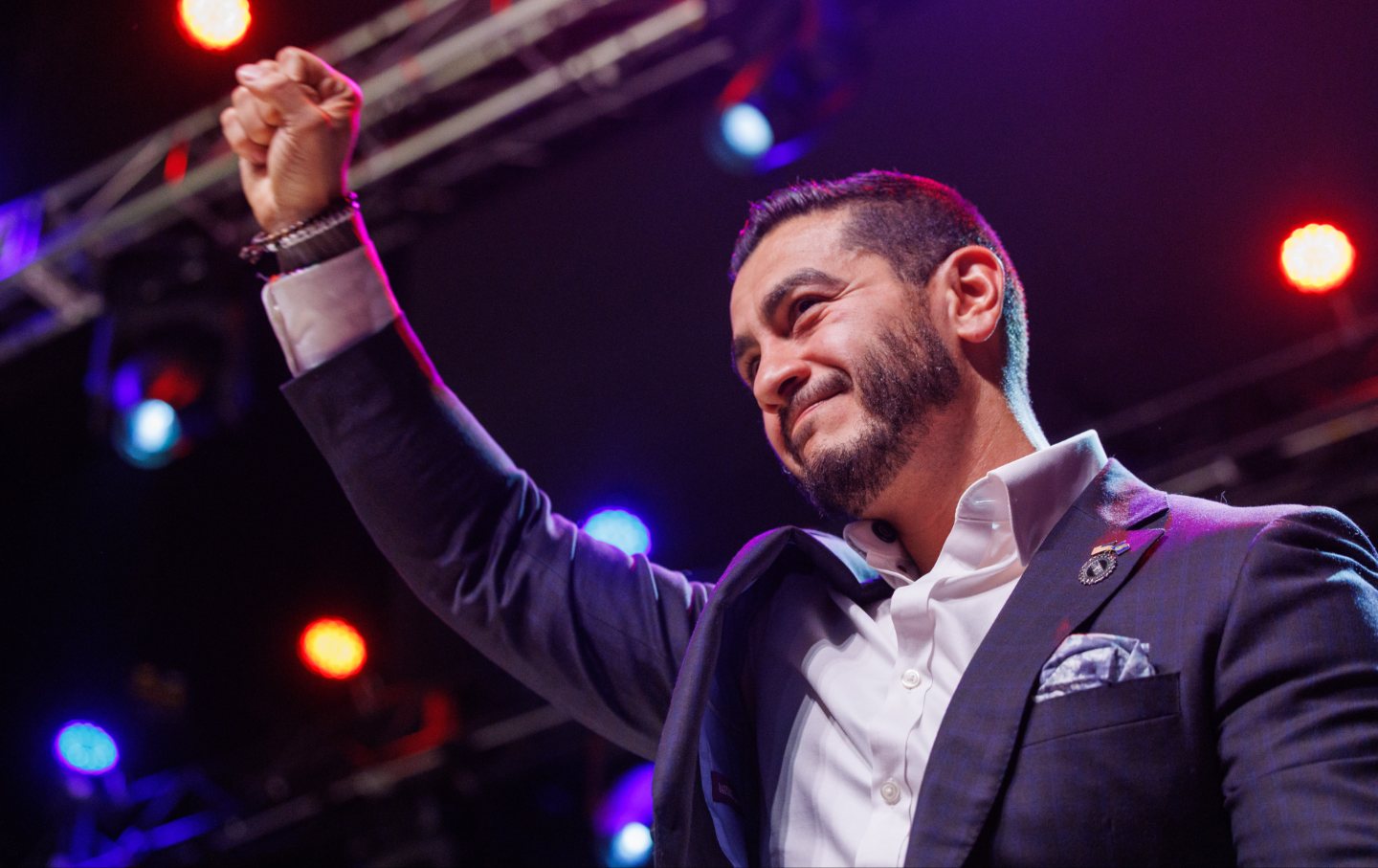
“swipe left below to view more authors”Swipe →State Senator Omar Fateh, a democratic socialist looking to unseat Frey, echoed the sentiment, telling me, “If Trump tries to send troops here and re-traumatizes our residents who lived through 2020, they’re going to have to go through us first.” A core part of his platform is ensuring local government is the last line of defense against the Trump administration, including strengthening the aforementioned separation ordinance and arresting federal agents who wear masks.
“Trump’s deployment of federal law enforcement and National Guard to cities across the United States has felt like an attempt to rerun the summer of 2020, only with a different outcome,” said Stuart Schrader, an associate professor of history at Johns Hopkins University and author of Badges Without Borders: How Global Counterinsurgency Transformed American Policing. He added that it shouldn’t be surprising that the GOP would target Minneapolis. After all, during the first Trump administration, the city “touched off a global movement against police violence.”
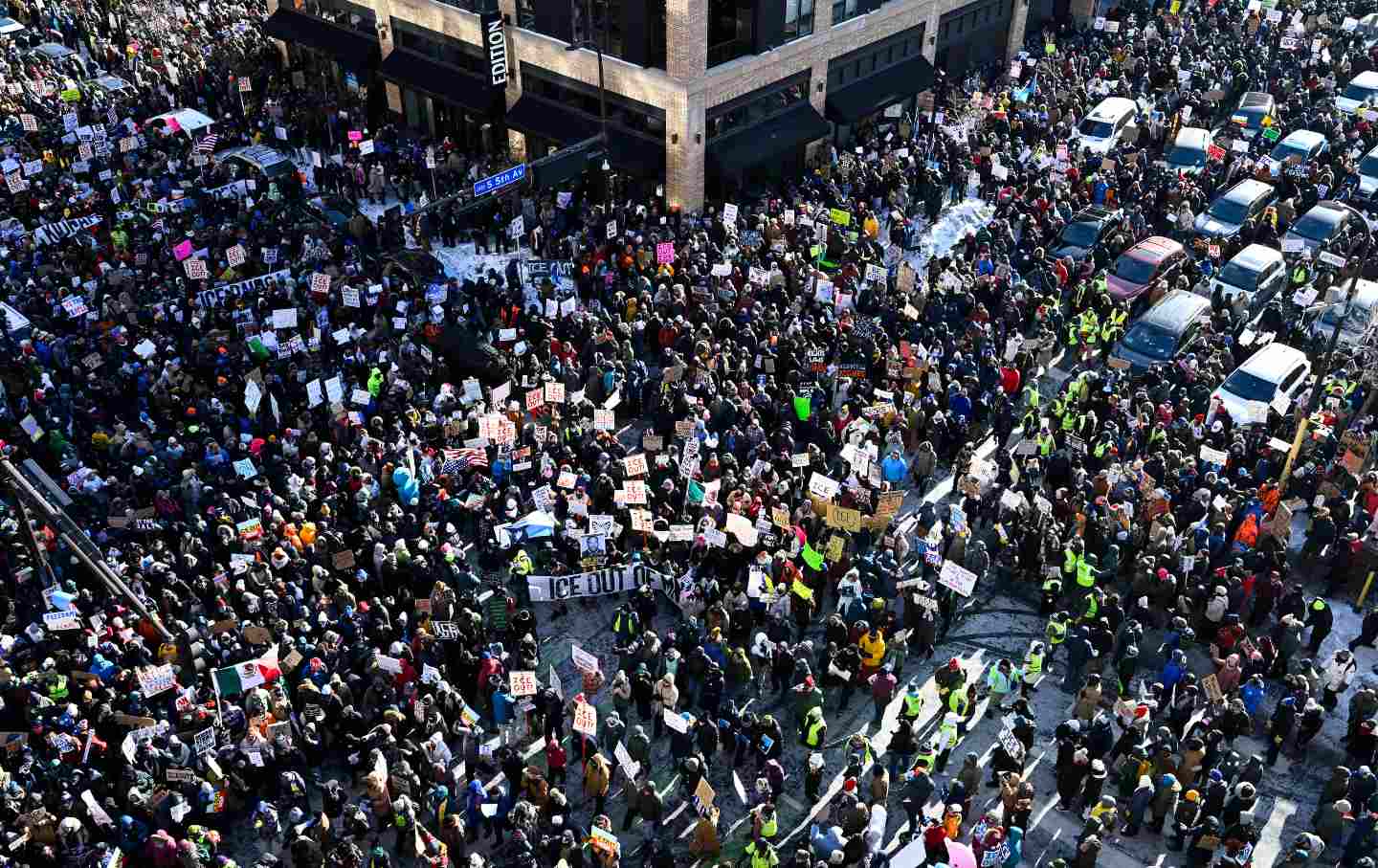
Regardless of whether—or when—the National Guard is deployed, a coalition of resistance is assembling. The protests outside the Bishop Henry Building connected the dots between disparate social problems—Allison Gunderson of the MN Anti-War Committee, for one, noted that US destabilization abroad creates immigration crises to begin with—but also to link the grassroots responses to them.
The People’s Action Coalition Against Trump was formed earlier this year and includes organizations such as the Democratic Socialists of America, Black Lives Matter MN, the Twin Cities Coalition for Justice (created in 2015 after two Minnesota police officer killed Jamar Clark), the Climate Justice Committee, the Abortion Action Committee, the Minnesota Immigrant Rights Action Center, and Asamblea de Derechos Civiles, to name a few. Organizers have said they want to make “united against fascism” not just a slogan but a reality.
Minnesota’s protesters understand the paradox of the present. On the one hand, their fight has tremendous precedence. On the other, it has only just begun. As Noem wrapped up her remarks, hundreds outside the building chanted in unison: “You don’t scare us. We’ll be back.”
Become a Sustaining Donor This September
Between the reemergence of right-wing red-baiting and Donald Trump’s use of the chilling National Security Presidential Memorandum–7 to criminalize left political organizing, we’re seeing McCarthyism reborn before our eyes.
This assault on democracy cannot be ignored or wished away. Resisting it requires bravery in the face of threats and repression, a steadfast commitment to the truth, and the unwavering belief that we can—and will—overcome this darkness.
We must have an independent media that sets the record straight, unearths corruption and abuses of power, and advances a politics of justice and dignity for all if we’re to win this fight.
That’s why I’m writing to you today. This September, The Nation needs to add 100 monthly donors to sustain our progressive journalism. Your contribution makes the next investigative report, the next truth-speaking column, and the next pathbreaking essay all possible.
I hope you’ll support our work with a recurring donation today. If you donate $10 or more a month, we’ll send you a brand new “Hands Off the Free Press!” sticker to recognise your commitment to our cause. Please, donate today.
Onward,
Katrina vanden Heuvel
Editor and Publisher, The Nation