How María Corina Machado’s Nobel Peace Prize Could Lead to War
Machado’s record makes a mockery of the idea she is a committed champion of peace, promoter of democracy, or unifying figure.
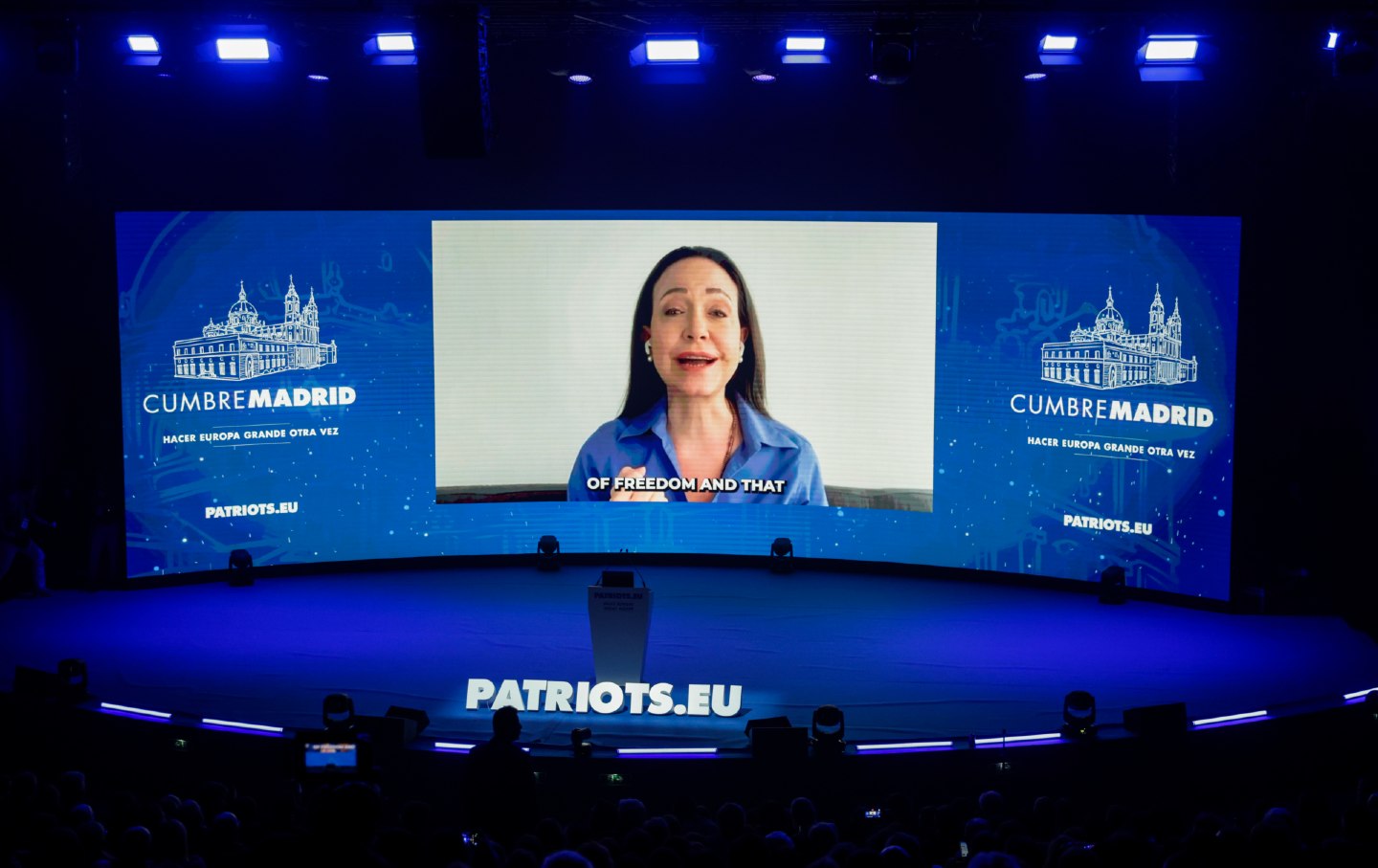
Donald Trump didn’t get his Nobel Peace Prize. But that may be the only positive thing that can be said about this year’s award, which went to Venezuelan opposition leader María Corina Machado. In announcing the prize, the Nobel Committee lauded Machado as a “brave and committed champion of peace” and “unifying figure in a political opposition that was once deeply divided.”
The committee highlighted Machado’s “tireless work promoting democratic rights for the people of Venezuela and…her struggle to achieve a just and peaceful transition from dictatorship to democracy.” It is hard to contest Machado’s bravery. She has been in hiding within Venezuela for more than a year. But Machado’s record makes a mockery of the idea that she is a committed champion of peace, tireless promoter of democracy, or unifying figure.
In contrast to the Nobel Committee’s laughably—and dangerously—inaccurate characterization of Machado, far-right influencer Laura Loomer was shockingly on point in stating that Machado’s “actions are actively stoking and promoting violent regime change in Venezuela.” Not only is this true, but it has also been true for most of Machado’s political career, which began in 2002 when she cofounded Sumaté, a nongovernmental “organization with the explicit mission statement of recalling [former Venezuelan president Hugo] Chávez from power.” Research shows that the National Endowment for Democracy and USAID “provided immense financial support for Sumaté.” Any pretense that Machado supported peaceful change alone was rendered moot by her support of the 2002 coup against Chávez, with Machado signing the notorious “Carmona decree” dissolving Venezuela’s Congress, Constitution, and Supreme Court. It is hard to see these actions as part of a record of “tireless work promoting democratic rights.”
Over the next two decades, Machado continued to support violent regime change. She was one of the leaders of the 2014 LaSalida or “the exit”) protests, which left dozens dead (with evidence showing far-right protesters and state security forces each responsible for roughly half the deaths). Machado also helped lead a second wave of violent protest in 2017, which also left dozens dead at the hands of protesters and state security forces. Machado has been a vocal cheerleader for the harshest US sanctions on Venezuela, and has repeatedly called for US military intervention. Machado was (initially) a strong supporter of Juan Guaidó, who self-declared himself Venezuela’s president in 2019. Like Machado, Guaidó supported US sanctions and military intervention, sought to incite the Venezuelan military to rebel against Maduro, and funded a disastrously incompetent May 2020 maritime invasion of Venezuela by US mercenaries.
In direct contrast to the Nobel Committee’s portrayal of Machado as a unifying figure, her actions have consistently divided Venezuela’s opposition. Machado’s and other far-right figures’ support for the 2014 LaSalida protests stopped the opposition from unifying around the more moderate Henrique Capriles. Machado supports extremist neoliberal economic policies that she knows are unpopular, “giving orders to her allies not to refer to the total privatization of health care, education, or the state oil company PDVSA” in the lead-up to the 2024 presidential election.
Machado is openly aligned with far-right figures in Latin America and beyond, including Brazil’s Jair Bolsonaro, Argentina’s Javier Millei, and Israel’s Benjamin Netanyahu. Machado even penned a letter to Netanyahu in 2018 asking for Israel’s help in forcefully overthrowing Maduro.
In 2023, Machado reversed her long-standing opposition to elections and embraced an electoral path to change in Venezuela. Machado decisively won an October 2023 primary to be the opposition candidate in Venezuela’s 2024 presidential contest, with results showing Machado winning over 90 percent of the 2.4 million primary votes. When the government blocked Machado from running, she supported Edmundo Gonzalez and crisscrossed Venezuela for months in 2024 campaigning for him. During this time, Machado could justifiably claim to be a unifying figure and a supporter of peaceful change and democratic rights within Venezuela. This, however, would not last.
The trigger for Machado’s resumed support for violent regime change was Maduro’s brazen theft of the 2024 election. Available evidence indicates that Maduro lost by a large margin, but the result will never be known in full since the government refused to release precinct-level tallies of the vote, as Venezuelan law requires. Like many others inside and outside Venezuela, Machado condemned Maduro’s actions. Machado celebrated Donald Trump’s 2024 election as US president and his selection of her longtime friend and ally Marco Rubio as secretary of state. Machado immediately began campaigning for Trump to overthrow Maduro, arguing that Venezuela could give him “an enormous foreign policy victory in the very, very short term.”
In the past five months (which is to say, the months immediately preceding the announcement of the 2025 Nobel Peace Prize), Machado’s support for violent regime change has been particularly clear. Machado has thoroughly endorsed Trump’s recent actions with respect to Venezuela. She supported Trump’s widely rejected claim that the Venezuelan gang Tren de Aragua is seeking to “invade” the United States, a claim Trump officials have used as a pretext for the administration’s escalating campaign against Venezuela. Most crucially, Machado has vocally backed Trump’s dangerous and illegal bombing of Venezuelan boats in the Caribbean, which have now killed a reported 21 people. The New York Times’ reporting suggests that the victims of the first bombing were not drug traffickers, as Trump and Machado claim, but fishermen murdered in cold blood.
Like Trump, whom she dedicated her Nobel Prize to, Machado has never been overly bothered about the “collateral damage” the dangerous policies she endorses (sanctions, bombings, invasions) have meant or might mean for Venezuelans. It is thus unsurprising that Machado has not questioned the idea that Trump’s campaign in Venezuela is about drugs, a claim difficult to believe since the vast majority of cocaine from South America reaches the US via the Pacific, not the Caribbean. Machado clearly approves of the efforts of Rubio and other administration hardliners seeking to convince Trump to violently overthrow Maduro. In a September interview, Machado’s international affairs adviser said her team is in touch with Trump officials plotting Maduro’s removal, which he said, “has to be done with the use of force.” In giving Machado a Peace Prize, the Nobel Committee is not only continuing its practice of honoring morally dubious people, like Henry Kissinger. It is also fanning the flames of war.