
Is This Man Britain’s Next Prime Minister?
At a somber Labour conference in Liverpool, disillusionment with Keir Starmer gave way to open talk of succession—and the name on everyone’s lips was Andy Burnham.
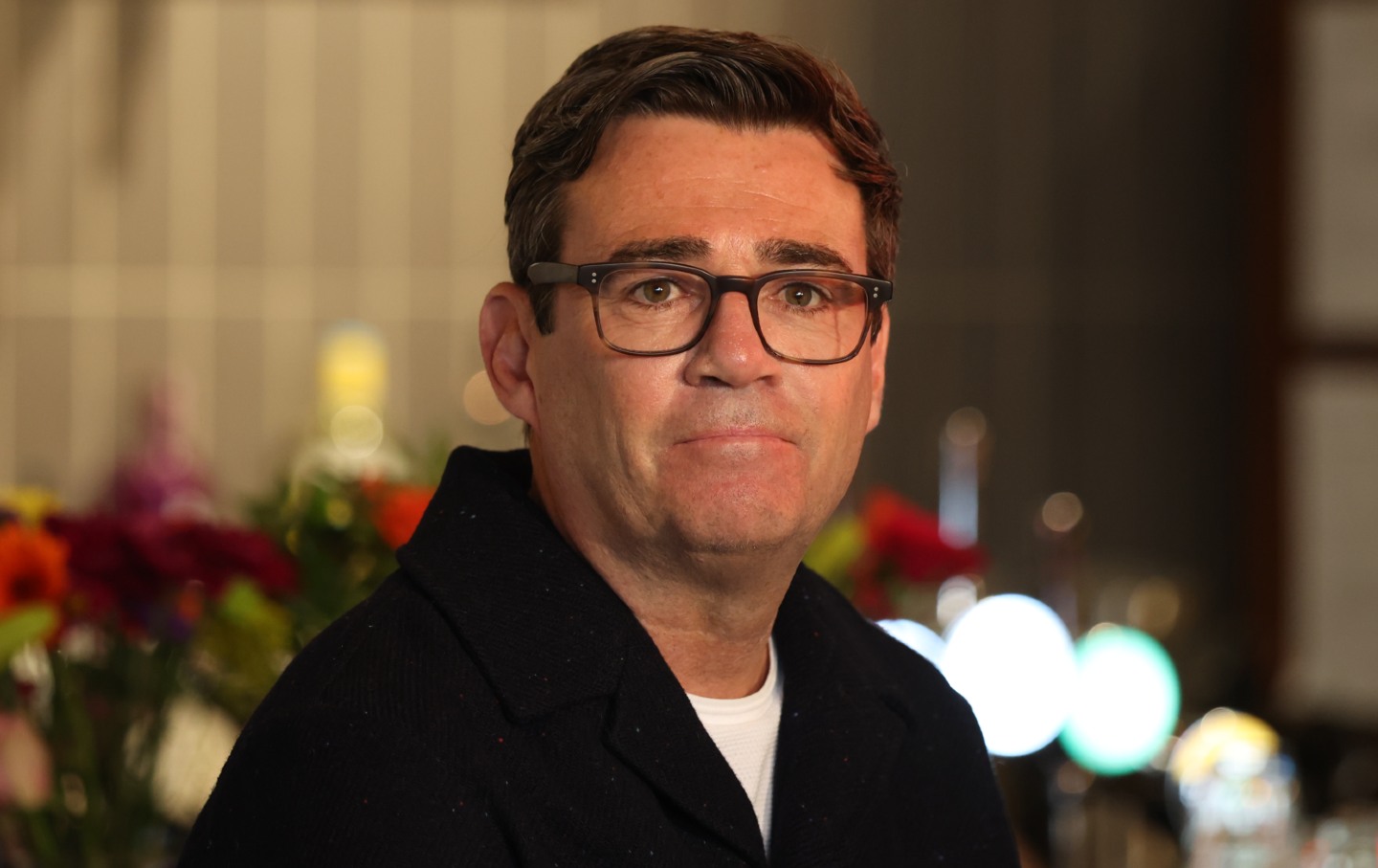
Mayor of Greater Manchester Andy Burnham attends an event during day two of the Labour Party conference at ACC Liverpool on September 29, 2025, in Liverpool, England.
(Dan Kitwood / Getty Images)If last year’s Labour Party conference showed a definite enthusiasm from the faithful after Prime Minister Keir Starmer’s July 2024 electoral landslide, this year’s gathering saw hope vanish from all but the staunchest of Starmerite.
Party members, unions, affiliated societies, and parliamentarians were drawn to Liverpool more by duty than conviction, with fewer stall exhibitors and visitors than in previous years. Major political announcements from the government were scarce, with speeches from ministers Lisa Nandy and Shabana Mahmood doing little to energize party members or shape discourse. Starmer’s keynote speech, intended to define his agenda against the populist right Reform UK and lay out a plan for national renewal, assuaged few fears about the direction of his government. On the conference floor, a housing policy lobbyist based in northern England remarked to me, “It’s like seeing a tsunami heading to your house and closing the kitchen window.”
On the conference floor, delegates rejected a leadership-supported motion that falsely framed the UN Commission of Inquiry into Gaza as warning of a “risk” of genocide. Despite conference’s pro-Starmer chair’s selecting nine speakers for the motion and none for a motion calling for an arms embargo on Israel, the embargo motion carried. Meanwhile, Scottish Labour leader Anas Sarwar and government minister Jonathan Reynolds partied at a Labour Students event sponsored by TikTok, a company accused of union-busting, walking past protesting workers on their way into the venue.
The reasons for demoralization are clear. After a year in government, Labour has little to sing about. The politicians who fought a scorched-earth battle against the membership of their own party for the past decade have, perhaps unsurprisingly, shown little initiative in government beyond attacking their own voters. From refusing to abolish the two-child welfare cap to lift millions of children out of poverty, allowing record high arms sales to Israel, watering down workers’ rights legislation, and promising crackdowns on immigrants, Labour is offering little positive. No wonder, then, that as opinion polls show Starmer is the most unpopular prime minister on record, the discussion surrounding his departure among conference attendees was a matter of if, not when.
The Man Who Would Be King
Aside from fleeting press talk about Home Secretary Shabana Mahmood, who refused to rule out future ambitions, every serious conversation about Starmer’s successor turned to Andy Burnham. Having laid out a humane alternative to the current government agenda in a New Statesman exclusive, the 55-year-old mayor of Greater Manchester featured prominently in practically every conversation of conference attendees.
Burnham’s trajectory isn’t typical. Born to a postal workers’ family in Warrington, an industrial town between Manchester and Liverpool, Burnham grew up under Margaret Thatcher, following Manchester’s music scene and Liverpool’s Everton Football Club with equal fervor. After studying at Cambridge and working for the National Health Service, the government’s Football Task Force, and several MPs, he was elected to represent the northern former mining town of Leigh in 2001.
Inside Parliament, Burnham rose rapidly through the New Labour ranks, becoming a minister under both Tony Blair and Gordon Brown. Following Labour’s defeats at the 2010 and 2015 elections, he stood repeatedly for the leadership, losing to Ed Miliband and Jeremy Corbyn respectively. He served both as a shadow cabinet minister, and following his refusal to take part in what he called a coup against Jeremy Corbyn in 2016, he left Parliament to contest the Greater Manchester regional mayoralty, which he won with 63 percent of the vote in 2017.
Becoming the mayor at a time of historic homelessness in Manchester, Burnham donated 15 percent of his £110,000 salary to charities and made a visible difference in tackling street homelessness. Attacking the region’s poor transport services, he launched the Bee Network, which brought local buses into public control, complete with new routes and reduced prices—a move that brought 40 years of transport neoliberalism to an end. He supported the Enough Is Enough campaign led by militant union leaders Mick Lynch and Dave Ward during the 2022–23 strike wave and defended left-wing Labour politicians against attacks from the party’s bureaucratic machinery, which he claims has created a “climate of fear” in British politics.
But if any single moment cemented Burnham’s national presence, it was in October 2020 when, at the height of the Covid-19 pandemic, he was informed on a live broadcast of Boris Johnson’s refusal to properly fund Greater Manchester’s economy as it was placed under harsh new lockdown measures. His blunt condemnation of the government’s “brutal” conduct as being “no way to run a country” captured an exasperated public’s mood; in all polling since then, he has proved to be one of the UK’s most popular politicians, and was rewarded for his stance in the 2021 local elections, where he won every electoral ward in Greater Manchester.
Some of Burnham’s change of heart is detailed in Head North, the book he co-authored with Liverpool City Region Mayor Steve Rotheram, a left-wing bricklayer who entered Parliament in 2010 and soon left in disgust at the Westminster bubble.
Unlike most interventions from Britain’s incurious political sphere, Head North is intriguing; partially a story of both Burnham and Rotheram’s journey toward the conclusion that Britain is “not only deeply unequal, but deliberately unequal,” it’s also a manifesto for dramatic change. Alongside demanding a written Constitution and wholesale electoral reform, the authors criticize the opaque maneuverings of the security state (giving examples of the 1984 police assault on striking miners at Orgreave, Yorkshire and the Hillsborough disaster) and argue for a law that guarantees the “fundamental right to the essentials of life”—housing, water, energy, and transport.
Bumps on the Road
For Burnham, the real obstacle isn’t insufficient support. Voters have made clear their preference for him above any other Labour figure by some margin, and a recent poll of Labour members suggested that more than 62 percent would vote for him in a leadership contest with Starmer (29 percent).
The first problem is constitutional: Straightforwardly, he is not an MP. Speculation over a parliamentary return has been rife for years, most recently over the possibility that suspended Greater Manchester MP Andrew Gwynne could quit and allow Burnham to run. Gwynne, who was suspended from Labour after hoping for a constituent’s death, has scuppered such rumors, and other rumors that several older MPs in Greater Manchester and Merseyside could stand down for him have remained only rumors.
The second problem is political: Many influential Labour figures are hostile to Burnham as a former New Labour minister turned critic. Recently, Thangam Debbonaire, a former MP gifted a life peerage by Starmer after a landslide defeat to the Greens last year, said Burnham should “pipe down” and stop “sticking his oar in” to government business.
Many MPs unconnected to the New Labour era find this closedness embarrassing: “It’s baffling,” one MP from last year’s parliamentary intake told me. “He has a track record. He talks and delivers. He’s clearly owed a hearing.” Some welcome such ire from perceived “establishment” figures like Debbonaire, who lost a 28,000-voter majority in 2024: “She could say going to the pub is terrific and people would go sober,” another Labour figure says.
Others have more concerns over the party’s apparatus, and whether it would try to block Burnham from gaining a Labour nomination for a parliamentary seat. I asked him if it is far-fetched to imagine someone with his record and stature being blocked, a former MP points to the feverish defense of Peter Mandelson offered by leadership loyalists up until his removal: “[Blocking Burnham] wouldn’t be the maddest thing some of these people have done recently.”
In the meantime, the deputy leadership election prompted by Angela Rayner’s shock resignation last month is widely seen as a straightforward struggle between Starmer and his critics. In the contest, Lucy Powell, a Manchester politician close to Burnham, is decisively leading among Labour members, but has been soundly beaten 175 to 117 in MP’s nominations to Bridget Phillipson, a stalwart of the Starmer project.
Labour’s Last Hope?
These internal struggles are reflections of the profound fear in Labour’s camp. Nobody is unaware of the existential threat posed by Nigel Farage; throughout the whole year, his Reform UK party has been storming opinion polls, with the latest showing them on track to win an astonishing 311 seats, compared to their current seven, and Labour hemorrhaging 267 MPs. Additionally, Labour is losing ground to its left in the growing Green vote.
The Starmerite answer out of this malaise is a pale imitation of their insurgent opponents; the hope is that through conservative stances on migration, refugees, and profuse public flag-waving, a “patriotic Labour” can halt the populist right. But such crass politics rings hollow in a country defined by 21 percent of its citizens living in abject poverty, where wages have stagnated for decades and people are forced to surrender ever higher portions of their wage packet every year to water industry bosses who can’t run anything but a tight parliamentary lobby.
Popular
“swipe left below to view more authors”Swipe →Millions of Labour voters feel the inability to address even some of these aspects that make daily life so miserable is due to the Labour leadership’s fundamental disconnect from ordinary people, as the party’s mass character increasingly becomes a hollowed-out apparatus broadly unmoored from the role and meaning it once occupied in working-class communities. In this light, Burnham’s promises to clean up Westminster, raise peoples’ living standards, clean up some of neoliberalism’s most obvious excesses, and give Britain’s regions and nations a greater sense of dignity are a welcoming offer to Labour members and voters who feel that the task of rediscovering Labour’s fundamental purpose and values needs to begin now, not after a 2029 general election defeat.
That is if Labour can even be “reconstructed” after such a historic collapse. “I can’t recall a time where the mood has been so hostile [to Labour],” a senior trade unionist said to me. “It’s getting existential, it’s really very dark… and it’s all down to ignoring people for far too long.”
Could Burnham be the figure change the tide? “He’s not human perfection, but at least he gets you can’t stave off Reform with a more polite management of the status quo.” Remembering that he used to joke that Burnham was “a man for all seasons,” he reflected, “When all’s said and done, something’s got to change with people’s lives here, either we’ll do it or [Reform] will. His season might be now.”
Become a Sustaining Donor This September
Between the reemergence of right-wing red-baiting and Donald Trump’s use of the chilling National Security Presidential Memorandum–7 to criminalize left political organizing, we’re seeing McCarthyism reborn before our eyes.
This assault on democracy cannot be ignored or wished away. Resisting it requires bravery in the face of threats and repression, a steadfast commitment to the truth, and the unwavering belief that we can—and will—overcome this darkness.
We must have an independent media that sets the record straight, unearths corruption and abuses of power, and advances a politics of justice and dignity for all if we’re to win this fight.
That’s why I’m writing to you today. This September, The Nation needs to add 100 monthly donors to sustain our progressive journalism. Your contribution makes the next investigative report, the next truth-speaking column, and the next pathbreaking essay all possible.
I hope you’ll support our work with a recurring donation today. If you donate $10 or more a month, we’ll send you a brand new “Hands Off the Free Press!” sticker to recognise your commitment to our cause. Please, donate today.
Onward,
Katrina vanden Heuvel
Editor and Publisher, The Nation
More from The Nation
The AfD’s Rise Isn’t Just About East Germany The AfD’s Rise Isn’t Just About East Germany
The Alternative für Deutschland has a stable national poll lead, including in the former West Germany. Its rise owes to much more than Eastern grievances.
Cities as Climate Labs: Inside the U20 Summit Cities as Climate Labs: Inside the U20 Summit
Mayors at the Urban 20 Summit worked across borders to confront the climate crisis at the local level.

How the AfD Benefits Politically From the Ukraine War’s Backlash How the AfD Benefits Politically From the Ukraine War’s Backlash
No election result is monocausal, and there are clearly many factors that have converged to make the AfD Germany’s most popular party.
Let Them Eat Spreadsheets Let Them Eat Spreadsheets
How the EU is contributing to the rise of Europe’s far right.
The German Far Right’s Shocking Victory in Saxony-Anhalt Is a Warning for Germany The German Far Right’s Shocking Victory in Saxony-Anhalt Is a Warning for Germany
The Alternative for Germany just shattered the political firewall meant to keep the party out. Now the country’s establishment is scrambling to stop the rise of the far right.
The Bund and the Radical History of Jewish Anti-Zionism The Bund and the Radical History of Jewish Anti-Zionism
Molly Crabapple’s Here Where We Live Is Our Country revisits the past of the Jewish Labor Bund and considers what it might mean for our future.

