Reporting the Truth When Politicians Lie
With the global rise of organized misinformation campaigns, outlets should embrace “the truth sandwich” and place a false claim between the actual facts.
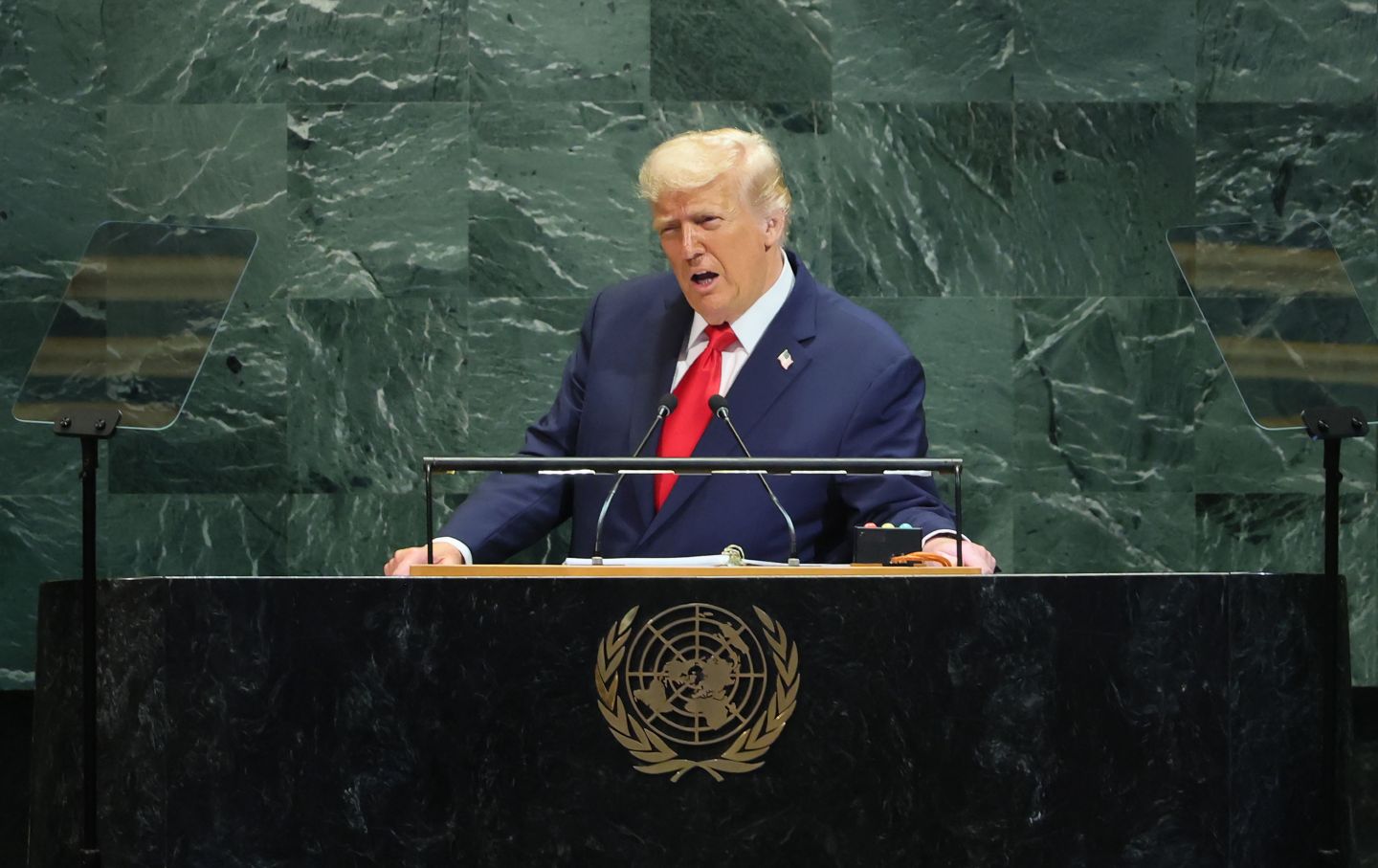
President Donald Trump speaks during the United Nations General Assembly at the United Nations headquarters on September 23, 2025, in New York City.
(Michael M. Santiago / Getty Images
When President Donald Trump delivered a barrage of false statements about climate change during his September 23 speech to the UN General Assembly, he made headlines around the world. Mocking climate change as a “con job” promoted by “stupid people,” Trump’s remarks also illustrated a dilemma facing journalism’s traditional approach to covering politics, where not appearing to take sides has long been a cardinal rule. As more and more political leaders and movements mirror Trump’s habit of making factually inaccurate claims, a new report from the Reuters Institute for the Study of Journalism offers a fresh way to think about this dilemma, along with a host of practical tools for tackling it.
“Populist politicians are rewriting the rules, and we [journalists] keep giving them oxygen,” writes Michael Hauser Tov, a correspondent for the Israeli newspaper Haaretz, in the report, called “Reporting populism: the harm-reduction playbook.” Parker Molloy, an American journalist whose Substack The Present Age covered the report shortly after its release, praised Tov for recognizing that “the normal rules of political coverage don’t work anymore. Ignoring provocative statements lets them spread unchecked. Covering them neutrally amplifies them and creates a false sense of legitimate debate.”
Some of the coverage of Trump’s UN speech had exactly the latter effect. In a nine-minute video package, the BBC did not include a sentence correcting Trump’s climate inaccuracies. The broadcaster’s only hint about the overwhelming scientific consensus on climate change and its devastating impacts on people and economies was to note that Trump’s remark was “met with gasps across the assembly floor.”
The Associated Press and The New York Times, however, avoided such pitfalls. Both news organizations employed a journalistic technique known as “a truth sandwich.” A concept developed by the linguist George Lakoff and backed by media critics including Margaret Sullivan and Brian Stelter, a truth sandwich starts by stating the factual truth, then reports the false claim, then restates what’s true. The AP story began by reporting that some of the world leaders gathered at the UN “are watching their citizens die in floods, hurricanes and heat waves, all exacerbated by climate change.” Trump’s remarks “didn’t match” that reality, the AP continued, “nor did it align with what scientists have long been observing.” AP’s story did quote Trump at length, but it put his statements in context, citing data and quoting experts making it clear that Trump, knowingly or not, was spreading misinformation.
The Reuters playbook endorses the same approach, but uses a different term for it, FWEF, which stands for: “State the Fact. Warn the audience they’re about to hear a lie. Explain how the lie misleads. Restate the Fact.” Adopting this approach won’t “cost money, needn’t hurt ratings…and is something newsrooms can start doing tomorrow,” Tov writes. The same holds for other techniques Tov’s report recommends, including one he applies to Brexit coverage but that also addresses a long-standing shortcoming in climate reporting: “Avoid false balance. If you platform two sides, show the real distribution of expertise or public support (e.g., ‘60 economists against, one for’).”
Perhaps anticipating concerns from some fellow journalists, Tov emphasizes that his reforms are “not about abandoning objectivity.” But objectivity, he argues, “is a tool, not the goal.” The global rise of politicians and movements that routinely lie, mislead, or otherwise try to misinform the public calls for “reinterpreting” objectivity, he writes, so “it aligns with other journalistic values that are no less important—foremost among them, providing the audience with the truth, and only the truth.”