
“True Bruin Values”: How UCLA Justified a Crackdown on Protest
More than a year after the Gaza encampments, the university’s newly enforced “time, place, and manner” restrictions have spread to any sort of contentious content on campus.
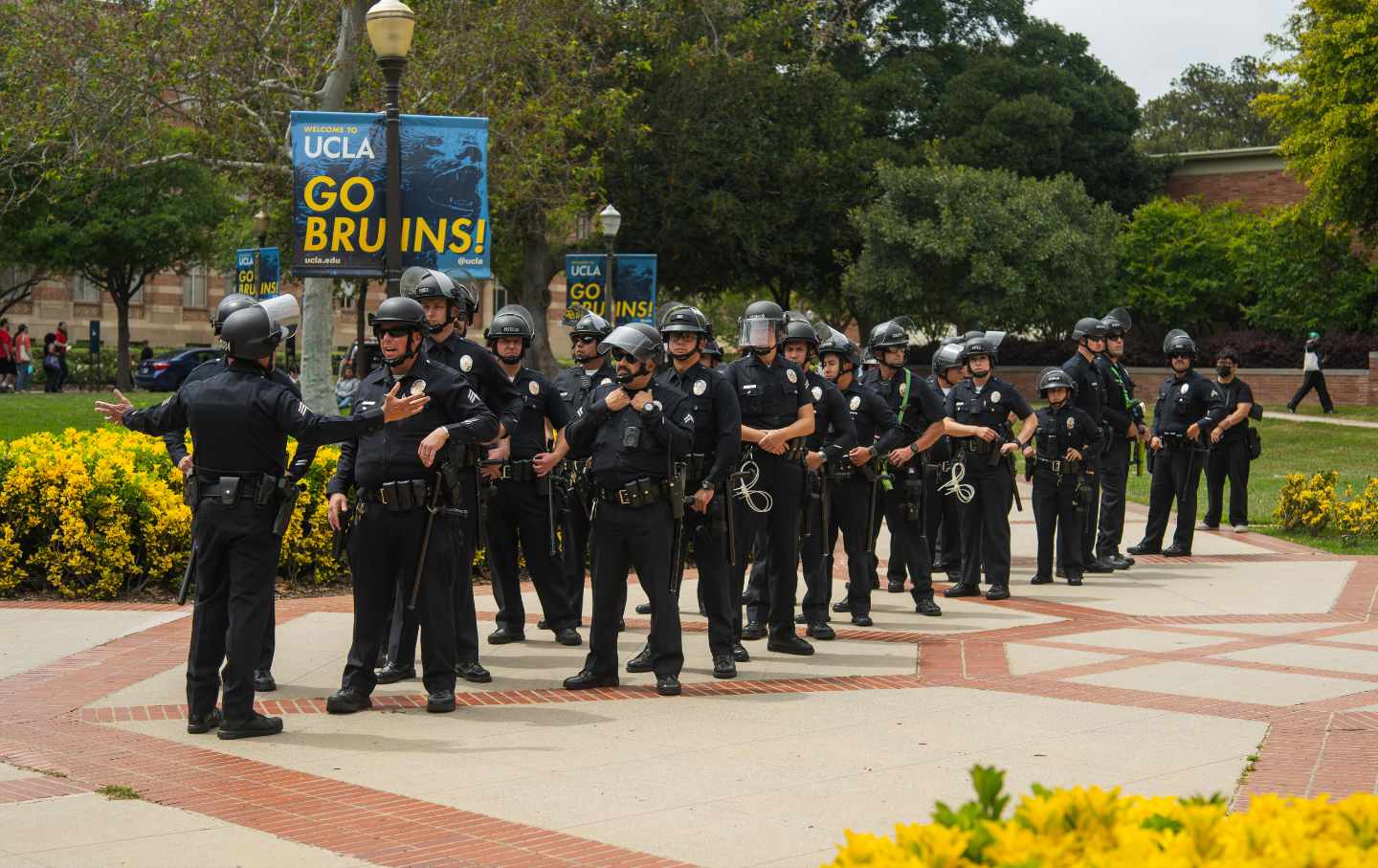
Police on the UCLA campus in May 2024.
(Shay Horse / Getty)
For the last six years, Eric Martin spent nearly every day at the University of California, Los Angeles, teaching theology to undergraduates.
But on April 11, 2025, Martin opened his door to a FedEx courier holding a thick folder. The package was from Michael Levine, the UCLA vice chancellor for academic affairs and personnel, a 146-page “Notice of Intent to Dismiss” informing Martin that he was banned from campus.
Martin was among the many professors, faculty, teaching assistants, and students present at UCLA’s Palestine Solidarity Encampments calling for divestment from Israel.
“While I was banned, I continued to receive e-mails about a workplace violence prevention training,” said Martin, who said he was present at UCLA encampments to provide support for his students. “It was ironic, because I got fired precisely for trying to prevent violence at my workplace. It was just that the violence came from the admin and the police. Apparently, trying to stop someone from firing a gun at students doesn’t count as violence prevention,” he said. “I was arrested while in the encampment—while I was standing there, pleading with police officers not to open fire on my students.”
Ten days after his receiving the package, an e-mail from Darnell Hunt, the UCLA executive vice chancellor and provost, notified Martin of termination from his position as a lecturer at UCLA. For his proclaimed “insubordination” and violation of UCLA’s “Time, Place and Manner” protest policies, which define where and how people on UCLA campus are permitted to exercise their First Amendment rights, Martin was fired. He was put under investigation by UCLA administration, but he said he refused to cooperate. “I do not think a body that rejects the invitation to consider their complicity in genocide is capable of running an investigation in a moral way.”
While the “Time, Place, and Manner” policies have been in place since 2018, they were newly enforced during the encampment in an “interim” manner. At the start of the new fall quarter in September 2025, the TPM policies were finalized. Graeme Blair, political science professor at UCLA since 2018, said that “under the Constitution, institutions have the right to determine reasonable restrictions on the time, place, and manner that that free expression activity can take place, but they don’t have the right to respond to protests in a content-specific way and change the rules to prevent particular people from sharing views that they don’t like.”
According to Blair, the university implemented new discipline policies for professors after the encampment, which were then enforced after the events. “The new responses are clearly aimed at stopping speech about Palestine,” Blair said. “I think they’re also unconstitutionally restrictive. There are no free expression zones in areas below a certain point on South Campus. In the medical school area, there is no free expression zone. The proportion of campus that allows free expression is less than 5 percent.”
Martin shared a similar sentiment, saying that TPMs seem to be selectively applicable: “There was a humongous screen put up [by counterprotesters outside the encampment] that was left up for many weeks,” he said. “It later came out it was up without a permit for those many weeks—and there was a security team protecting it much more ardently than the students in the encampment were ever protected. It tells you everything about the priorities of the university.”
Michael Chwe, a lecturer at UCLA since 2001, shared his view that TPM is used to stifle student movement, even after the encampment. This May, a student-led on-campus screening of The Encampments was shut down by the police. The students showing the film, according to Chwe, “started at Royce Hall—that’s not a public expression area. Then they moved down to the bottom of Tongva Steps—and that’s not a zone of free expression…so we moved to Bruin Plaza.” Later that night, police came in with riot gear and ended the screening. A number of professors—alongside many students—were arrested and given disciplinary charges under various UCLA codes.
John Branstetter, a faculty member who has taught political theory and other subjects at UCLA since 2017, said he was also present at the encampments on May 1, 2024—the night after counterprotesters attacked the encampment. Branstetter said he was there after students requested faculty presence inside the encampment after the attack by counterprotesters took place. “Surely, you put a bunch of old people in academia regalia up front, and these people are not going to attack us,” Branstetter said. “It was a way to calm the situation.”
But the following days were anything but calm. While the police were already on campus, they began to break apart the encampment in the early morning hours of May 2. Branstetter found himself standing in the front row between the police and the encampment, and said he was among one of the first 20 people to get arrested.
“The police knocked the shield on my hand,” Branstetter said. “Then they did a pro wrestling move: They reached behind me and pulled my jacket up over my face. They slammed me to the ground and then dragged me across the concrete. I was bruised and bleeding as this guy put his knee on my back, did the zip ties and stuff, and they took us downtown for processing.”
Popular
“swipe left below to view more authors”Swipe →After being led to the police bus, arrested lecturers, TAs, and students all received citations for TPM violations. Branstettor said the university revoked his—and others’—right to be on campus due to unlawful assembly and received a letter of censure, which he is still fighting.
Like Martin, Branstetter was placed under investigation. The UCLA Campus Human Resources Office alleged that Branstettor violated, “UCLA’s Time, Place, and Manner (TPM) Policies, as well as UCLA’s Principles of Community, the UC Statement of Ethical Values, and True Bruin Values.”
According to UCLA’s website, True Bruin Values include respect, accountability, integrity, service, and excellence. While these five traits are preached to UCLA students during freshmen orientation, the university has also, apparently, employed them as a legal term, used to justify the investigation of Branstetter and other professors who were arrested at the site of the protest. “It’s a vague gesture of being nice and they treat it as a legal document,” he said. “It’s so vague that it’s hard to even know what exactly the problem is. I think cops and hooligans shouldn’t beat up my students, right? That’s not a violation of True Bruin Values.”
In the following weeks, LA City Attorney Hydee Feldstein Soto threw out the criminal charges against Martin, Branstetter, and most of the others who were arrested for involvement in the encampment. Martin remains banned from campus. Hunt, UCLA’s executive vice chancellor and provost, declined to comment.
Blair expressed concern for university administration’s ability—and willingness—to wield policies “against a whole range of people, for doing nothing else but participating in a protest on campus.” Blair is currently involved in two lawsuits against the UC Regents. In Boosinger v. Regents of Univeristy of California, plaintiffs claim that the UCLA administration discriminated against students and professors with pro-Palestinian viewpoints, allowing counterprotesters to brutalize and cause physical harm to students and professors. Blair v. Regents of the University of California argues that UC, UCLA, and UCPD violated protesters’ First Amendment rights in taking measures to dismantle the encampment.
More than a year after the crackdown on the encampments, UCLA students are still feeling its effects. Walking on campus, you find signs that read: “This is not a zone for public expression”—a reference to the infamous TPM policies—alongside many private security personnel, geared in black uniforms and riding bikes, patrolling students on campus. “Not everyone experiences cops as a calming thing, even at the best of times,” said Branstetter. “We’ve made this argument to this administration before, but they don’t seem to get that message. Their response is just more cops, more cops, more cops.”
These restrictions have quickly eclipsed the encampment, extending to any sort of contentious content. Chwe hung a “Stop Visa Revocations” poster on his office window, which UCLA security removed within two hours. Branstetter said that when he took his class studying fascism to a picket line, his group was dispersed, citing TPM policies. “Its not just the content of these policies which are very limiting in terms of where you can say things,” Chwe said. “It’s the fact that they are being used in a very false way to intimidate people.”
Spenser Kussin-Gika is a fourth-year graduate student studying political theory. Gika, who is Jewish with a thesis revolving around Zionism and its history, said that the hostilities after the encampment have had a chilling effect on research efforts on campus. He described the inclination of the political theory department at UCLA to study what is “comfortable, less controversial.” A UCLA Fielding School Public Health class focusing on treatment of refugees—particularly those from Gaza—was canceled by UCLA’s Educational Policy and Curriculum Committee, in line with a recent incident at Cornell.
“There have been all kinds of administrative changes that have put a chill on speech, activism, and even research and teaching to some extent,” Branstetter said. “Even the atmosphere in the classroom is tense, and it makes it more difficult to have conversations. As a Bruin, that sucks. It shouldn’t be that way.”
Become a Sustaining Donor This September
Between the reemergence of right-wing red-baiting and Donald Trump’s use of the chilling National Security Presidential Memorandum–7 to criminalize left political organizing, we’re seeing McCarthyism reborn before our eyes.
This assault on democracy cannot be ignored or wished away. Resisting it requires bravery in the face of threats and repression, a steadfast commitment to the truth, and the unwavering belief that we can—and will—overcome this darkness.
We must have an independent media that sets the record straight, unearths corruption and abuses of power, and advances a politics of justice and dignity for all if we’re to win this fight.
That’s why I’m writing to you today. This September, The Nation needs to add 100 monthly donors to sustain our progressive journalism. Your contribution makes the next investigative report, the next truth-speaking column, and the next pathbreaking essay all possible.
I hope you’ll support our work with a recurring donation today. If you donate $10 or more a month, we’ll send you a brand new “Hands Off the Free Press!” sticker to recognise your commitment to our cause. Please, donate today.
Onward,
Katrina vanden Heuvel
Editor and Publisher, The Nation
More from The Nation
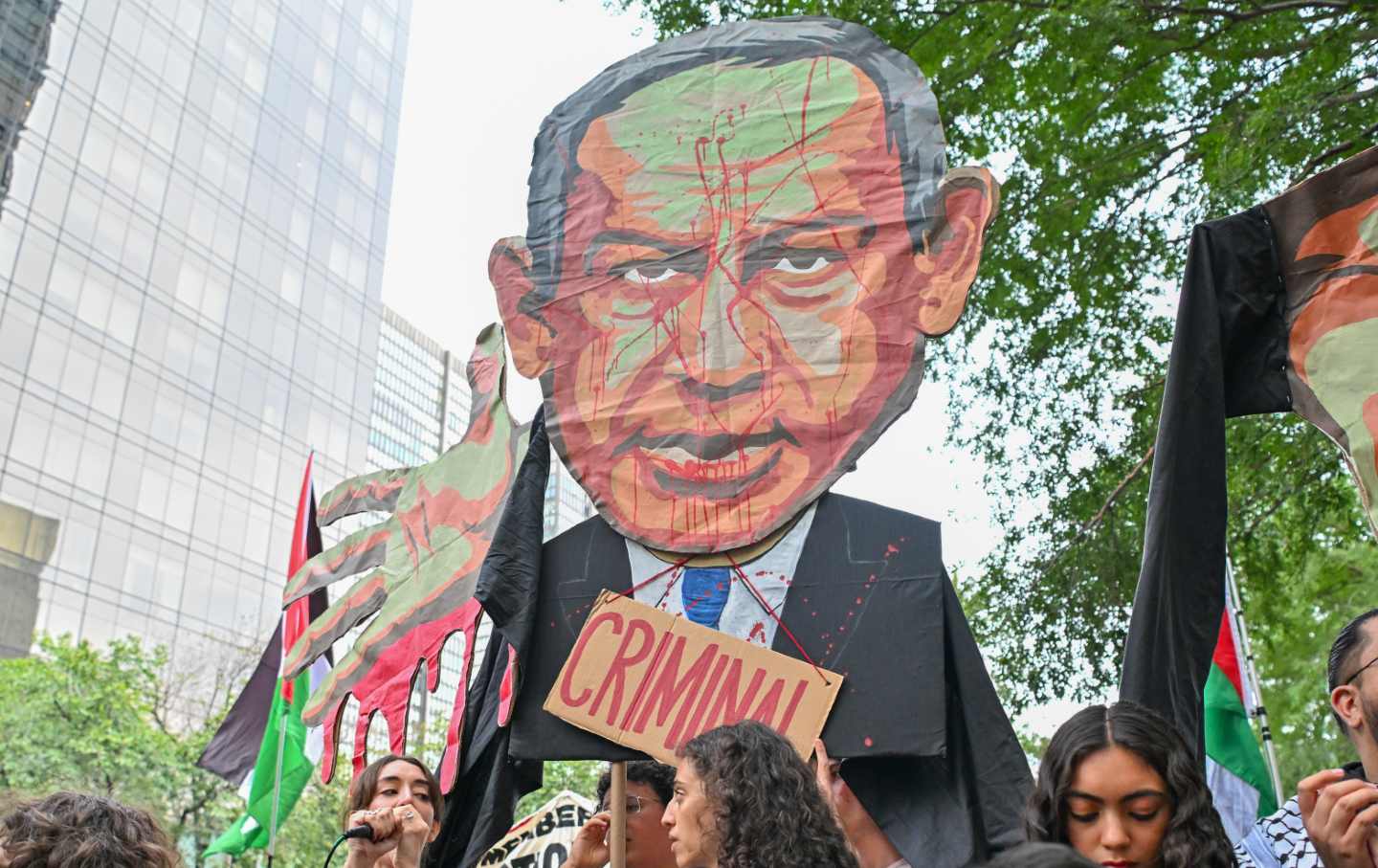
Netanyahu Came to New York. New Yorkers Were Ready for Him. Netanyahu Came to New York. New Yorkers Were Ready for Him.
Scenes from the defiant protest against the genocidal leader’s UN speech.
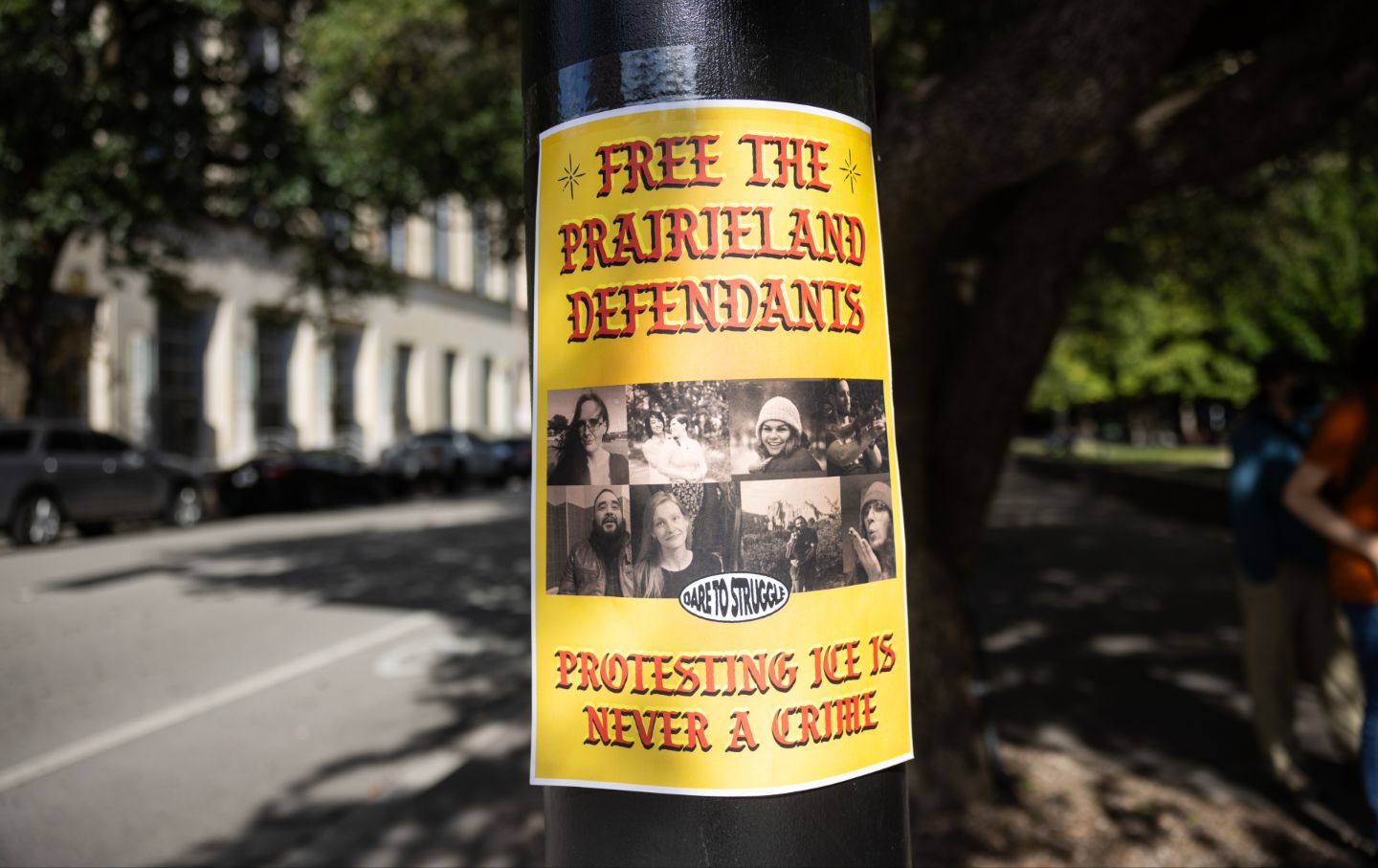
A Message From Prairieland Prisoner Autumn Hill: “Don’t Be Afraid” A Message From Prairieland Prisoner Autumn Hill: “Don’t Be Afraid”
I talked to the political prisoner about the politics of love, her case, surviving as a trans woman in a men’s prison, and how she makes it through the day.
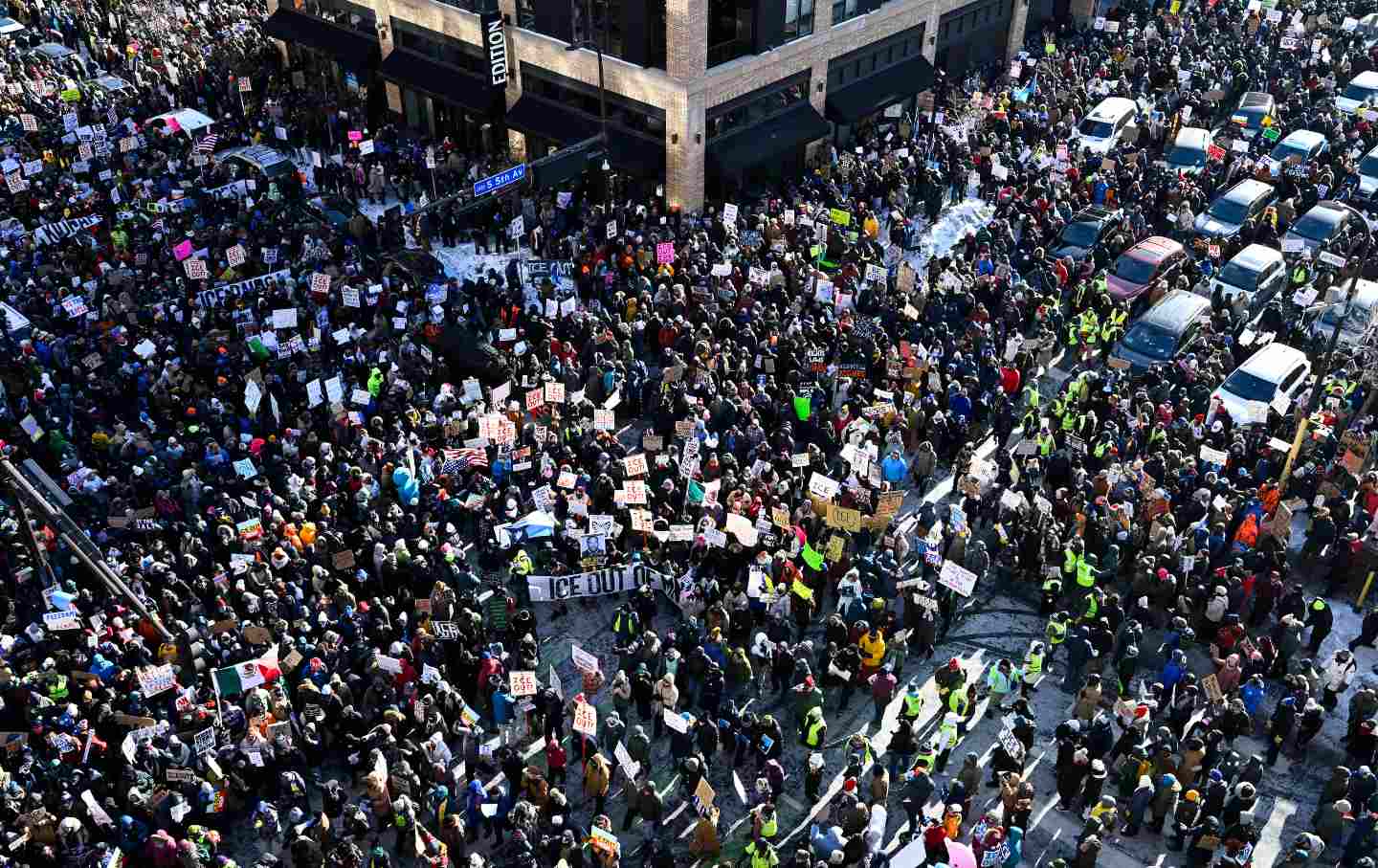
The Impossible Will Take a Little While: The Power of Persistence The Impossible Will Take a Little While: The Power of Persistence
In troubled times, history offers a lesson: Seemingly impossible change can begin with ordinary people who refuse to give up.
Gloria Steinem’s Many-Splendored Feminist Life Gloria Steinem’s Many-Splendored Feminist Life
The feminist icon lived the struggle for gender equality and always found time to lend support and solidarity to other women leaders, even in her final days.
No, Woke 1 Was Not Crazy No, Woke 1 Was Not Crazy
AOC and others are laughing off 2020 as a wild, isolated moment. None of that is true.
How Occupy Wall Street Still Explains Politics Today How Occupy Wall Street Still Explains Politics Today
It sowed the seeds for a new era of social movements—but its politics of powerlessness should act as a cautionary tale.

