Old, Wealthy Democrats Are Sabotaging Their Own Party
The problem of gerontocracy includes the donor class.
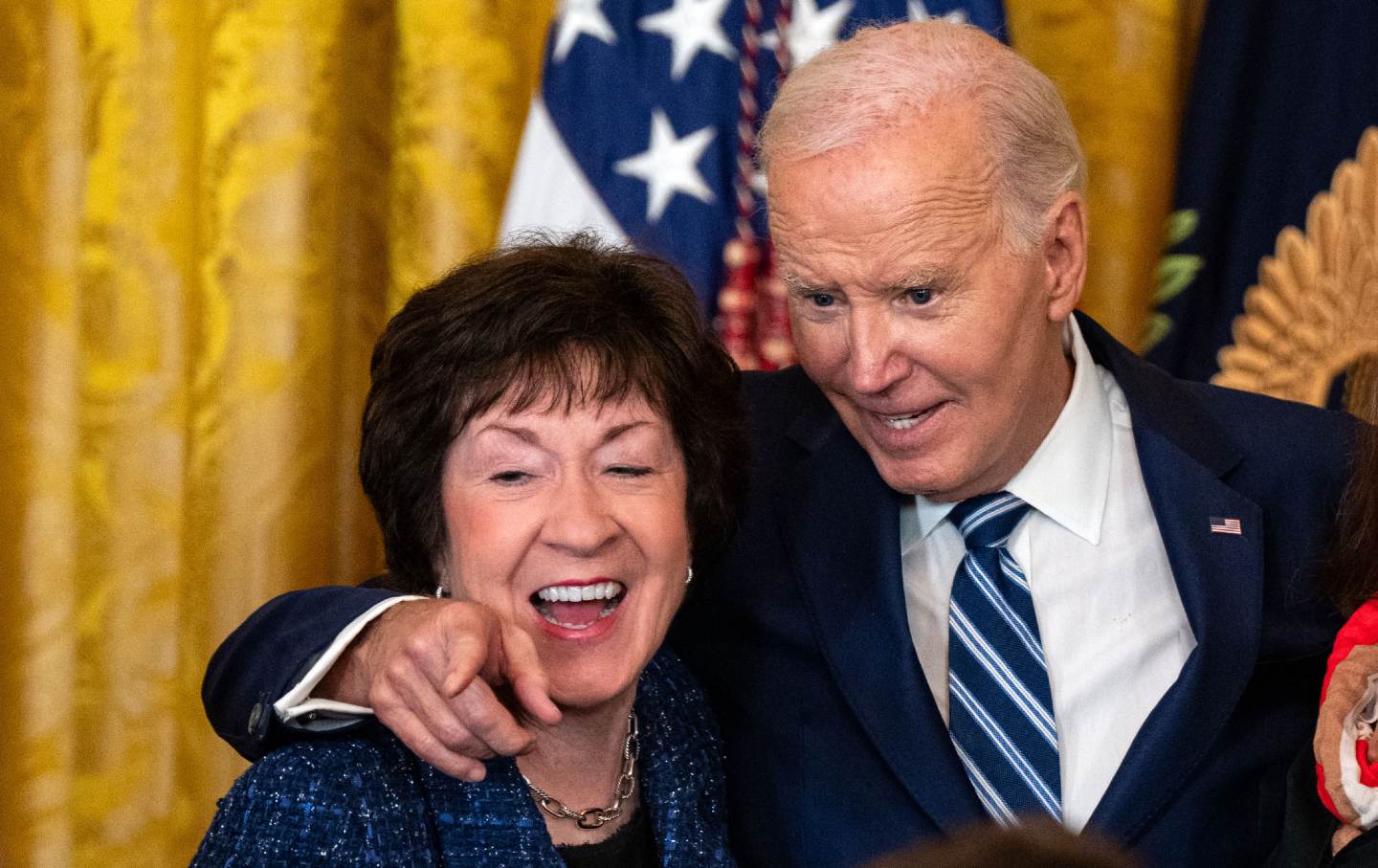
Senator Susan Collins (R-ME) poses with President Joe Biden in the East Room of the White House on January 5, 2025, in Washington, DC.
(Kent Nishimura / Getty Images)Republican Senator Susan Collins is facing a tough reelection bid in Maine next year, but she has an ace up her sleeve: Hollywood Democrats who love her and are ready to fill up her election coffers.
On August 19, The New York Times reported that Collins will be attending a fundraiser on her behalf on September 26 in the Bel Air home of Sherry Lansing, the former Paramount Pictures chair and a prominent Democratic Party fundraiser. Media-industry bigwig Casey Wasserman, who shares the same political profile as Lansing, is cohosting the event. Harry E. Sloan, onetime chairman of Metro-Goldwyn-Mayer, who in the past supported moderate Republicans such as John McCain but more recently has donated heavily to Joe Biden and Kamala Harris, will be in attendance. The reception is geared toward the well-heeled, with ticket prices ranging from $3,500 to $10,000.
As the Times notes:
That Ms. Collins is the toast of some liberal donors is something of an odd-bedfellows moment. But the senator has prided herself as independent, with fans among moderate Democratic voters and donors.
The Collins dinner offers a snapshot of the special world of wealthy Democratic donors, who enjoy outsize power even though they frequently make decisions that are terrible for both their party and their country.
Backing Collins is a perfect example. One would think that donors who identify as Democrats or even consider themselves friendly to the party would recognize that defeating Collins is essential—particularly since Maine, where Kamala Harris defeated Donald Trump by 7 percent in 2024, gives Democrats a rare chance to flip a Republican Senate seat in 2026.
Collins’s Democratic fans would probably say that they think it’s important to support “moderates” like her, no matter what party they come from. But Collins’s carefully nurtured reputation as a senator willing to counter Trump’s extremism is in tatters. Even as centrist a source as Time acknowledges that her “protest votes are as strategic as they are symbolic” (in other words, almost never cast when they could actually stop a policy Trump wants). Collins voted for all but one of Trump’s cabinet nominees. In the first three years of Trump’s first term, she supported more than 96 percent of his judicial nominees, including Supreme Court Justices Neil Gorsuch and Brett Kavanaugh. She now claims she was misled by these nominees on abortion, but that doesn’t change the fact that the end of Roe v. Wade, along with other legal horrors, rests on her shoulders.
Beyond the fact that her claims to be a moderate are fictional, Collins is worth defeating because she’s a member of the GOP, a party that threatens US democracy. Undoing the impact of Trumpism will require winning as many Democratic seats as possible. The fact that Collins has a political profile that wealthy Democrats like (fiscally conservative and socially liberal) shouldn’t matter. She has an R next to her name. That should be the end of the discussion.
The rich Democrats raising money for Collins obviously either don’t understand or don’t accept the common refrain from their party leaders that this is a moment of maximum peril for democracy. One obvious explanation for their behavior is that, as members of the 1 percent, these donors know that Collins will tend to their financial interests better than Democratic alternatives such as Graham Platner, an oyster farmer hoping that a robust message of economic populism will propel him to victory.
Age is another factor. In an article published earlier this year in the Journal of Public Economics, the political scientists Adam Bonica and Jacob M. Grumbach document that gerontocracy is a problem that intertwines both the political elite and the donor class in the United States. The average American is roughly 39 years old, the average voter 47, and the average member of Congress 57.5. But the age of the average donor surpasses even that. As Bonica and Grumbach note that
if we weight donors by dollar amounts, we find that the average dollar came from a 64-year-old (i.e., the mean dollar-weighted age of donors is 63.9). The median dollar came from a 66-year-old. We also find that only 9% of contribution dollars came from donors who are 40 years old or younger.
In other words, the typical donor is nearly 20 years older than the typical voter.
Popular
“swipe left below to view more authors”Swipe →Older, wealthier, whiter, and more conservative than the public at large, donors tend to prefer candidates who think like them and are also closer to being their age. The fact that Collins is 72 years old and has been in the Senate since 1997 makes her more attractive to the donor class, regardless of their party affiliation.
The tendency toward gerontocracy among donors has a distinct ideological cast as well. This is a group that has responded to Trumpism by adopting a creed of ancien régime restoration that envisions the best possible future as a return to the glory days of bipartisan comity. Never mind that this nostalgic vision of the past has little bearing on reality (since conflict has always by definition been endemic to politics). We already know that it’s a political dead end. It’s the kind of mythos that Biden appealed to when he waxed eloquent about his friendship with racist reactionaries like Strom Thurmond, and that Kamala Harris tried to exploit when touting the support she received from Liz Cheney and her family. As we know all too well, voters were less than impressed.
Gerontocracy is a problem because different age cohorts can have strikingly different interests. As Bonica and Grumbach note:
There are also strong reasons to support greater representation of the young based on cohort effects. Societal crises, technological change, and economic shocks are not distributed uniformly across time. In other words, age in politics is more than life-cycle effects—there are critically important differences in generational cohorts that leave us uncertain about whether younger and future generations will achieve the same political dominance as the current Baby Boomer generation. The Baby Boomer generation, for instance, built considerable wealth through housing but then helped to create restrictive zoning laws and other policies that made wealth-building through homeownership more difficult for younger generations. Compared to younger people, older generations will also avoid much of the civilizational cost of climate change.
One major reason Democrats lost the presidential election in 2024 was the enormous erosion of the youth vote. Too many young voters who had supported Biden in 2020 either sat out the 2024 election or voted for Trump. The alienation of young people from the party has many factors, but surely one reason is that Democrats are in thrall to a plutocratic and geriatric donor class that prevents the party from embracing economic populism or listening to the deep revulsion of voters toward the genocide in Gaza.
The fundraising party for Collins is emblematic of a donor class deeply at odds with Democratic Party voters. This is a donor class that is more likely to sabotage their own party than help it win elections.