Trump’s Petty-Tyrant Brand of Fascism
The GOP president is both a dire threat to democratic governance and a clownish mob boss.
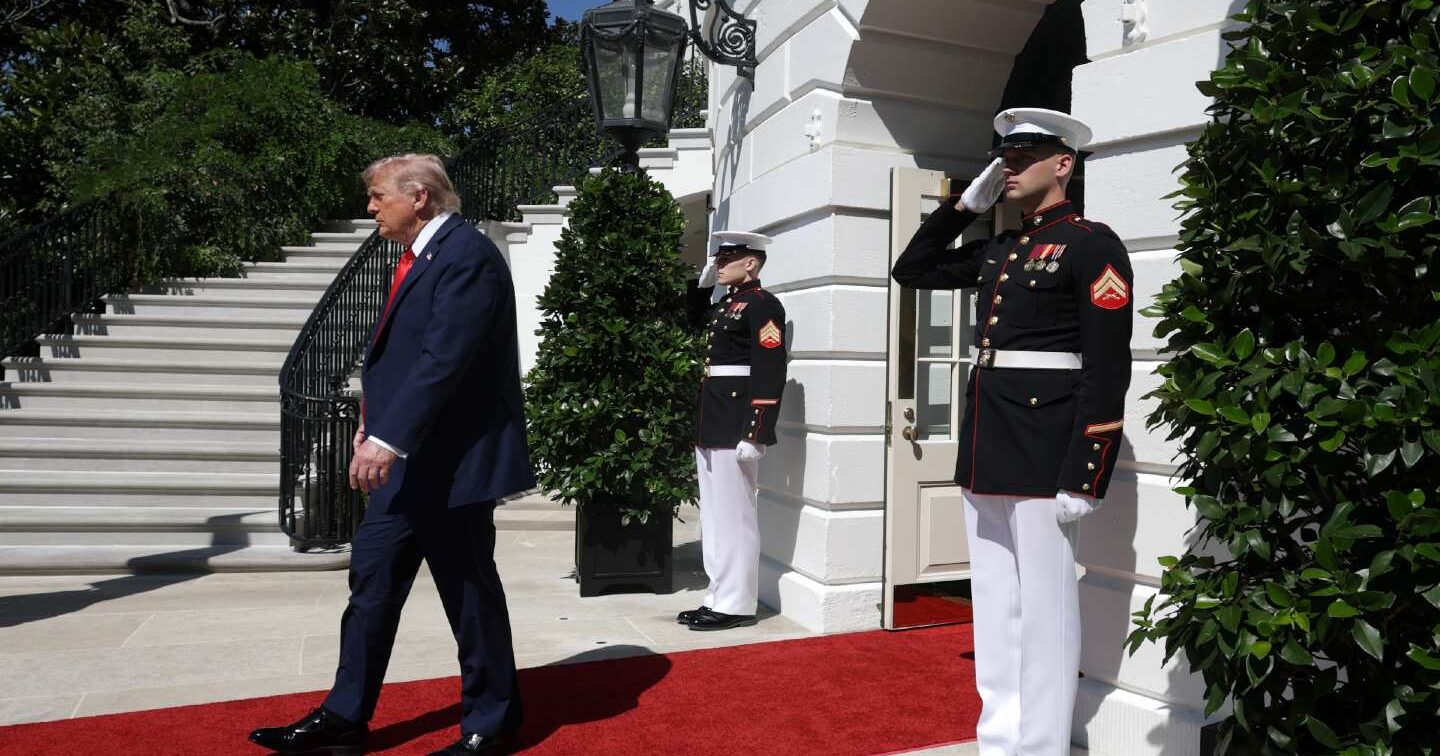
As we come up on the anniversary of the 2024 election, it seems as good a time as any to ask, “Has it happened here?” Can we meaningfully call the second Trump administration a fascist regime? For most casual observers, it’s not much of a question. What are you supposed to call it when masked and uniformed federal police show up at a political rally for an opposition politician? Or when the president essentially declares martial law in the capital city? Or, for that matter, when the executive is trying to enforce its cultural policy on a nation’s universities and museums? And what else to call it when the administration is trying to cook the unemployment numbers to hide a struggling economic picture? What do you call it when a senior White House aide says they are “looking at” suspending habeas corpus? Or when the government deports people without due process to camps beyond the rule of law, where internees are subject to torture? Pedants will still protest that this or that detail does not align historically, and that it is not as violent, dramatic, and all-encompassing as Hitlerism or Mussolini-ism, but they can’t really tar their opponents as hysterics or alarmists anymore. They must admit, the alarms were somewhat justified. Surely this is it, or some version of it.
In The New York Times, Jamelle Bouie writes about how the president relies on manufactured states of exception and emergency to justify these extraordinary expansions of power. This is exactly the expedient suggested by the evil genius of Nazi jurisprudence, Carl Schmitt, who declared that sovereignty was the ability to decide what was an exception to the rule of law and to act accordingly. Schmitt also demanded the periodic identification of internal enemies and their energetic persecution as a path to a healthy polity—another feature of fascist rule that Trump and his gang are emulating, via anything-but-veiled depictions of immigrants and nonwhite city dwellers as maniacs, killers, and urgent threats to civil peace and order.
But still, there is something so cheap and tawdry, something so manifestly hollow and farcical about this regime, that to give it the name of a grand historical tragedy like “fascism”—or even the terrible title “dictatorship,” implying as it does the concentrated, legalized use of terror and force—grants it a dignity it does not deserve. The regime may be authoritarian in its aims, but it can’t fairly be said to be totalitarian, except in the dreamworlds of its most servile supporters: Political life and pluralism amble on and are unlikely to be swept away entirely. Trump may wish to shape reality to his whims, but he cannot; gravity still holds, and the poll numbers are going down. I understand the hesitation to award the Trump administration the badge of fascist dishonor, especially when it so badly wants to be taken as something formidable and frightening. It all seems like a spectacle. Why, indeed, take it so seriously when its attempt to cow Los Angeles into submission with military occupation fizzled? Or dress up what is a massive agglomeration of rackets and scams led by a racketeer in chief, more Al Capone than Il Duce, into a world-historical drama? Why contribute to the climate of numbing conspiratorial speculation that proved so instrumental to Trump’s rise by granting him an additional air of hocus-pocus?
Perhaps the better words for all this are the older terms “tyrant” and “tyranny.” Tyranny, since its first formal explication by Plato in The Republic, suggests fundamental disorder and irrationality. The totalitarian regime pursues a world of terrifying ideological consistency, destroying with ruthless logic anything that gets in its way—but the tyrant is arbitrary and incontinent, subject to unruly passions and appetites. The tyrant, according to Aristotle, rules only according to his own interests, without heeding any notion of the greater good. As such, the tyrant treats the polis, the republic, like a giant extension of his own household. That’s just what Trump, who has been justly accused of setting up a “patrimonial” system, is attempting to do. Commentators often remark that Trump is “transactional” and that he operates within a “zero-sum” world. Another way to put this is that he is completely instrumental in his relations with others: He uses them. Again, this is characteristic of a classical tyrant, who cannot have true friends with whom he shares a common goal; he sees only pawns to be moved and potential rivals to be cowed. The overriding selfishness of tyrants corrodes the communal life of the entire people: They all relate to one another as objects to be disposed of or controlled. He plays upon the hopes for private gain and the fears of private loss. The social order that bends to his will thus becomes a world of people concerned only with their own private needs, who sulk apart in fear and loneliness and are unable to act in concert—that is to say, act politically. And that suits Trump the tyrant just fine.
How do tyrannies end? Badly—for the tyrants and, sadly, also for their subjects. The tyrant’s juggling act, his constant need to alternately exploit, bribe, blackmail, flatter, insult, injure, and intimidate his subjects, eventually breeds hatred that leads to the downfall of his regime, either through a conspiracy of his former close supporters or an uprising of the people. But one also imagines that the tyrant, if he’s old and unfit, must just die sometimes. We should be so lucky.
Your support makes stories like this possible
From Minneapolis to Venezuela, from Gaza to Washington, DC, this is a time of staggering chaos, cruelty, and violence.
Unlike other publications that parrot the views of authoritarians, billionaires, and corporations, The Nation publishes stories that hold the powerful to account and center the communities too often denied a voice in the national media—stories like the one you’ve just read.
Each day, our journalism cuts through lies and distortions, contextualizes the developments reshaping politics around the globe, and advances progressive ideas that oxygenate our movements and instigate change in the halls of power.
This independent journalism is only possible with the support of our readers. If you want to see more urgent coverage like this, please donate to The Nation today.