Rebuilding Trust Across the Divide Isn’t Just Possible—It’s Essential
And here’s how it can be done.
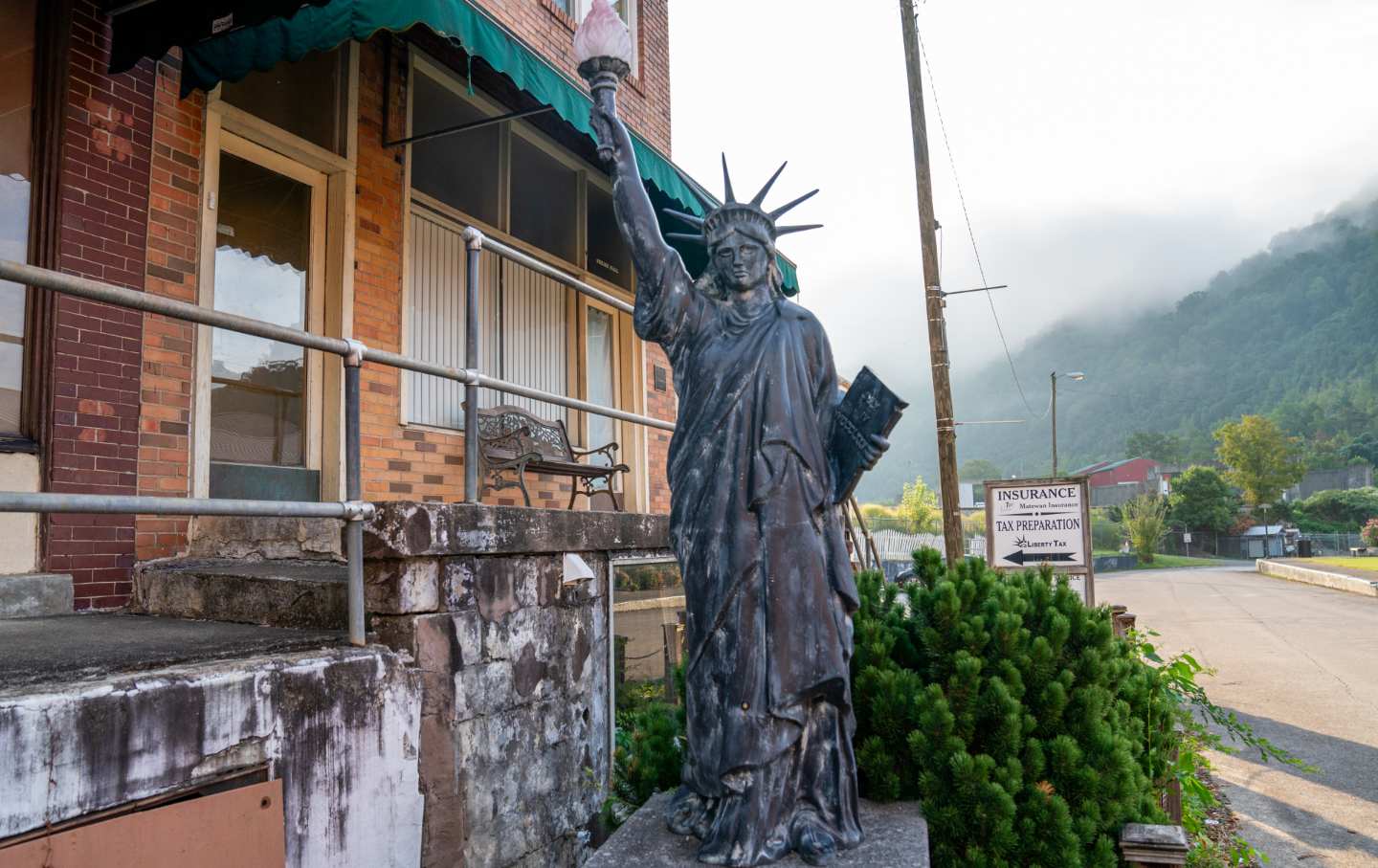
A model of the Statue of Liberty stands on a pedestal in Matewan, West Virginia.
(Robert Nickelsberg / Getty Images)
It was April of 2012 when I pulled into the restaurant parking lot in the tiny town of Lebanon, Virginia. I’d recently begun my campaign in the state’s Ninth Congressional District and the folks at the restaurant were there to see what I was about.
I recognized the fellow who greeted me as I got out of the car—a retired coal miner who had been to other campaign events we’d held. He was a union guy: United Mine Workers of America.
“What do you think about that bombshell Obama dropped on us?” he asked. Sensing that I wasn’t sure what he was referring to, he made it clear. “You know, gay marriage.” Then I remembered: President Obama had just come out for the legalization of same-sex marriage.
“What do you think about it?” I asked.
“It’s an abomination, the Bible says so. Marriage is between a man and woman. Anything else is unnatural, it’s wrong!” He was, as we say in these parts, convicted in his words.
“I hear you,” I replied. “I know that the idea seems a little odd to some folks. But the main thing I get from the Bible is that we’re supposed to love one another, especially people who are different from us, hard for us to love.” That’s all I said. He chewed on that for a moment and then replied, “I guess you’re right.” And then, after a bit more pondering, “Well, I suppose they’re just born that way anyway.”
This retired coal miner, influenced by a very conservative church and community, went from “homosexuality is an abomination” to “that’s just who they are and we should love them” in the span of a hundred-yard walk.
Why? In part because I listened to him and didn’t try to scold him. But more importantly, because he trusted me. He trusted me because he knew I’d been on the picket lines with the miners during their 1989–90 Pittston Coal strike, that I’d fought to improve black-lung rules for miners, and worked to create new jobs in his community. He trusted me because he believed I had his back, and that trust enabled him to reconsider a deeply held view.
This is what we on the left have lost: the trust of millions of rural and working-class people. Some of that has come from the relentless and dishonest narrative on right-wing media. Some of it is our own damn fault. But, either way, huge numbers of the people we need, not just to vote for us but to join us in taking this country back from Trump and the billionaires, deeply mistrust us. Reversing that mistrust is essential to everything else progressives seek to do.
There is much to applaud in the range of efforts to facilitate civil dialogue and build empathy. However, we’ve taken a different approach, one that puts action ahead of words.
Two years ago, the Rural Urban Bridge Initiative, which I cofounded with Erica Etelson, launched Community Works, or “CWorks,” in four rural, deeply red counties in Virginia. One year later, we initiated it in rural Georgia.
Our process was simple. We identified county Democratic committees that were struggling but interested in trying something different. We then worked with them to undertake regular, concrete, nonpolitical community work, side by side with civic groups, churches, veterans and senior citizen groups, local nonprofits, and, eventually, local elected officials. Local CWorks chapters, each affiliated with the county Democratic committee, do at least three community events per month, turning out dozens (or more) volunteers to solve local problems collaboratively with their neighbors.
Our goal? To test the idea that, if people worked side by side to address local needs, bit by bit, trust would be rebuilt. Democrats and liberals, working with independents and conservatives to pack food for the needy, pick up trash in the creek, fix a neighbor’s roof, install smoke alarms in trailers, and organize activities for kids. And much more. No proselytizing, no persuasion, no candidate buttons.
We’re barely two years in, but it is clearly working. The six CWorks chapters in Virginia and Georgia have held more than 500 local events, involving at least 200 collaborations with a wide range of civic and community organizations. According to CWorks national director, Meredith Dean, “Stuff is getting done, community is being rekindled, and people are feeling hope. We’ve also seen very positive impacts on the local Democratic committees themselves, many of which were previously discouraged. With the addition of CWorks, they’ve experienced a dramatic growth in energy, enthusiasm, and volunteers.”
Collaborative community problem solving efforts like Community Works are generating interest from people in many places. CWorks itself is rapidly expanding, with new chapters recently added in Minnesota, Alabama, Maryland, California, and elsewhere. For many on the left, particularly young people, there’s a hunger to do something concrete and constructive, rather than just fighting the bad stuff that never seems to stop. Could collective local action, done collaboratively and intentionally with folks “on the other side” save us from Donald Trump? We don’t know the answer just yet. But it is clear that when we stop trying to convince people that they’re wrong and start working together to fix things, we build trust.
Popular
“swipe left below to view more authors”Swipe →Trust is a prerequisite to persuasion. It can also, we have found, be a generator of enthusiasm and activism.
Kenya Adams’s involvement with the Jenkins County, Georgia CW chapter helped her “become much more aware of the needs in our area. Many young adults are in a state of “IDK, IDC”[I Don’t Know, I Don’t Care], totally disengaged. But working with CWorks motivated me to join my local Democratic Committee and become president of our first-ever Young Dems chapter.”
We’ve seen how nonpolitical work leads people to political involvement. Shanelle Carr, also in Georgia, describes herself as “one of those people who sat on the couch and complained.” But after experiencing the power of local community work, “everything changed for me. I started attending our School Board and Town Council meetings.” Community Works, she said, “set a fire in me to become more engaged and active in my community.”
This strategy is helping revitalize local Democratic committees in rural, red areas. But is it helping overcome the overwhelmingly negative views of Democrats? Anecdotally, at least, the evidence for this is strong and growing. Heather Vaughn who leads the CWorks chapter for the Scott County, Virginia Democrats says that their events increasingly are “in response to other groups or individuals asking us for assistance. At this point, people know who we, they know they can count on us and they trust us to help.”
In a county where fewer than 20 percent of people voted for the Democratic ticket in 2024, that’s significant.
The Page County Democrats CWorks chapter has been among the most active and successful thus far. With their dazzling track record of getting things done, the community—again, overwhelmingly red—has come to see them in a very different light, extending even to the Republican-controlled county Board of Supervisors. They’ve moved from skepticism of this Democratic initiative to now actively working to support and partner with the CWorks chapter.
As one of the Page County volunteers, Bob Richey put it, “Community Works is bridging a political divide that I didn’t think was bridgeable.”
Disobey authoritarians, support The Nation
Over the past year you’ve read Nation writers like Elie Mystal, Kaveh Akbar, John Nichols, Joan Walsh, Bryce Covert, Dave Zirin, Jeet Heer, Michael T. Klare, Katha Pollitt, Amy Littlefield, Gregg Gonsalves, and Sasha Abramsky take on the Trump family’s corruption, set the record straight about Robert F. Kennedy Jr.’s catastrophic Make America Healthy Again movement, survey the fallout and human cost of the DOGE wrecking ball, anticipate the Supreme Court’s dangerous antidemocratic rulings, and amplify successful tactics of resistance on the streets and in Congress.
We publish these stories because when members of our communities are being abducted, household debt is climbing, and AI data centers are causing water and electricity shortages, we have a duty as journalists to do all we can to inform the public.
In 2026, our aim is to do more than ever before—but we need your support to make that happen.
Through December 31, a generous donor will match all donations up to $75,000. That means that your contribution will be doubled, dollar for dollar. If we hit the full match, we’ll be starting 2026 with $150,000 to invest in the stories that impact real people’s lives—the kinds of stories that billionaire-owned, corporate-backed outlets aren’t covering.
With your support, our team will publish major stories that the president and his allies won’t want you to read. We’ll cover the emerging military-tech industrial complex and matters of war, peace, and surveillance, as well as the affordability crisis, hunger, housing, healthcare, the environment, attacks on reproductive rights, and much more. At the same time, we’ll imagine alternatives to Trumpian rule and uplift efforts to create a better world, here and now.
While your gift has twice the impact, I’m asking you to support The Nation with a donation today. You’ll empower the journalists, editors, and fact-checkers best equipped to hold this authoritarian administration to account.
I hope you won’t miss this moment—donate to The Nation today.
Onward,
Katrina vanden Heuvel
Editor and publisher, The Nation
More from The Nation

Islamophobic Elites Lied to Destroy the Life of a Palestinian Brown Student Islamophobic Elites Lied to Destroy the Life of a Palestinian Brown Student
Plutocrats, pundits, and government officials joined together in a racist smear campaign against a queer Palestinian student at Brown University.
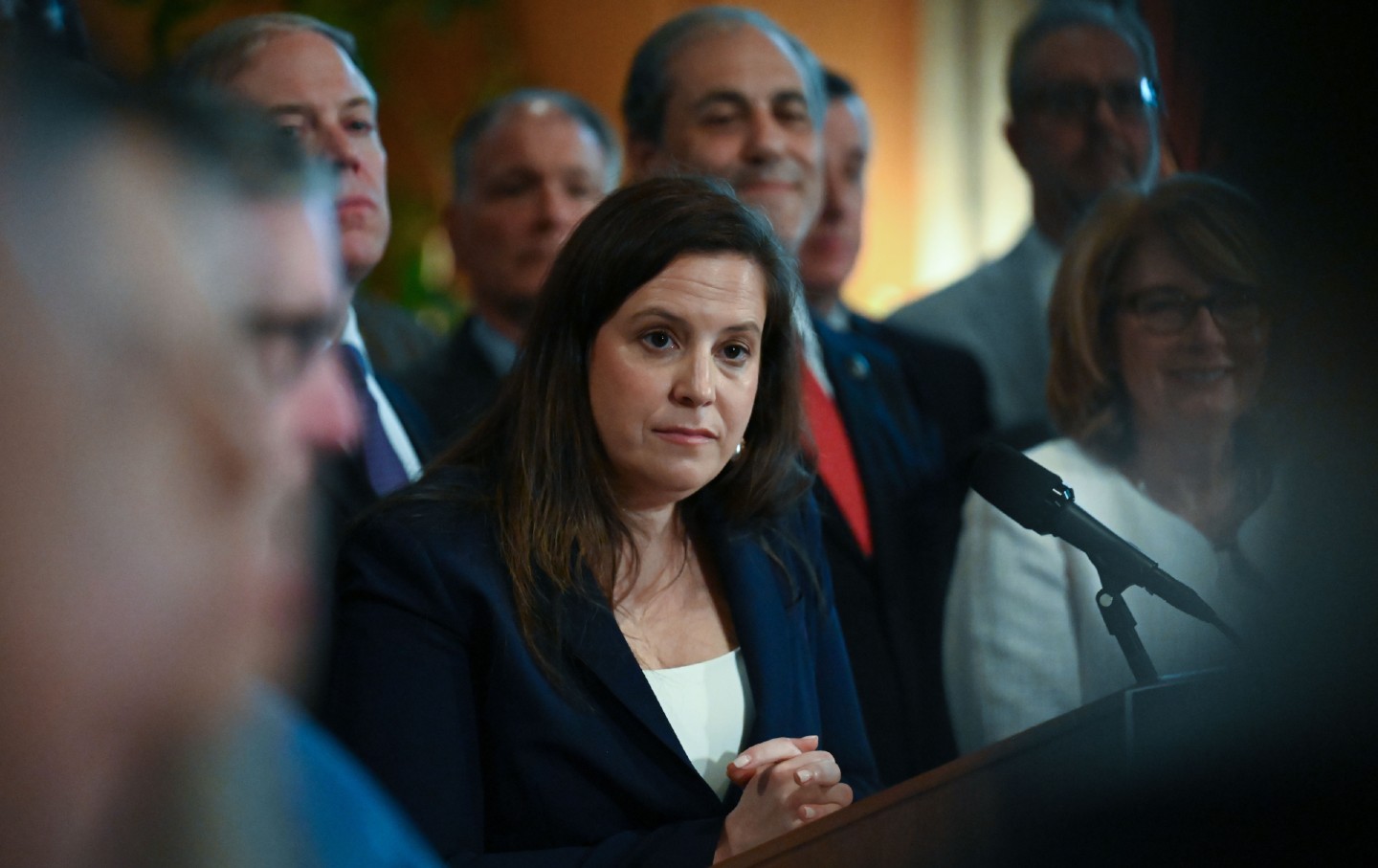
Recent Democratic Victories Have Republicans Running Scared Recent Democratic Victories Have Republicans Running Scared
Elise Stefanik is just the latest top Republican deciding against running in the 2026 midterms.

Pirate Trump Pirate Trump
Donald Trump escalates Caribbean tensions with vessel attacks near Venezuela.

Trump’s “Warrior Dividend” Might Be His Scariest Idea Yet Trump’s “Warrior Dividend” Might Be His Scariest Idea Yet
This week’s “Elie v. US” explores the authoritarian threat beneath Trump’s bonuses for military families. Plus, a case for getting rid of the Second Amendment.

HUD Is Refusing to Enforce Anti-Discrimination Law—and Won’t Let Anyone Else Do It, Either HUD Is Refusing to Enforce Anti-Discrimination Law—and Won’t Let Anyone Else Do It, Either
The initial chaos of layoffs has been followed by a concerted effort by the Trump administration to halt the enforcement of the Fair Housing Act.

