
Trump’s War on Higher Ed Comes to the Bargaining Table
As two of the nation’s largest private graduate student unions fight for new contracts, their members have been among the most vulnerable to the president’s attacks on universities.
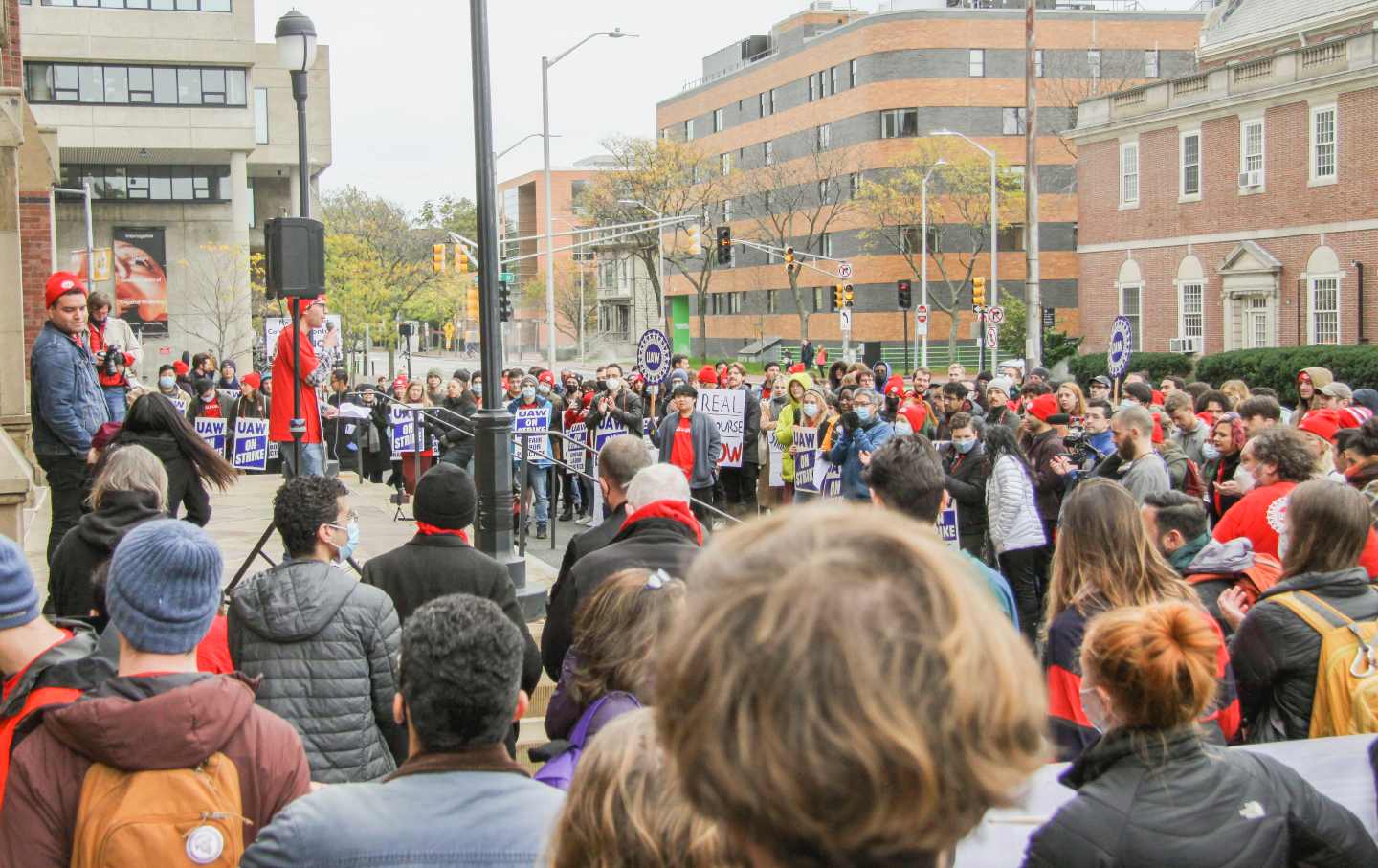
The Harvard Graduate Student Union–United Automobile Workers during a rally in 2021.
(Harvard Graduate Student Union-United Automobile Workers)
Workers in Columbia and Harvard graduate student unions were on tenterhooks. After a month of student detainments and discipline—including the expulsion of Columbia’s graduate union president, Grant Miner, the day before contract negotiations were set to begin—representatives headed to the bargaining table on March 28 hoping to forge ahead in negotiations. But they emerged from heated sessions without having discussed a single contract article or finalized ground rules. Since then, both unions’ contracts have expired, with no resolution in sight.
The March session set the tone for what has become an increasingly fraught round of contract negotiations for two of the nation’s largest private graduate student unions—uniquely impacted by Columbia’s and Harvard’s touch-and-go tangos with President Donald Trump’s administration. Harvard’s graduate students may continue bargaining into 2026, and Columbia and its graduate student union—faced with a stall in negotiations—have been sparring over a potential contract extension but have yet to reach an agreement.
Since 2012, the number of graduate students represented by a union has more than doubled, ballooning from 64,000 to 150,000 by the beginning of 2024. These workers are often international scholars, and researchers buoyed by federal dollars—precisely the demographic most vulnerable to the Trump administration’s high-profile attacks on universities.
But even as the public lauded Harvard for delivering a resounding legal rejoinder to the Trump administration’s demands, union members at both Harvard and Columbia say administrators are mounting bargaining-table battles against their own workers, harnessing changes in the National Labor Relations Board to gain an upper hand. Under a Republican NLRB, it’s possible private-sector student workers will lose their right to unionize altogether.
Faced with limited legal recourse and growing precarity from federal crackdowns, these two unions—and their compatriots across the nation—are adapting: bolstering contract language, tapping into larger networks of academic organizers, and doubling down on politics as a galvanizing force. “A general unionism and the push to have more workers involved in the decisions of how the university spends its money, how the university structures itself, is vital,” said Sara Speller, president of Harvard Graduate Student Union–United Automobile Workers.
Neither Student Workers of Columbia–UAW nor HGSU-UAW is new to organizing. The two groups unionized soon after graduate students in the private sector were declared employees in a 2016 NLRB decision concerning Columbia students, and both have gone on strike multiple times in the process of bargaining contracts.
The intensity of the attacks from the federal government, however, is a first—and has heightened tensions at both universities in a tumultuous year for higher education. HGSU-UAW and SWC-UAW have already clashed with administrators over international worker protections amid arrests and deportations.
In other circumstances, these unions could have taken some of the ongoing issues—including Miner’s initial exclusion from the bargaining table, a replacement of graduate jobs in Columbia’s core curriculum, and the removal of more than 900 students from HGSU-UAW’s bargaining unit—to the NLRB.
But in January, Trump dismissed NLRB member Gwynne Wilcox, leaving the board in limbo as her case climbs through the courts. Neither union is likely to bring unfair-labor-practice charges against their university under the circumstances, fearing that the case could be used to roll back student protections: Once a quorum is reinstated, the board will skew Republican and could topple the 2016 Columbia decision entirely. Columbia already has two pending Unfair Labor Practice charges against SWC-UAW.
These challenges aren’t new for workers at either university, who unionized after Trump was first elected president in 2016 and ran contract campaigns under a Republican NLRB. This time, however, the NLRB’s very existence is under threat. In recent cases, Amazon, SpaceX, and Trader Joe’s have all questioned the board’s constitutionality. In May, a Supreme Court ruling denying a stay on Wilcox’s reinstatement indicated that the judges may end the NLRB’s independent functioning altogether.
“There are a lot of reasons to question whether the board is going to be the same kind of path for due process and justice that it has been in the past, and a lot of unions will be considering more what other economic weapons they have available to them,” Lauren McFerran, a former NLRB chairman and one of the authors of the 2016 Columbia decision, told The Nation.
With federal legal recourse no longer forthcoming, unions are pursuing both formal and informal avenues to secure protections. They’ve leaned on new state legislation and attempted to expand the scope of bargaining subjects.
Several states, including New York and Massachusetts, have drafted legislation that would cede control over certain private-sector cases and employees to state labor boards under specific conditions, such as when the NLRB lacks a quorum. The Massachusetts bill would allow the state board to certify graduate worker unions if the NLRB declares they are not employees, and to take them under its wing if the NLRB were dismantled altogether.
According to Dorothy Manevich, an HGSU-UAW member on the executive board of the UAW’s Massachusetts political action committee, the Massachusetts bill draws from state laws designed to restrict abortion once Roe v. Wade was overturned.
“This is taking a page out of the conservative playbook with their reproductive rights trigger laws or their abortion ban trigger laws, where they were passing all these laws at the state level in anticipation of federal action,” Manevich said. “That proved to be quite effective, right?”
One of these bills has already been signed into law. Brown University’s Graduate Labor Organization created legislation in concert with the AFL-CIO that would explicitly enshrine students’ employee status in state law if the Columbia decision were overturned. GLO president Michael Ziegler said that the provision has provided “a real sense of security” to workers as they keep their eyes on negotiations at Harvard and Columbia: “If and when that challenge is brought before the board, we would move in to support the higher ed labor movement as a whole, to try to make sure it remains in place, but the worst-case scenario we do have now is this fallback.”
SWC-UAW and HGSU-UAW have also been attempting to secure protections on salient issues—whether it be international worker rights or academic freedom—within contract language itself, rather than leaning upon university and federal policies.
After Columbia placed several of its departments under the supervision of a senior vice provost—and Harvard, more quietly, suspended its Divinity School’s Religion, Conflict, and Peace Initiative and dismissed the heads of its Center for Middle Eastern Studies—union members say they are working on incorporating academic freedom rights into their contract, provisions that are relatively rare among graduate union contracts. HGSU-UAW has also been adding language allowing workers to bargain over the impacts of any federal changes on issues such as immigration and nondiscrimination.
These changes will likely face opposition from administrators, who generally favor the status quo in union contracts. In their Unfair Labor Practice filing against SWC-UAW in August, Columbia administrators wrote that the union “seeks to bargain over subjects unrelated to employment and instead related to student and academic issues,” referencing an April 18 video on X in which workers outlined bargaining requests relating to law enforcement and international student visa revocations. But some scholars have argued that these distinctions are ambiguous and somewhat antiquated, failing to encompass shifting influences and workplace-specific concerns.
“We’re going to see more and more issues that are ‘non-mandatory’ come up in collective bargaining all across the country,” MIT Work and Employment Research faculty member Thomas Kochan said. “It’s, I think, irresponsible for one side or the other to just hold firm on a legalistic doctrine that doesn’t fit the situation that people are in today.”
Outside of exploring legal recourse, unions have been expanding organizational efforts. HGSU-UAW and SWC-UAW have long pulled on mass organizing, including striking, during their campaigns. Crucially, however, they have one advantage that they did not have in 2016: numbers.
Union growth has been particularly visible within the UAW, where roughly 100,000 of its 400,000 members work in higher education; the international union held an inaugural in-person meeting of its Higher Education Council the weekend of June 21. Both SWC-UAW and HGSU-UAW are also part of Higher Education Labor United, an organization founded in 2021 with the goal of helping higher education unions collaborate.
Popular
“swipe left below to view more authors”Swipe →Members have also constructed new, informal avenues of communication. According to Ziegler, a clutch of graduate student unions—including those at Columbia, Harvard, Brown, and Northeastern—have convened to share notes and tactics. This kind of interaction, even if only in the form of texts after major developments, “outlines a blossoming community that goes beyond the university systems,” Speller said.
Many of the political frontiers graduate unions are currently navigating—whether they be worker detainments or academic freedom—have been inextricably tied to activism over Palestine. Union members thus toe a difficult line: Speaking about Palestine, and about free speech and protest rights more generally, facilitates broader organizing efforts but can also result in steeper bargaining-table battles and legal backlash. Besides arguing that the union sought to bargain over issues “unrelated to employment,” Columbia has accused the union of violating the no-strike clause in its contract by directing members to participate in a May pro-Palestine demonstration in a campus library.
In a news release concerning a Cornell student’s challenge to student unions’ legality, the National Right to Work Legal Defense Foundation—a “right-to-work” organization opposing unions’ rights to collect dues from all represented workers—argued that student opposition to unionization “has spiked in recent years as union officials have pursued increasingly radical and divisive ideological activities on campuses.” The organization is also representing two other Cornell students who alleged that the union’s dues-paying structure was discriminatory.
But these broader social battles can bolster union growth: The United States’ first official graduate student union, formed at the University of Wisconsin, Madison, in 1969, emerged out of anti-war campus protests. According to Harvard labor historian Joel Suarez, unionism has declined since the 1950s precisely because workers have winnowed their focus to “bread-and-butter” economic issues—abandoning broader social visions of cross-sectoral solidarity.
“It has made the union a lot stronger to be able to say, ‘We support people of conscience who are protesting. We are going to fight for your rights. We are going to try and secure protections for you, against your employer, who is harassing you and punishing you and surveilling you,’” SWC-UAW bargaining committee member Sohum Pal said.
“I think we were able to bring in a much larger swath of employees, of workers, who have a wide array of interests, not just economic but also social interests, political interests,” he added.
According to Miner—a Jewish organizer whose own protest involvement had him barred from the bargaining table—activism has served as a uniting organizing force even as it has heightened tensions at negotiations. After his expulsion, dozens of demonstrators rallied at the Studebaker Building to protest the university’s decision. At Harvard, workers across campus unions have organized several collective actions calling on the school to commit to protecting international workers and support academic freedom.
“The ways that they are clamping down on the right to public participation at Columbia is deeply connected across lines of labor and the graduate student/undergraduate student labor movement, Palestine movement, whatever movement,” Miner said.
In some sense, these unions may have room to create new organizing methods as they broach uncharted waters. Harvard and Columbia themselves are navigating a federal bargaining table with little precedent, and certainly no ground rules. “All bets are off,” Ziegler said.
More from The Nation
Tiger Woods Plus Donald Trump: A Tragedy Made in the USA Tiger Woods Plus Donald Trump: A Tragedy Made in the USA
Woods and Trump’s famous friendship is built on a shared knack for accumulation, vacuousness, and power worship. It’s as American as apple pie.

The Cost of the Iran War The Cost of the Iran War
“It takes money to kill bad guys,” Defense Secretary Pete Hegseth said as he sought $200 billion in funding for the Iran war in March. But the cost far exceeds money.
The Supreme Court Absolutely Shredded Trump’s Birthright Citizenship Case The Supreme Court Absolutely Shredded Trump’s Birthright Citizenship Case
But this also begs the question: why is this facially unconstitutional case before the court in the first place?
Why Black People Can’t Earn Our Way Out of Racism in Maternal Care: A Q&A With Khiara Bridges Why Black People Can’t Earn Our Way Out of Racism in Maternal Care: A Q&A With Khiara Bridges
In her new book, Bridges found that healthcare provided through private markets leaves more room for discrimination and unequal care to take root than in a public program like Med...
The Olympics Is Repeating One of Its Worst Mistakes The Olympics Is Repeating One of Its Worst Mistakes
The IOC’s new anti-trans testing regime revives some of the most discredited and discriminatory policies in the history of the games.
My Years-Long Fight to Say “They” My Years-Long Fight to Say “They”
Over and over again, I would use the pronoun in my writing. Over and over again, editors would try to remove it.

