Environment / August 14, 2025

What’s Next for Covering Climate Now’s 89 Percent Project

An overwhelming global majority supports stronger climate action. Who are the people behind the numbers?
Mark Hertsgaard

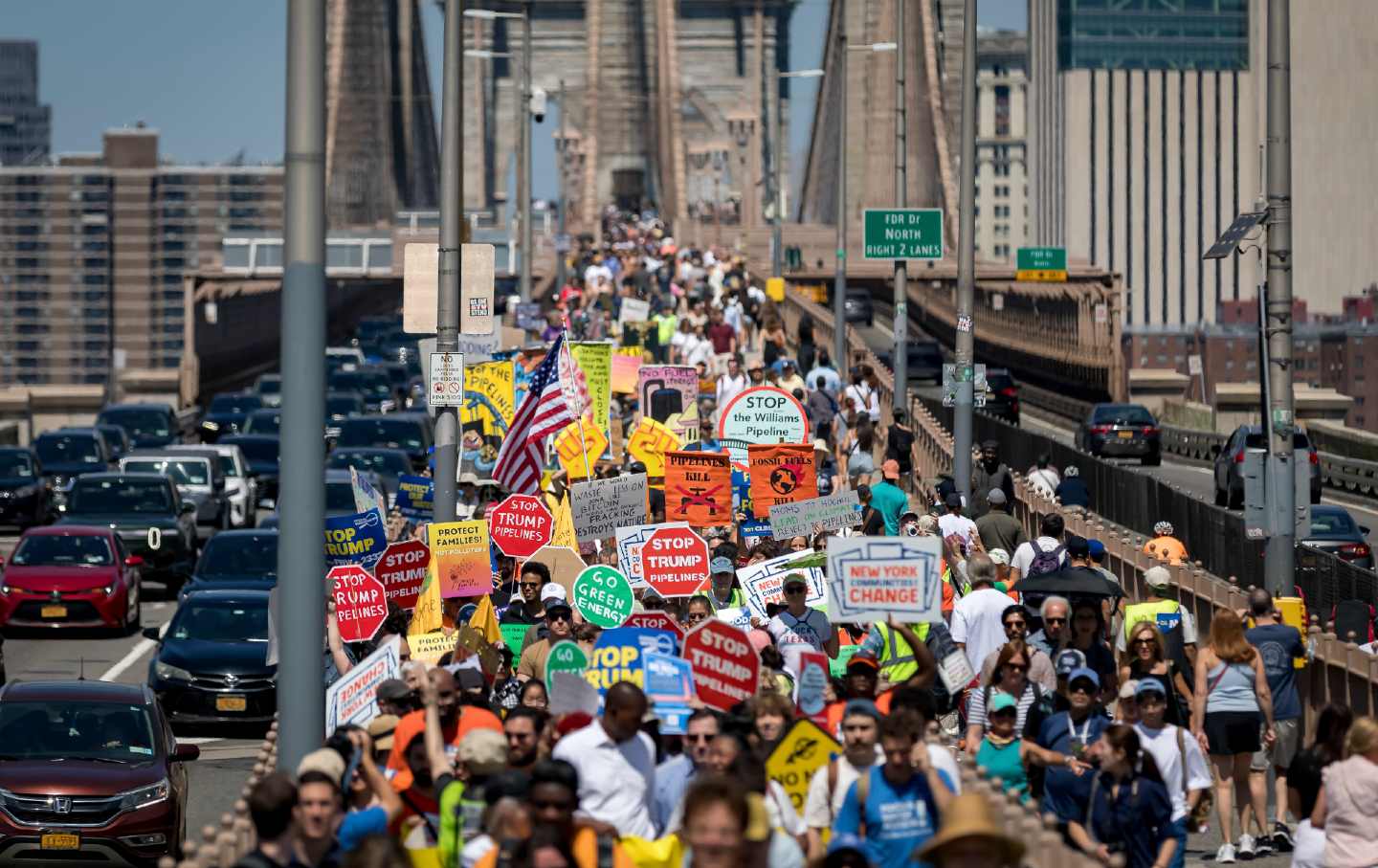
Climate activists march across the Brooklyn Bridge to demand that New York Governor Kathy Hochul stop the construction of the Williams Pipeline in New York City on August 9, 2025.

(Michael Nigro / Pacific Press / LightRocket via Getty Images)

When Covering Climate Now launched The 89 Percent Project in April, the goal was to draw attention to the fact that an overwhelming majority of the world’s people—80 to 89 percent, according to scientific studies—want their governments to “do more” about climate change.

Now, in the next phase of the project, it’s time to explore who those people are.

Since The 89 Percent Project began four months ago, additional research—by the European Commission, Dynata, and the Yale Program on Climate Change Communication—has confirmed that roughly eight out of 10 people around the world support stronger climate action. Even in the United States, a leading petro-state where climate disinformation has operated the longest, three out of four people (74 percent) want stronger action.

These figures put the lie to the one-dimensional caricature of people who care about climate change as left-wing or fringe. The sheer size of the climate majority means that it includes almost everyone—across political, economic, generational, racial, and other lines.

Phase 2 of The 89 Percent Project aims to humanize the numbers by reporting on the people making up the climate majority. Who are they, where do they live, what do they do? Why do they care, and what do they want? Are they surprised to learn that they are, in fact, the majority?

The Guardian kicked things off on Tuesday, asking its readers to answer such questions, and CCNow invites journalists and news outlets everywhere to do likewise. Everyone is welcome to draw inspiration from The Guardian’s questions, adapting them for one’s own audience, augmenting them with “person in the street” interviews, and finding new ways to tell these stories through video, audio, and graphics. The Guardian will use the responses it gathers to craft short profiles of individuals who personify the climate majority. Again, fellow journalists and news outlets everywhere are invited to do the same.

In the coming days, CCNow will host a “Talking Shop” webinar to take through how news organizations can report their own “the people behind the numbers” profiles. We invite everyone’s ideas and creativity. The overarching goal of this phase of The 89 Percent Project is to present a vivid, factually grounded portrait of the global climate majority in all its diversity and potential.

Like CCNow itself, this phase of The 89 Percent Project is a collaboration, a way to work together throughout the news industry to reframe the public narrative about the climate crisis and its solutions. For newsrooms, it is also a commercial opportunity. The climate majority represents not merely a sliver but the bulk of the global news audience. Here’s a chance to engage them—to let them see themselves reflected in news coverage and thus be more inclined to read, watch, or listen to that coverage. The next phase of The 89 Percent Project starts now. We can’t wait to see what it produces.

Disobey authoritarians, support The Nation

Over the past year you’ve read Nation writers like Elie Mystal, Kaveh Akbar, John Nichols, Joan Walsh, Bryce Covert, Dave Zirin, Jeet Heer, Michael T. Klare, Katha Pollitt, Amy Littlefield, Gregg Gonsalves, and Sasha Abramsky take on the Trump family’s corruption, set the record straight about Robert F. Kennedy Jr.’s catastrophic Make America Healthy Again movement, survey the fallout and human cost of the DOGE wrecking ball, anticipate the Supreme Court’s dangerous antidemocratic rulings, and amplify successful tactics of resistance on the streets and in Congress.

We publish these stories because when members of our communities are being abducted, household debt is climbing, and AI data centers are causing water and electricity shortages, we have a duty as journalists to do all we can to inform the public.

In 2026, our aim is to do more than ever before—but we need your support to make that happen. 

Through December 31, a generous donor will match all donations up to $75,000. That means that your contribution will be doubled, dollar for dollar. If we hit the full match, we’ll be starting 2026 with $150,000 to invest in the stories that impact real people’s lives—the kinds of stories that billionaire-owned, corporate-backed outlets aren’t covering. 

With your support, our team will publish major stories that the president and his allies won’t want you to read. We’ll cover the emerging military-tech industrial complex and matters of war, peace, and surveillance, as well as the affordability crisis, hunger, housing, healthcare, the environment, attacks on reproductive rights, and much more. At the same time, we’ll imagine alternatives to Trumpian rule and uplift efforts to create a better world, here and now. 

While your gift has twice the impact, I’m asking you to support The Nation with a donation today. You’ll empower the journalists, editors, and fact-checkers best equipped to hold this authoritarian administration to account. 

I hope you won’t miss this moment—donate to The Nation today.

Onward,

Katrina vanden Heuvel 

Editor and publisher, The Nation

Mark Hertsgaard

Mark Hertsgaard is the environment correspondent of The Nation and the executive director of the global media collaboration Covering Climate Now. His new book is Big Red’s Mercy:  The Shooting of Deborah Cotton and A Story of Race in America.

More from Mark Hertsgaard Mark Hertsgaard Illustration

Chris Packham addresses the audience at a National Emergency Briefing on the climate and nature crisis, at Central Hall Westminster on November 27, 2025, in London, England.

The UK’s Climate National Emergency Briefing Should Be a Wake-Up Call to Everyone The UK’s Climate National Emergency Briefing Should Be a Wake-Up Call to Everyone

The briefing was a rare coordinated effort to make sure the media reflects the science: Humanity’s planetary house is on fire, but we have the tools to put that fire out.

Mark Hertsgaard

People participate in a demonstration in front of the main entrance of COP30 in Belém, Brazil, on November 10, 2025.

Backsliding in Belém Backsliding in Belém

Petrostates at COP30 quash fossil fuel and deforestation phaseouts.

Mark Hertsgaard

Indigenous Activists to COP30: “We Will Fight to the Death”

Indigenous Activists to COP30: “We Will Fight to the Death” Indigenous Activists to COP30: “We Will Fight to the Death”

Indigenous people lead COP30 protests against agribusinesses that “want to take everything.”

Mark Hertsgaard

World leaders attend a session on the energy transition on the second day of COP30 on November 7, 2025, in Belém, Brazil.

Global Leaders Are Glad the US Isn’t Attending COP30 Global Leaders Are Glad the US Isn’t Attending COP30

Momentum behind decarbonizing the global economy has built to the point where it is inevitable—with or without the United States.

Mark Hertsgaard

A group of Indigenous people is leading a demonstration for the climate organized in Brussels, Belgium, on October 23, 2022.

Coming Sunday: The People Behind the Climate Numbers Coming Sunday: The People Behind the Climate Numbers

The next phase of The 89 Percent Project profiles climate’s supermajority.

Mark Hertsgaard

President Donald Trump speaks during the United Nations General Assembly at the United Nations headquarters on September 23, 2025, in New York City.

Reporting the Truth When Politicians Lie Reporting the Truth When Politicians Lie

With the global rise of organized misinformation campaigns, outlets should embrace “the truth sandwich” and place a false claim between the actual facts.

Mark Hertsgaard