Our Back Pages / August 12, 2025

What History Tells Us About the Rise of Fiorello La Guardia

Zohran Mamdani’s favorite mayor was nobody’s idea of a shoo-in—until he became inevitable.
Richard Kreitner

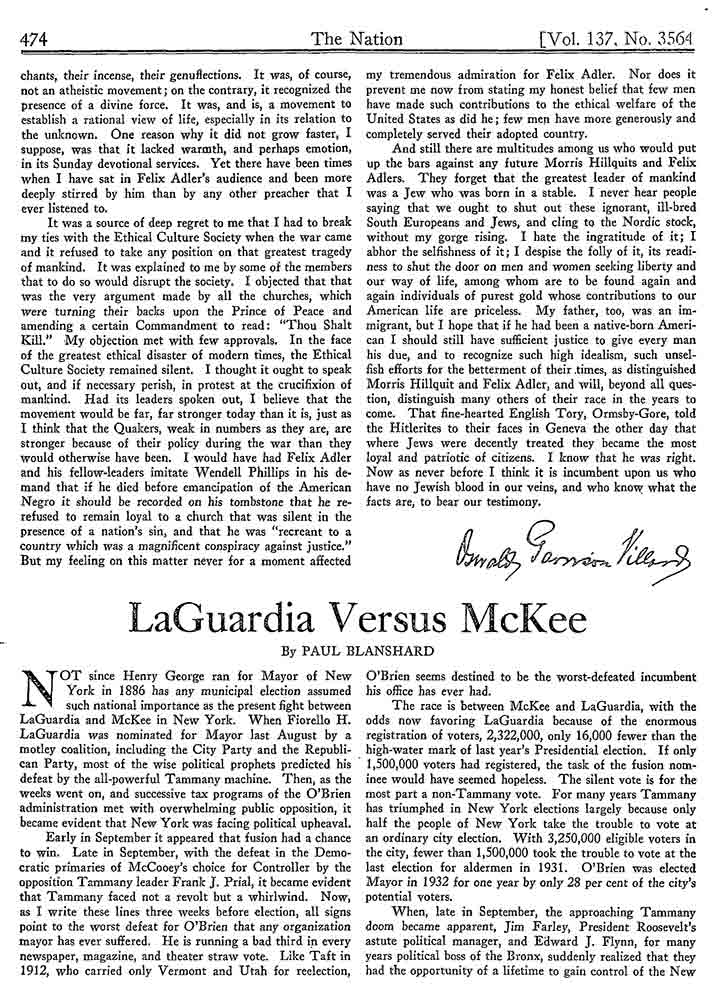
When Fiorello La Guardia was first nominated for mayor, “most of the wise political prophets predicted his defeat by the all-powerful Tammany machine,” the lawyer, humanist, and longtime Nation correspondent Paul Blanshard wrote in these pages in October 1933. But as the election approached, “it became evident that New York was facing political upheaval.”

The first sign came in the primaries, which warned of “not a revolt but a whirlwind.” Weeks later, that Depression-era whirlwind would send La Guardia to Gracie Mansion—just as a different kind of upheaval may do the same for Zohran Mamdani this fall.

Then as now, The Nation was excited about the insurgent candidate, while fully aware of the obstacles he faced: There was “still great prejudice in New York against Italian leadership,” Blanshard warned while noting that newspaper baron William Randolph Hearst regularly attacked La Guardia as “the little red flower of communism.” And if elected? Blanshard cautioned that La Guardia would have to find a way to unify “the many diverse elements that are now working for his success,” Blanshard warned—not least those “Socialists” likely to look askance at any compromises that La Guardia might have to make with the city’s powerful business elite.

Blanshard thought both sides had it wrong. “What is more important than any associations of LaGuardia’s,” he wrote, “is the forthright manner in which he has spoken in this campaign…. [I]t seems to be as certain as anything can be in politics that if he is sent to the City Hall he will exercise the vast powers of the Mayor of New York with economic insight and political independence.”

Blanshard admitted that there were limits to what La Guardia might be able to achieve. A “social revolution” would not be forthcoming: “Within the framework of our State and federal governments what could a good Mayor accomplish? He could not, even if he were a Socialist…go very far in the direction of public ownership without running afoul of the State constitution and the conservative legislature at Albany. New York does not have the power to build its own houses, operate its own buses, or own its own banks; and none of these powers can be obtained without the consent of Albany.”

Even so, La Guardia’s election would advance political and economic democracy. “From the long-range point of view,” Blanshard concluded, La Guardia’s election could not only foster “new faith in the capacity of a city to use democracy intelligently,” but even turn it into “a gigantic laboratory for civic reconstruction…. [H]is elevation to New York’s City Hall might mean a genuine new deal for a long-suffering metropolis.”

It’s a prediction that would prove astonishingly prescient. Working closely with President Franklin Roosevelt, La Guardia helped usher in an era of expansive public works and political reform that fundamentally reshaped New York. (Blanshard himself would go on to head the city’s Department of Investigations and Accounts under La Guardia, a position he used to help root out corruption.)

Of course, unlike La Guardia, a Mayor Mamdani would find no ally in the White House, at least not anytime soon. But that hasn’t dulled his appreciation for the Little Flower. When asked to name the best mayor of New York, he chose La Guardia.

Disobey authoritarians, support The Nation

Over the past year you’ve read Nation writers like Elie Mystal, Kaveh Akbar, John Nichols, Joan Walsh, Bryce Covert, Dave Zirin, Jeet Heer, Michael T. Klare, Katha Pollitt, Amy Littlefield, Gregg Gonsalves, and Sasha Abramsky take on the Trump family’s corruption, set the record straight about Robert F. Kennedy Jr.’s catastrophic Make America Healthy Again movement, survey the fallout and human cost of the DOGE wrecking ball, anticipate the Supreme Court’s dangerous antidemocratic rulings, and amplify successful tactics of resistance on the streets and in Congress.

We publish these stories because when members of our communities are being abducted, household debt is climbing, and AI data centers are causing water and electricity shortages, we have a duty as journalists to do all we can to inform the public.

In 2026, our aim is to do more than ever before—but we need your support to make that happen. 

Through December 31, a generous donor will match all donations up to $75,000. That means that your contribution will be doubled, dollar for dollar. If we hit the full match, we’ll be starting 2026 with $150,000 to invest in the stories that impact real people’s lives—the kinds of stories that billionaire-owned, corporate-backed outlets aren’t covering. 

With your support, our team will publish major stories that the president and his allies won’t want you to read. We’ll cover the emerging military-tech industrial complex and matters of war, peace, and surveillance, as well as the affordability crisis, hunger, housing, healthcare, the environment, attacks on reproductive rights, and much more. At the same time, we’ll imagine alternatives to Trumpian rule and uplift efforts to create a better world, here and now. 

While your gift has twice the impact, I’m asking you to support The Nation with a donation today. You’ll empower the journalists, editors, and fact-checkers best equipped to hold this authoritarian administration to account. 

I hope you won’t miss this moment—donate to The Nation today.

Onward,

Katrina vanden Heuvel 

Editor and publisher, The Nation

Richard Kreitner

Richard Kreitner is a contributing writer and the author of Break It Up: Secession, Division, and the Secret History of America's Imperfect Union. His writings are at richardkreitner.com.

More from The Nation

Candles are lit by framed photos of mass shooting victims Mukhammad Aziz Amurzokov and Ella Cook at a makeshift memorial near Brown University in Providence, Rhode Island, on December 15, 2025.

Islamophobic Elites Lied to Destroy the Life of a Palestinian Brown Student Islamophobic Elites Lied to Destroy the Life of a Palestinian Brown Student

Plutocrats, pundits, and government officials joined together in a racist smear campaign against a queer Palestinian student at Brown University.

Jeet Heer

Elise Stefanik is joined by state GOP lawmakers during a news conference where she spoke in opposition to Governor Kathy Hochul on June 9, 2025, in Albany.

Recent Democratic Victories Have Republicans Running Scared Recent Democratic Victories Have Republicans Running Scared

Elise Stefanik is just the latest top Republican deciding against running in the 2026 midterms.

John Nichols

Pirate Trump

Pirate Trump Pirate Trump

Donald Trump escalates Caribbean tensions with vessel attacks near Venezuela.

OppArt / Felipe Galindo

Trump’s “Warrior Dividend”  Might Be His Scariest Idea Yet

Trump’s “Warrior Dividend” Might Be His Scariest Idea Yet Trump’s “Warrior Dividend” Might Be His Scariest Idea Yet

This week’s “Elie v. US” explores the authoritarian threat beneath Trump’s bonuses for military families. Plus, a case for getting rid of the Second Amendment.

Elie Mystal

How Do We See Hegseth?

How Do We See Hegseth? How Do We See Hegseth?

Surf's up!

Steve Brodner

HUD Is Refusing to Enforce Anti-Discrimination Law—and Won’t Let Anyone Else Do It, Either

HUD Is Refusing to Enforce Anti-Discrimination Law—and Won’t Let Anyone Else Do It, Either HUD Is Refusing to Enforce Anti-Discrimination Law—and Won’t Let Anyone Else Do It, Either

The initial chaos of layoffs has been followed by a concerted effort by the Trump administration to halt the enforcement of the Fair Housing Act.

Bryce Covert