
A New Report Exposes How Major American Corporations Have Been All Too Eager to Aid Israeli’s Atrocities in Gaza
It also reveals our nation’s now undeniable complicity in what has been described as the worst humanitarian crisis of the 21st century.

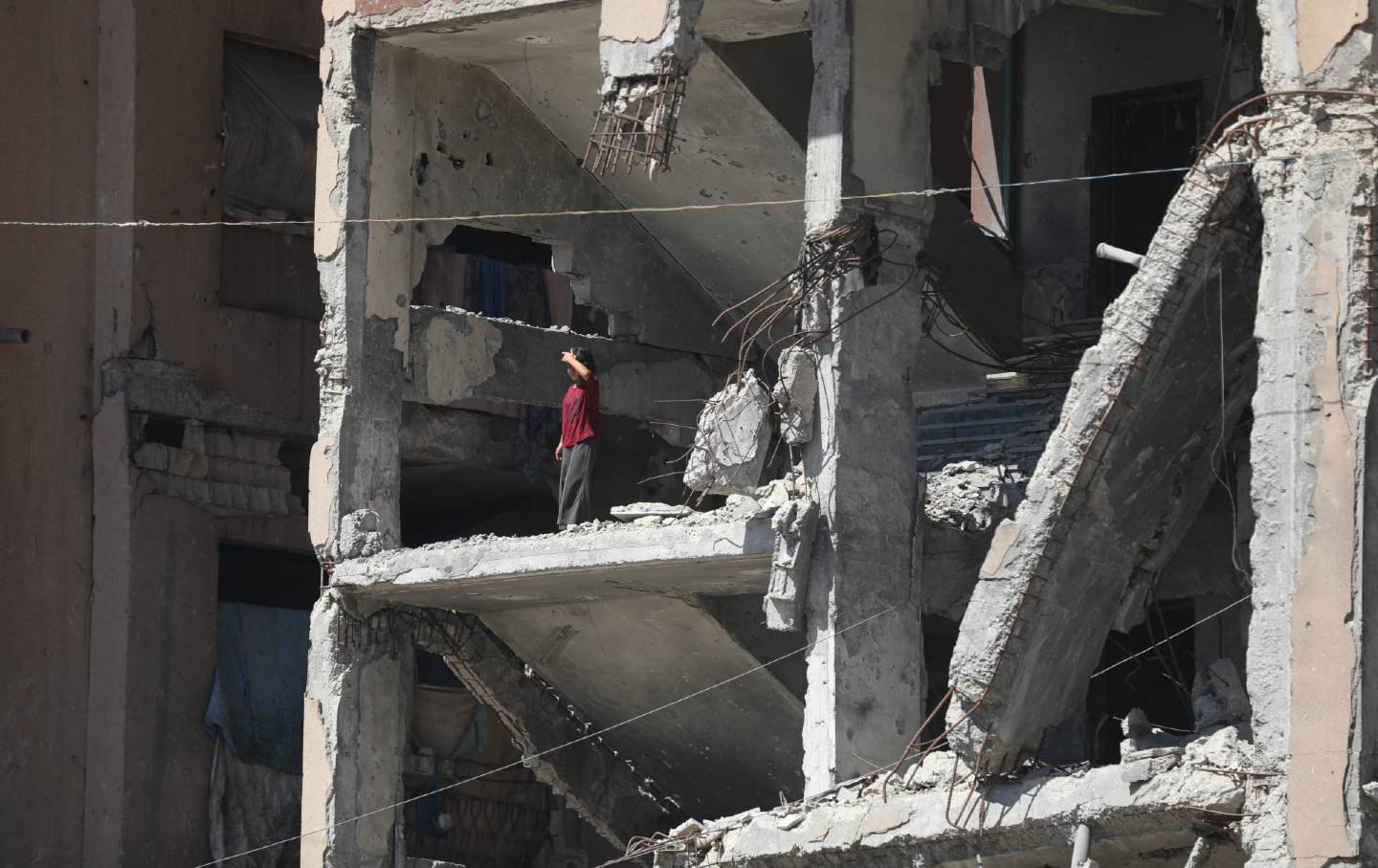
Thousands of famished people waiting for hours in 90-degree heat to secure bags of flour that run out after 10 minutes—this is a typical scene at the four aid distribution centers remaining in Gaza. The cause of this desperation isn’t shortages per se, because the World Food Programme has 116,000 metric tons of food waiting to be delivered to malnourished Palestinians.
Instead, the problem is Israel’s monthslong blockade of aid, which over 100 humanitarian organizations have stated is causing “chaos, starvation, and death.” And though Israeli authorities began allowing a trickle of convoys to resume deliveries over the weekend, the face-saving gesture is too little for the one in three Gazans who hasn’t eaten in days, and too late for the dozens who have already starved to death.
Amid this manufactured famine, however, Israel has permitted another kind of shipment to flow freely. Weapons imports have continued unabated, with thousands of pounds of bombs, guns, and ammunition pouring into the Israeli Defense Force. A new report by Francesca Albanese, the United Nations special rapporteur on the occupied Palestinian territories, has uncovered the major supplier of this fatal equipment: the United States.
Titled “From Economy of Occupation to Economy of Genocide,” the exposé lays bare how major American corporations have been all too eager to facilitate Israel’s atrocities in Gaza in exchange for billions of dollars in revenue. It also reveals our nation’s now undeniable complicity in what has been described as the worst humanitarian crisis of the 21st century.
War profiteering is a phenomenon as ancient as war itself, but Albanese’s investigation shows that the military-industrial-technological complex is reaping uniquely horrible payoffs in Palestine. Albanese describes how Lockheed Martin has built fighter jets for Israel that have carried out bombings that have killed or wounded almost 200,000 Palestinians. She details how Palantir inked a deal with the Israeli military to provide AI-generated target lists, then consummated that partnership by holding a sycophantic board meeting in Tel Aviv. And she brings to light how Caterpillar Inc. has provided equipment to demolish homes and hospitals, crushing to death civilians stuck inside those structures.
Perhaps the most hypocritical offenders are the members of the Magnificent Seven. Google’s unofficial motto was once “Don’t be evil,” but now the company has joined Amazon to provide cloud computing services to the IDF for a persuasive $1.2 billion. Albanese quotes an Israeli colonel who calls this technology “a weapon in every sense of the word,” a cloud as deadly as any poison gas.
The Trump administration has responded to Albanese’s research with its classic combination of denial and retribution. Secretary of State Marco Rubio has sanctioned her, calling her work “political and economic warfare.”
But Albanese’s conclusions align with those of several prominent Jewish and Israeli figures. Former IDF soldier and leading genocide historian Omer Bartov defended Albanese by writing, “I have been teaching classes on genocide for a quarter of a century. I can recognize one when I see one.” On Monday, two major Israeli human rights groups announced that they agree with that description. Journalist Peter Beinart, editor at large of Jewish Currents, has called Israel an apartheid state, and recently condemned the crisis in Gaza as “an astonishing level of death and suffering that has been normalized.” A simple scan of the Israeli newspaper Haaretz turns up recent headlines like “The Mathematics of Starvation” and “Israel’s Destruction of Gaza.”
In the US Capitol, progressive lawmakers such as Representative Rashida Tlaib and Senator Bernie Sanders have repeatedly called for ending the transfer of US arms to Israel. A handful of other Democrats have also introduced the Block the Bombs Act, which would prohibit the sale of certain weapons without congressional approval, including those made by American companies like Boeing and General Dynamics.
While the bill has gained little traction, outrage over Gaza has become a bipartisan consensus among voters. Only 23 percent of Americans deem Israel’s military actions to be justified. But with activists like Mahmoud Khalil facing deportation over their pro-Palestinian advocacy, and with other protests worldwide being met with brutal and even deadly repression, crystallizing sentiment into a social movement seems an increasingly daunting task.
Amid so much pushback, though, grassroots organizing against weapons exports to Israel still represents a concrete if challenging opportunity for change. Students in Israel, the United States, and across the globe have already been providing a moral witness on this front, despite the threat of retaliation, expulsion, and blacklisting. Now, a broader coalition will be necessary to convince lawmakers that they should fear constituent backlash more than a primary challenge bankrolled by AIPAC.
Beyond pouring into the streets, Americans can also boycott the corporations living large while the population of Palestine dwindles. The employees of those very companies can do the same, like the 50 now-terminated workers at Google who led “No Tech for Apartheid” protests last year. Otherwise, the warning recently issued by Peter Beinart will remain true: “Blood is on our hands as Americans because it is our weapons that are responsible for those children starving to death.”
In the meantime, the thirsty toddlers of Khan Younis will continue to wait for some drops of salt water to drink, and the emaciated doctors of Gaza City will continue to scrounge for a few cans of expired food to eat.
Become a Sustaining Donor This September
Between the reemergence of right-wing red-baiting and Donald Trump’s use of the chilling National Security Presidential Memorandum–7 to criminalize left political organizing, we’re seeing McCarthyism reborn before our eyes.
This assault on democracy cannot be ignored or wished away. Resisting it requires bravery in the face of threats and repression, a steadfast commitment to the truth, and the unwavering belief that we can—and will—overcome this darkness.
We must have an independent media that sets the record straight, unearths corruption and abuses of power, and advances a politics of justice and dignity for all if we’re to win this fight.
That’s why I’m writing to you today. This September, The Nation needs to add 100 monthly donors to sustain our progressive journalism. Your contribution makes the next investigative report, the next truth-speaking column, and the next pathbreaking essay all possible.
I hope you’ll support our work with a recurring donation today. If you donate $10 or more a month, we’ll send you a brand new “Hands Off the Free Press!” sticker to recognise your commitment to our cause. Please, donate today.
Onward,
Katrina vanden Heuvel
Editor and Publisher, The Nation
More from The Nation
Israel’s Election Can’t Fix What Netanyahu Broke Israel’s Election Can’t Fix What Netanyahu Broke
The fundamental problem is not the name of the prime minister, but rather the actions of the Israeli government and the urgent issues that need to be addressed.

The AfD’s Rise Isn’t Just About East Germany The AfD’s Rise Isn’t Just About East Germany
The Alternative für Deutschland has a stable national poll lead, including in the former West Germany. Its rise owes to much more than Eastern grievances.
Chinese Development Is the Betrayal Washington Cannot Forgive Chinese Development Is the Betrayal Washington Cannot Forgive
The prospects for Xi Jinping’s visit are dim because American leaders are blaming China for the failures of globalization.

Pinochet: The Verdict of History in the Letelier-Moffitt Case Pinochet: The Verdict of History in the Letelier-Moffitt Case
An act of international terrorism on the streets of Washington, DC, still reverberates 50 years later.
How to Arrest Benjamin Netanyahu How to Arrest Benjamin Netanyahu
Make no mistake: The United States can seize Netanyahu for crimes under US law and prosecute him in US courts when he is in New York City this week.

In the Age of AI, Nuclear Weapons Abolition Is a Renewed Imperative In the Age of AI, Nuclear Weapons Abolition Is a Renewed Imperative
As long as we have nuclear weapons, the job of ending humanity will continue to be as easy as the push of a button—or an AI agent hacking into a nuclear command-and-control system...

