
Life and Death
Hulu’s new slapstick crime series.
The Slapstick Criminality of Hulu’s “Deli Boys”
The show is at once a succession story, a riches-to-rags tale, and a buddy comedy about two hapless brothers trying to save their father’s convenience-store empire.
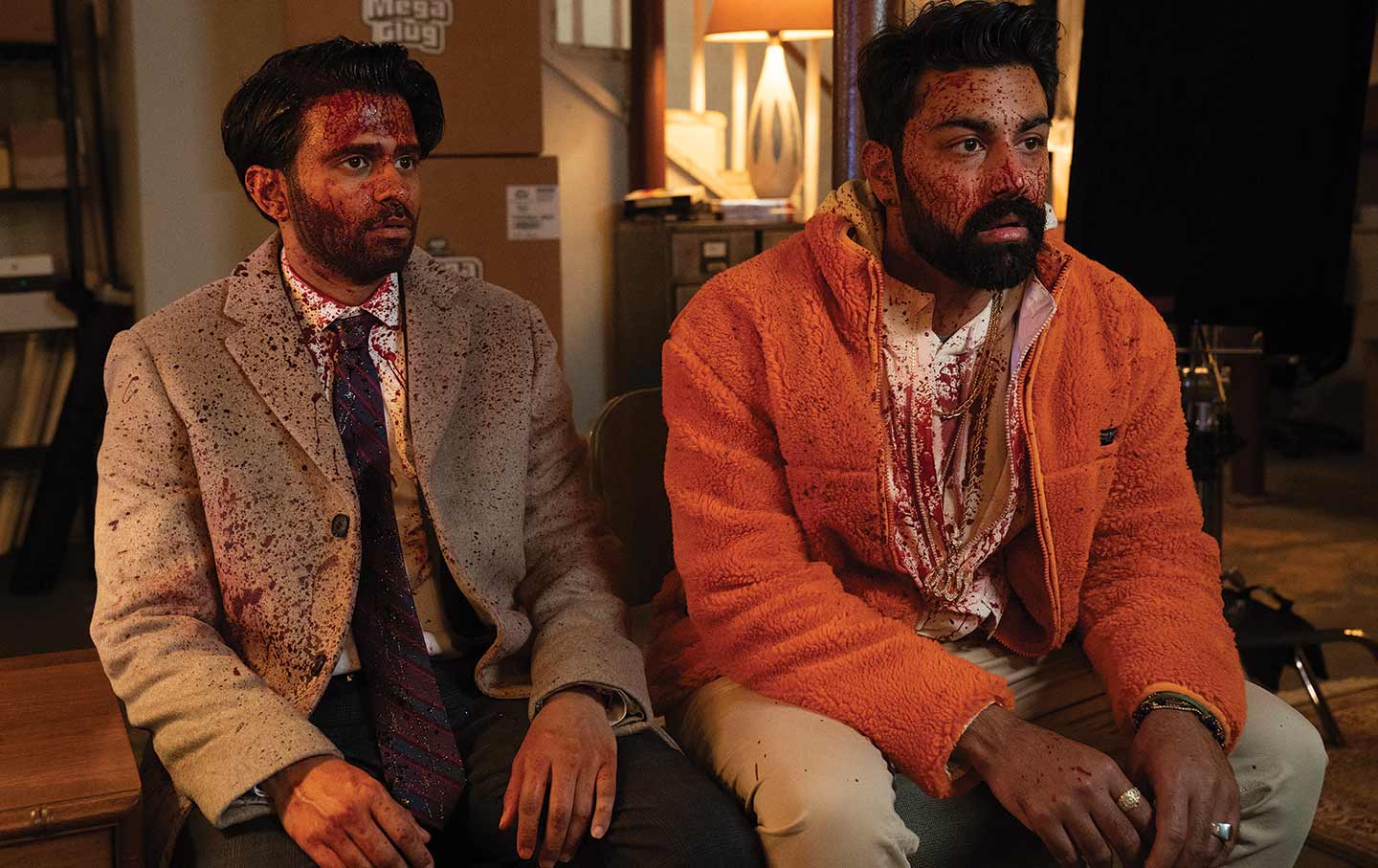
Asif Ali and Saagar Shaikh in Deli Boys.
(Elizabeth Sisson / Disney)
Organized crime has long been mythologized as the darker side of the American dream—of the drive to hustle and succeed, to create your own opportunities whatever it takes. It’s a world with its own codes of honor and family structures, but it still ends with Tony Soprano moving to a McMansion in the suburbs. Film and television have often glamorized crime, lending cachet to a world defined by violence and exploitation, where men can still be men and anyone with a plan has a chance. But particularly in those depictions rooted in ethnic and immigrant communities, organized crime has also been a theme that tracks inheritance and the changing of generations—from debates over old-school methods and drug dealing in The Godfather and Goodfellas to the shifting technology in The Wire.
Deli Boys, a new crime comedy on Hulu created by Abdullah Saeed, is of this tradition, and self-consciously so: Its image of organized crime favors a type of empathic and slapstick criminality that’s more reminiscent of the Coen brothers’ Fargo or Steven Soderbergh’s Logan Lucky. Tossing comedy and ethnicity into a blender with the standard Mafia and drug-dealing tropes, Deli Boys is at once a succession story, a riches-to-rags tale, and, perhaps most important, a buddy comedy following two hapless brothers, Mir and Raj, who inherit their father’s convenience-store empire only to immediately lose it. The series is really about how they rebuild that business, which turns out to be not at all what they expected, because the stores were merely fronts for the sale and distribution of cocaine.
Deli Boys unfolds through a series of upheavals. We are first introduced to the show’s Pakistani patriarch Baba Dar (Iqbal Theba), his company DarCo, and his particular story of immigrant success. Then we meet his two sons, both in their late 30s, each one still holding on to his silver spoon but spoiled in different ways. Mir (Asif Ali) is the ambitious one: He wants to be the company’s next CEO but has none of his father’s swagger (it doesn’t help that he’s always bringing up his business degree from Drexel University). His brother, Raj (Saagar Shaikh), meanwhile, has inherited plenty of Baba’s swagger but none of his drive: He’s a party animal who cares only about drugs, auras, his shaman, and her leeches (they’re for sucking out any bad juju). You can imagine the conflicts that arise between them. But the two will have to learn to depend on one another, because soon after we meet them, Baba is killed in a golfing accident.
At the funeral, we are introduced to several family friends who will turn out to be key personnel in their late father’s business. Baba’s boys thrust their “auntie” Lucky (Poorna Jagannathan, flexing some overlooked acting chops) into a maternal role, and she eventually becomes a mentor as she introduces them to the harsh, unforgiving reality of their father’s true business. Their “uncle” Ahmad (Brian George) is their other guide, but he’s mostly concerned with vying for control of the company in the vacuum left by Baba, a position he feels he has earned. Lucky and Ahmad will spend most of the season locked in a cold war.
Shortly after the funeral, Mir walks into DarCo in Kendall Roy drag, ready to assume the mantle of CEO once and for all. But unbeknownst to his sons, Baba was boosting the company’s profits with all sorts of corporate malfeasance. (They haven’t learned about the drug dealing yet.) So instead of inheriting an empire, the boys inherit an FBI raid, and nearly all of their corporate and personal assets are seized.
Left with nothing, Mir and Raj turn on each other. But Mir eventually sees a way through: They still have Baba’s original convenience store, and they can use it to rebuild DarCo—legit, this time! But as you may have already surmised, it’s not going to be that easy, since white-collar crime was only the tip of the iceberg at DarCo. Before the day is through, the boys will have to deal with a complete unraveling of everything they thought they knew about their father—and, perhaps more pressing, the power vacuum he left behind, the money they now owe to a scary local crime boss for drugs they’re no longer able to distribute, and, oh yeah, a dead body.
Though familiar crime-drama tropes generally drive the show’s plot, the ethnic and cultural milieu of Deli Boys is certainly unique. And yet the show deals with this in a specifically millennial way: It refuses any solemnity. Deli Boys is not really interested in giving us a message about the immigrant experience or the struggles of Pakistani Americans. The show is diligent about casting Pakistani actors in Pakistani roles, but there is also a conscious rejection of model-minority myths and the notion that it has a responsibility to provide positive representation. If anything, Deli Boys is committed to its premise of depicting how the diametrically different sons of an accomplished (if criminal) immigrant father prove to be comically incompetent in taking his place. The show is more interested in slinging one-liners, and in the twists and turns of its crime yarn, than in making any sort of high-minded statement.
Indeed, in almost every way, Deli Boys feels deliberately structured to avoid this. Though the boys speak fondly of their father, as a character he’s mainly a prop: Baba’s story of immigration and struggle is presented only so that it can set up his success. When he dies, Mir and Raj are effectively orphaned; the show never gives them a mother or some older relative who could shed light on their family’s origins, and it mostly focuses on one sliver of the story—the rise of an entrepreneurial immigrant and the floundering of his coddled kids.
Thus, although Deli Boys is informed by the Pakistani American experience, it features none of the typical ambivalence stemming from a hyphenated immigrant identity. No one on the show frets about being “Pakistani enough” or “American enough” or “too American.” No one ever misses their home country or yearns to visit the place their parents came from. The show is more suffused by a millennial disillusionment with older generations, with inheriting a world sucked dry of idealism. When Deli Boys does make a reference to injustice, it is always for comedic effect and to describe the more generalized irrationality of American society. In one scene early on, Raj says he feels comfortable about the brothers’ potential criminal liability because, unlike their father, he and Mir have not committed any crime—to which Mir snaps back, in a biting tone, “Yeah, we’d be the first innocent brown people in jail.”
Mir and Raj’s eventual struggles to survive and thrive in the world of drug dealing drive the show’s plot in classic fashion: Who is going to succeed Baba as the head of “Dark DarCo” (as the criminal side of the enterprise is known)? How do they move product without a network of convenience stores? How can they sell enough—and quickly—to appease the scary crime boss? How do they expand their territory from East Philly to West Philly? Hit men are sent to kill them; there are FBI stakeouts and informants wearing wires. Each episode brings a new obstacle for the Dar boys, which they usually overcome. And there’s a pacing to the show’s developments that feels almost soap-operatic: Each episode ends with a resolution that is then immediately upended by a twist or revelation before the show cuts to black.
But Deli Boys is not completely episodic. The brothers suffer defeats and humiliations from episode to episode, but like true comedic figures, they reliably bounce back from being continually beaten down. Yet while the brothers’ problems change from day to day, the FBI is playing a longer game. In fact, the show’s real overarching plotline belongs not to our protagonists but to the investigators on their trail, led by Agent Mercer (Alexandra Ruddy), who is determined to find out what the Dar family is up to, and her boss, Director Simpson (Tim Baltz). Over the course of the season, Mercer and Simpson offer a comedic commentary track for the show as they surveil Mir and Raj’s activities.
One of the series’ strengths is the way its supporting characters buttress the comedic structure. Baltz in particular is a standout as the overconfident FBI agent who is always reliving his former glory, when he went undercover for the January 6 attack on the US Capitol. Newcomer Jake Prizant shines as Baba’s loyal servant, a white man who seems to love Baba and his culture even more than his sons do. Also great are Amita Rao as Raj’s surprise fiancée and Sofia Black-D’Elia as the scary crime boss’s chaotic daughter.
Popular
“swipe left below to view more authors”Swipe →In the end, despite its serious trappings, Deli Boys is most interested in being a comedy. No plot ever overstays its welcome: A man is shot, but it’s mainly a gag about Raj and Mir being splattered in the face with blood. The show is shameless about putting quips and zingers into any character’s mouth, even when it feels forced. But I kept wishing the series would dig a little deeper emotionally and take more risks—I was never worried that Mir and Raj would not turn out OK. When they lose all their money, they loaf around but never struggle materially. They each go through periods of darkness, but their moping is always temporary, only a setup for the next punch line.
With a total of 10 episodes, each less than half an hour long, Deli Boys moves fast and goes down easy—but those strengths are also the series’ weakness. Even when the brothers are caught up in a life-and-death dilemma, the show opts out of providing any real emotional stakes. In the second episode, the boys are chasing after someone they’ve been ordered to kill, when they stumble upon some stale pretzels left on a dumpster. Raj has the idea to position the pretzels as an enticing trap for their quarry. Mir is aghast: “You think your pretzel trap is going to work? Life is not a cartoon, Raj.” And Raj’s response is like the show itself speaking: “Agree to disagree.”
More from The Nation
The Genius of Charli XCX The Genius of Charli XCX
On her new album, Music, Fashion, Film, the musician embraces rock.


The Architectural Follies of Trump’s Washington, DC The Architectural Follies of Trump’s Washington, DC
The president plans to remake the capital in his own image, but is all he is doing destroying what’s already there?
The Carnival of Venice Biennale The Carnival of Venice Biennale
That so much of the art of “In Minor Keys” is muted in effect is ironic, because so much of it is overproduced, aspirationally eye-catching, and so big.

