Warren Buffett Is a Climate-Wrecker
Los Angeles Times climate columnist Sammy Roth scoops his business beat colleagues.
Warren Buffett Is a Climate-Wrecker
Los Angeles Times climate columnist Sammy Roth scoops his business beat colleagues.
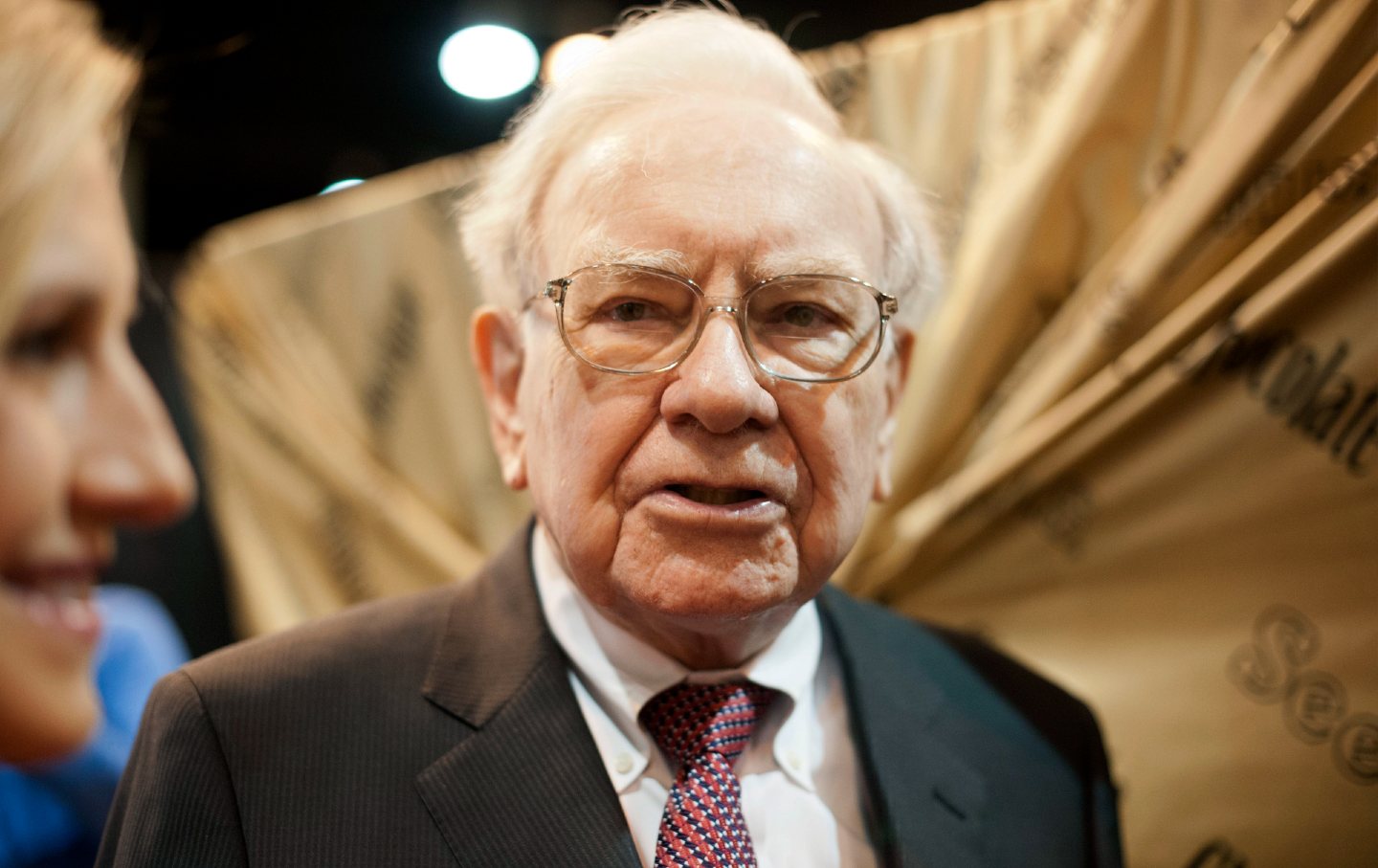
Warren Buffett, chairman of Berkshire Hathaway, tours the exhibition floor prior to the Berkshire Hathaway shareholders meeting in Omaha, Nebraska, on May 3, 2014.
(Daniel Acker / Bloomberg via Getty Images)
When legendary investor Warren Buffett recently named Greg Abel his designated successor as CEO of Berkshire Hathaway, journalists swarmed the story. Most of them reiterated Buffett’s reputation as a Wall Street “sage” and highlighted his confidence in Abel, who leads Berkshire’s energy division. Reporters noted Buffett’s criticism of President Donald Trump’s tariffs, which he called “a big mistake,” and chronicled the devoted investors who flock, cult-like, to Berkshire’s annual meeting in Omaha.
But little of that coverage mentioned that the beloved Buffett ranks as one of the world’s biggest financiers of climate change.
But Sammy Roth’s column in the Los Angeles Times confronted the matter head-on. His lede didn’t mince words: “Warren Buffett has invested tens of billions of dollars in fossil fuels, propping up some of the nation’s dirtiest coal plants as well as major oil and gas suppliers even as the climate crisis threatens human civilization.”
Drawing on his decade of covering energy news for the LA Times and, previously, The Desert Sun, Roth reported that Abel began his career as a supporter of renewable energy. But as Abel rose through the ranks at Berkshire, he shifted to backing coal, the dirtiest, most carbon-intensive conventional fossil fuel.
“Once I saw the announcement that Buffett was retiring and Abel would replace him,” Roth told Covering Climate Now, he remembered, “Hmm, Abel used to work on renewables. I think I know something here that no one else outside [Berkshire Hathaway] does.”
It’s that kind of deeply informed reporting, combined with elegant, plain-spoken prose, that have made Roth’s “Boiling Point” column required reading for anyone serious about US climate news.
Roth learned journalism as a reporter and editor at his high school and college newspapers. “It’s a lot cheaper than grad school,” he joked. He isn’t surprised that business reporters in other newsrooms missed the climate angle of the Buffett story. “Whether it’s a business, or a politics, or some other kind of story where climate is involved, the climate angle often gets left out,” he said. “It’s a huge oversight.”
To rectify it, Roth has two pieces of advice for fellow journalists: First, read more climate journalism. “You don’t have to read dense scientific reports to know enough about climate change to include a decent paragraph or two in whatever story you’re doing. Just read your colleagues.”
Second, don’t be scared of making the climate connection. “I get the sense from some colleagues [on other beats] that they’re afraid of being called an activist or getting cut off by their sources if they include climate in their stories. But I write these kinds of stories all the time, and it doesn’t cut me off from the companies. Making these kinds of connections is just part of your job as a reporter.”
Become a Sustaining Donor This September
Between the reemergence of right-wing red-baiting and Donald Trump’s use of the chilling National Security Presidential Memorandum–7 to criminalize left political organizing, we’re seeing McCarthyism reborn before our eyes.
This assault on democracy cannot be ignored or wished away. Resisting it requires bravery in the face of threats and repression, a steadfast commitment to the truth, and the unwavering belief that we can—and will—overcome this darkness.
We must have an independent media that sets the record straight, unearths corruption and abuses of power, and advances a politics of justice and dignity for all if we’re to win this fight.
That’s why I’m writing to you today. This September, The Nation needs to add 100 monthly donors to sustain our progressive journalism. Your contribution makes the next investigative report, the next truth-speaking column, and the next pathbreaking essay all possible.
I hope you’ll support our work with a recurring donation today. If you donate $10 or more a month, we’ll send you a brand new “Hands Off the Free Press!” sticker to recognise your commitment to our cause. Please, donate today.
Onward,
Katrina vanden Heuvel
Editor and Publisher, The Nation