
The Road to DOGE Was Paved With Pyramid Schemes
The second Trump administration has been compared to the Mafia, feudal empires, and the petro-states of the Persian Gulf—but an even more relevant analogy may be Nutrilite.
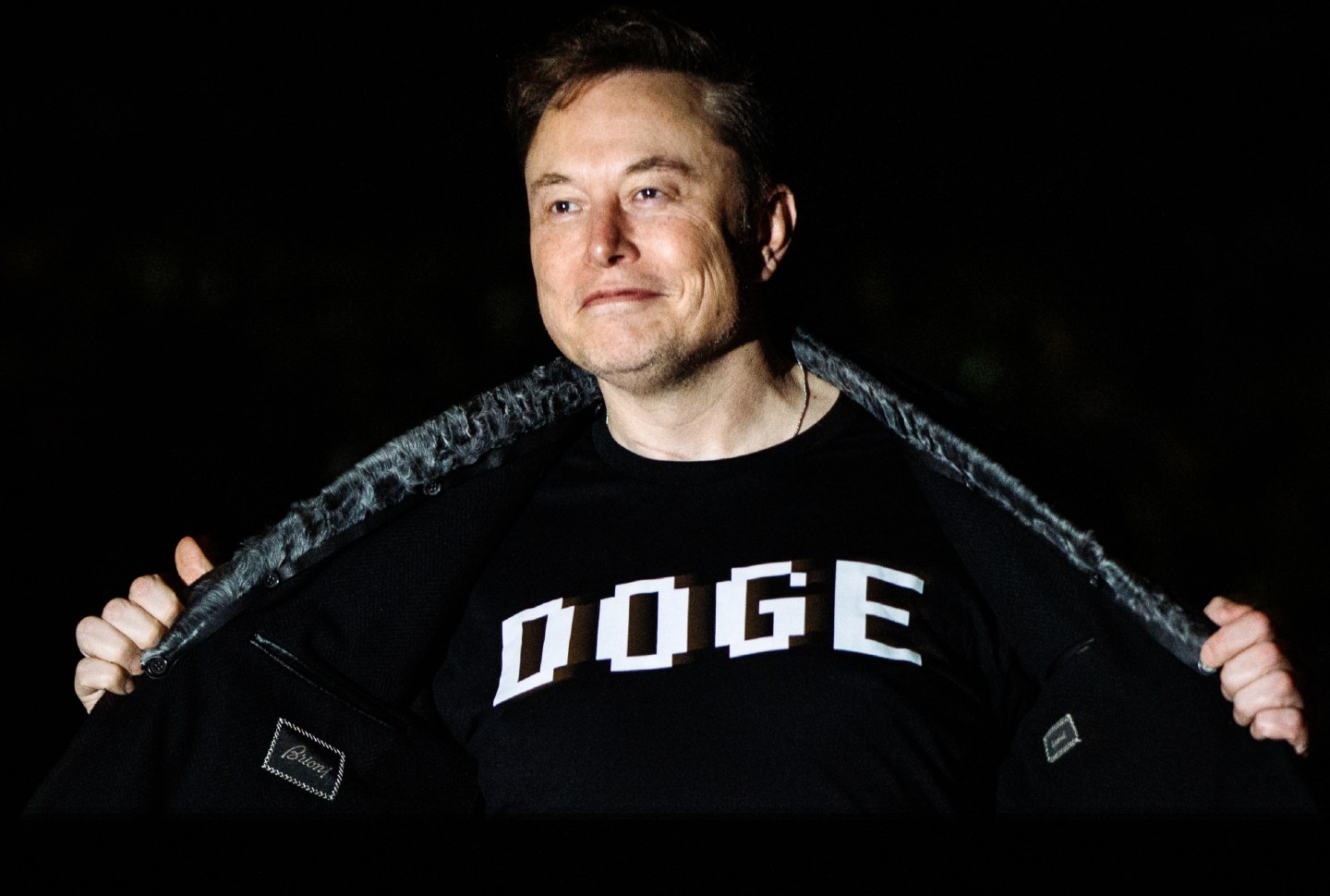
Elon Musk walks to the White House after landing in Marine One on the South Lawn on March 9, 2025, in Washington, DC.
(Samuel Corum / Getty Images)
In January 2025, Dave Grimaldi, a crypto lobbyist, became the head of the Direct Selling Association, the trade group that represents a scandal-plagued industry known as multilevel marketing. Grimaldi was excited to work with the new regime in Washington, DC: “If you think about Donald Trump—steaks, watches, sneakers, Bibles, right?” he told Politico at the time. “You have possibly one of the most overt and successful direct sellers in American history about to be president.”
The second Trump administration has been compared to the Mafia, real estate, and Big Brother. But an even more relevant paradigm for understanding its aims may be the pyramid scheme, a homegrown scam that is also the origin of multilevel marketing (MLM). This sector has closer ties to the president and his backers than even his most caustic critics understand.
The modern pyramid scheme was invented in 1945 in Long Beach, California, by two men: Stanford-educated pop psychologist William Casselberry, and Lee Mytinger, a skilled salesman. They convinced Carl Rehnborg, a huckster who occasionally posed as a scientist, to let them take over operations at his failing vitamin company, Nutrilite.
Mytinger and Casselberry’s plan smuggled the mechanics of the Ponzi scheme, by then a well-known financial scam, into the occupation of door-to-door selling. Instead of taking money from “investors” and using the cash from new marks to pay returns to old ones, they enlisted salesmen and women (sellers were predominantly married couples at the time) to buy a product: vitamins. Those buyers would in turn sell those vitamins again—not primarily to customers, but to other salespeople, creating a hierarchy of participants called a downline. The bigger a recruiter’s downline chain, the bigger the kickback they got from Mytinger and Casselberry. The chain could go on forever. The “profits pyramid,” as they originally called it, was born.
Nutrilite’s operators got rich quick, and the profits pyramid spread across the country like a contagion. Men and women who worked for Nutrilite and its early offshoots started their own companies, each promoting a different once-in-a-lifetime product, including Mary Kay (1963) and Herbalife (1980). By far the most successful spinoff was a household products company founded in 1958 by two charismatic Nutrilite salesmen and devout Michigan Christians, Jay Van Andel and Richard DeVos. They named it American Way, later shortened to Amway.
By the 1970s, the profits pyramid was a national scourge. Minnesota Senator Walter Mondale described it as “the consumer fraud problem” of the era on the Senate floor in 1972. That’s because no one was really making money selling vitamins or make-up—the products were a cover for recruiting, and most pyramid companies collapsed just like Ponzis. Those who got in early, at the top, profited the most. Victims at the bottom were left with boxes of overpriced junk in their basements—and thousands of dollars of debt.
Responding to public outcry, the Federal Trade Commission went after several high-profile pyramid schemers for fraud and deception, and in 1975, it set its sights on Amway. The agency sued the company for operating a chain-selling scheme. But DeVos and Van Andel were by then powerful donors to the Republican Party. President Gerald Ford was their hometown congressman and a prominent supporter. They funded anti-regulatory grassroots movements like the tax revolt in Michigan through the US Chamber of Commerce, which Van Andel chaired.
In 1979, an administrative law judge ultimately decided against the FTC, accepting Amway’s word that it had rules in place that kept it from being a pyramid scheme. (It didn’t.) DeVos and Van Andel were heralded by their political movement as small business Davids who had vanquished a meddling Goliath. Pyramid selling, under its cleaner name, “multilevel marketing,” remains legal, a side-hustle “income opportunity” in which, evidence shows, most of its untold millions of participants lose money. Amway’s own disclosure documents make that clear: In 2023, 98.7 percent of people in Amway didn’t reach any level of achievement in the company.
I spoke to one young mother outside Houston, Texas, in 2023 who estimated that she and her husband lost $120,000 over six years trying to make it in Amway. At the end, before they quit, they were budgeting their life around buying Amway products. Their family of three was spending just $20 a week on groceries.
Meanwhile, the Amway families and their allies have used their billions to protect that “opportunity.” They championed right-to-work legislation that weakened unions and left more people looking for part-time income. They lobbied against laws that would make it harder for businesses to use independent contractors, like their participants, who don’t receive benefits or other protections. They pioneered the use of punitive employment contracts that quash dissent and prevent lawsuits. They stripped funding from the welfare state, including public childcare, keeping more women at home—and desperate for opportunities to be their own bosses. They helped pass tax cuts that enabled them to hold on to more of their money, and funded the movement to end restrictions on campaign contributions so they could Citizens United–funnel more of it into elections. All in the name of free enterprise and unfettered capitalism.
In 2016, they helped elect Donald Trump, himself the face of two multilevel marketing companies founded in the 2000s. One was a dietary supplement MLM called Ideal Health rebranded as “The Trump Network,” and the other was ACN, an Internet and phone service MLM for which Trump served as a spokesperson. In 2017, he installed Richard DeVos’s daughter-in-law, Betsy DeVos, as education secretary—who that year alone raked in at least $8 million from Amway’s holding company. The industry rejoiced: One shareholder in Herbalife, which had recently been fined $200 million by the FTC for misleading its participants, was sure that what little enforcement had impeded multilevel marketing would be killed for good. “We are in a post regulatory world,” he crowed in an e-mail after DeVos was confirmed.
The industry’s influence did not end with Betsy. Jay Van Andel’s daughter, Barbara Van Andel-Gaby, is the chair of the Heritage Foundation, of which Jay was a founding trustee, and to which the family has given millions. When she inducted the current Heritage president into office in 2021, Van Andel-Gaby promised that he would “ensure that our unprecedented influence on Capitol Hill continues.” Shortly after Trump was elected again, that promise was largely fulfilled, as Elon Musk set about enacting much of Project 2025, Heritage’s plan for a second Trump term. Via DOGE, he has targeted nine of the federal agencies the group hoped to see gutted, including the Education Department, which Betsy DeVos had previously pledged to eliminate as secretary. (Members of the DeVos family including Betsy gave Musk’s pro-Trump PAC at least $12 million in 2024.)
The DeVoses, the Van Andels, and the so-called industry they represent are not just overlooked dark-money funders of the radical right wing, as influential as the Mercers or Kochs. These multilevel marketers in Trump’s shadow cabinet give the administration’s game away. For all its populist trappings, DOGE is not cutting the red tape for the benefit of the average American.
Musk, Trump, and the companies formerly known as pyramid schemes have one shared goal in mind: impunity. They are dismantling government oversight of labor conditions, business practices, financial disclosures, worker rights, consumer rights, and other pesky limits on the ways private companies can accumulate wealth. In other words, Musk and Trump would like to extend the unique corner of grift that multilevel marketing has enjoyed largely uninterrupted for the last 80 years—the post-regulatory world—to the rest of America’s corporate elite.
Popular
“swipe left below to view more authors”Swipe →And they are doing so using the tactics of pyramid sellers, by promising to unleash limitless opportunity and riches for the masses as a justification for getting rid of the rules. In reality, with no one to stop them, the time, money, and dreams they promise are being hoarded at the top, by private companies and individuals who are accountable only to themselves—just as Mytinger and Casselberry envisioned in their profits pyramid.
Most disturbing, as in the original pyramid scheme design, the administration is counting on each of us to turn into our own Ponzi operator, inviting others to join us. Beyond multilevel marketing, there are now more get-rich-quick opportunities than ever before, all running on the pyramid principles of fraudulent growth and recruitment, set to be further unleashed by the Trump administration’s deregulatory agenda. It is no coincidence that Grimaldi, the new head of the multilevel marketing lobby, comes from cryptocurrency, another “industry” that relies on a pyramid-style chain of constant investment, in which Trump has also enriched himself.
If DOGE is successful, the future won’t be shaped by an army of entrepreneurs but by a legion of little scammers, all operating their own memecoin or predatory lender or AI scheme, hoping to pull the rug and cash in before the whole thing collapses. If the name weren’t already taken, we might call it the American Way.
Become a Sustaining Donor This September
Between the reemergence of right-wing red-baiting and Donald Trump’s use of the chilling National Security Presidential Memorandum–7 to criminalize left political organizing, we’re seeing McCarthyism reborn before our eyes.
This assault on democracy cannot be ignored or wished away. Resisting it requires bravery in the face of threats and repression, a steadfast commitment to the truth, and the unwavering belief that we can—and will—overcome this darkness.
We must have an independent media that sets the record straight, unearths corruption and abuses of power, and advances a politics of justice and dignity for all if we’re to win this fight.
That’s why I’m writing to you today. This September, The Nation needs to add 100 monthly donors to sustain our progressive journalism. Your contribution makes the next investigative report, the next truth-speaking column, and the next pathbreaking essay all possible.
I hope you’ll support our work with a recurring donation today. If you donate $10 or more a month, we’ll send you a brand new “Hands Off the Free Press!” sticker to recognise your commitment to our cause. Please, donate today.
Onward,
Katrina vanden Heuvel
Editor and Publisher, The Nation
More from The Nation
The School Behind the Billionaires and the Billionaire Tax The School Behind the Billionaires and the Billionaire Tax
UC Berkeley will inevitably be behind the defeat or victory of Proposition 40.
Dolly Parton Was a Proud Union Sister Dolly Parton Was a Proud Union Sister
Organized labor is celebrating the life and legacy of an artist who championed working women and carried a union card for almost 60 years.
Of Debt and Deficits and the Dollar System Of Debt and Deficits and the Dollar System
By force of preset agendas, conservatives and liberals react to debt headlines like Pavlov’s dogs.

What Happens When 8 Million People Lose Their Student Loan Repayment Plan? What Happens When 8 Million People Lose Their Student Loan Repayment Plan?
As the Biden-era SAVE plan ends, borrowers are facing unaffordable bills, lost payment records, and errors that have falsely put some into default.
David Ellison’s Delusional Stab at Self-Justification David Ellison’s Delusional Stab at Self-Justification
While the Skydance–Warner Bros. merger is in legal limbo, the CEO seeking to pull it off makes a disingenuous case for it in the court of public opinion.
The War on the UAW The War on the UAW
The United Auto Workers called for a ceasefire in Gaza. The union’s federal monitor didn’t like it—and now he’s investigating Shawn Fain, just weeks before union elections.

