Why Trump’s “Liberation Day” Could Usher in Economic Catastrophe
New trade barriers are going to reduce demand for US exports while increasing the cost of living domestically. This will only worsen conditions in the manufacturing sector.
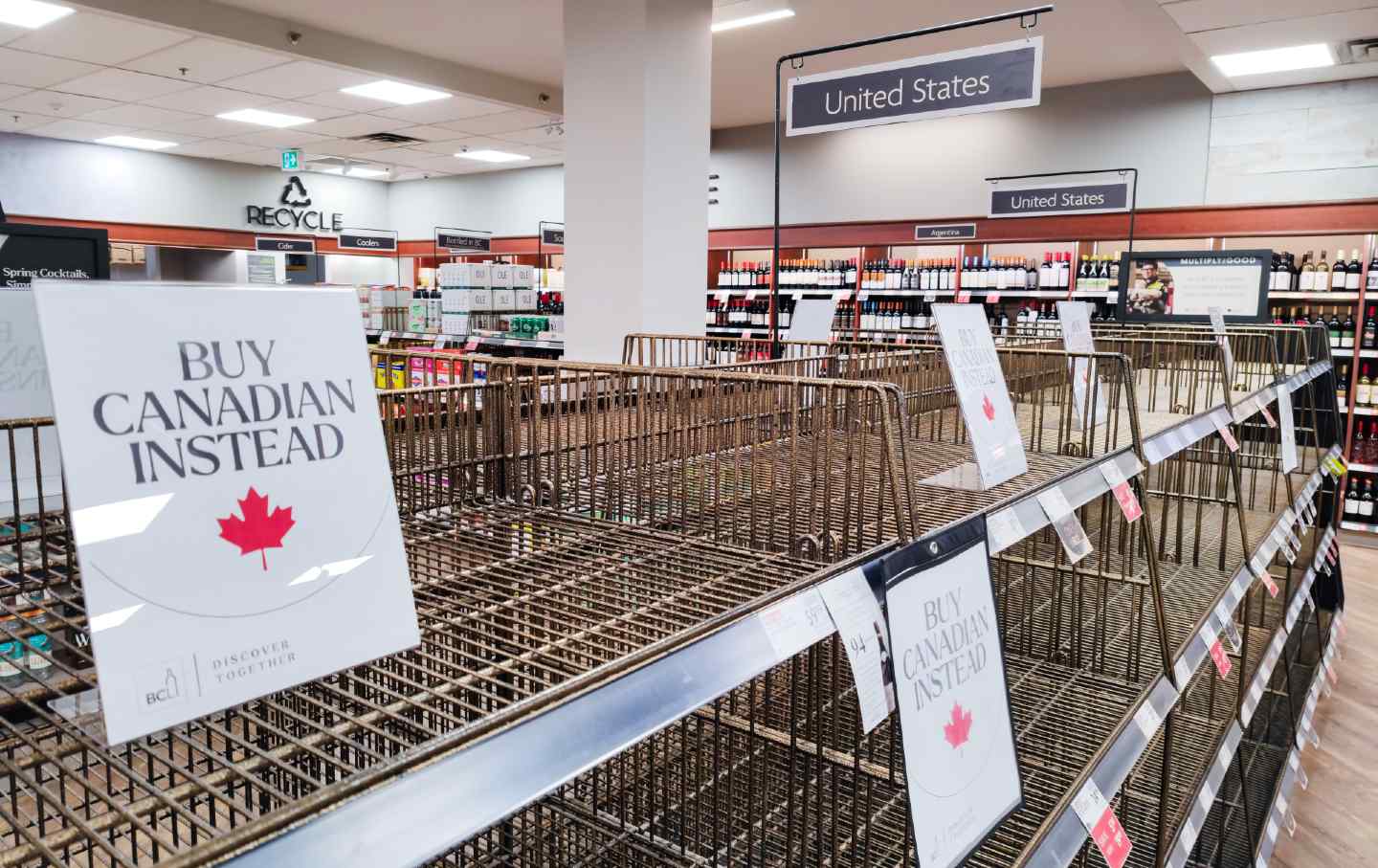
Tags reading “Buy Canadian Instead” are seen on the empty shelf of American products at a supermarket on March 28, 2025, in Vancouver, Canada.
(VCG / Getty Images)So far Donald Trump’s “Liberation Day”—his midweek announcement of a battery of reciprocal tariffs intended to punish longtime US trading partners—has been greeted with a ringing vindication of the freedom to sell short. The week global investment markets kicked off with nosedives on NASDAQ and the Dow Jones indexes, as investors realized that Trump, who had earlier debuted tariffs against Colombia, Canada, and Mexico before walking them back, means what he says about trying to reduce the nation’s trade deficit with massive new tariffs.
In part, this downturn in the paper economy—something that Trump himself has long touted as the surest measure of a president’s economic performance—bespeaks broader worries about the prospects of a recession. In a letter to investors, Wall Street titan Goldman Sachs upgraded the odds that the economy will spiral into recession from 20 percent to 35 percent in no small part due to the Trump tariff plan. Yet the growing panic in the investor class also comes in response to what might be the best-case scenario in the Trump-launched trade wars: that, as in the Canada, Colombia, and Mexico tariff increases, the president will either fold in the face of symbolic concessions or carve out a slew of loopholes and exceptions to allow favored players to go on conducting business as usual. That scenario is in line with the central theme of Trump’s second term in office: maximally concentrating authoritarian power and dispensing favors on a strict cash-return basis. That’s how Trump has re-oriented basic policy in spheres ranging from immigration to corporate law and higher education, and it’s clearly how he imagines the American economy at large should operate.
It’s a mob-style vision for our political economy, whereby insiders are lavishly rewarded and outsiders are brought to heel to further enrich the insiders. And it certainly coheres with the contours of an economy increasingly designed to redistribute wealth upward, into the tight and unproductive grip of the finance, insurance, and real-estate industries. Yet Trump is selling his tariff program as a heroic bid to revive American manufacturing after years of reckless US trade policy that didn’t respond in kind when foreign countries imposed excises on US exports. The problem is that new trade barriers are going to reduce demand for US exports while increasing the cost of living domestically. This will only worsen conditions in the manufacturing sector.
Indeed, Trump’s first-term tariffs demonstrated this pattern on a smaller scale. Many key US industries have extensive global supply chains, which means that the higher production costs sparked by tariffs will likely be passed on to consumers—further depressing demand and stoking recessionary conditions. What’s more, the US labor economy is close to full employment—a major obstacle for either foreign firms establishing US-based plants or American companies reshoring their foreign operations. The director of the furniture industry’s trade group told USA Today that US workers simply aren’t available to meet major production demands—and even if they were, they typically make three times what their counterparts in Asia make. The same market logic goes for any industry now enmeshed in global labor and supply chains—most certainly auto-making, which, despite the UAW’s fanciful endorsement of the 25 percent tariff on auto imports Trump has already instituted, could experience withering job losses should this next round of tariffs become permanent.
If Trump’s tariffs won’t revive manufacturing and are spooking investors, they are also provoking target nations to band together to minimize damage from US trade barriers. Ahead of Wednesday’s announcement, China, Japan, and South Korea—regional powers that otherwise share precious little in the way of political or economic consensus—announced that they were forming a trade bloc. Japan and South Korea are, after Mexico, the leading exporters of cars to the United States, while China is the country’s third-largest trading partner, and a leading trader with virtually all Western nations. A trade war with this group will not bring about a manufacturing renaissance or working-class economic revival. Far more likely are higher US auto prices, declining demand, and—stop me if you’ve heard this one already—a recession. When Trump announced that he “couldn’t care less” if auto prices go up as a result of his trade policies, he’s saying that he doesn’t care about this broader economic fallout either. During the runup to “Liberation Day,” Trump and his economic advisers have conceded that economic pain will result from their policy calls, but that it will all be a small price to pay for the glorious economic boom ahead.
Again, the returns from Trump’s first-term tariffs show otherwise. In addition to costing around 750,000 jobs, those trade strictures triggered a $28 billion bailout for American farmers denied affordable access to foreign markets; another larger bailout package is reportedly in the works for this prized MAGA heartland constituency. While frantic after-the-fact rescue plans may preserve the peace within the Trumpist base of the GOP, they will produce nothing in the way of broad-based prosperity.
What they will generate is yet another sop to the ego of America’s authoritarian leader. According to a 2018 New York Times report, Trump’s public enthusiasm for tariffs came to the fore in 1989, a few months after he lost an auction bid to a Japanese competitor when he wanted to acquire an upright piano featured in the 1942 film classic Casablanca. “America is being ripped off,” he brayed to Diane Sawyer back then. “We’re a debtor nation, we have to tariff, we have to protect this country.” All that seems to have changed over the ensuing 37 years is the source of the great leader’s pique—surely, by now, he’s sworn off any residual fondness for a movie with an anti-fascist message.