
Trump Is Unpopular—and So Are the Do-Nothing Democrats
The president is increasingly hated, but so is an opposition party that fails to oppose.
Donald Trump won the presidency by a unusually narrow margin of victory, falling short of winning a majority of the popular vote and receiving only 1.5 percent more than rival Kamala Harris. But he’s been governing as if he enjoyed a massive mandate from a historic landslide. In the first five weeks of his presidency, Trump unleashed an onslaught of executive orders that, if they went unchallenged, would represent a counterrevolution on American government that would substantially undo Franklin Roosevelt’s New Deal and Lyndon Johnson’s Great Society. Key to Trump’s efforts has been the creation of the Department of Government Efficiency (DOGE), overseen by Elon Musk, the world’s richest man. DOGE is asserting a novel—and almost certainly unconstitutional—license to slash funding and programs already voted on by Congress and signed into law by previous presidents.
Beyond DOGE, Trump has rapidly shifted foreign policy by explicitly using American leverage over allies (notably NATO countries and Ukraine) as an instrument of extortion, most clearly by demanding that Ukraine hand over rights to half its mineral wealth to the United States. He’s also nominated an unusual cohort of extremists and misfits to high office, including Pete Hegseth as secretary of defense, Robert F. Kennedy Jr. as secretary of health and human services, Tulsi Gabbard as director of national intelligence, and Kash Patel as head of the FBI.
In theory, this type of shock-and-awe governance should produce a backlash in Congress, especially since Republicans have a hold on power as narrow as Trump’s electoral victory. Republicans currently enjoy only a three-seat advantage over Democrats in the House of Representatives (218 seats to 215) as well as a thin majority in the Senate (53 out of 100 seats). Yet Democrats have so far been unable to peel off enough Republicans to stall the president’s agenda. To date, almost all of Trump’s nominees have sailed through to confirmation (Matt Gaetz’s failed bid to become attorney general being the major exception). Nor have congressional Republicans, despite their prior support for Ukraine, been willing to speak out against Trump’s foreign policy.
GOP subservience to Trump, motivated by a mix of political expedience and also genuine fear, is not a new story. Vanity Fair reports, “According to one source with direct knowledge of the events, North Carolina senator Thom Tillis told people that the FBI warned him about ‘credible death threats’ when he was considering voting against Pete Hegseth’s nomination for defense secretary.” The magazine also quoted a former Trump official who said, “They’re scared shitless about death threats and Gestapo-like stuff.”
Yet, even as Congress remains submissive, the public at large is quickly souring on Trump and his right-wing man Elon Musk.
On Thursday, The Washington Post reported:
President Donald Trump has opened his second term with a flurry of actions designed to radically disrupt and shrink the federal bureaucracy, but reviews from Americans are mixed to negative on many of his specific initiatives, and 57 percent say he has exceeded his authority since taking office, according to a Washington Post/Ipsos poll.
Overall, 43 percent of Americans say they support what the president has done during his first month in office, with 48 percent saying they oppose. Those who strongly oppose outnumber those who strongly support by 37 percent to 27 percent.
Among the other major findings of the poll: 57 percent of the public think Trump is exceeding his authority; Elon Musk is widely unpopular (with only 34 percent approval and 49 percent disapproval); most Americans disapprove of Trump’s handling of the economy (53 percent disapproval versus 45 percent approval); and roughly six in 10 of Americans disapprove of tariffs on Canada and Mexico.
Further, many DOGE activities are unpopular. According to the Post:
About 6 in 10 oppose shutting down the U.S. Agency for International Development, which provides humanitarian aid in low-income countries….
At a time when each day brings reports of firings at one agency after another, almost 6 in 10 Americans say they oppose laying off large numbers of federal government workers or making it easier to fire longtime government employees. Also, more than 2 in 3 oppose blocking federal health agencies from communicating with the public without approval from a Trump appointee.
Given these numbers, Democrats should be in good shape for regaining control of Congress in the 2026 midterms. Indeed, the same poll shows 54 percent of the public saying they would vote for congressional Democrats in order to hold Trump in check.
Yet Democrats have no reason to be complacent about this number, since other polls show that the party is historically unpopular, with the base deeply dissatisfied by the current leadership. A recent Quinnipiac Poll shows that congressional Democrats have just 21 percent approval, against 68 percent disapproval (for a net negative of 47 percent). This compares unfavorably with congressional Republicans (40 percent approval, 52 percent disapproval, net negative 12) and Trump himself (45 percent approval, 49 percent disapproval, net negative 4 percent). This poll matches other evidence of Democratic Party unpopularity, including a deep slump in funding from both big and small donors.
As Prem Thakker of Zeteo News notes, congressional Democrats’ current unpopularity stands in sharp contrast to a comparable moment in Trump’s first term—February 2017—when they had 59 percent approval and 31 percent disapproval (a net of plus 28 percent).
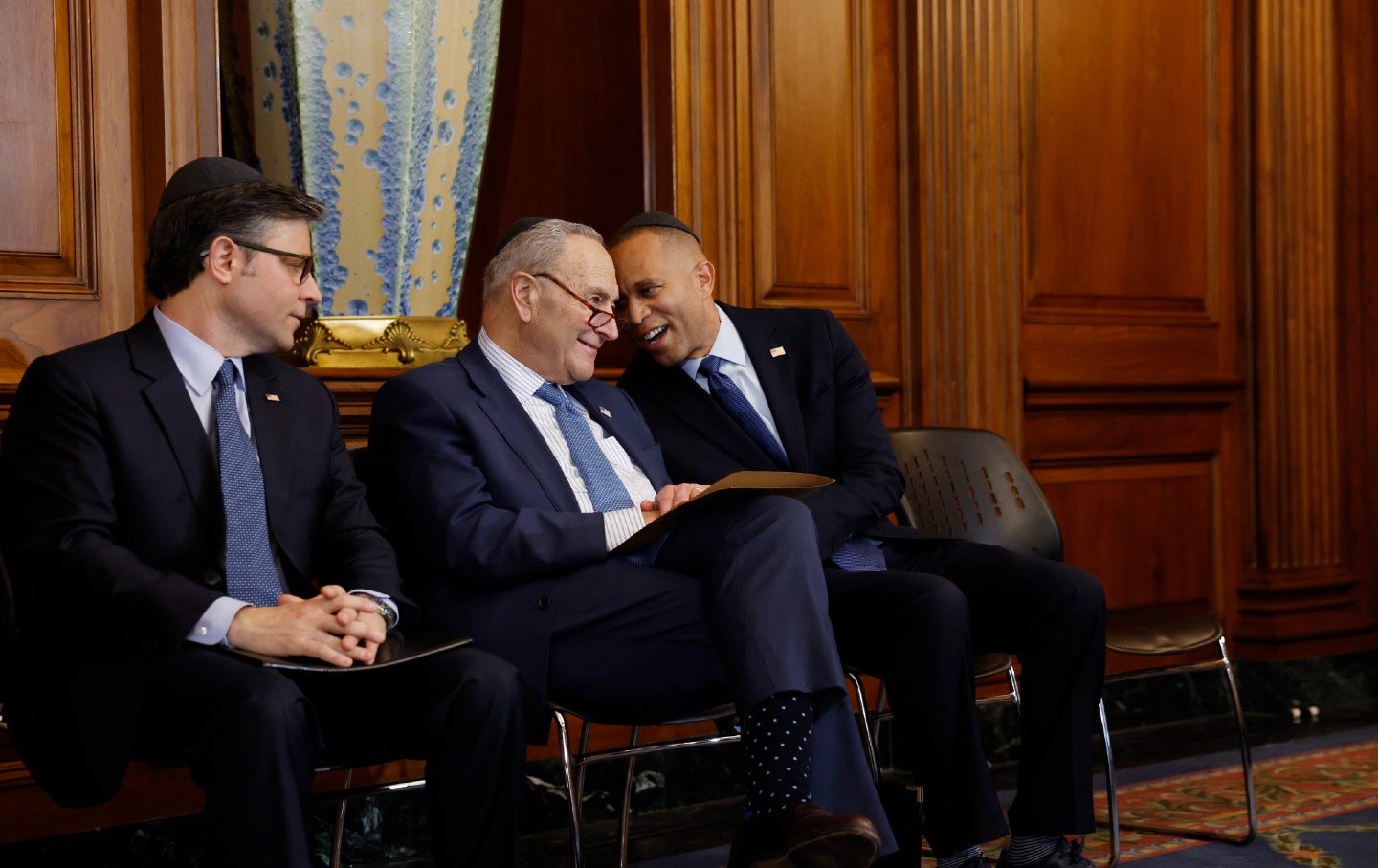
It might seem paradoxical that even as Trump sinks in popularity, weighed down by a widely disliked agenda, Democrats are even more disliked by the public. But the two facts are connected: Pushing a hard-right agenda allows Trump to maintain his support among Republicans even as Democrats and independents turn against him. By contrast, congressional Democrats, under the craven leadership of Senator Chuck Schumer and Representative Hakeem Jeffries, are despised by their own party (for failing to fight Trump) as well as Republicans (for just being Democrats).
The difference between 2017 and 2024 is one of leadership among congressional Democrats. In 2017, congressional Democrats harnessed the popular anger at Trump (fueled by a grassroots resistance movement) and marked out a clear position of opposition. In 2024, congressional Democrats have been much more “timid,” as my Nation colleague David Zirin recently noted. Zirin offered a number of explanations for the pusillanimity of the Democratic leadership—including the reliance on wealthy tech donors, the fact that centrist Democrats share Musk’s cost-cutting agenda, and the stranglehold of Clintonian and Obamaite thinking leaving the party helpless to respond to current realities. One could add that Schumer in particular is clearly putting his hopes on the courts (which he calls “the first line of defense”) to stop Trump’s steamrolling of the government—a plan that, even if it had theoretical plausibility (and if you think the courts are going to save us, I might try to sell you some of Trump’s cryptocoins) will simply demobilize Democratic voters. At the end of the day, defeating Trump is a matter of politics, not the courts.
The current Democratic leadership is simply not up to the task of stoking the deeply felt anger at Trump and using it for the productive political ends of scaring the Republican Party and mobilizing for future elections. The disjunction between a spineless leadership and an increasingly enraged base suggests that the Democrats are due for a shake-up or hostile takeover—comparable to the way the Tea Party movement took over the GOP in Barack Obama’s first term.
Popular
“swipe left below to view more authors”Swipe →Apart from the dispiriting level of current Democratic leadership, there are some striking voices in the party (or allied with it) who are gaining a wide and appreciative audience precisely for their willingness to speak out against Trump: not just stalwart leftists such as Senator Bernie Sanders and Representative Alexandria Ocasio-Cortez but also more mainstream figures such as Illinois Governor J.B. Pritzker and Connecticut Senator Chris Murphy.
Democrats now have a clear choice: They can ramp up anti-Trump anger by elevating these forceful voices—or they can continue to let the Schumer/Jeffries do-nothing strategy drag their party down to future defeat.
Become a Sustaining Donor This September
Between the reemergence of right-wing red-baiting and Donald Trump’s use of the chilling National Security Presidential Memorandum–7 to criminalize left political organizing, we’re seeing McCarthyism reborn before our eyes.
This assault on democracy cannot be ignored or wished away. Resisting it requires bravery in the face of threats and repression, a steadfast commitment to the truth, and the unwavering belief that we can—and will—overcome this darkness.
We must have an independent media that sets the record straight, unearths corruption and abuses of power, and advances a politics of justice and dignity for all if we’re to win this fight.
That’s why I’m writing to you today. This September, The Nation needs to add 100 monthly donors to sustain our progressive journalism. Your contribution makes the next investigative report, the next truth-speaking column, and the next pathbreaking essay all possible.
I hope you’ll support our work with a recurring donation today. If you donate $10 or more a month, we’ll send you a brand new “Hands Off the Free Press!” sticker to recognise your commitment to our cause. Please, donate today.
Onward,
Katrina vanden Heuvel
Editor and Publisher, The Nation
More from
Jeet Heer 

Even Republicans Are Figuring Out That Pete Hegseth Is a Disaster Even Republicans Are Figuring Out That Pete Hegseth Is a Disaster
Hegseth was always a horrible choice for defense secretary. At long last, some in the GOP are admitting it.
Why Aren’t We Talking About the Warmongering Lies of Mike Rogers? Why Aren’t We Talking About the Warmongering Lies of Mike Rogers?
The media’s relentless focus on Hasan Piker allows the dishonest GOP hawk (and actual Michigan Senate candidate) to evade scrutiny.

MAGA Is Exploiting the Lindsay Clancy Case to Try to End Voting for Women MAGA Is Exploiting the Lindsay Clancy Case to Try to End Voting for Women
As Trump subverts elections, his most ardent fans want to overturn the 19th Amendment.

Accountability for the Gaza Genocide Can’t Focus on Netanyahu Alone Accountability for the Gaza Genocide Can’t Focus on Netanyahu Alone
Getting rid of one bad leader won’t bring justice.
In Trump’s Mafia, Even Goons Can Do Billion-Dollar Shakedowns In Trump’s Mafia, Even Goons Can Do Billion-Dollar Shakedowns
Corey Lewandowski is a disposable underling, but he’s protected enough to scorn the law.

Maria Bartiromo Was Fired for the Wrong Reason Maria Bartiromo Was Fired for the Wrong Reason
For Fox News, blind servility to Trump is fine until it hits the bottom line.

