Trump Already Has Blood on His Hands
The president is taking a chain saw to our public health infrastructure—and people will die as a result.
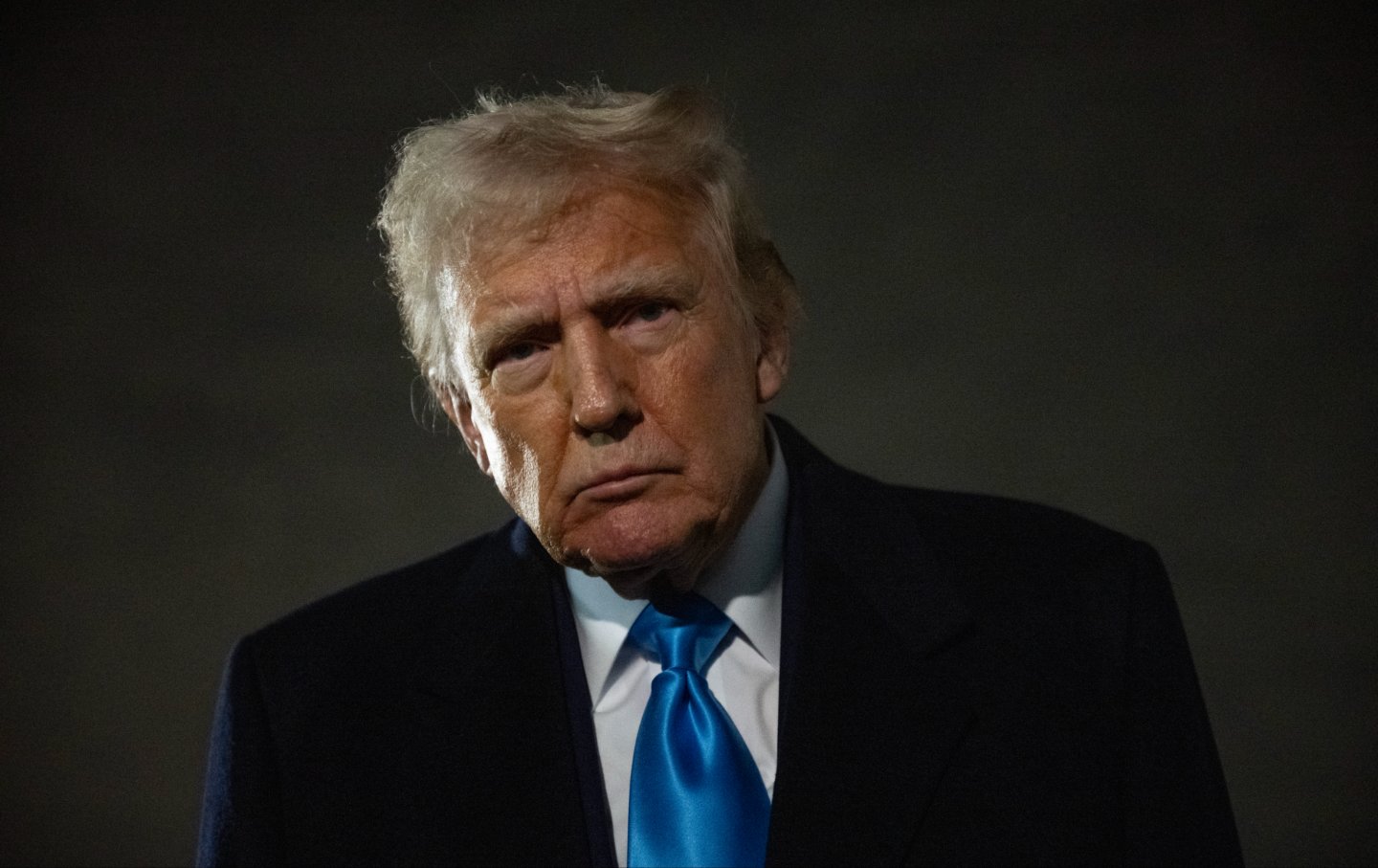
A few weeks into Donald Trump’s second administration, the logic of his actions is becoming clear. It’s the logic of the chain saw. Many have pointed out the affinity that Trump and Argentine President Javier Milei have for each other. Milei has made the demolition of the administrative state a key part of his rule—slashing budgets, eliminating ministries, and firing tens of thousands of government workers. And the chief symbol of this campaign? A chain saw, which Milei likes to wield in political appearances across the country.
Milei justified this shock treatment by pointing to Argentina’s flailing economy. For Trump, the justification is in the act itself. Gutting the federal government has been a far-right wet dream of radical conservatives since Ronald Reagan. With Trump, there is no logic but destruction. People are going to suffer, get sick, and die, and it will happen faster than you think. Trump does not care about the pain he will inflict; in fact, like most sadists, he and his friends will simply feed on it.
I want to focus on one area of Trump’s assault: public health. In late January, the State Department issued a 90-day stop order for all US foreign aid. Swept up in this is the President’s Emergency Plan for AIDS Relief, a landmark, bipartisan program established under George W. Bush that has saved over 25 million lives and prevented millions of new HIV infections around the world. PEPFAR provides lifesaving HIV treatment for 20.6 million people, including 566,000 children, in over 50 countries. But the stop order was merciless: No services, including the provision of treatment, were allowed through PEPFAR, even if pills were on the shelves and patients were waiting outside. After court challenges and a public outcry, the White House lifted some of the suspensions, but no one knows if these reprieves will last, and any confusion still puts people at risk.
Let me explain how AIDS treatments work. The drugs inhibit HIV, the virus that causes AIDS, interrupting its life cycle. Without these pills, HIV destroys T-cells, a key component of our immune systems. As we lose T-cells, we become vulnerable to opportunistic infections and cancers, health conditions usually held in check in people who are HIV-negative, though we see these health events in transplant patients and people with other kinds of immunodeficiencies. Interrupting treatment, which Trump is doing for millions around the world right now, means the virus comes roaring back.
For those who start HIV medications when they are very sick, the chance of their immune system quickly eroding in a process called “decompensation” becomes acute. Their risk of falling ill with these opportunistic diseases and dying shoots up.
In addition, interruptions in treatment can lead to drug resistance, making it harder to treat HIV infection with the standard medications. The stop order on PEPFAR means that millions of others risk being left without a powerful tool to prevent HIV transmission, including newborn infants around the world. And that’s just one program in one area of public health.
This may seem far away to many Americans. But the damage is also happening at home. Days after returning to the White House, Trump suspended all federal grants, including those administered by the National Institutes of Health (NIH). Legal and political challenges again forced the lifting of that freeze, but the threat remains real.
And even a brief pause is disastrous. The infrastructure of US biomedical research at universities is highly dependent on federal grants to keep the lights on. That was all disrupted. Experiments that rely on continuity—with the daily passage of cell lines or care of laboratory animals, for instance—were destroyed.
Any longer halt would be even worse. Richer universities like mine may be able to weather the storm for a short time, but smaller institutions will feel the impact immediately. People will lose their jobs. But this anarchy is a feature, not a bug, for Trump and his minions. They see universities as the enemy, and going after NIH funding is a way to bring down higher education in the United States. Biomedical research at the NIH, like PEPFAR, has always had bipartisan support, and the United States’ biomedical research enterprise is still the envy of the world. It has taken decades to build this infrastructure. Now Trump wants to tear everything down. The Centers for Disease Control and Prevention, the National Science Foundation, and countless other agencies and programs are also on the firing line. It’s terrifying.
Yet there is no real opposition from the Democrats to Trump’s chainsaw massacre. They continue to reward him with votes in the Senate for his nominees. The professional organizations representing scientists, physicians, and others have been notably silent or demure in their statements.
So let me say it again for those in the back: All of this is going to have deadly and lasting consequences. These people are terrorists in all but name, and we will all have to live in the rubble of the aftermath.
Become a Sustaining Donor This September
Between the reemergence of right-wing red-baiting and Donald Trump’s use of the chilling National Security Presidential Memorandum–7 to criminalize left political organizing, we’re seeing McCarthyism reborn before our eyes.
This assault on democracy cannot be ignored or wished away. Resisting it requires bravery in the face of threats and repression, a steadfast commitment to the truth, and the unwavering belief that we can—and will—overcome this darkness.
We must have an independent media that sets the record straight, unearths corruption and abuses of power, and advances a politics of justice and dignity for all if we’re to win this fight.
That’s why I’m writing to you today. This September, The Nation needs to add 100 monthly donors to sustain our progressive journalism. Your contribution makes the next investigative report, the next truth-speaking column, and the next pathbreaking essay all possible.
I hope you’ll support our work with a recurring donation today. If you donate $10 or more a month, we’ll send you a brand new “Hands Off the Free Press!” sticker to recognise your commitment to our cause. Please, donate today.
Onward,
Katrina vanden Heuvel
Editor and Publisher, The Nation