Will Trump End the Most Successful Foreign-Aid Program in US History?
The President’s Emergency Program for AIDS Relief is in danger of being shuttered. The decision could kill hundreds of thousands of people and kickstart an epidemic.
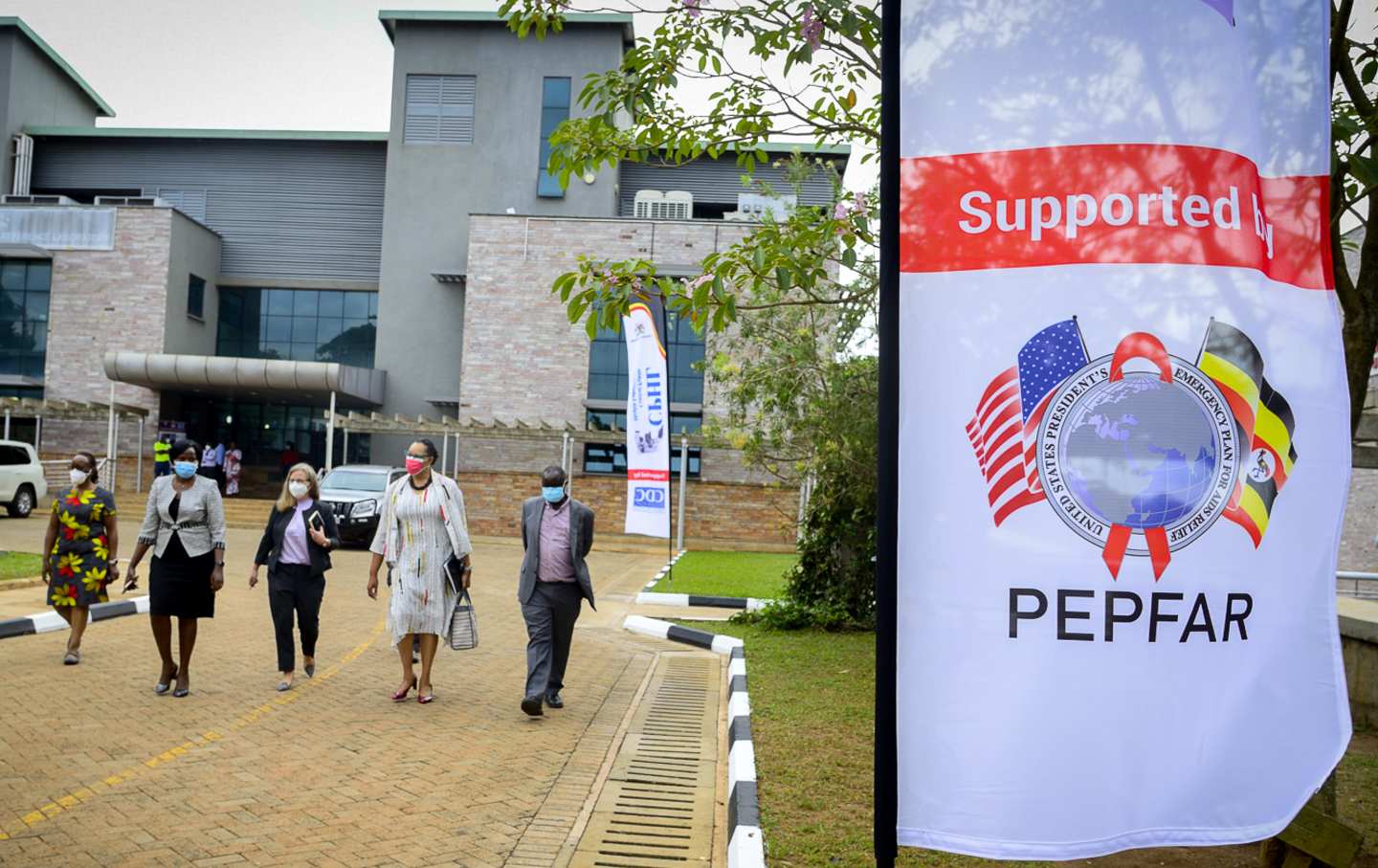
The US ambassador to Uganda, Natalie A. Brown, visits the PEPFAR-supported National Health Laboratory and Diagnostic Services facility in Kampala, Uganda.
(Chris Lubega / US Embassy in Uganda)
On January 27, it looked as if the Trump administration had given death sentences to hundreds of thousands of people, most of them in Africa, who are surviving with HIV/AIDS thanks to the most successful foreign-aid health program in US history. The US government had effectively ordered clinics and hospitals across Africa and in countries like Haiti, Brazil, and India to cancel appointments and turn away people who were showing up for their regular doses of the life-saving antiretroviral (ARV) medications. Panic spread across the more than 50 poor nations that receive the drugs.
Then, late on January 28, Secretary of State Marco Rubio issued a “waiver,” which may allow some elements of the health program to start up again. But PEPFAR, the President’s Emergency Program for AIDS Relief, remains under threat, even though it has—no exaggeration—saved the lives of an estimated 26 million people since President George W. Bush launched it in 2003. PEPFAR has also prevented an estimated 5.5 million mother-to-child transmissions.
PEPFAR earns enormous respect for the United States in the countries that receive the aid. What’s more, until just a few years ago, the program also enjoyed overwhelming bipartisan support in the US Congress, even from conservative members, in part because evangelical Christians were enthusiastic about it and in fact manage many of the hospitals and clinics in Africa that dispense the life-giving medications. In 2018, during the first Trump administration, Congress renewed PEPFAR without controversy.
As soon as the Trump administration made the announcement this week, this crisis hit. The Foundation for AIDS Research (amfAR), a US-based advocacy group, estimates that more than 222,000 people pick up ARV medications every day. The administration not only froze funding but also shut down PEPFAR’s data system.
Emily Bass has spent decades researching and writing about the global campaign against AIDS; her 2021 book, To End a Plague: America’s Fight to Defeat AIDS in Africa, is a compelling history of how grassroots movements in both the United States and Africa eventually pressured the US government to act. She told me about a friend of hers in Uganda whose clinic ran out of the ARVs she needed and was already laying people off. “Let’s also not forget mental health,” she said. “People in Africa just experienced the same fear and strain that Americans did when the administration also paused Medicaid today.”
As US ambassador to Zambia from 2017 to 2020, Dan Foote managed that country’s PEPFAR program. He is enthusiastic about the program and warned about what eliminating it could unleash. “Ending PEPFAR will cause an AIDS explosion in Africa, which will lead to an AIDS epidemic in the United States, period. That’s how the global movement among countries works,” he said. “HIV/AIDS is extremely virulent when it gets out there. It’s like a steamroller.”
Foote also explained why PEPFAR is vital to US national security: “If we want to continue being a superpower, we need to make sure that citizens of the world continue to like and respect us. When we have a good name overseas, ordinary people put pressure on their governments to maintain or create alliances with the United States. And alliances are probably the biggest single key to sustaining US national security over the long term.”
“Instead,” Foote added, “we’ve started to go around, and kick every ally we have in the shins. China will absolutely take advantage of the end to PEPFAR.”
Unfortunately, the latest threat to PEPFAR has been swamped by the news of Trump’s simultaneous suspension of many other domestic federal programs. What’s more, the US mainstream media has failed in recent years to either report on PEPFAR’s ongoing success or to document the growing danger to its future.
PEPFAR’s budget for the current year is $7.5 billion. That’s half of what a single US Navy aircraft carrier costs. In the more than two decades since George W. Bush started the program, there has not been a single major corruption scandal anywhere.
The cost of the HIV/AIDS medications has dropped, but they are still beyond the reach of most people in poor countries. A few years back, Jean William Pape, the Haitian doctor who manages PEPFAR’s ARV distributions to 100,000 people in Haiti, told me that the drugs cost $250–300 per person a year. “The United States supplies 90 percent of our needs. Without that help, thousands of Haitians would be dying every month.”
Become a Sustaining Donor This September
Between the reemergence of right-wing red-baiting and Donald Trump’s use of the chilling National Security Presidential Memorandum–7 to criminalize left political organizing, we’re seeing McCarthyism reborn before our eyes.
This assault on democracy cannot be ignored or wished away. Resisting it requires bravery in the face of threats and repression, a steadfast commitment to the truth, and the unwavering belief that we can—and will—overcome this darkness.
We must have an independent media that sets the record straight, unearths corruption and abuses of power, and advances a politics of justice and dignity for all if we’re to win this fight.
That’s why I’m writing to you today. This September, The Nation needs to add 100 monthly donors to sustain our progressive journalism. Your contribution makes the next investigative report, the next truth-speaking column, and the next pathbreaking essay all possible.
I hope you’ll support our work with a recurring donation today. If you donate $10 or more a month, we’ll send you a brand new “Hands Off the Free Press!” sticker to recognise your commitment to our cause. Please, donate today.
Onward,
Katrina vanden Heuvel
Editor and Publisher, The Nation