Joe Biden’s Indictment
The former president’s unexpectedly powerful farewell address rightly condemned the very oligarchy he empowered.
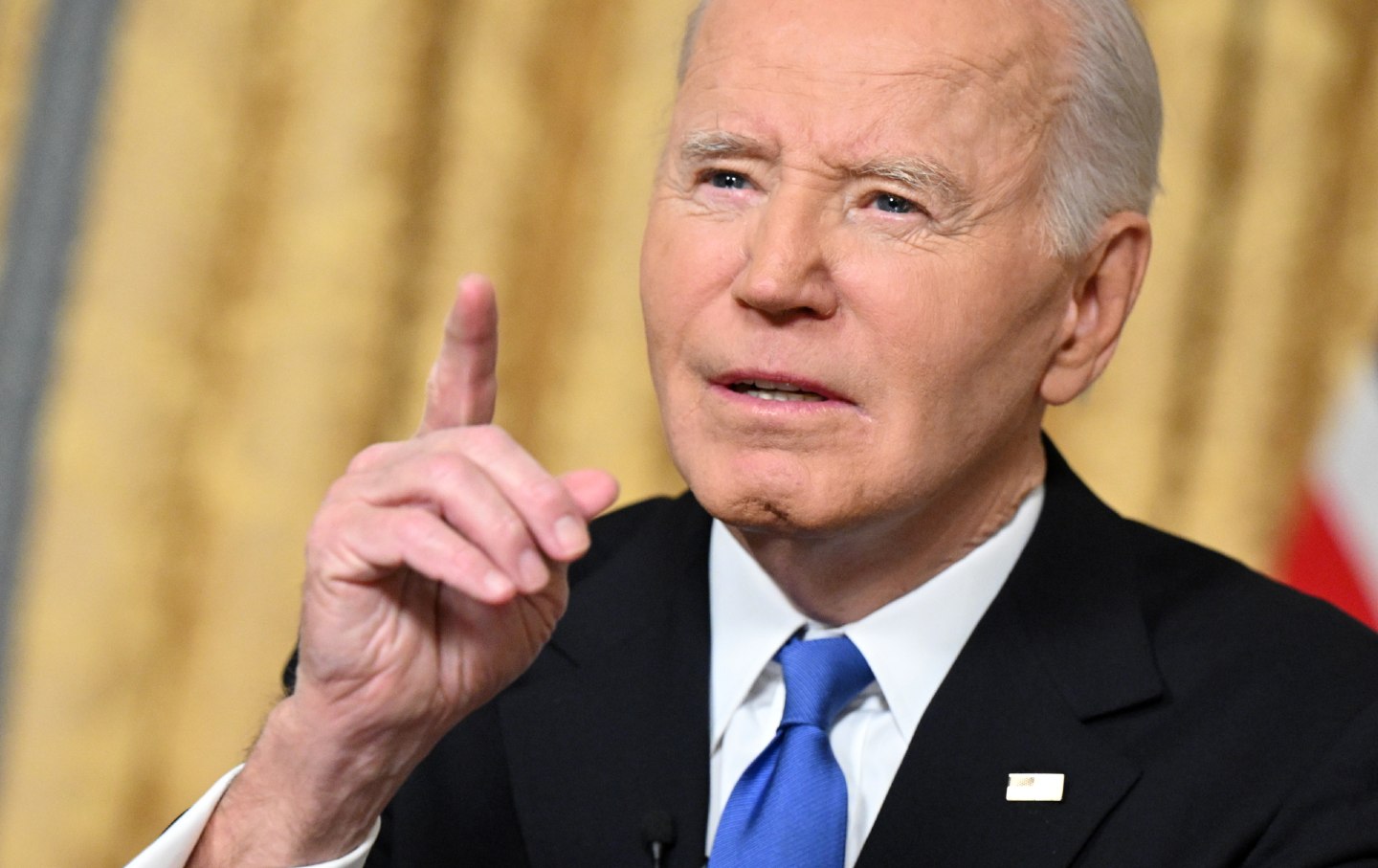
Joe Biden unexpectedly saved the best for last. No one ever accused the former president of being an outstanding orator. In his last two years in office, he was increasingly halting and confused in his public speeches. But on January 15, less than a week before his successor was sworn in, Biden delivered an outstanding farewell address—one that should be especially welcomed by progressives and liberals.
The first part of the speech was taken up by expressing Biden’s deep commitment to American democracy and pluralism. He also outlined the achievements of his administration, with an emphasis on rebuilding the economy. This boasting was understandable: Although there is much in Biden’s record to criticize, he has launched the largest public spending on social policy in generations and invested serious money in tackling climate change. With Trump returning to the White House, Biden performed a necessary service by celebrating a progressive economic vision that serves as both an alternative to Trumpism and a launching pad for future Democratic administrations.
But the real meat of Biden’s speech came not from his laundry list of accomplishments but his dark foreboding about the threats to American democracy. Biden warned: “Today, an oligarchy is taking shape in America of extreme wealth, power and influence that literally threatens our entire democracy, our basic rights and freedoms and a fair shot for everyone to get ahead. We see the consequences all across America.”
Biden compared this oligarchy to the robber barons of the 19th century. Those robber barons eventually provoked a popular reaction leading to trust busting and progressive taxation.
Specifying the nature of this oligarchy, Biden cited one of the most famous of all farewell addresses, Dwight Eisenhower’s 1961 warning of “the dangers of the military-industrial complex.” Quoting Eisenhower, Biden raised the specter of “the disastrous rise of misplaced power.” The new concern, Biden advised, was “the potential rise of a tech-industrial complex that could pose real dangers for our country as well.” Thanks to the tech lords, “Americans are being buried under an avalanche of misinformation and disinformation enabling the abuse of power.”
Biden also insisted that “the existential threat of climate change has never been clearer. Just look across the country, from California to North Carolina.”
These are all wise words—ones that Democrats should heed as they rebuild their shattered party. Yet Biden’s speech was double-edged, serving not just as a preemptive strike against the coming abuses of the Trump administration but also, if we are honest, as a rebuke to Biden’s own record.
In warning of oligarchy, Biden sounded as if he had suddenly shed his lifelong identity as a milquetoast centrist and been possessed by the spirit of Bernie Sanders. Indeed, the Vermont Senator himself seemed aware of this fact. The following day, Sanders grilled billionaire Scott Bessen, Trump’s nominee to be treasury secretary, and quoted Biden’s admonishment about oligarchy. Bessen tartly noted that Biden gave the Presidential Medal of Freedom “to two people who would qualify as oligarchs.”
Alas, Bessen had a point. Biden did in fact give the nation’s highest civilian honor to two billionaires, George Soros and David Rubenstein, both examples of the outsize power of money in American democracy. The award to Rubenstein is particularly egregious, since he is a crony capitalist who has built his fortune thanks to close ties to government officials.
To reformulate Bessen’s retort: If you talk the talk, you have to walk the walk. You can’t talk like Bernie Sanders if you’re actually Joe Biden—the “senator from MBNA” who has been cozying up to plutocrats his entire life. Speaking to wealthy donors in 2019, then-candidate Biden reassured them that he planned no large tax hikes. Under his presidency, “no one’s standard of living will change, nothing would fundamentally change.” In other words, Biden was never a threat to the oligarchy.
The same contradiction between words and actions applies to Biden’s caution about a “tech-industrial complex.” In a speech delivered to the State Department the same day as his farewell address, Biden boasted about all the new spending on military technology undertaken by his administration as part of a program of military Keynesianism. Biden crowed:
We’ve increased our military power, making the most significant investments in the Defense Industrial Base in decades.
We’ve increased the technology power, taking the lead on artificial intelligence and other technologies of the future….
We’ve also significantly strengthened the defense industrial base, investing almost $1.3 trillion in procurement and research and development. In real dollars, that’s more than America did in any four-year period during the Cold War.
If the “tech-industrial complex” is a new manifestation of the military-industrial complex, then Biden has immeasurably strengthened its grip on our economy and our politics. It is public funding that is making tech lords like Elon Musk (who has billions in government contracts) stronger. Once again, Biden is the architect of the very oligarchy he decries.
Popular
“swipe left below to view more authors”Swipe →There’s a further contradiction in fighting the existential threat posed by climate change while pushing for renewed great-power competition with China—as Biden has done. Any real climate solution will require international cooperation, not economic nationalism.
Biden’s parting rebuke to oligarchy is welcome. But if Biden wants to see why plutocracy now threatens America, he needs to begin by looking in the mirror.
Become a Sustaining Donor This September
Between the reemergence of right-wing red-baiting and Donald Trump’s use of the chilling National Security Presidential Memorandum–7 to criminalize left political organizing, we’re seeing McCarthyism reborn before our eyes.
This assault on democracy cannot be ignored or wished away. Resisting it requires bravery in the face of threats and repression, a steadfast commitment to the truth, and the unwavering belief that we can—and will—overcome this darkness.
We must have an independent media that sets the record straight, unearths corruption and abuses of power, and advances a politics of justice and dignity for all if we’re to win this fight.
That’s why I’m writing to you today. This September, The Nation needs to add 100 monthly donors to sustain our progressive journalism. Your contribution makes the next investigative report, the next truth-speaking column, and the next pathbreaking essay all possible.
I hope you’ll support our work with a recurring donation today. If you donate $10 or more a month, we’ll send you a brand new “Hands Off the Free Press!” sticker to recognise your commitment to our cause. Please, donate today.
Onward,
Katrina vanden Heuvel
Editor and Publisher, The Nation