
Joe Biden Loves Awarding Participation Trophies to the Failed Establishment
Unwavering support for ancien régime restoration means prizes for Liz Cheney, Hillary Clinton, and George Soros.
In theory, the beheading of a king and queen should trigger some sober reflections in the ruling class. But after Louis XVI and Marie Antoinette were famously guillotined in 1793, the surviving members of the House of Bourbon and their most fervent supporters were still adamantly committed to reviving to the same arrogant autocracy that provoked the French Revolution in the first place. In 1796, the Chevalier de Panat, a moderate who had hoped that in exile the monarchist faction would learn political prudence, despaired in a letter to a friend that “no one has forgotten anything, nor learned anything.” In historical memory, de Panat’s quip is usually distilled into a punchier formulation: “The Bourbons have learned nothing and forgotten nothing.”
After Napoleon’s defeat in 1815, the Bourbons did in fact enjoy a brief return to power, but the new regime of Louis XVIII and Charles X vindicated de Panat’s analysis. The restored Bourbons displayed no greater governing skill than before, leading to the July Revolution of 1830.
I’ve often thought that the epitaph “learned nothing and forgotten nothing” applies not just to the Bourbons but to the Democratic Party establishment. In 2016, this establishment received a major historical shock when their own Hillary Clinton—the candidate they had worked overtime to make the party’s presidential nominee—was defeated by a rank outsider running an anti-system campaign, Donald Trump. The rise of Trumpism did not lead to any establishment self-criticism but rather generated fantasies of an ancien régime restoration: While the party did come to accept a few populist economic policies advocated by Bernie Sanders and Elizabeth Warren, these were subsumed into a larger project to counter Trumpism by restoring bipartisan comity. The goal was a centrist-led popular front that gave pride of place to putatively moderate Republicans (notably John McCain and Mitt Romney) and wealthy donors (notably the former Republican Michael Bloomberg)—a coalition that would relegate Trumpism to the fringes of the political spectrum.
In 2020, the Democratic coalition coalesced behind Joe Biden as the most natural avatar of ancien régime restoration. Within the party itself, Biden was the one candidate who could fend off the insurgent threat of Bernie Sanders. More broadly, with a Senate career dating back five decades and a history of friendship with Republicans such as Strom Thurmond, Biden was the very embodiment of the old order. Making Biden the presidential nominee was the equivalent of French monarchists using demonic magic to revive a zombie Marie Antoinette. While Biden did make some adjustments to the realities of the 21st century, notably in supporting robust social spending advocated by the left wing of the Democratic Party, on the whole his presidency was a sustained exercise in bipartisan nostalgia—especially his foreign policy, devoted to funding proxy wars in Europe and the Middle East to shore up American global hegemony.
Now, with Donald Trump’s second presidential victory in three election cycles, the fantasy of ancien régime restoration should have been dealt a death blow.
Yet over the past week Biden has been using the waning days of his failed presidency to hand out awards that show his commitment to revitalizing a failed establishment is stronger than ever.
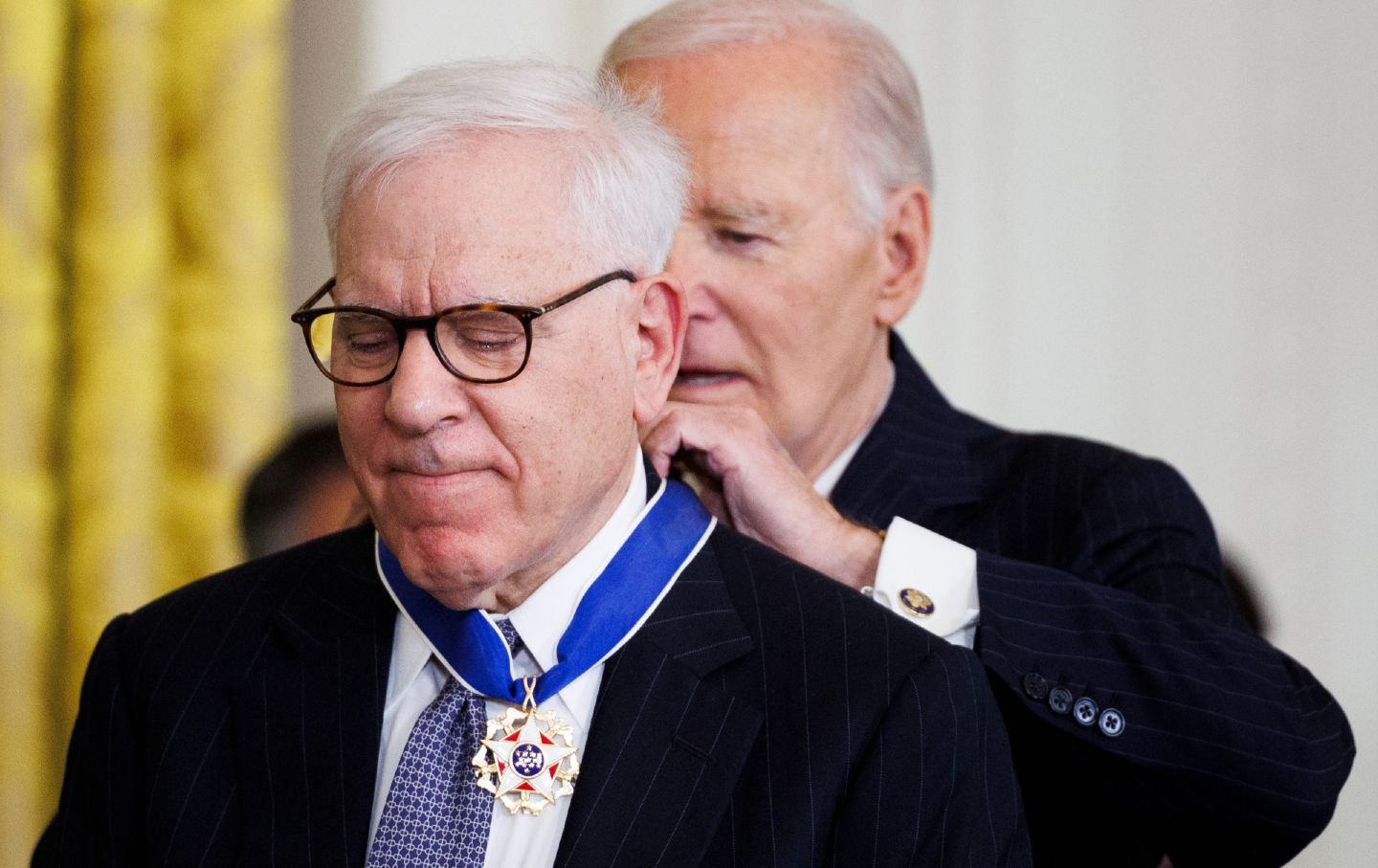
On Thursday, Biden gave the Presidential Citizens Medal to 20 people, including Liz Cheney, a former representative who is much celebrated among centrist Democrats for being a Republican who has been forthrightly critical of Donald Trump’s attempted coup of 2021. Two days later, Biden gave the Presidential Medal of Freedom—the nation’s highest civilian honor—to a group that The New York Times described as “core members of the political, financial and celebrity establishment of which he has long been a part.” Among the recipients were Hillary Clinton, the late George Romney (onetime governor of Michigan and father of Mitt Romney), and the billionaire George Soros. The Times explained the award to Soros by observing, “After weeks in which Mr. Trump has showcased Elon Musk, the world’s richest man, as a member of his inner circle, Mr. Biden appeared to want to say: We have our billionaires, too.”
Nor is Soros the only billionaire laureled by Biden: David Rubenstein, founder of the private equity fund The Carlyle Group, also joined the honor roll of the Presidential Medal of Freedom. As historian Rick Perlstein recently documented in The American Prospect, Rubenstein’s stock in trade is leveraging political access for private profit, pioneering the vulture capitalist tactic of buying companies on borrowed money and strip mining them for profits. Garlanding a figure like Rubenstein as “our billionaire” is a good way to destroy any credibility the Democratic Party might have as a champion of ordinary people.
Another decidedly elite honoree was Anna Wintour, editor of Vogue. Explaining Wintour’s prize, The New York Times noted that Wintour “put the first lady, Jill Biden, on the cover of Vogue twice in the last four years while spurning Melania Trump during her husband’s presidency. Ms. Wintour is one of the leading fund-raisers in the fashion industry, having hosted events for Mr. Biden’s re-election campaign in London and Paris last year.”
The Times sees Biden’s awards as making a political statement, stating that “the 82-year-old president is sending an unmistakable message of support for a democratic order he has said is threatened by Mr. Trump’s re-election.” Biden underscored this point at the end of the ceremony by saying, “Let’s remember, our sacred effort continues, and to keep going, as my mother would say, we have to keep the faith.”
The noble injunction to “keep the faith” is less inspiring when we consider the exact nature of the faith Biden is celebrating here. In truth, these award ceremonies offer dispiriting proof that Biden has forgotten nothing and learned nothing. As Trump prepares to return to the White House and wreak untold damage, Biden is handing out participation trophies to a failed establishment. He is recommitting to the delusion of a revitalized bipartisan comity and the mirage of ancien régime restoration even after this project has proven decisively to be a disaster for America and for the world.
Even worse, by presenting politics as a choice between Trump and this failed establishment, Biden is doing Trump a massive favor. The incoming president is no political genius. Trump is a squalid, nasty figure who has been deeply unpopular at most times with most of the population ever since he entered national politics. The one political advantage Trump has—the trump card that rarely fails—is he has been the voice of antiestablishment rage in a time when most Americans are unhappy with the political elite.
We live, as I’ve repeatedly insisted, in an age of anti-system politics. This has been the dominant reality in the United States since as least 2005, when the Iraq war intensified. In both the United States and the rest of the world, anti-system politics further intensified with the global economic meltdown of 2008.
Consider the group that Biden decided to honor. What do Joe Biden, Mitt Romney, Hillary Clinton, and the Cheney family all have in common? They all supported the Iraq war (and Dick Cheney was a major instigator of that war). David Rubenstein, whose Carlyle Group enormously benefited by buying up distressed defense firms in the 1990s that flourished after the 9/11 attack, is a direct beneficiary of militarism. To his credit, George Soros opposed the Iraq war, but one can still question the wisdom of honoring a billionaire during a time of antiestablishment rage. Broadly speaking, Biden has created a pantheon of figures who are associated with the most noxious features of the current system.
To be sure, Biden did honor some progressive figures in his choice for the Presidential Medal of Freedom, but it is striking that two of them are dead: Robert F. Kennedy Sr. (who was assassinated in 1968) and the civil rights leader Fannie Lou Hamer (who died in 1977). Kennedy was surely picked as a way to take back the Kennedy name, long cherished by Democrats, from the slain leader’s renegade son, the Trump ally Robert F. Kennedy Jr. Again, this seems like an exercise in nostalgia. Hamer of course deserves all honors, but there are living civil rights leaders who could have been acknowledged as well. The struggle against racism is ongoing—all the more so with Trump’s returning to the White House. It should not be relegated to mere history.
Popular
“swipe left below to view more authors”Swipe →A Democratic politics based on nostalgia and antiquarianism was always doomed to failure. The only way to fight Trump’s fraudulent anti-system politics is to organize an anti-system politics of the left grounded in economic populism. This is the urgent political task of the present moment, and it means we have to relegate Biden and his illusions of ancien régime restoration to the same dustbin of history that houses the Bourbons.
Become a Sustaining Donor This September
Between the reemergence of right-wing red-baiting and Donald Trump’s use of the chilling National Security Presidential Memorandum–7 to criminalize left political organizing, we’re seeing McCarthyism reborn before our eyes.
This assault on democracy cannot be ignored or wished away. Resisting it requires bravery in the face of threats and repression, a steadfast commitment to the truth, and the unwavering belief that we can—and will—overcome this darkness.
We must have an independent media that sets the record straight, unearths corruption and abuses of power, and advances a politics of justice and dignity for all if we’re to win this fight.
That’s why I’m writing to you today. This September, The Nation needs to add 100 monthly donors to sustain our progressive journalism. Your contribution makes the next investigative report, the next truth-speaking column, and the next pathbreaking essay all possible.
I hope you’ll support our work with a recurring donation today. If you donate $10 or more a month, we’ll send you a brand new “Hands Off the Free Press!” sticker to recognise your commitment to our cause. Please, donate today.
Onward,
Katrina vanden Heuvel
Editor and Publisher, The Nation
More from The Nation


The First Amendment Lives for Another News Cycle—Maybe The First Amendment Lives for Another News Cycle—Maybe
In this week’s Elie v. U.S., our justice correspondent parses Trump’s attacks on CNN, MS NOW, and Politico. Plus: it’s time to impeach the judges!
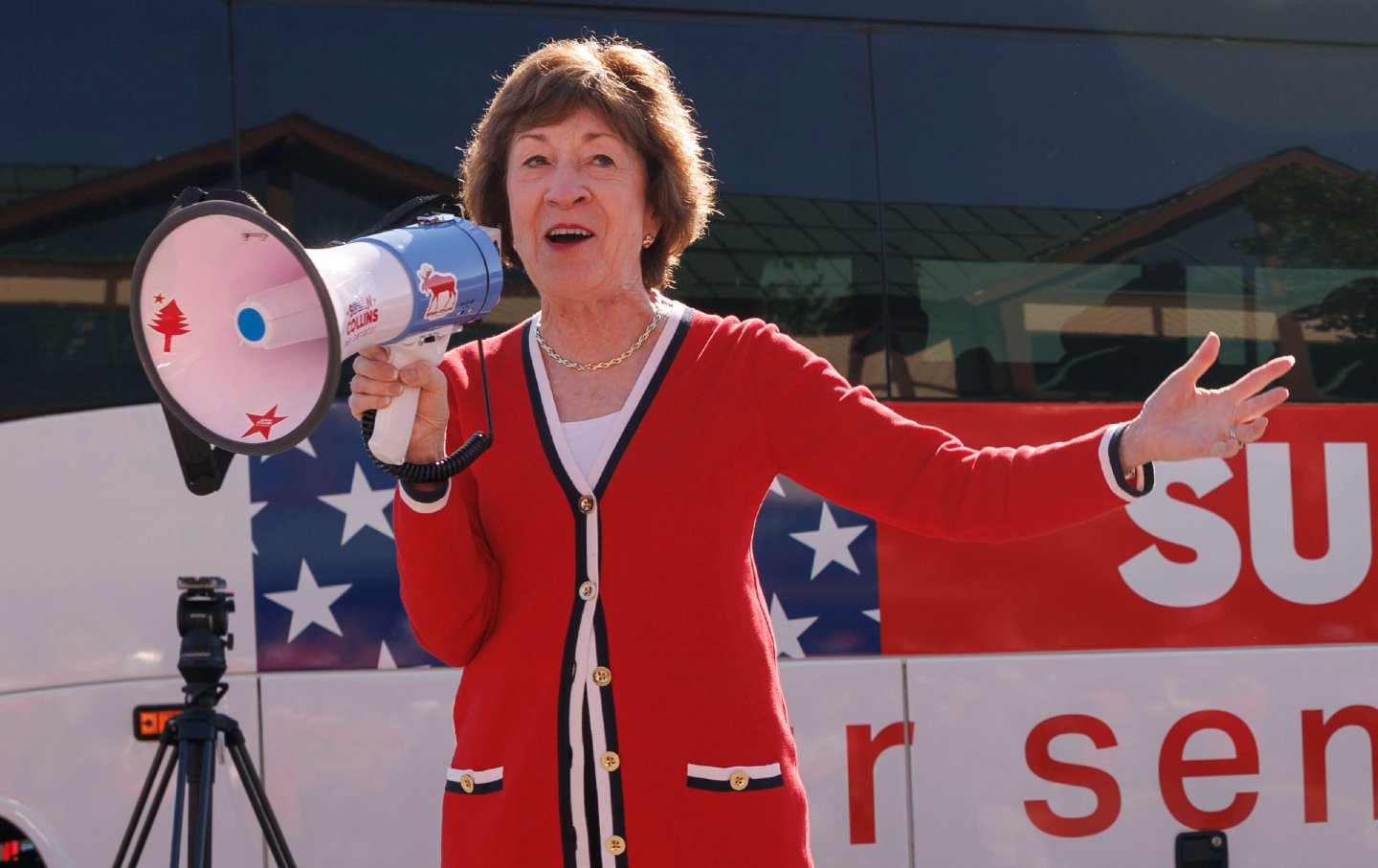
Susan Collins Is Corrupt. She Still Might Be Reelected. Susan Collins Is Corrupt. She Still Might Be Reelected.
Despite being embroiled in scandal, the Maine senator is benefiting from Democratic Party divisions.

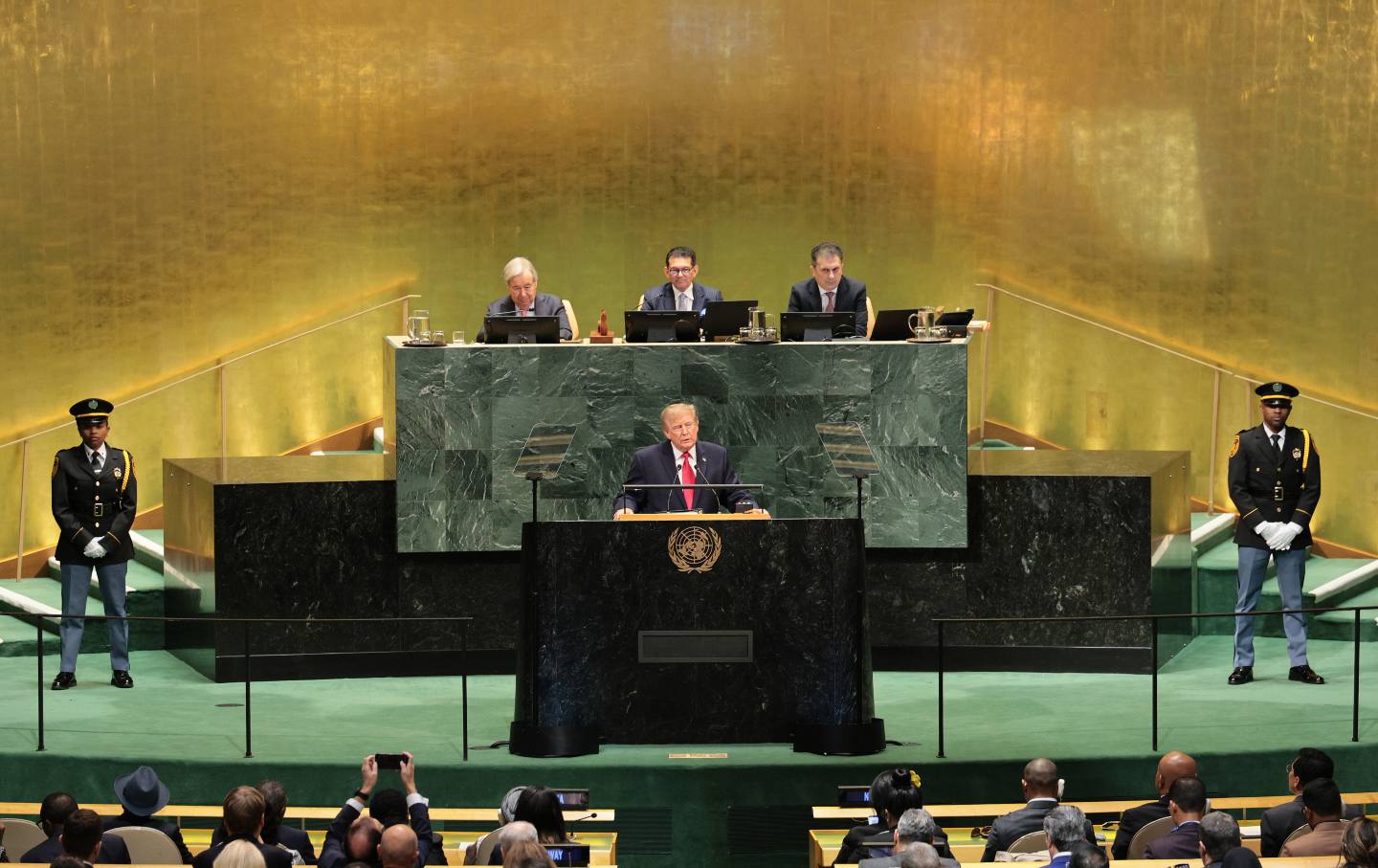
Trump Impersonated Hitler at the United Nations Trump Impersonated Hitler at the United Nations
It was just one more of many examples of the president mirroring a fascist leadership.

Trump Is Destroying Public Health. Democrats Need to Fight Back. Trump Is Destroying Public Health. Democrats Need to Fight Back.
If they win in the midterms, the party must move quickly and aggressively to undo the harm Trump and his cronies have caused.

