
Newspapers That Refuse to Endorse Are Betraying Journalism—and Democracy
Billionaire publishers who censor endorsements that offend Donald Trump confirm their scorching disregard for the traditions of a free press.
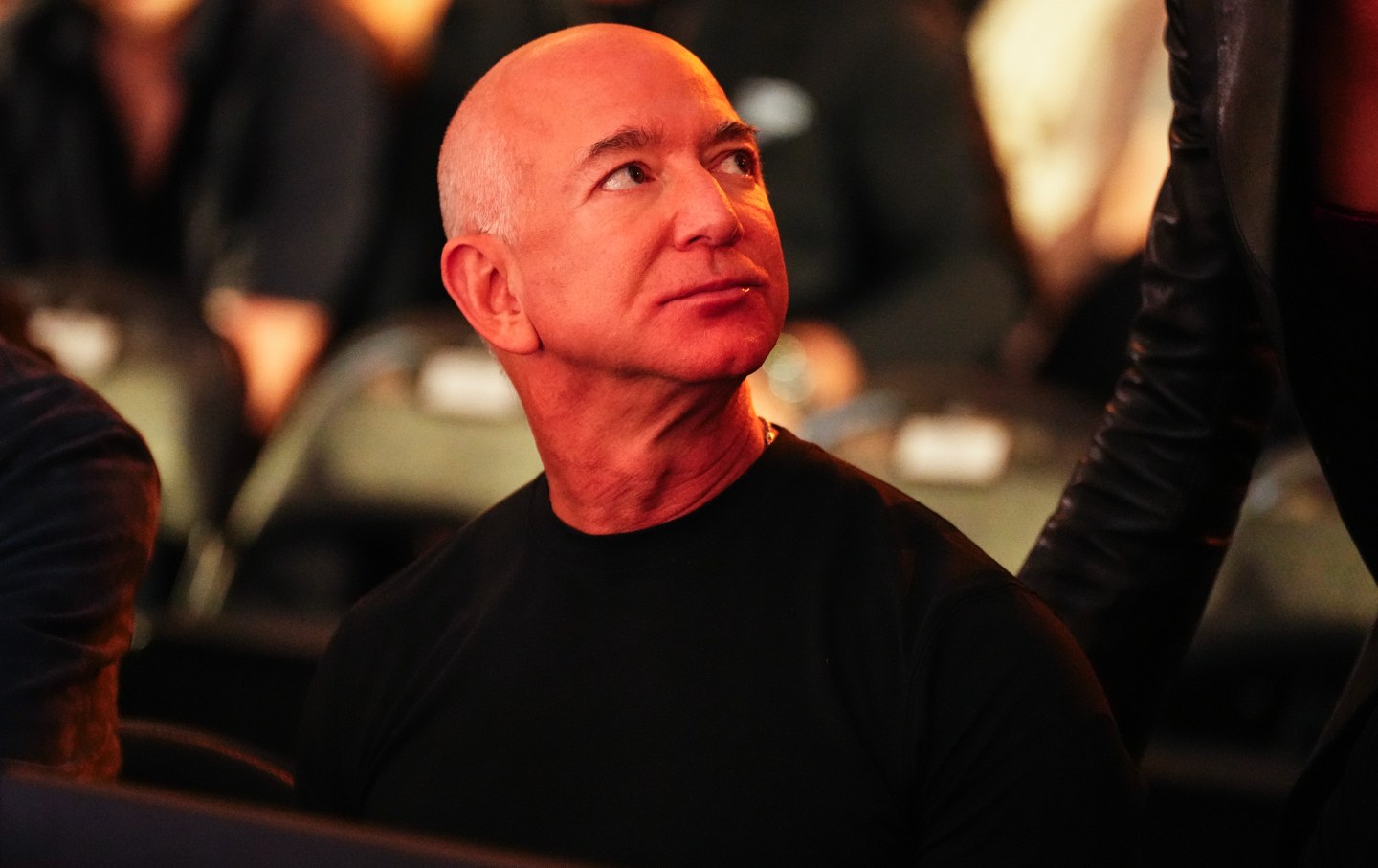
Jeff Bezos attends the UFC 306 at Riyadh Season Noche UFC event at Sphere on September 14, 2024, in Las Vegas, Nevada.
(Jeff Bottari / Zuffa LLC via Getty Images)When billionaire-owned newspapers such as The Washington Post and the Los Angeles Times refuse to make endorsements in contests for the presidency of the United States—at a point when most Americans believe that the very future of this country’s democracy is at stake—they reject the basic premise of press freedom in the United States.
The founders of the American experiment did not establish constitutional protections for media outlets so that hedge-fund managers could strip newspapers for parts, or billionaires could make them political playthings. They understood that the point of a free press was to speak truth to power, to stir debate, and, perhaps above all, to express opinions about who should occupy the Oval Office.
When Alexis de Tocqueville surveyed the progress of the American experiment in the early 1830s, Andrew Jackson, a crudely racist president who rejected the rule of law in order to assert his own power, was finishing the first of two miserable terms. The election of 1832 was approaching and, the Frenchman would recall, “The first newspaper over which I cast my eyes, upon my arrival in America, contained the following article: ‘In all this affair the language of Jackson has been that of a heartless despot, solely occupied with the preservation of his own authority.… His conduct in the political arena has been that of a shameless and lawless gamester. He succeeded at the time, but the hour of retribution approaches, and he will be obliged to disgorge his winnings, to throw aside his false dice, and to end his days in some retirement, where he may curse his madness at his leisure; for repentance is a virtue with which his heart is likely to remain forever unacquainted.’”
Perhaps it will not be surprising to learn that Donald Trump has identified Jackson as his favorite president—or that Trump allies, such as Steve Bannon, revere the dictatorial seventh president.
Despite Jackson’s abuses of power and his threatening approach to those who dared dissent against his malignant presidency, the newspapers of his day were full of robust debate about whether he was a hero or a villain. And about whether he should remain in office.
After observing that “in America there is scarcely a hamlet which has not its own newspaper,” Tocqueville explained, “All the political journals of the United States are indeed arrayed on the side of the administration or against it; but they attack and defend in a thousand different ways.”
Newspapers then had principles. They had ideologies. They had souls. And the printed expressions of these personas took the form of denunciations of candidates they despised and endorsements of candidates they approved.
Those traditions were kept alive for the better part of two centuries. But in recent decades, too many American newspapers have experienced a slow death. They have lost their character and their quality, and they have abandoned their historic commitment to maintain a robust national discourse.
Pressured by the evolution of broadcast and digital media—and by the loss of advertising-based funding models—newspapers went into decline. Local ownership, and the diversity of opinions associated with it, began to disappear, as once-independent newspapers were bartered off to profit-hungry chains, and then sold again to roving bands of hedge-fund managers, who wanted only to strip local and regional papers for parts—or to sell off the downtown “real estate” where their offices once stood. In many cases, as newspapers ceased to be locally owned, they also ceased to make political endorsements—eliminating one of the most important avenues for engaging with, and influencing, the debates that mattered to the communities they served. The hedge-fund managers, interested only in making money, didn’t want to offend particular groups of readers. But they ended up creating drab publications that were so inoffensive that people wondered why they bothered to subscribe.
More recently, some of the most prominent newspapers in the country have been grabbed up by billionaires who see legacy publications as personal playthings—and, potentially, as tools for influencing the regulation of their vast fortunes.
Though wealthy buyers of once great newspapers have portrayed themselves as saviors of journalism—a fantasy that even some journalists have embraced—no long-term good was ever going to come of giving Amazon’s Jeff Bezos control of The Washington Post or biotech billionaire Patrick Soon-Shiong control of the venerable Los Angeles Times. While they infused money into influential publications at a point when media companies were struggling to adjust to the digital age, it was only a matter of time before they abused their ownership status in order to achieve their own economic and political ends.
That happened last week. when it was revealed that both the Post and the Times—on the orders of their billionaire owners—would not make endorsements in the 2024 presidential race. Bezos and Shoon-Shiong imposed these decisions on the able journalists who worked for them, despite the fact that individual reporters, columnists, and editorial board members at both newspapers have written extensively—sometimes brilliantly—about the threat posed by Trump’s bid for a second term.
The Post and the Times were, according to credible accounts, prepared to endorse Kamala Harris until their publishers intervened. These moves to sideline the editorial voices of major papers were overt gifts to Trump.
Bezos defended his decision in a Post op-ed on Tuesday, claiming that eliminating endorsements would strengthen readers’ trust in the paper. Those readers would appear to disagree: More than 200,000 of them have canceled subscriptions in the wake of the endorsement controversy. The cancellations, according to David Folkenflik, NPR’s media correspondent, represent “about 8 percent of WaPo’s subscriber base—a staggering sum.”
Popular
“swipe left below to view more authors”Swipe →Readers recognize that the refusal to endorse—or, more accurately, the refusal to endorse Harris—is not merely an act of surrender to a Republican whose campaign has trafficked in racist and xenophobic messaging. They understand preelection cowardice on the part of billionaire newspaper owners as a signal that, should Trump again assume the presidency, two of the most influential publications in the country are prepared to bend to the will of an increasingly authoritarian and fascistic commander in chief who has expressed an interest in governing as a dictator.
The safest bet in politics is that newspapers that lack the courage to make endorsements before an election won’t have the courage to speak truth to power after the election.
That reality has led to anguished protests—and in some cases resignations—by senior editors at both the Post and the Times. Describing the failure of the Post to endorse in the Harris-Trump race, Pulitzer Prize–winning Post writer David Maraniss complained, “This is an act not of benign neutrality but of cowardice in the face of the biggest challenge to democracy in our post-WWII lifetimes.”
Maraniss is right. But this is about more than one newspaper and one election. This is about an understanding of American journalism that is as old as the country itself. Thomas Paine knew that freedom of the press provided an essential underpinning for American democracy. So did Alexis de Tocqueville. So did generations of writers for the biggest and smallest publications of a country where editors and publishers preached the gospel of press freedom at home and abroad.
That understanding is now under assault—not by autocratic governmental overlords but by the very owners of what were once great newspapers.
More from The Nation
My Family’s Dark, Hidden History With Institutionalization My Family’s Dark, Hidden History With Institutionalization
My great-great-grandfather was the namesake of an infamous institution for the disabled. From long-neglected records of the property, the lives of forgotten people were uncovered....
Smoke and Mirrors: The Right's Latest Attacks Against Trans People Smoke and Mirrors: The Right's Latest Attacks Against Trans People
The MAGA movement is redoubling its attacks on trans healthcare in an attempt to win votes this November.
Is Blockbuster Video the Answer to Our Digital Privacy Woes? Is Blockbuster Video the Answer to Our Digital Privacy Woes?
The Supreme Court is weighing whether a 1988 video-store law can be used to protect our digital privacy.
How Congress Is Cashing In on the AI Boom How Congress Is Cashing In on the AI Boom
Roughly one in five members of Congress has household investments in the industry.
Obviously, the Knicks Should Not Visit the White House. Why Is This Even a Discussion? Obviously, the Knicks Should Not Visit the White House. Why Is This Even a Discussion?
The Knicks shouldn’t let their legacy include genuflecting to Donald Trump, one of the most hated figures in the very city printed on their jersey. New Yorkers deserve better.

The Real AI Threat Is Already Here The Real AI Threat Is Already Here
Never mind some future apocalypse—AI is being used right now to cause enormous suffering.

