
Disabled Union Members Are Strengthening the Labor Movement
Disabled workers are getting louder and more effective as they push their unions to be more accessible and inclusive. All workers are benefiting.
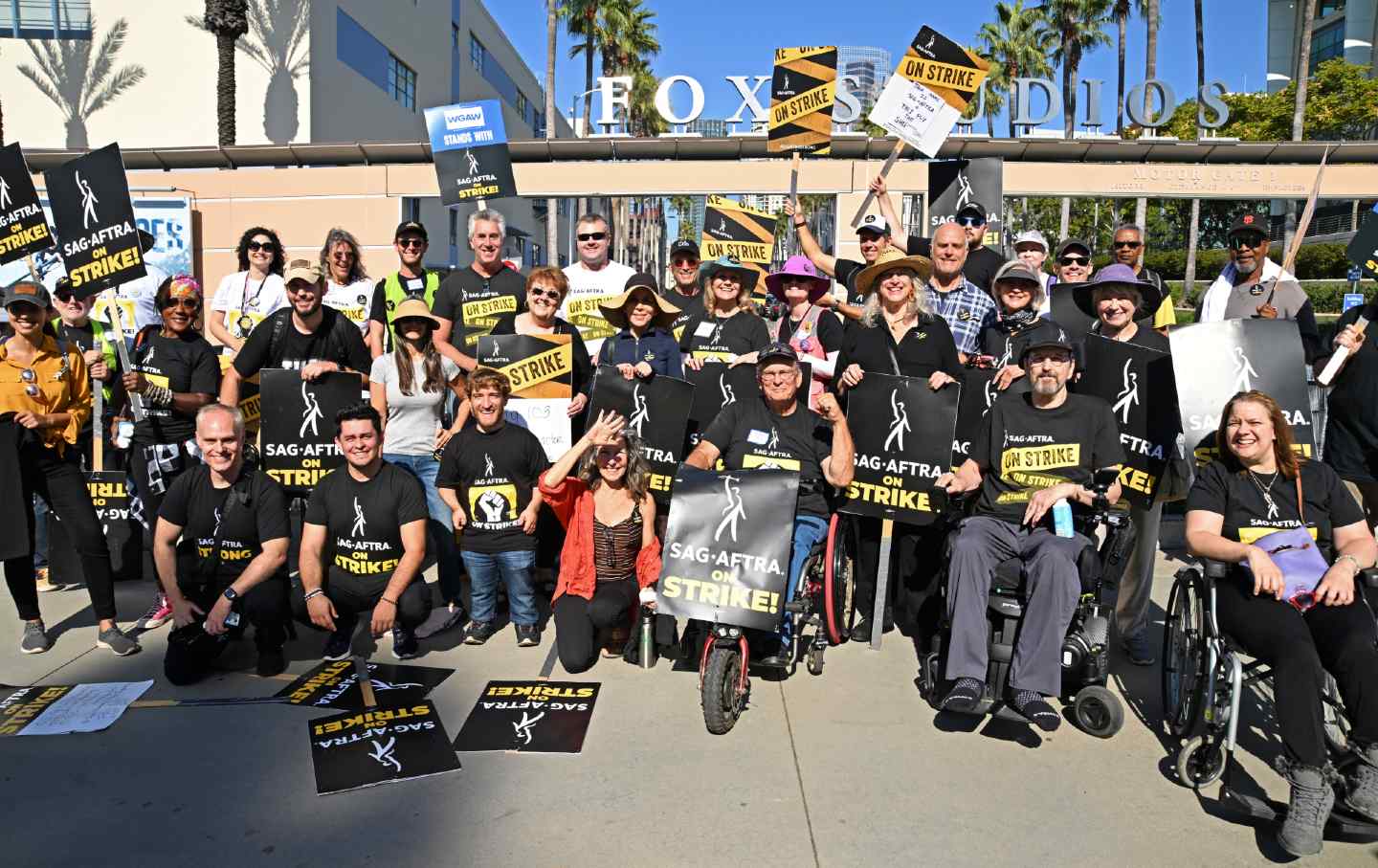
Members of Performers with Disabilities and Seniors pose on the SAG-AFTRA picket line at Fox Studios on October 26, 2023, in Los Angeles, California.
(Michael Tullberg / Getty Images)
When San Francisco State University attempted to lay off 131 staffers in 2020, union members fought the attempt to dismiss 8 percent of their colleagues with a classic labor tactic: an informational picket to increase visibility and educate the public.
There was a problem, though. It was the height of the Covid-19 pandemic—not a great moment to gather a boisterous crowd, especially one that included vulnerable workers and those caring for people at high risk.
Katie Murphy, an administrative analyst at San Francisco State University who leads the California State University Employee Union Disability Constituency Group, said the idea to livestream the picket emerged from disabled union members who wanted to advocate with their colleagues. “We had it so that people could participate in them on YouTube. People who were not able to actually come to the pickets because of their health concerns, because they don’t have a car, they were able to participate and comment and keep momentum going online,” Murphy said. “In addition to the on-foot picketing, we had a motorcade—people in their cars just driving down 19th Avenue right outside the administration building.”
Disabled workers historically left out by the demands of in-person picketing were suddenly able to participate.
For unions, Covid-19 was a wake-up call. Large numbers of unit members were suddenly affected by disability issues: Workers needed paid sick leave, personal protective equipment, workplace accommodations, and help balancing caregiving needs. Disabled union members and organizers, who are often familiar with the Americans with Disabilities Act of 1990 and their rights under the law, became especially important. Many disabled workers told me that since the start of the pandemic, their unions have given them more responsibility and that a union’s willingness to collaborate with disabled members is crucial to determining how effective it can be in helping all of its members.
Murphy’s situation is notable not only because of the sheer institutional size and influence of the California public higher education system but also because of the diversity of unions within that system. Collectively, the system serves nearly 3 million students and includes nearly 150 academic facilities like the University of California, California State University, and California Community College campuses, labs, and medical centers. Nearly 400,000 faculty and staff—from professors, janitors, cafeteria workers, technologists, graduate student teaching assistants, and more—make daily operations possible. They’re represented by unions such as the California Faculty Association, California Federation of Teachers, UAW 4811, and numerous SEIU, Teamsters, AFSCME, and other locals.
In 2022, California’s public higher education workers made national headlines with the largest strike of the year, involving 48,000 academic workers. It disrupted operations across the state, with union members winning concessions on cost-of-living increases, anti-harassment contract provisions, and better benefits for caregivers. The agreement, though still imperfect, has become a model for other unions and campuses across the country.
The Covid-19 pandemic, which drove a number of health-related workplace concerns, and George Floyd’s murder, which sparked a diversity, equity, and inclusion “boom,” influenced disability organizing in union settings. The disability community, which counts one in four US adults, has an especially significant stake in labor organizing. The consequences of failing to address the needs of disabled workers across industries are stark; disabled people are twice as likely as the able-bodied to live in poverty, and they face similarly poor performance along a range of other economic indicators.
Popular
“swipe left below to view more authors”Swipe →“With our [California Faculty Association] meetings and in daily life, I see the ableism in pretty much everything. With our meetings, bringing those issues to the table has made our meetings better,” said Leslie Bryan, a retired arts professor from California State University’s San Bernardino campus who now chairs the California Faculty Association’s Disability Caucus. Thoughtfully including issues of concern to disabled people—such as campus and meeting accessibility, resources for disabled students and faculty, and training for those serving and working with disabled people—improves meeting turnout and engagement, mobilizing more members to work on causes important to the union. This also benefits nondisabled people—greater numbers of active union members make for more robust labor actions and solidarity work, and workplace gains for disabled people are good for nondisabled people too. For example, more generous sick leave with reduced barriers to access helps everyone. Similar trends can be seen with increased diversity, equity, and inclusion (DEI) in unions in general; when more people feel included, respected, and supported by the union, they’re more invested in that union’s work.
Bryan noted that the union framework provides an ideal avenue for ensuring that disabled people’s needs are heard. By design, unions uplift all workers by way of facilitating coordinated, collaborative actions. A collective union action pushing for better ventilation at work, for example, has a much higher impact than a single disabled worker asking for this accommodation. Solidarity between disabled and nondisabled members also makes it clear to bosses that workers are invested in inclusion for everyone—and as a marginalized community, disabled people are more vulnerable to discrimination at work that unions can help them fight. For the CFA, that inclusion started with advertising accommodations and supports at meetings to make it clear that disabled workers would be both welcome and heard, increasing meeting turnout and interest in engaging with the union. She said, “If you put the accommodations out there and let people know they’re there, they will come.”
She told me that she’s seen policy shifts at the CFA, including captioning and ASL at union meetings and improved on-site accessibility. Disability advocacy drove these changes, not only within the CFA but also in discussions with sibling unions, such as Murphy’s CSUEU, which collaborated on conversations about safe emergency evacuation for disabled students and staff. Disabled people are often left out of emergency planning, not just in academic settings but everywhere: Wheelchair users in particular are sometimes directed to wait for help, rather than being included in an evacuation plan that helps them get out of a building quickly in a fire, earthquake, shooting, or other disaster. At San Francisco State, one significant change included installing evacuation chairs and training people in their use so that wheelchair users and others with mobility impairments could get to safety at the same time as other faculty, staff, and students. Murphy told me, “Having an ongoing conversation without defensiveness, people turning against each other—and being able to mediate some of our own inter-union issues without management being the referee has been a real accomplishment.”
Collaborating on solutions
In 2020, the UC Access Now Demandifesto highlighted the needs of disabled workers and showcased possible solutions, including universal design to expand physical accessibility and promotion of disabled people into key roles in campus DEI and decision-making bodies.
Higher education’s accommodation bureaucracy can be daunting, especially for those who both need and provide accommodations, such as disabled graduate student instructors. Knowledgeable disabled workers can often help people negotiate or file grievances more effectively.
The shifts since Covid are also reflected in remote or hybrid union meetings and pushes for masking at meetings and on picket lines to protect attendees from Covid-19 and other respiratory illnesses, along with calls for strike pay for those who can’t participate in on-site pickets but are still involved in active organizing. This kind of inclusion promotes and increases engagement from unit members.
Of course, it isn’t all roses for disabled union members in California, as became apparent during the 2022 strike and protracted negotiations over returning to campus. Heather Ringo, 35, has been teaching college-level English as an adjunct for over a decade on community college campuses and, most recently, as a graduate student instructor at the University of California, Davis. Like many disabled white-collar workers across the United States, she benefited from remote work in 2020–21, although she had an advantage: Like many disabled workers, Ringo already had experience in disability issues and in advocating for herself. To better serve her students, she’d had training in remote and hybrid pedagogy, making the transition easier for her than some of her colleagues. Her interest in improving her skills to best serve her students before the pandemic turned into an asset for everyone, as she supported other faculty and staff in making their own transitions.
The change to remote instruction was good for Ringo and her students, she told me: “My student success and retention rate went way above average, improved drastically. In terms of equity, comparing myself to previous years and everybody else, my scores went up substantially.” As someone with asthma, Ringo was also relieved to be able to work safely from home during an airborne pandemic.
When the University of California began to pressure people back into onsite work, Ringo argued it wasn’t safe for her without protections such as masking and air filtration, and she mobilized with other graduate students. Ringo found herself caught in the larger culture war over remote and hybrid work. During the first waves of Covid, disabled workers found new opportunities thanks to an expansion of what the workplace could look like, only to see them disappear with the return-to-office push.
Ringo counted on her union to advocate for her as a worker, but ultimately she felt betrayed. She told me her union used “disabled folks as a token” in negotiations. Disability rights, she said, were something to trade away.
Writing for the Disability Visibility Project in 2023, Ringo said that union leadership did not prioritize accessibility. Ringo and her colleagues wanted better workplace safety, improved training on disability issues, and a fund for access improvements—none of which were included in the final collective bargaining agreement.
Ringo and her co-author, Julia Métraux, stressed that “we are not describing this ableism and harm because we are anti-union” but instead were documenting the experience of being “shoved from the ivory tower.” They wanted fellow union organizers to understand the importance of disability inclusion. Ringo noted that living and working through Covid and fighting for support at work “radicalized” many disabled people on campus, leading to meaningful changes such as increased interest in training for union organizing roles and better tracking of outcomes for remote instruction that she hopes will continue.
The increased role of disability rights and justice conversations in union spaces will likely lead to employment opportunities, more affirming workplaces for disabled people, better conditions for learning and teaching in the disability community, and innovative new forms of inter-union solidarity. The visibility of public education in California may also make it a valuable resource for organizers across the country—and advocates such as Ringo are hoping that other organizers learn from their experiences and implement more disability-forward policies, particularly as the nation deals with the lingering effects of the pandemic and long Covid’s effects on workers.
Union members must organize to force employers to invest in their disabled workers, Ringo told me: “It’s a case of you make more work for them to fight than it is for [employers to provide accommodations].” On their own, disabled workers can flounder in jobs where their needs are ignored, and only an active and inclusive union can force management to accommodate everyone—and everyone benefits from a more disability-friendly workplace.
Become a Sustaining Donor This September
Between the reemergence of right-wing red-baiting and Donald Trump’s use of the chilling National Security Presidential Memorandum–7 to criminalize left political organizing, we’re seeing McCarthyism reborn before our eyes.
This assault on democracy cannot be ignored or wished away. Resisting it requires bravery in the face of threats and repression, a steadfast commitment to the truth, and the unwavering belief that we can—and will—overcome this darkness.
We must have an independent media that sets the record straight, unearths corruption and abuses of power, and advances a politics of justice and dignity for all if we’re to win this fight.
That’s why I’m writing to you today. This September, The Nation needs to add 100 monthly donors to sustain our progressive journalism. Your contribution makes the next investigative report, the next truth-speaking column, and the next pathbreaking essay all possible.
I hope you’ll support our work with a recurring donation today. If you donate $10 or more a month, we’ll send you a brand new “Hands Off the Free Press!” sticker to recognise your commitment to our cause. Please, donate today.
Onward,
Katrina vanden Heuvel
Editor and Publisher, The Nation
More from The Nation
The Impossible Will Take a Little While: The Power of Persistence The Impossible Will Take a Little While: The Power of Persistence
In troubled times, history offers a lesson: Seemingly impossible change can begin with ordinary people who refuse to give up.
Gloria Steinem’s Many-Splendored Feminist Life Gloria Steinem’s Many-Splendored Feminist Life
The feminist icon lived the struggle for gender equality and always found time to lend support and solidarity to other women leaders, even in her final days.
No, Woke 1 Was Not Crazy No, Woke 1 Was Not Crazy
AOC and others are laughing off 2020 as a wild, isolated moment. None of that is true.
How Occupy Wall Street Still Explains Politics Today How Occupy Wall Street Still Explains Politics Today
It sowed the seeds for a new era of social movements—but its politics of powerlessness should act as a cautionary tale.
Abdul El-Sayed’s Win Is a Landmark. But the Fight Is Far From Over. Abdul El-Sayed’s Win Is a Landmark. But the Fight Is Far From Over.
Even though the Palestine movement is on the march, we can’t afford any complacency.
Mamdani’s Team Redefined Political Video. Now They’re Betting on Short Films. Mamdani’s Team Redefined Political Video. Now They’re Betting on Short Films.
Premiering exclusively in The Nation, a new short film produced by City Hall and narrated by Morgan Spector highlights the efforts of the biggest tenant-led union in New York City...

