A Strong Policy Debate Is Kamala Harris’s Best Shot to Break the Election Tie
Attacking Donald Trump is a start. But the Democratic nominee also has to sell herself and her vision.
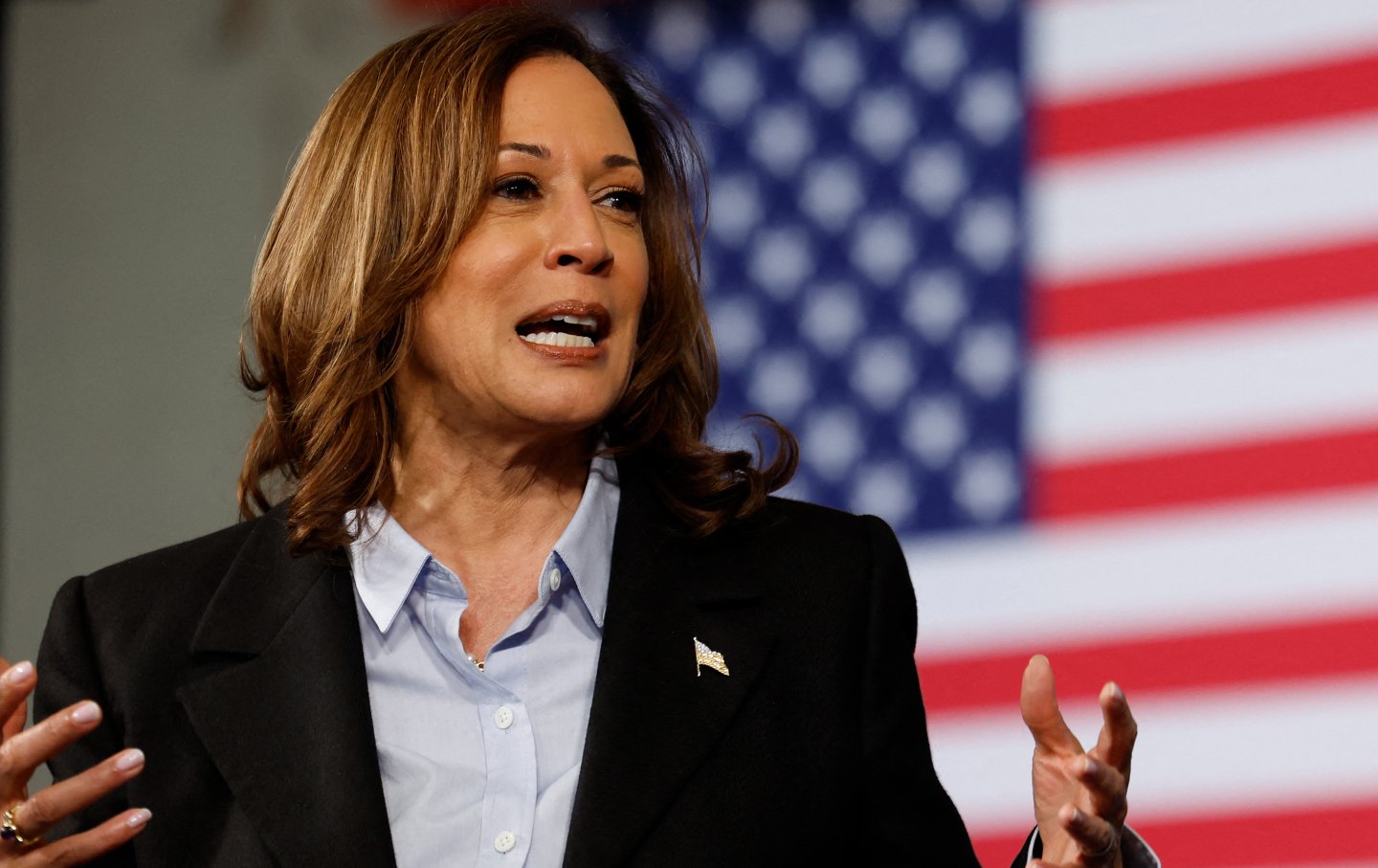
The first presidential debate of 2024 was a catastrophe that ended Joe Biden’s political career. The second debate could be even more consequential. In the first debate, Biden’s incoherent, mumbling performance was so bad it sparked a revolt inside his own party that forced the president to give up his reelection bid. With the second debate, Kamala Harris has her best chance to secure a decisive lead and make history as the first woman president. But if she fails to do so, there is a real possibility that the current polling deadlock will continue, resulting in the disastrous return of Donald Trump to the White House. That is a prospect that risks not just the loss of a winnable election but the very end of American democracy. The stakes for Tuesday’s debate could not be higher.
On Sunday, the Harris campaign received some sobering news: The respected and closely watched New York Times/Siena poll showed that Trump had retained his lead, with 48 percent support nationally as against 47 for Harris. To be sure, Democratic partisans had a reasonable retort that this poll was an outlier and that Harris still led in other recent polls: Quinnipiac (+1), Wall Street Journal (+1), Economist (+2), Emerson (+2), Morning Consult (+3). More importantly, as John Nichols of The Nation has noted, Harris has transformed the political map in ways that should hearten her supporters. She is much more competitive than Joe Biden in swing states in the South and Southwest (Georgia, North Carolina, Arizona, Nevada). This gives her many more possible paths than Trump has to 270 electoral votes.
But even the polls most favorable to Harris, while undoubtedly offering a rosier picture than the The New York Times/Siena data, still paint a picture of a scarily close race—one well within the margin of error. Harris, to her credit, has tried to throw cold water on the heady optimism of her more enthusiastic supporters, rightly insisting that this remains a razor-thin race. She enjoyed a surge of support after replacing Biden, but that has already peaked. One worrisome fact is that Harris did not get the expected bump from the Democratic National Convention. This suggests her campaign may be sputtering, perhaps because of its pursuit of a low-risk strategy of minimal media appearances and avoiding strong policy stances.
The Harris campaign has prioritized good vibes over concrete proposals. This good-vibes campaign has had some success—but is now reaching its limits, which means that the time is ripe for Harris to be much more substantive on the issues.
With the debate, Harris has a chance to break the deadlock, but she has to emphasize three strengths: her ability to stand up to Donald Trump’s bullying, her compelling life story, and her ability to be a change president who can make life better for ordinary Americans.
Taking Donald Trump down a notch is the easiest task. Aside from his encounter with the radically diminished Biden, Trump has never done well in national debates. Both Hillary Clinton in 2016 and Joe Biden in 2020 were able to present themselves as sober and qualified candidates in a way that highlighted Trump’s erratic behavior and weak grasp of policy. Even in the June debate with Biden, Trump actually made many absurd and wildly untrue statements, such as his comment that every legal scholar had wanted to overturn Roe v. Wade. This statement would have badly hurt Trump if he had faced an opponent with a minimum ability to communicate.
As Lisa Lerer noted in The New York Times, Harris has a formidable record as a debater:
Ms. Harris forged her political rise through rhetorical combat, capturing attention with lacerating exchanges on debate stages and in congressional hearings. Her attacks are strategic and direct, with a controlled delivery—sometimes even a smile—and an instinctual sense for a news-making moment.
In 2010, she won a tough race for California attorney general after twisting a pivotal 47 seconds to her advantage in the contest’s only debate. Her piercing questioning of Trump administration appointees and officials from her perch on the Senate Judiciary Committee built her national profile. And a brutal exchange with President Biden during the 2020 primary over race and his warm remembrances of segregationist senators transformed her image into one of a presidential contender.
It’s reasonable to expect Harris to hold her own against Trump and Trump himself to self-sabotage by his tendency toward bizarre and aggressive behavior.
But more important is whether Harris can win over voters for whom she remains an unknown quantity, despite all the media attention she has gotten since Biden gave up the ghost of his presidential hopes. The New York Times, in a gloss on its recent poll, noted that on Trump, “opinions are largely fixed” but “Harris is still unknown to many.” The report added, “The survey found that 28 percent of likely voters said they felt they needed to know more about Ms. Harris, while only 9 percent said they needed to know more about Mr. Trump.” The Democratic National Convention began the work of introducing Harris to the American public, but clearly this remains a task that requires another push. In using Trump as foil, Harris can underscore her record as an experienced leader who knows how to fight.
But much more important than her personality, policies are the best way for Harris to make the case for her presidency. Some analysts are encouraging Harris to continue with a low-calorie campaign of good vibes. Writing in The New Republic, Peter Rothpletz argued that the best “strategy to win the election isn’t to push out white papers and hyper-detailed plans for policies; it’s to continue to make the vibes- and values-based argument that has been working for Harris for the last six weeks.” This is myopic and counterproductive advice. Polls have shown that the good-vibes strategy has peaked. There are not any more new voters to win with vibes. Voters still on the fence want to know what Harris will do to make their lives better. As it happens, there is much Harris could say that would clarify the difference between her and Trump on very specific issues (reproductive freedom, prescription drug prices, price gouging). To score the knockout she needs, Harris as to put the good vibes aside and make the policy pitch that can turn a dead-heat race into a decisive victory.