The Paris Olympics Are Kicking Off With Protests
“The Olympic Games are profoundly disrupting the lives of French people,” the protesters wrote in a joint statement.“The question then arises: Who benefits from the Games?”
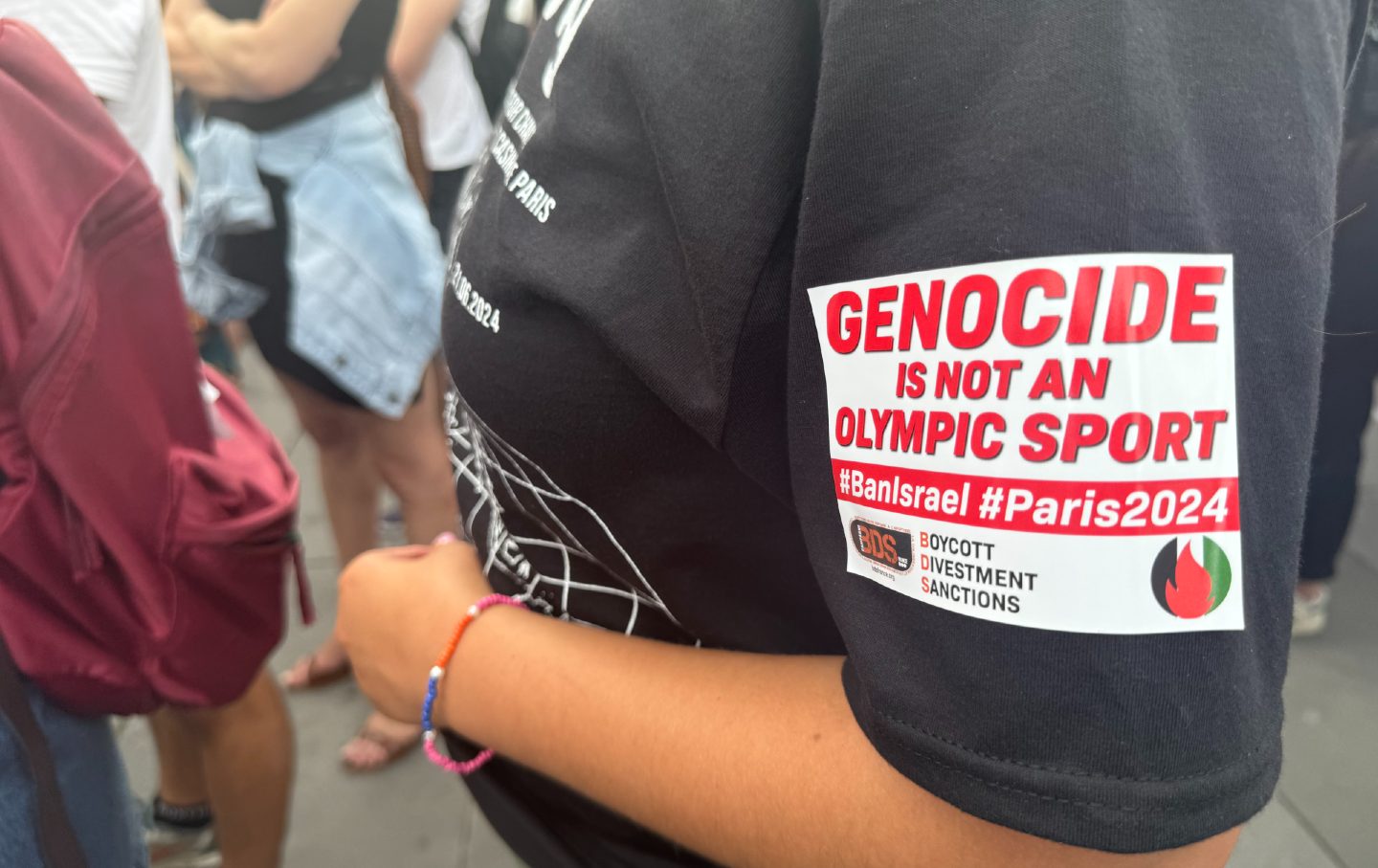
A protester at the Counter-Opening of the Olympics event in Paris on July 25, 2024.
(Jules Boykoff)
On the night before the opening of the 2024 Paris Olympics, several thousand activists mobilized at Place de la République for speeches, a DJ set, and interviews with swarms of international journalists. Dubbed the “Counter-Opening Ceremony of the Olympics,” the event featured more than 80 grassroots organizations that signed onto a statement titled “des Jeux, mais pour qui?” (“Games, but for whom?”) Among the organizations were trade unions, environmental groups, civil-liberties organizations, and residents of Saint Denis, an area in the north of the city deeply and negatively affected by the Paris Games. The activist collective Le Revers de la Médaille (the Other Side of the Medal) coordinated the raucous gathering.
Ahead of the mobilization, Le Revers de la Médaille issued a joint statement on behalf of the wider coalition in the major French newspaper Libération titled, “Inclusive, Popular, Carbon-neutral Olympics? No Way!” In their scathing missive, they slammed Olympic organizers and elected officials for a slew of false pledges. “We see that the Olympic Games are profoundly disrupting the lives of French people, without the promised legacy being delivered,” the group wrote. “The question then arises: who benefits from the Games?”
Antoine de Clerck, of Le Revers de la Médaille, explained to us that the purpose of the “Counter-Opening Ceremony” was “to raise public awareness of what’s happening, but also to have a little bit of a party together.” Because of the intensified displacement the Games have brought about, he said, “it has been a really difficult last days and weeks.”
Running like a lightning bolt through the protest was solidarity with Palestine. Flags, keffiyehs, and speakers showcased an iron link between the Palestinian cause and the counter-Olympics struggle. The presence of Israeli athletes at the Games—and the way it normalizes the state of Israel—is seen as a particularly brutal example of “sportswashing.” Many of the speakers made this link between the Olympics and the need for Palestinian solidarity. “Genocide is not a spectator sport” has become an ubiquitous slogan among protesters. Even rally speakers, like a group of African migrants whose squat was destroyed as part of the Olympic “social cleansing,” connected their displacement with Gaza.
The rally also showcased the internationalism of what has become an “anti-Olympic movement” throughout the world. When Natsuko Sasaki from the anti-Olympics group Saccage 2024 took the stage, she unveiled “the anti-Olympics torch,” a toilet plunger festooned with cloth ribbons bearing anti-Games slogans. This torch was born 14 years ago by activists in Canada who opposed the Vancouver 2010 Winter Olympics. At the time, longtime anti-poverty activist Jean Swanson bought ribbons from the dollar store and decorated the plunger with them. Little did she know that the torch would make its way around the world.
Vancouver activists passed the torch to London-based anti-Games organizer Julian Cheyne, who brought it to protests against the 2012 London Olympics. He then gave it to a New Jersey–based group of Circassian activists protesting the 2014 Sochi Olympics. The alternative torch eventually made its way to Rio for the 2016 Summer Olympics and Pyeongchang for the 2018 Winter Games before arriving in Tokyo, where it was prominently featured at the first-ever transnational anti-Olympics summit in 2019, just ahead of the Covid-plagued 2020 Games.
A spirit of democracy pervaded the proceedings, as members of this French resistance spoke to reporters and passers-by. This spirit is not being matched by the International Olympic Committee, which is renting out the Hôtel du Collectionneur for a whopping 22 million euros. According to German journalist and Olympics watchdog Jens Weinreich, the IOC have barred reporters from entering the premises, a first in decades. The IOC has become a bastion of authoritarianism under current president Thomas Bach—exactly what the French have rejected at the ballot box.
But the workers at the hotel are not letting the IOC live in a bubble. They coordinated a walkout to demand salary hikes on the day before the opening ceremony. Their union, the Union Départementale CGT Paris, tweeted, “We can’t wait for the workers of the world to discover our French way of striking.”
Let the Games begin? They’ve already begun.