At My High School, the Library Is for Everything but Books
The administration has rebranded our library as a communal space for doing almost everything except reading.
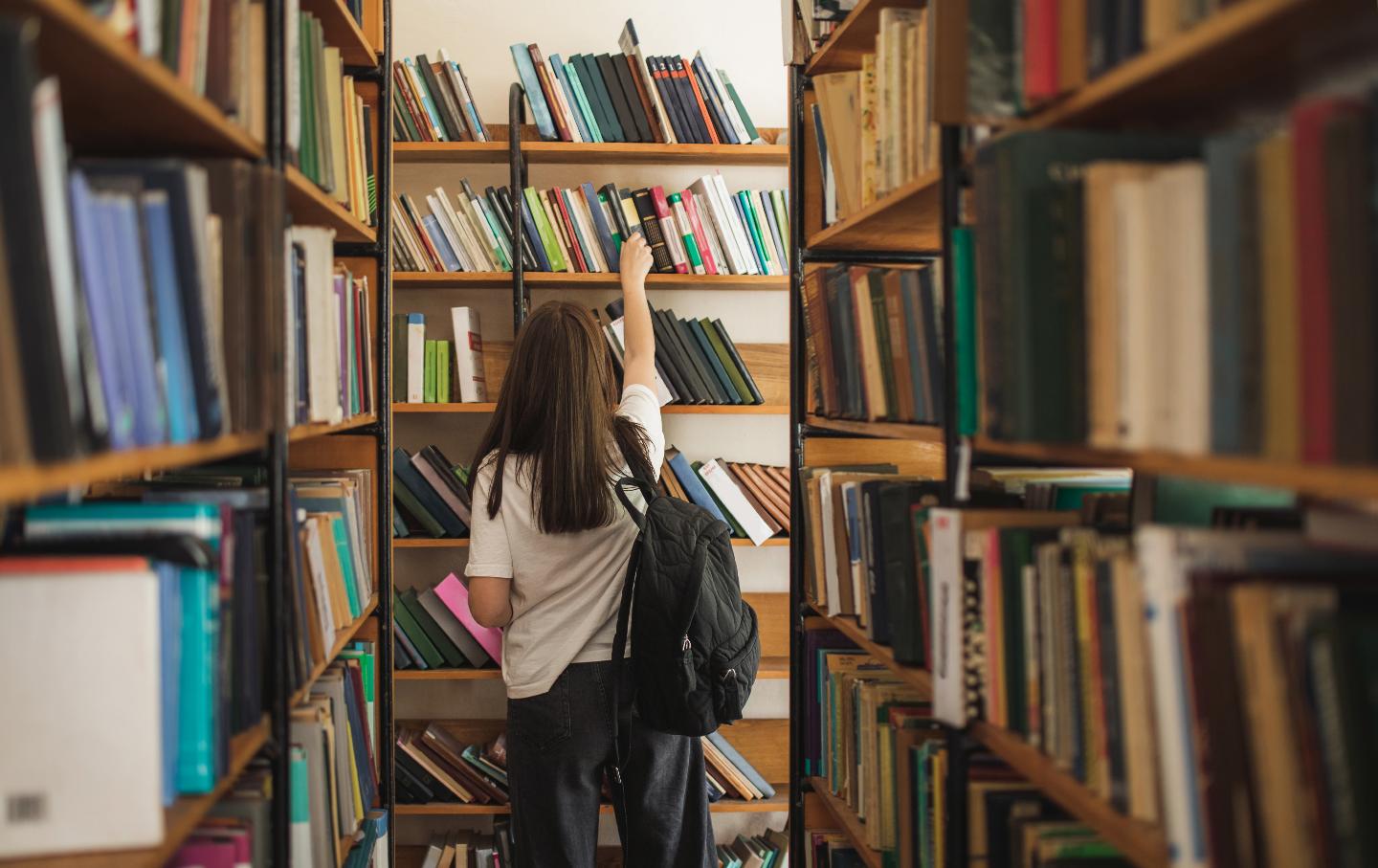
A student looking for a book in a school library.
(Anastasiia Krivenok / Getty)
Take a peek into the library at Burlingame High School, located on the northern edge of Silicon Valley in California, and you’ll find students doing schoolwork on their computers, talking with friends, playing chess, or checking in with their college and career advisor. No one is reading a book.
According to school records, only about 50 books were checked out by students during the 2023 fall semester. In response, the administration has decided to take a different approach, rebranding the library as a student union—a communal space for students to interact and complete school work.
At the beginning of this transition last year, the school moved the College and Career Center into the library. This year, this school is removing any book that has not been checked out for over a decade.
While school officials say the change is meant to cater to student needs and interests, it also feels like a capitulation to the basic fact that many in my generation simply don’t read much anymore—at least not books. A recent survey found that nearly 50 percent of American adults read zero books in 2023. Another by Gallup in 2022 found a similar decline in reading among young adults though not as severe as older age groups.
“I don’t really read any books outside of what’s assigned in my English class because I feel like many high schoolers don’t have that extra free time to read for enjoyment,” said junior Dora Yang.
According to Burlingame High School librarian Rebecca Velasco, she’s only seen around 10 students check out books since January 2024. “The numbers are pretty low. We have gone through our books and gotten rid of the books that kids just weren’t checking out, or are severely outdated. I could probably count on both hands, kids that came in to check out books just for reading on their own time,” Velasco said.
All of this is happening as, across the country, states are fighting over what books students should or shouldn’t read. According to PEN America, there were 1,477 instances of individual books being banned during the 2022–23 school year, affecting 874 unique titles. Bans were most prevalent in Texas, Florida, Missouri, Utah, and South Carolina.
With growing technology use and addiction, most teenagers I know prefer digital textbooks over physical ones. Many use SparkNotes or LitCharts—which offer short summaries—rather than reading an assigned text. We spend our spare time surfing social media instead of diving into a novel. Revamping the library and stripping it of books will simply reinforce this trend.
“I think with Google being so prominent now, kids don’t come into the library to do research anymore because your research is essentially at your fingertips,” Velasco said. “I still think it is crucial and super important to get kids in here, even if it’s just checking out novels and books on their own. The benefit of a physical book is huge and we need to keep that going.”
According to a study conducted by The Age, while most students had access to school libraries and were frequently given time to use them, almost half were not regular weekly borrowers. Around 17 percent borrowed once or twice a month, 13 percent a few times a year, and another 13 percent never or almost never borrowed books at all.
Between 2010 and 2020, the US Department of Education found that more than 10 percent of public libraries in the United States closed their doors permanently or reduced their operating hours significantly. Many closures were attributed to budget cuts at the local, state, or federal levels. During the economic downturns in the late 2000s and early 2020s, funding for libraries often faced reductions as municipalities prioritized other essential services.
Popular
“swipe left below to view more authors”Swipe →For Yang, non-English books can promote reading interest, especially if a student is learning another language. At Burlingame, however, that bookshelf is not very comprehensive.
“In regards to novels and books that kids would check out for their own reading abilities in other languages, it’s just very, very low. It’s not very inclusive,” Velasco said.
An alternative approach can be seen at Palo Alto High School, where officials have created more avenues that promote the use of library resources—including its books. These include tutoring programs or programs to promote reading. Adding resources like student ambassadors and opportunities for librarians to teach students about research methods and credible sources will allow students to learn real-world skills while also helping them reconnect with books.
Introducing a wider variety of literary options—rather than imposing bans and limiting student choice—might also help students feel more motivated to check out books to read. Restocking the few shelves in the library with books students want to read would draw more students to rekindle their love of reading.
In short, doing away with our library would be an injustice to our students. Let’s at least try to give them a space where they feel confident and excited to read and make use of all a library has to offer. Let’s not give up on reading yet.
As a high school journalist, advocating for the importance of reading feels both like a duty and a personal passion. In a world increasingly dominated by digital content, the value of physical books cannot be overstated. For me, books have been more than just sources of information; they have been companions, mentors, and windows into worlds beyond my own. There’s something intimate and immersive about holding a physical book in your hands, turning its pages, and allowing yourself to be transported into its narrative world. It’s an experience that digital content, no matter how convenient, simply cannot replicate.